Free Online Plagiarism Checker for Students: How to Check Work Responsibly
A free online plagiarism checker for students can be a useful first step before submitting an essay, research paper, dissertation chapter, or thesis draft. It can highlight passages that resemble material found elsewhere and help you notice copied notes, missing citations, over-close paraphrases, or quotations that need clearer attribution. But the result is not a verdict on academic misconduct, and it should never be treated as a simple “pass” or “fail” score.
The central academic question is not “How do I get my similarity percentage to zero?” It is “Have I represented other people’s words and ideas honestly, cited them correctly, and written the analysis in my own scholarly voice?” A similarity report can support that review, but only a reader can decide whether a match is a quotation, a reference, standard technical language, common phrasing, or a genuine attribution problem. This distinction matters because students often waste time rewriting harmless matches while overlooking a short but important uncited passage.
Free checkers also vary greatly in what they search. Some focus mainly on publicly accessible web pages. Others may search additional publications or cached content. University systems may have access to collections that a public checker does not, including student submissions or licensed academic databases. Privacy rules also differ. Before uploading unpublished work, read the service terms and confirm whether the document is stored, reused, indexed, or shared.
This guide shows how to use similarity checking responsibly, interpret a report without panic, repair citation and paraphrasing problems, protect unpublished work, and decide when self-service checking is enough. It also explains why academic integrity depends on source use and author responsibility rather than a single percentage.
Quick Answer: How Should Students Use a Free Plagiarism Checker?
Use a free plagiarism checker as a draft-review tool, not as proof that a paper is plagiarism-free. Run your text through a trustworthy service only after checking its privacy terms, then review every highlighted passage in context. A match may require a citation, quotation marks, a stronger paraphrase, or no change at all.
Do not aim blindly for a zero similarity score. Bibliographies, standard phrases, titles, technical terminology, and correctly quoted material can legitimately match other sources. The important task is to identify whether each borrowed idea or exact phrase is acknowledged in the way your university, discipline, or citation style requires.
For assessed work, use your institution’s approved originality system when available and follow the assignment’s rules on AI, collaboration, editing, and source use. If a free checker flags extensive overlap, fix the scholarship behind the match rather than trying to manipulate the software.
Key Takeaways
- A similarity score measures detected text overlap; it does not automatically measure plagiarism.
- There is no universal “safe” percentage that applies to every university, assignment, discipline, or journal.
- Free checkers may search a smaller or different source collection than institution-approved systems.
- Good paraphrasing changes both wording and sentence structure while still crediting the original idea.
- Before uploading a thesis or unpublished paper, check whether the service stores, indexes, or reuses your document.
- Fix missing citations and over-close paraphrases rather than using tricks to lower a score.
- When problems are extensive, ethical editing can improve clarity and attribution while preserving the student’s authorship.
What This Page Covers
- What plagiarism and similarity checking actually mean in academic work
- How free plagiarism checkers compare with institution-provided systems
- A practical workflow for checking an essay, thesis chapter, or research paper
- How to interpret similarity percentages and highlighted matches
- How to fix quotation, paraphrasing, citation, and reference problems
- Privacy considerations for unpublished academic work
- When professional academic editing or citation support may be appropriate
Table of Contents
Methodology and Academic Sources
This guide is grounded in common academic-writing, citation, proofreading, and integrity-review workflows. It also draws on public guidance from the University of Oxford on plagiarism, the Purdue Online Writing Lab plagiarism overview, and Turnitin’s student guidance on Draft Coach. These sources reinforce a key principle: source attribution, accurate citation, and responsible authorship matter more than chasing a particular similarity percentage.
Policies vary by institution, country, discipline, assessment type, and target journal. Students should therefore check their own university handbook, assignment instructions, supervisor guidance, and approved tools before uploading or revising assessed work. Contentxprtz can assist with ethical editing, proofreading, citation consistency, and plagiarism-risk reduction guidance, but the author remains responsible for the work, evidence, sources, and final submission.
What a Plagiarism Checker Actually Checks
A plagiarism checker usually detects similarity between your text and material available in the checker’s searchable sources. It may identify exact phrases, close wording, repeated sentence fragments, or larger passages that resemble another document. The software then presents the matches so that a person can review them.
That process is different from deciding whether plagiarism occurred. Plagiarism is an academic-integrity issue involving unacknowledged use of another person’s words, ideas, data, structure, or other intellectual work. A similarity system can provide evidence that helps a reviewer investigate, but it cannot understand every context. For example, a correctly quoted definition may create a strong match even though it is properly cited. Conversely, a student could take another author’s distinctive argument, rewrite it enough to avoid a text match, and still fail to acknowledge the source.
Similarity is evidence, not a verdict
Imagine a 2,000-word essay with a 12% similarity score. If most of the overlap comes from the reference list, assignment title, and correctly quoted legal wording, the academic concern may be small. Now imagine another essay with a 3% score where one paragraph closely follows an uncited source. That lower number could represent a more serious problem. This is why responsible review is passage-by-passage rather than score-by-score.
What free tools may not see
Public checkers can differ in database coverage. A free service may search open web content effectively but may not have access to subscription journals, publisher archives, institutional repositories, books, or private collections of prior student work. Therefore, a “no match” result does not prove originality. It only means the tool did not find a match in the sources and methods available to it.
Why Students, PhD Scholars, and Researchers Use Plagiarism Checkers
Students use similarity checking because writing from multiple sources creates practical risks that are easy to miss during drafting. Notes can be copied into a document and later mistaken for original prose. A paraphrase may remain too close to the source. A citation can be added to one sentence but not the next. A quotation may lose its quotation marks during editing. These are often process failures rather than deliberate misconduct, but they still need correction.
PhD scholars and researchers face additional complexity. Literature reviews can include hundreds of sources, methods sections may use conventional terminology, and long manuscripts often evolve over months or years. Similarity checking can help identify repeated text, earlier wording carried over from proposals, and places where source boundaries need clarification. Researchers also need to consider self-reuse: reusing substantial portions of previously submitted or published work may require citation, permission, disclosure, or journal-specific treatment.
For multilingual writers, a similarity report can be particularly helpful when paraphrasing in academic English is difficult. However, the solution is not aggressive synonym substitution. Good academic writing depends on understanding the source, reconstructing the explanation in your own logical pattern, and citing the original idea.
Free, Low-Cost, and Professional Options for Similarity Review
Different review options serve different purposes. The table below helps students choose based on the sensitivity of the work, the stage of writing, and the level of assurance needed.
| Option | Best use | Main strength | Main limitation or caution |
|---|---|---|---|
| Free web plagiarism checker | Early draft screening and short passages | Fast and accessible | Database coverage and privacy practices vary |
| University-approved originality checker | Coursework, theses, dissertations, formal draft review | Closer alignment with institutional workflows | Access may be restricted or controlled by faculty |
| Reference manager plus manual source check | Citation and bibliography consistency | Improves traceability of sources | Does not itself detect copied wording |
| Supervisor, tutor, or writing centre | Interpretation of policy and academic practice | Institution-specific guidance | Availability may be limited |
| Professional academic editor | Complex citation, paraphrasing, language, and manuscript review | Human context and document-wide consistency | Must remain within institutional rules and preserve authorship |
Free checking is most useful when it helps you find issues early. Institutional systems are better suited to assessed work because they reflect the university’s actual process. Human support becomes valuable when the problem is not just a match percentage but the quality of paraphrasing, source synthesis, citation style, or academic expression.
When a Free Checker Is Enough—and When It Is Not
A free checker may be enough for a short, non-confidential draft when you want a quick scan for obvious copied wording. It can also help you inspect a single paragraph that was developed from dense source notes. If the tool has clear privacy terms, does not retain your work unexpectedly, and produces transparent source links, it can be a useful part of self-editing.
It is not enough when the document is high stakes or sensitive. A final thesis, dissertation, grant proposal, unpublished dataset description, client report, patent-related document, or manuscript under confidential review requires stronger privacy judgment. You may also need an institution-approved system when a university requires a particular submission process.
Free checking is also insufficient when you are struggling to decide whether a paraphrase is genuinely yours, whether common knowledge needs citation, or whether a complex source has been represented accurately. Those are academic-writing judgments. A tutor, supervisor, librarian, writing centre, or qualified editor may provide better guidance than repeatedly rerunning a checker.
How to Use a Free Online Plagiarism Checker for Students: Step by Step
1. Check your institution’s rules first
Before uploading assessed work to any third-party service, read the assignment instructions and your university’s academic-integrity guidance. Some institutions provide approved draft-checking tools; others restrict where assessment material can be uploaded. If the paper includes confidential, personal, clinical, commercial, or unpublished research information, privacy requirements should come before convenience.
2. Save a clean version of your draft
Keep a dated copy before making changes. This lets you compare revisions and protects you from over-editing. It also helps you maintain an audit trail of your own writing process, which can be useful for long projects.
3. Review references before checking similarity
Confirm that quotations have quotation marks or block formatting, that citations are present where borrowed ideas appear, and that reference-list entries match the in-text citations. A checker should supplement this review, not replace it.
4. Read the checker’s privacy and retention terms
Look for clear statements about storage, indexing, deletion, third-party sharing, copyright, and use of submitted text. If the terms are vague and your work is sensitive, do not upload the full document. Consider an institution-approved alternative or a limited excerpt.
5. Run the document or selected passage
Upload only what is necessary. For a long thesis, section-by-section checking during drafting may be more manageable. Record which version you checked so that later revisions do not become confused with the earlier report.
6. Ignore the headline score at first
Open the detailed matches. Start with the longest or most meaningful passages rather than focusing on the overall percentage. Examine whether the source is correct and whether the wording represents a citation, quotation, reference, common phrase, or genuine problem.
7. Fix the underlying academic issue
Where necessary, add a citation, insert quotation marks, paraphrase from understanding, or rewrite the passage using your own analysis. If a source is not reliable or does not support the claim, revise the evidence rather than merely changing words.
8. Recheck selectively
After revision, review the corrected sections. Rechecking can confirm that the close wording has been reduced, but it should not become an endless attempt to force the score down. Stop when the source use is academically sound and the writing reflects your own reasoning.
How to Interpret a Similarity Report Without Panicking
A similarity report becomes useful only when you classify the matches. Most student reports contain a mixture of harmless, expected, and problematic overlap. The following questions help separate them.
Is the match a quotation?
If the wording is intentionally copied because the exact language matters, use quotation marks or block-quote formatting according to the required style and cite the source accurately. A correct quotation may remain highlighted, and that is not automatically a problem.
Is the match from the reference list?
References naturally repeat publication titles, author names, journal names, DOIs, and other bibliographic information. Many systems can exclude bibliographies, but settings vary. Do not rewrite accurate references simply to reduce similarity.
Is it standard academic or technical language?
Some phrases are difficult to avoid because they describe established methods, legal language, statistical procedures, or technical concepts. Check whether the wording is truly conventional or whether a distinctive sentence has been copied. Citation may still be necessary when the idea is not common knowledge.
Is the paraphrase too close?
This is one of the most important match types. If your sentence follows the source’s wording, order, and structure with only minor substitutions, rewrite it from comprehension. Good paraphrasing preserves the idea accurately while using your own sentence architecture and emphasis—and it still cites the source.
Is a source missing?
A checker may reveal that wording came from a page you forgot to cite. Return to the source, verify that it actually supports the claim, and add the citation in the required style. Never cite a source solely because the checker linked to it; confirm the original document yourself.
Why Free Plagiarism Checkers and University Systems Can Give Different Results
Two plagiarism tools can analyze the same essay and produce different percentages because they do not necessarily search the same material or use the same matching rules. This is normal and is one reason students should not compare scores across platforms as though they were equivalent grades.
A university system may include databases that a public service cannot access. It may also be configured to exclude quotations, bibliographies, small matches, or specific repositories. Conversely, a public checker may find a web page that an institutional configuration does not prioritize. Some systems update their indexes at different intervals, so a source available today may not have been indexed when a previous check was run.
The practical implication is simple: use a free checker for learning and early drafting, but do not assume it predicts the exact institutional result. If your university offers an authorized draft checker, use it according to local rules. If it does not, concentrate on citation quality and original writing rather than trying multiple free websites until one gives you the lowest number.
How to Fix Similarity Problems Correctly
The right correction depends on why the text matches. There is no single “remove plagiarism” button because different academic problems require different actions.
| Match type | What it may mean | Responsible action |
|---|---|---|
| Exact uncited wording | Copied text without clear acknowledgement | Quote and cite if the exact wording is necessary, or rewrite genuinely and cite the idea |
| Close paraphrase | Sentence structure and wording follow the source too closely | Return to the source, understand it, rewrite from comprehension, and cite |
| Correct quotation | Intentional exact wording with attribution | Verify quotation marks, page details where required, and citation accuracy |
| Reference-list match | Normal bibliographic overlap | Usually retain accurate formatting; use exclusion settings only if appropriate |
| Common phrase or method wording | Conventional language or required terminology | Check context; cite the method/source when academically necessary |
| Your previously submitted text | Possible self-reuse or duplicate submission | Check institutional or publisher policy and cite/disclose prior work where required |
Paraphrase from meaning, not from the sentence
A practical technique is to read the source, close it, write a short note explaining the idea in your own words, and then draft the paragraph from that note. Afterward, compare your version with the source for accuracy and accidental phrase copying. This reduces the temptation to perform word-by-word substitution.
Strengthen synthesis
In literature reviews, similarity problems often arise because the writer summarizes one source at a time. Stronger synthesis combines evidence from multiple sources around a theme, comparison, disagreement, method, or research gap. That naturally shifts the writing toward your analytical voice while maintaining clear citations.
Audit the reference chain
Check that every citation is authentic and traceable. If you found a claim in a secondary source but did not read the original study, do not pretend that you did. Cite the source you actually consulted unless your discipline specifically requires another approach and you can verify the original.
Ethical Academic Editing and Author Responsibility
Academic editing should improve clarity, organization, grammar, citation consistency, and presentation without replacing the author’s intellectual contribution. The student or researcher remains responsible for the argument, evidence, data, interpretation, citations, and final submission.
This principle is especially important when a similarity report is high. Ethical assistance can explain why a paragraph is too close to a source, suggest a clearer structure, flag missing references, and improve language after the author has supplied the ideas. It should not create fake citations, invent research, conceal copied work, or deliberately manipulate a similarity detector.
Students should also distinguish plagiarism checking from AI detection. Similarity software may identify source overlap, while AI detectors attempt a different form of classification. A low similarity score does not prove that AI use was permitted, and an AI-related result does not prove plagiarism. Follow the exact rules for the assessment and disclose tools when required.
Common Plagiarism-Checker Mistakes to Avoid
- Chasing a zero score. A zero is not an academic-quality target and may be unrealistic for referenced work.
- Replacing words with synonyms. This can create awkward prose while leaving the borrowed structure intact.
- Ignoring ideas because the wording is different. Citation is needed for borrowed ideas even when no text match appears.
- Uploading confidential work without checking privacy. A free service may retain or process the text in ways you did not expect.
- Assuming every highlighted passage is plagiarism. Quotations, references, titles, and standard phrases can be legitimate matches.
- Assuming a low score means the paper is safe. One uncited paragraph can matter more than many harmless matches.
- Using manipulation tactics. Hidden characters, screenshots of text, or deliberate misspellings undermine readability and integrity.
- Citing the checker’s source without verification. Open the original source and confirm authorship, wording, context, and relevance.
- Forgetting self-reuse. Previously submitted or published text may need citation, disclosure, or permission depending on policy.
Practical Examples: What Students Should Do After a Similarity Check
Example 1: The literature-review paragraph
A master’s student checks a literature review and sees a 19% overall score. Most of the largest matches come from the bibliography and paper titles, but one paragraph closely follows a review article. The student had changed a few verbs and adjectives while keeping the same sentence sequence. The correct response is not to keep swapping synonyms. The student rereads the original source, identifies the underlying argument, compares it with two additional studies, and rewrites the paragraph as a synthesis with citations to all relevant sources. The new version is stronger academically even if some technical terms still match.
Example 2: The properly quoted definition
An undergraduate essay contains a short definition from an official organization. The checker highlights the sentence as an exact match. The student has placed it in quotation marks and added the correct citation. There is no reason to distort the quotation simply to reduce the score. Instead, the student verifies the quotation, confirms the reference details, and ensures that the rest of the paragraph explains why the definition matters to the argument.
Example 3: The PhD methods chapter
A doctoral researcher finds repeated matches in a methods chapter because standard descriptions of an established laboratory procedure are similar across many papers. Some overlap is unavoidable, but the researcher also discovers two sentences copied years earlier from a protocol and never cited. The researcher cites the protocol, rewrites the explanation around the actual procedure used in the thesis, and consults the supervisor about disciplinary conventions. The goal is a transparent methods account, not a cosmetically low percentage.
Example 4: The unpublished proposal
A student considers uploading a research proposal to an unfamiliar free checker. The proposal includes a novel project idea and participant details. Instead of uploading the full file immediately, the student reads the privacy terms, cannot find clear deletion and storage information, and decides not to proceed. The student uses the university writing centre for citation review and checks a non-sensitive excerpt separately. This protects the work while still addressing the writing concern.
Student Plagiarism and Academic Integrity Checklist
- I have checked the university or course rules for plagiarism, collaboration, editing, and AI use.
- I understand that a similarity score is not the same as a plagiarism judgment.
- I have cited ideas, data, images, tables, code, methods, and wording that came from other sources where required.
- Direct quotations are clearly marked and referenced according to the required style.
- My paraphrases use my own structure and wording while preserving the source meaning accurately.
- Every in-text citation has a corresponding reference-list entry, and references are authentic and traceable.
- I have reviewed long or important matches individually rather than focusing only on the total percentage.
- I have not used synonym swapping, hidden text, screenshots, or other tactics intended to deceive a checker.
- I have considered whether any reused text from my own earlier work requires citation or disclosure.
- I have checked privacy and retention terms before uploading unpublished or sensitive work.
- I have saved the final version and can explain the reasoning, evidence, and sources in my own words.
How Contentxprtz Can Help After a Similarity Check
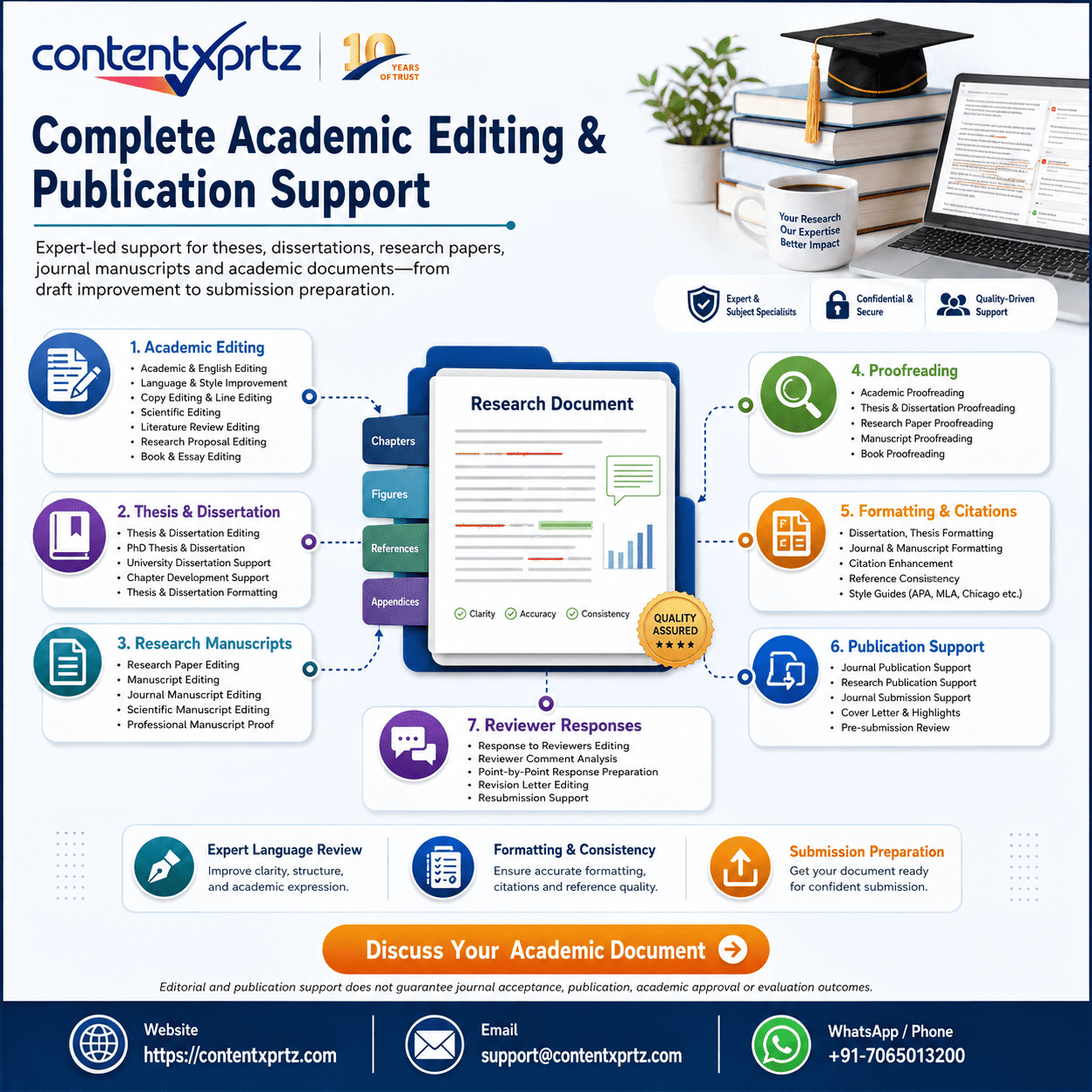
A similarity report is often most useful because it reveals where the writing process needs attention. Contentxprtz can support students, PhD scholars, researchers, and academic authors with ethical plagiarism-risk reduction and publication support, as well as academic editing, proofreading, citation consistency, and manuscript clarity.
The service is not designed to disguise copied work or promise a particular similarity score. The goal is to help authors understand where source attribution is weak, where paraphrasing is too close, where references are inconsistent, and where language can be improved without changing the author’s ideas. Students should use professional support only within the editing rules of their institution and should review every change before submission.
Summary: Free Online Plagiarism Checker for Students
A free online plagiarism checker for students can help identify matching text before submission, but it cannot decide academic integrity on its own. Use it to locate passages that deserve human review, then ask what each match represents: a quotation, citation, bibliography entry, common phrase, close paraphrase, uncited idea, or reused text.
The safest workflow combines responsible source use, accurate citation, thoughtful paraphrasing, privacy awareness, and institutional guidance. A low score is not proof of originality, and a higher score is not automatically evidence of misconduct. The academic objective is transparent attribution and writing that reflects your own understanding.
When the report exposes repeated citation or paraphrasing problems, ethical editing and proofreading can help you improve the document while preserving your authorship and responsibility.
Frequently Asked Questions
What is a free online plagiarism checker for students?
A free online plagiarism checker for students is a web-based tool that compares submitted text with material available in its searchable sources and highlights matching or similar passages. The result is usually a similarity report rather than a final judgment that plagiarism has occurred. A match may be a properly quoted sentence, a common phrase, a reference entry, a technical expression, or text that genuinely needs citation or rewriting. Students should therefore read the report line by line instead of chasing a zero score. The most useful workflow is to identify each match, open the source where possible, decide whether the idea or wording belongs to someone else, and then quote, paraphrase, cite, or rewrite as academically appropriate. Free tools can be helpful for early drafts, short assignments, and basic self-checking, but their source databases, privacy practices, word limits, and report quality vary widely. For graded work, always follow your university or school rules and use any institution-approved originality system when required.
Are free plagiarism checkers accurate enough for university assignments?
Free plagiarism checkers can be useful for a preliminary review, but they are not equally accurate and they may not search the same databases used by universities. Some tools primarily compare against public web pages, while institutional systems may also include licensed publications, archived web content, or collections of previously submitted student papers. This means a free checker can miss overlaps that later appear in an official report, or it may flag harmless wording that does not represent misconduct. Accuracy also depends on text length, file handling, language, reference exclusion, quotation detection, and the quality of source matching. Treat a free result as a diagnostic aid, not a certificate of originality. If your institution provides a draft checking service, use that route first because it is more closely aligned with the system used for submission. Regardless of the tool, the student remains responsible for correct attribution, authentic sources, appropriate paraphrasing, and compliance with the assessment rules.
What similarity percentage is acceptable for a student paper?
There is no universal similarity percentage that is automatically acceptable or unacceptable. A report of 5%, 15%, or 25% cannot be judged responsibly without looking at what produced the matches. A low score may still contain one serious uncited passage, while a higher score may result from a correctly formatted bibliography, a methods section using standard terminology, required template language, or properly quoted material. Universities, departments, journals, and individual instructors may apply different review practices, and many focus on the nature of the matched text rather than a single threshold. Students should therefore avoid trying to “beat” a percentage target by making unnatural word substitutions. Instead, review each highlighted passage: Is it a direct quotation that needs quotation marks and a citation? Is it a paraphrase that is too close to the source? Is the citation missing? Is the wording genuinely common or unavoidable? The goal is accurate attribution and original academic expression, not an artificial zero score.
Can I check my essay for plagiarism before submitting it?
Yes, if your institution permits draft checking and the tool’s privacy terms are suitable for your work. Checking an essay before submission can help you notice missing citations, copied notes that accidentally remained in the draft, quotations without quotation marks, and paraphrases that follow the source too closely. Before uploading, confirm whether the service stores your document, adds it to a database, uses it for training, or permits deletion. This is especially important for unpublished research, confidential assignments, dissertations, client material, or work containing personal data. If your university provides an approved originality checker, that is generally the safer route. After receiving the report, do not simply replace highlighted words with synonyms. Return to the source, understand the idea, write from your own comprehension, cite the source correctly, and preserve exact wording only when a quotation is genuinely necessary. Then run a final citation and reference-list review before submission.
Will a plagiarism checker detect paraphrasing?
A plagiarism checker may detect some close paraphrasing, but no tool can reliably determine whether every paraphrase is academically acceptable. Similarity systems are strongest when wording or phrase patterns overlap with indexed sources. A student can still produce an unethical paraphrase even when the checker reports little or no match—for example, by following another author’s structure, argument sequence, or distinctive idea without acknowledgement. The opposite can also happen: a well-cited technical passage may generate a visible match even though it is properly attributed. Good paraphrasing therefore requires more than changing vocabulary. Read the source, set it aside, explain the idea in a structure that reflects your own understanding, compare the new version with the original, and cite the source because the underlying idea is still borrowed. The University of Oxford and Purdue OWL both emphasize that attribution applies to ideas as well as wording. A checker is useful evidence, but academic judgment and citation practice remain essential.
Do plagiarism checkers detect AI-generated text?
Plagiarism detection and AI-writing detection are different tasks. A similarity checker looks for overlap between submitted text and sources in its searchable collections, while an AI detector attempts to estimate whether language may have been generated by an AI system. A passage can be AI-generated yet show no meaningful similarity to existing sources, and a human-written passage can show substantial similarity because it contains quotations, references, standard phrases, or copied material. Students should not assume that a low similarity score proves that AI use complies with course rules. Universities increasingly publish specific instructions about whether generative AI may be used for brainstorming, language support, coding, drafting, or assessment. The responsible approach is to follow the exact policy for the assignment, disclose AI use when required, verify every factual claim and citation, and retain your own notes and drafting history where useful. Use similarity checking to review source overlap, not to certify authorship or authorized AI use.
Is it safe to upload my thesis or unpublished research to a free plagiarism checker?
It can be risky unless you have checked the service’s privacy, retention, security, and ownership terms. A thesis, dissertation, research proposal, unpublished manuscript, or client document may contain original findings, confidential data, personal information, commercially sensitive material, or text that you do not want stored in an external database. Before uploading, verify whether the provider keeps a copy, indexes the document, shares it with third parties, allows permanent deletion, and identifies the jurisdiction in which data is processed. For sensitive academic work, an institution-approved system or locally controlled workflow is usually preferable. You can also test a short non-sensitive excerpt when you only need to examine a particular passage. If you are unsure, ask your supervisor, research office, librarian, or data-protection contact. Protecting unpublished scholarship is part of responsible research practice, and convenience should not override confidentiality or institutional requirements.
How do I fix plagiarism or high similarity in my paper?
Start by reviewing the similarity report source by source and classifying each match. If you copied exact wording, either quote it accurately with a citation or rewrite the idea in genuinely original language and still cite the source. If a paraphrase is too close, return to the source, understand the meaning, and rebuild the sentence structure from your own comprehension. If the wording is yours but the idea is borrowed, add the required citation. Check that every in-text citation has a matching reference-list entry and that every reference-list entry is actually used where required. Remove accidental duplication, placeholder notes, and copied source summaries that were never rewritten. Do not use synonym swapping, hidden characters, image-based text, or other tactics designed to manipulate a checker. Those methods do not improve scholarship and may create new problems. When the issue is extensive, an ethical academic editor can help identify citation, paraphrasing, and clarity problems while preserving the student’s authorship and original ideas.
Can I use a plagiarism checker without uploading the whole document?
Often yes. Many tools allow students to paste a passage or check a limited number of words, which can be useful when only one section needs review. This approach may reduce exposure of confidential or unpublished material, although you should still read the provider’s privacy terms because pasted text can also be stored. Segment checking is particularly useful for literature-review paragraphs, definitions, background sections, or passages developed from detailed notes. However, checking sections separately has limitations: it may not reveal repeated wording across your own document, duplicated content between chapters, or patterns that become visible only in the full file. For a thesis or long research paper, use section-level checks during drafting and an approved full-document review closer to submission when institutional policy permits. Remember that a checker cannot confirm whether your citations are complete, your sources are authentic, or your argument is original; those still require careful human review.
When should I get professional help after using a plagiarism checker?
Professional help is useful when the report reveals repeated close paraphrasing, inconsistent citations, unclear source boundaries, language problems that make paraphrasing difficult, or a large thesis or manuscript that needs a systematic integrity review. Ethical support should not disguise copied work, fabricate references, write an assessment on the student’s behalf, or manipulate similarity scores. Instead, it can help you distinguish quotation from paraphrase, improve clarity while preserving your meaning, standardize citation style, cross-check references, and identify passages that need you to revisit the original source. Students should also check university rules on permitted editing assistance. Contentxprtz offers plagiarism-risk reduction guidance, proofreading, academic editing, and citation support designed to strengthen clarity and attribution while keeping responsibility with the author. The strongest result comes when the student understands every change, verifies every source, and approves the final wording before submission.
Conclusion: Check Similarity, Then Improve the Scholarship
The most useful plagiarism checker is the one you treat as a learning aid rather than a score generator. It can point you toward passages that deserve attention, but the academic work begins after the report appears: understanding the source, deciding whether the idea needs attribution, improving paraphrasing, checking references, and making sure the final paper expresses your own analysis clearly.
For short, non-sensitive drafts, a reputable free checker may be enough for early screening. For assessed coursework, dissertations, theses, and unpublished research, an institution-approved system and careful human review are safer. When a document contains widespread close paraphrasing, inconsistent references, or language problems, professional support can help—provided it remains ethical, transparent, and within university rules.
If you need careful assistance with citation consistency, academic editing, proofreading, or plagiarism-risk reduction, Contentxprtz plagiarism and publication services can help you strengthen the manuscript without replacing your authorship.
At Contentxprtz, we don’t just edit; we help ideas reach their fullest potential.