Definition of Plagiarism: Meaning, Types, Examples, and Prevention
The definition of plagiarism is straightforward in principle but often complicated in practice: plagiarism occurs when a writer presents another person’s words, ideas, methods, data, images, structure, or creative contribution without giving the credit required by the context. The problem is not limited to copying a paragraph. It can also involve close paraphrasing, unattributed translation, borrowed arguments, reused tables, concealed secondary sources, unacknowledged collaboration, or submission of earlier work as though it were new. In each case, the reader receives a misleading impression about who created the material and how the claim can be traced.
For students and postgraduate writers, the uncertainty usually begins at the boundary between learning from sources and relying on them too heavily. A student may cite the author but forget quotation marks. A PhD scholar may preserve the structure of a source while changing only a few words. A researcher may reuse a methods description from a previous paper without checking the journal’s text-recycling policy. An ESL author may follow the wording of a published sentence because the technical meaning seems difficult to restate. These situations require more than a plagiarism checker: they require sound note-taking, source evaluation, genuine paraphrasing, accurate citation, and knowledge of the rules that apply.
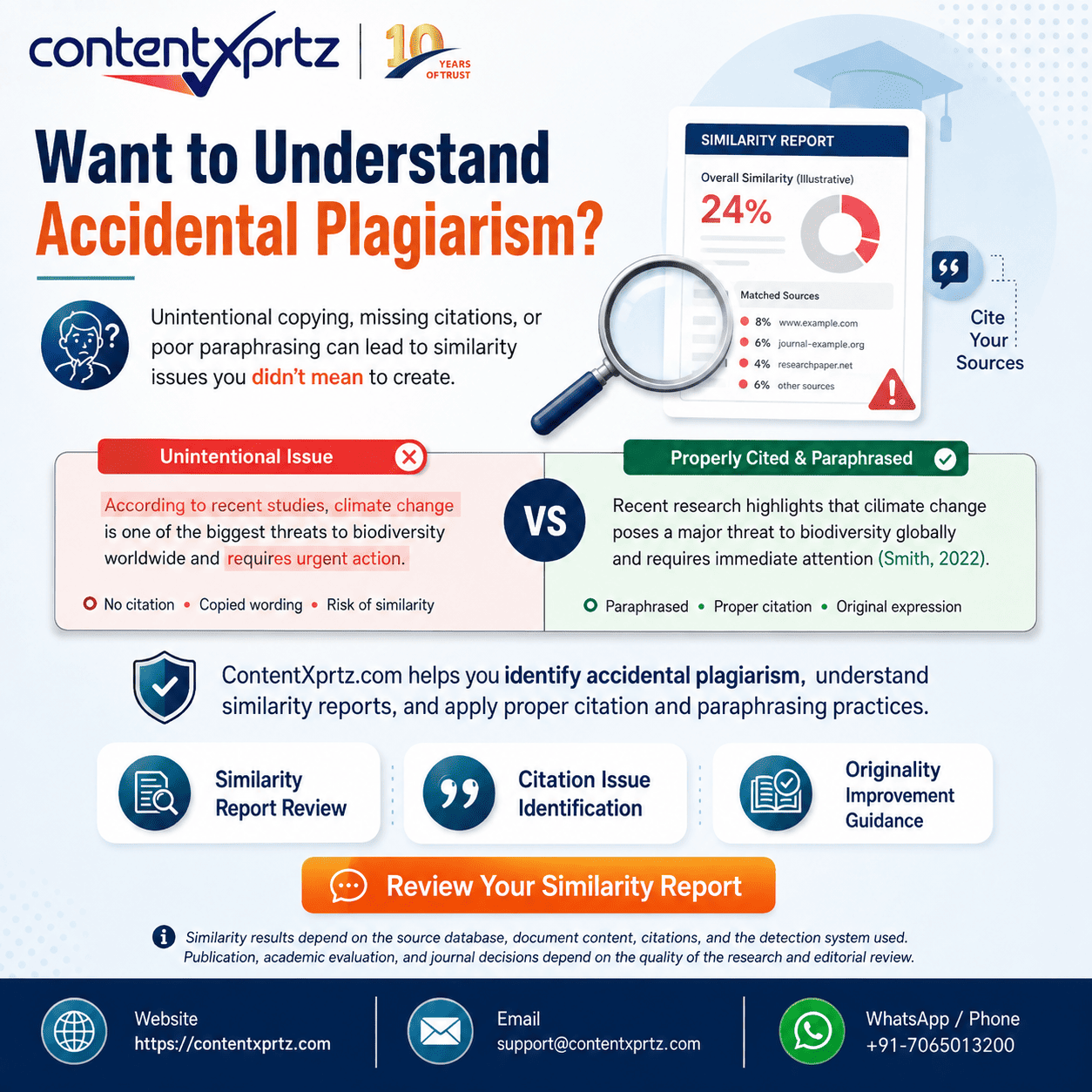
Plagiarism also cannot be reduced to a single similarity percentage. Matching-text software compares strings of words against available material, while a plagiarism decision considers attribution, context, originality, intent, permissions, and policy. A correctly quoted passage may create a match without being plagiarism. Conversely, an uncited idea, translated passage, image, dataset, or piece of code may be plagiarized even when software reports little textual overlap. The writer, supervisor, editor, or integrity reviewer must interpret the evidence rather than treating the score as a verdict.
This guide explains what plagiarism means in academic and research settings, how the major types differ, why accidental plagiarism happens, and how to prevent it through an ethical writing workflow. It also clarifies citation, paraphrasing, self-plagiarism, AI-assisted writing, and professional editing. Contentxprtz can support careful source integration and manuscript review through ethical plagiarism and AI integrity guidance, but authors remain responsible for their ideas, evidence, citations, disclosures, and final submission.
Quick Answer: What Is the Definition of Plagiarism?
Plagiarism is the use or presentation of another person’s words, ideas, research processes, results, data, images, code, structure, or creative work without appropriate acknowledgement. It misleads the reader about authorship or originality. Exact copying is one form, but plagiarism can also occur through close paraphrasing, missing citations, uncredited translation, misleading source use, or undisclosed reuse of earlier work.
The correct response depends on what has been borrowed. Exact wording normally requires quotation marks and citation. Paraphrased ideas require substantially original phrasing and structure plus citation. Visuals, data, code, instruments, and adapted models may require attribution and permission. Reuse of one’s own earlier work may require citation or disclosure.
Always check the policy that governs the work. University rules, assignment instructions, disciplinary norms, journal author guidelines, publisher licences, and research-integrity policies may differ. A similarity report can help locate overlap, but it cannot decide plagiarism by itself.
Key Takeaways
- Plagiarism is fundamentally an attribution problem, not merely a matching-text problem.
- Ideas, methods, data, images, code, translations, and structure can be plagiarized as well as words.
- A citation does not excuse copied wording that lacks quotation marks or a genuine paraphrase.
- Accidental plagiarism can result from poor notes, unclear source boundaries, or citation mistakes.
- Similarity scores require human interpretation and do not prove or disprove plagiarism.
- Self-plagiarism or text recycling depends on novelty expectations, disclosure, permission, and policy.
- Authors remain responsible for source accuracy, originality, ethical editing, and final submission.
What This Page Covers
- A practical definition of plagiarism in education, research, and publication
- The main types of plagiarism with examples
- The difference between plagiarism, similarity, and poor academic practice
- How quotation, paraphrasing, summarizing, and citation work together
- Accidental plagiarism, self-plagiarism, and AI-assisted writing risks
- A step-by-step plagiarism-prevention workflow
- When ethical academic editing or integrity review may be useful
Table of Contents
Methodology and Academic Sources
This article is grounded in established academic-integrity and responsible-research principles. The U.S. Office of Research Integrity describes plagiarism within research misconduct as taking another person’s ideas, processes, results, or words without appropriate credit. The Office of Research Integrity definition is especially relevant to research proposals, performance, review, and reporting.
Practical prevention guidance also draws on the Purdue Online Writing Lab plagiarism resources, the International Center for Academic Integrity’s fundamental values, and COPE guidance for suspected plagiarism in published articles. Policies vary, so writers should verify their university, employer, journal, funder, and publisher requirements.
What the Definition of Plagiarism Means in Academic Context
In academic work, plagiarism means that the boundary between the author’s contribution and the source’s contribution has not been represented honestly. The borrowed element may be language, but it may also be an argument, research design, framework, result, image, table, dataset, code segment, translation, or organization of material.
Three questions help clarify the issue:
- Origin: Did this wording, idea, evidence, or creative element originate with the current author?
- Representation: Can a reasonable reader clearly see what came from a source?
- Compliance: Does the acknowledgement meet the applicable citation, disclosure, and permission rules?
If the answer to the first question is no, the writer usually needs some form of acknowledgement. If the answer to the second or third question is no, the source use may be misleading even when a reference appears somewhere in the document.
What can be plagiarized?
- Exact words, memorable phrases, or distinctive sentence structures
- Ideas, hypotheses, interpretations, arguments, and conceptual frameworks
- Research methods, procedures, protocols, questionnaires, and instruments
- Data, results, calculations, tables, graphs, images, diagrams, and maps
- Software code, algorithms, design elements, music, and multimedia
- Translations, summaries, reviews, and unpublished communications
- Another person’s outline or sequence of reasoning
Common knowledge normally does not require citation, but what counts as common knowledge depends on the audience and discipline. When a fact is specialized, contested, recently established, or central to the argument, cite a credible source.
Why Students, PhD Scholars, and Researchers Plagiarize
Plagiarism often develops from a broken writing process rather than a single bad decision. Time pressure, language difficulty, uncertainty about citation, fragmented notes, weak source comprehension, and fear of changing technical meaning can all increase risk. Intentional misconduct is different from an honest mistake, but both can produce unattributed text in the final document.
Common causes of accidental plagiarism
- Copying text into notes without marking it as a quotation
- Drafting from an open source and unconsciously repeating its wording
- Leaving citations until the final editing stage
- Using a reference manager without checking imported metadata
- Confusing a summary with a paraphrase
- Believing that a bibliography alone covers every borrowed passage
- Translating text without citing the original source
- Using AI-generated references without verifying that they exist
Prevention must therefore begin before the final draft. Writers need a traceable system from source discovery to note-taking, drafting, citation, revision, and submission.
Types of Plagiarism and How They Differ
| Type | What it looks like | Example | Corrective action |
|---|---|---|---|
| Direct plagiarism | Exact language copied without quotation and credit | A paragraph is pasted from an article into a thesis chapter | Quote accurately or rewrite from understanding and cite |
| Mosaic or patchwriting | Source phrases and sentence patterns are mixed with small changes | Several synonyms are substituted while the original structure remains | Rebuild the explanation independently, then cite |
| Paraphrasing plagiarism | An idea is restated too closely or without attribution | A theory is summarized with no in-text citation | Create a genuine paraphrase and add the source |
| Idea or method plagiarism | A distinctive concept, framework, or process is presented as original | A proposal adopts another scholar’s research model without credit | Acknowledge the origin and explain the adaptation |
| Source-based plagiarism | The true source is hidden, misrepresented, or not consulted | A writer cites an original study based only on a review article | Read and cite the actual source or cite the secondary source honestly |
| Self-plagiarism or text recycling | Earlier work is reused without required disclosure or permission | The same assignment is submitted in two courses | Seek permission, cite or disclose the earlier work, and create new analysis |
| Non-text plagiarism | Data, images, tables, code, translations, or media are reused without credit | A published figure is redrawn without attribution | Attribute, label adaptations, and obtain permission where required |
The labels are useful for diagnosis, but policies may combine or define them differently. Focus on the underlying question: what did the writer borrow, what did the reader need to know, and what attribution or permission was required?
When Self-Service Review Is Enough and When Expert Help Is Safer
Self-service review is often enough for a short assignment with a manageable number of sources, clear instructor guidance, and sufficient time for revision. A writer can compare notes with the draft, verify citations, inspect similarity matches, and correct quotation or paraphrasing problems independently.
Expert review becomes more useful when the document is long, multilingual, heavily sourced, technically specialized, prepared under publication pressure, or built from earlier versions. Theses, dissertations, systematic reviews, book chapters, and journal manuscripts may contain hundreds of citations, repeated methods language, figures, appendices, or prior conference material. In these cases, ethical academic editing services can help distinguish language revision from authorship, improve source integration, and identify areas that need author verification.
Professional support should never be used to hide copied work or manipulate a similarity score. Its purpose is to improve clarity, attribution, consistency, and compliance while preserving the author’s responsibility.
How to Prevent Plagiarism: A Step-by-Step Workflow
1. Read the applicable rules before researching
Check the assignment brief, university academic-integrity policy, thesis editing policy, journal author instructions, funder requirements, and copyright conditions. Note any rules on collaboration, translation, prior work, generative AI, editing, or disclosure.
2. Create a source-tracking system
Record the author, title, year, publication, DOI or stable link, page numbers, and access notes when the source is first used. Keep exact quotations clearly marked and separate them from summaries and personal analysis.
3. Read for meaning before drafting
Do not paraphrase sentence by sentence while staring at the source. Read the relevant section, identify the claim and evidence, close or set aside the source, and explain the point in relation to your own research question.
4. Choose the correct form of source use
- Quote when exact wording is important, distinctive, disputed, or necessary for analysis.
- Paraphrase when the idea matters more than the original wording.
- Summarize when you need only the main point of a larger passage or study.
- Synthesize when comparing patterns, differences, or evidence across multiple sources.
5. Cite during drafting
Insert the in-text citation immediately. Do not rely on memory or plan to reconstruct sources after the chapter is complete. Ensure that the citation clearly covers the borrowed statement.
6. Verify every reference and borrowed element
Check that each in-text citation has a matching reference entry, every reference was actually consulted, and details agree with the original publication. Review tables, images, code, appendices, instruments, and translated material separately.
7. Interpret similarity matches
Review the passage and source, not just the percentage. Classify the match as legitimate quotation, reference material, standard wording, copied text, close paraphrase, template language, or prior-work overlap. Correct the underlying source-use problem.
8. Complete an author-responsibility review
Before submission, confirm that you can explain the origin, meaning, and role of every source-based statement. Obtain co-author approval and make any required editing or AI-use disclosures.
Quotation, Paraphrasing, Summarizing, and Citation
These are different tools, and each creates a different relationship between the writer and the source.
Quotation
A quotation reproduces exact wording. It requires quotation marks or block formatting, an in-text citation, and any page or location detail required by the citation style. A citation without quotation marks does not make copied wording acceptable.
Paraphrasing
A paraphrase expresses the source’s meaning through the writer’s own language and structure. It still requires citation. Replacing isolated words while preserving the original syntax is patchwriting, not a strong paraphrase.
Summarizing
A summary condenses the central point of a longer source. It should be selective, accurate, and cited. The writer must not exaggerate or remove qualifications that materially change the source.
Synthesis
A synthesis connects multiple sources around a question, pattern, disagreement, or gap. It demonstrates the author’s analytical contribution while retaining clear attribution for each evidence source.
Writers who need language-focused assistance can use scholarly proofreading support after the source relationships are correct. Proofreading can improve grammar and consistency, but it cannot repair missing evidence or decide authorship for the writer.
Plagiarism Versus Similarity: How to Read a Report
A similarity report highlights matching text found in the tool’s comparison sources. The report should start a review, not end it.
| Report finding | Possible explanation | Reviewer question |
|---|---|---|
| High overall similarity | Copied text, many quotations, references, template language, or prior-work overlap | Which matches are legitimate, and which misrepresent authorship? |
| Low overall similarity | Mostly original wording or material not represented in the database | Are ideas, translations, visuals, data, or code still properly attributed? |
| One long match | Copied passage, standard methods wording, or authorized reuse | Is quotation, citation, permission, or disclosure required? |
| Many small matches | Common phrases, patchwriting, references, or formulaic language | Do the sentence structures show independent writing? |
| Match to the author’s earlier work | Legitimate continuity or undisclosed text recycling | Does the new context require novelty, citation, or permission? |
Do not delete citations, distort technical meaning, or replace words mechanically to lower a score. The goal is an honest, readable, and traceable document—not a particular percentage.
Self-Plagiarism, Text Recycling, and AI-Assisted Writing
Self-plagiarism describes reuse of one’s own prior work that is misleading or non-compliant in the new context. The phrase can be confusing because authors cannot steal from themselves in the ordinary sense, but they can misrepresent novelty, duplicate publication, breach copyright, or submit the same work twice.
Acceptability depends on the type and extent of reuse. Reusing a brief standard methods phrase may be treated differently from reproducing an entire literature review. Developing a thesis chapter into a journal article may be allowed when the relationship is disclosed and publisher requirements are followed. Reusing a published figure may require permission even when the author created it.
AI-assisted writing adds another layer. Institutions and publishers may allow limited language support, require disclosure, restrict generative drafting, or prohibit particular uses. Writers should verify the rules before using AI, protect confidential data, check every reference, and ensure that the final text reflects their own understanding. Ethical AI-human editing should focus on accuracy, clarity, source verification, and author control rather than concealing how the text was produced.
Ethical Academic Editing and Author Responsibility
Editing can improve language, organization, consistency, and presentation without replacing the author’s intellectual contribution. The acceptable level of intervention depends on the institution, assignment, discipline, document type, and disclosure rules.
An ethical editor may identify unclear source boundaries, flag close paraphrases, query unsupported claims, check reference consistency, and suggest that the author return to the original source. The editor should not fabricate citations, add unverified evidence, impersonate the author, or rewrite copied passages solely to evade detection.
The author remains responsible for the research question, methods, data, interpretation, claims, source selection, citations, permissions, co-author communication, and final submission. When the permitted level of editing is unclear, obtain written guidance from the supervisor, university, journal, or publisher.
Common Plagiarism Mistakes to Avoid
- Believing that changing a few words is paraphrasing. Genuine paraphrasing changes language and structure because the writer understands the idea.
- Adding a citation but keeping exact wording. Exact words normally require quotation marks or block-quotation formatting.
- Citing only at the end of a long paragraph. Readers may not know which sentences came from the source.
- Using a source found inside another source without disclosure. Cite the secondary source honestly unless you have read the original.
- Assuming common knowledge is universal. Specialized facts may require citation for a particular audience.
- Ignoring figures, code, data, and appendices. Non-text elements also need attribution and sometimes permission.
- Trusting automated references. Verify authors, titles, dates, journals, pages, and DOIs against authentic records.
- Trying to beat a similarity checker. Mechanical word replacement can damage accuracy while leaving the attribution problem unresolved.
- Reusing earlier work without checking policy. Prior assignments, conference papers, preprints, and published text may require citation or disclosure.
- Submitting AI output without review. The author is responsible for originality, evidence, confidentiality, and policy compliance.
Practical Examples of Plagiarism and Correct Revision
Example 1: A PhD scholar paraphrases too closely
Situation: A doctoral candidate reads a review article and rewrites each sentence by replacing technical terms with synonyms. The sentence order, logic, and distinctive phrases remain close to the source.
Problem: The passage is patchwriting. Even with a citation, the wording may not represent independent expression.
Correct approach: The scholar should identify the key claim, consult the original studies where possible, write a synthesis organized around the thesis argument, and cite each source accurately. An editor can flag close phrasing, but the scholar must make the intellectual decisions.
Example 2: A first-time researcher copies a methods description
Situation: The researcher uses a validated procedure and copies a published methods paragraph because the steps cannot be changed.
Problem: Methodological accuracy does not automatically authorize verbatim reuse. The copied text may need quotation, citation, permission, or a new description.
Correct approach: Cite the original method, describe how it was applied in the current study, disclose any adaptation, and check the target journal’s text-recycling guidance. Preserve technical accuracy without claiming another author’s wording.
Example 3: An ESL author relies on AI-generated references
Situation: An AI tool produces a fluent introduction and a list of references. Several references are incomplete, and one does not exist.
Problem: The manuscript contains untraceable claims and fabricated citation data. Fluency masks an evidence problem.
Correct approach: Remove unverified material, locate authentic sources, read them, rebuild the argument from evidence, and disclose AI use if required. Language editing can improve clarity only after the claims and references are reliable.
Academic Integrity and Plagiarism-Prevention Checklist
Before drafting
- I have read the assignment, university, journal, and AI-use rules.
- I record complete source details at the point of discovery.
- I clearly mark direct quotations in my notes.
- I know which parts of the project involve collaboration or prior work.
During drafting
- I write from understanding rather than altering source sentences.
- I cite ideas, data, methods, images, code, translations, and distinctive wording.
- I use quotation marks for exact language.
- I distinguish my analysis from source summaries.
- I add citations immediately rather than reconstructing them later.
Before submission
- Every in-text citation has a matching, verified reference entry.
- Every reference was actually consulted.
- Similarity matches have been reviewed in context.
- Prior-work reuse is cited or disclosed where required.
- Figures, tables, data, code, and appendices have been checked.
- Any permitted editing or AI assistance is disclosed as required.
- I can explain and defend the final wording, evidence, and conclusions.
How Contentxprtz Can Help
Contentxprtz supports writers who need a careful, ethical review of source integration, language, citations, and manuscript presentation. Relevant assistance may include identifying passages that require author attention, checking whether quotations and paraphrases are clearly distinguished, reviewing citation consistency, improving academic language, and organizing revisions for a thesis, dissertation, research paper, journal manuscript, or professional document.
Support is most effective when the author provides authentic sources, explains the permitted level of editing, and remains actively involved in every decision. Contentxprtz does not promise a guaranteed similarity percentage, guaranteed plagiarism removal, guaranteed grade, or guaranteed publication outcome. The goal is a clearer, more traceable, and more responsible document.
Writers preparing complex research documents may also benefit from contextual research support that preserves author responsibility and follows institutional requirements.
Summary: Definition of Plagiarism
The definition of plagiarism centers on misleading attribution. A writer plagiarizes when another person’s words, ideas, methods, evidence, visuals, code, structure, or creative work are presented without the acknowledgement required by the context. Plagiarism may be direct or indirect, intentional or accidental, textual or non-textual.
Prevention requires more than a final software scan. It begins with policy awareness, reliable notes, source comprehension, independent writing, accurate quotation and paraphrasing, immediate citation, reference verification, and careful review of prior work, AI assistance, figures, data, and permissions.
Similarity reports can locate overlap, but only human review can determine whether the overlap is legitimate, misleading, or non-compliant. When source integration becomes complex, ethical editing can support clarity and consistency while the author retains responsibility for the work.
Frequently Asked Questions
What is the definition of plagiarism in academic writing?
Plagiarism in academic writing is the presentation of another person’s words, ideas, methods, data, images, structure, or creative work as though it were your own, without appropriate acknowledgement. It can involve exact copying, close paraphrasing, incomplete citation, borrowed arguments, uncredited translation, or reuse of material from an earlier submission without permission. The central issue is misleading attribution: the reader cannot accurately tell what originated with the writer and what came from a source. Universities, journals, funders, and publishers may define or classify plagiarism differently, so writers should check the rules that govern their assignment, thesis, manuscript, or professional document. A practical standard is to cite whenever a reader would reasonably need to know the source of a distinctive idea, wording, dataset, visual, or interpretation. Quotation marks are required for exact language, while genuine paraphrases still need citation. Proper attribution supports traceability, fairness, and trust in scholarship.
Is plagiarism always intentional?
No. Plagiarism can be deliberate, careless, or accidental, although an institution may still treat the outcome seriously. Intentional plagiarism includes knowingly copying text, buying or commissioning unauthorized work, using another person’s analysis as one’s own, or hiding the source of borrowed material. Accidental plagiarism often arises from weak note-taking, confusion about citation style, missing quotation marks, overly close paraphrasing, lost source details, or reliance on automatically generated references that were not checked. The distinction may influence how an instructor, university, journal, or employer responds, but lack of intent does not automatically make the text acceptable. Prevention is therefore process-based: record sources while researching, clearly separate quotations from personal notes, cite during drafting rather than at the end, compare paraphrases with the original, and review the final document against the applicable policy. When uncertain, ask the instructor, supervisor, editor, or research-integrity office before submission.
What are the main types of plagiarism?
Common types include direct plagiarism, mosaic or patchwriting plagiarism, paraphrasing plagiarism, idea plagiarism, source-based plagiarism, self-plagiarism or undisclosed text recycling, and plagiarism involving data, images, tables, code, translations, or other non-text material. Direct plagiarism reproduces wording without quotation and credit. Mosaic plagiarism mixes copied phrases or sentence patterns with minor changes. Paraphrasing plagiarism restates a source too closely or omits citation. Idea plagiarism uses a distinctive argument, method, framework, or interpretation without acknowledgement. Source-based plagiarism misrepresents where information came from, cites a source not actually consulted, or conceals a secondary source. Self-plagiarism refers to reusing one’s own prior work in a context that requires new, disclosed, or permission-based content. Labels vary across institutions, and one passage can fit more than one category. The safest response is to identify what was borrowed, how it was transformed, and what form of acknowledgement the relevant rules require.
What is the difference between plagiarism and a similarity score?
A similarity score is a software-generated measure of textual overlap; plagiarism is an academic or professional judgement about attribution, originality, context, and policy. A high similarity score does not automatically prove plagiarism because references, quotations, standard terminology, assignment templates, titles, and legitimate methodological language can create matches. A low score does not prove integrity because copied ideas, translated text, altered wording, images, data, code, or material from sources outside the comparison database may not be detected. Reviewers therefore need to inspect the matched passages, their sources, quotation marks, citations, the purpose of the reuse, and the rules that apply. Writers should not chase a target percentage by mechanically replacing words. Instead, they should improve source integration, paraphrase from understanding, quote only when exact wording matters, cite accurately, and disclose permitted reuse. Similarity reports are screening aids, not final verdicts.
Can I plagiarize even when I include a citation?
Yes. A citation may still be insufficient when the wording is copied without quotation marks, the paraphrase remains too close to the source, the citation is placed so ambiguously that readers cannot tell what it covers, or the cited source is not the actual source of the material. For exact words, use quotation marks or an approved block-quotation format and provide the required citation details. For paraphrases, change both the wording and the sentence structure while preserving the meaning, then cite the source. For tables, figures, images, datasets, code, instruments, and adapted models, follow the relevant attribution and permission requirements. Also avoid citing a secondary discussion as though you had read the original work. Citation is not a decorative add-on; it must accurately show the relationship between your contribution and the source. Read the local style guide and policy because expectations differ across assignments, disciplines, journals, and publishers.
What is self-plagiarism or text recycling?
Self-plagiarism, often discussed as text recycling or duplicate reuse, occurs when an author reuses substantial material from their own earlier work without the disclosure, citation, permission, or originality expected in the new context. Examples include submitting the same essay to two courses, republishing a large section of an article as new, dividing one study into overlapping papers without transparency, or reusing previously published tables and figures without permission. Not every repeated phrase is improper. Standard descriptions, methods language, conference-to-journal development, thesis-to-article adaptation, and authorized reuse may be acceptable when rules are followed and overlap is disclosed. The key questions are whether readers are being misled about novelty, whether copyright or licence restrictions apply, and whether the institution or publisher permits the reuse. Before reusing prior work, check the assignment instructions, journal policy, co-author agreements, and copyright status, then cite or disclose the earlier version as required.
How can I paraphrase without plagiarizing?
Paraphrase from understanding rather than by replacing individual words. Read the source, identify its essential claim and evidence, set the original aside, and explain the idea in a structure that fits your own argument. Then compare the new sentence with the source to check that distinctive wording, sequence, and syntax have not been copied. Add a citation because the underlying idea still belongs to the source. Use quotation marks for any exact phrase that is distinctive or necessary to preserve. A strong paraphrase is not merely shorter or filled with synonyms; it reflects genuine comprehension and makes clear why the source matters in the current discussion. Keep accurate notes so that quoted wording, paraphrases, and personal observations do not become mixed. For difficult passages, draft a brief summary first, verify it against the source, and only then integrate the point into the manuscript with the required in-text citation and reference entry.
Does using AI-generated text create plagiarism risk?
AI-generated text can create plagiarism and integrity risks when a writer submits it without checking authorship rules, factual accuracy, source traceability, originality, or required disclosure. An AI system may reproduce familiar phrasing, invent references, blur the source of ideas, or generate statements that resemble existing material. It may also produce fluent text that the writer cannot defend. Whether AI use is permitted depends on the university, course, journal, publisher, employer, and purpose. Writers should review the applicable policy before use, keep a record of permitted assistance, verify every claim and citation against authentic sources, rewrite from their own understanding, and disclose AI assistance when required. AI detection scores are not definitive proof of misconduct, just as similarity scores are not definitive proof of plagiarism. The author remains responsible for the submitted work, including its ideas, evidence, citations, originality, confidentiality, and compliance with institutional or publisher rules.
What should I do if I discover accidental plagiarism before submission?
Stop the submission process and repair the source use systematically. First, identify every passage that contains copied wording, close paraphrasing, missing attribution, uncertain source details, reused material, or unverified references. Locate the original sources rather than relying only on a similarity-report link. Decide whether each passage should be quoted, genuinely paraphrased, summarized, cited, disclosed as reuse, replaced with original analysis, or removed. Confirm that every in-text citation has a matching reference entry and that every reference was actually consulted. Check tables, figures, images, code, appendices, translations, and notes as well as body text. Then review the relevant university or journal policy. Ethical editing or plagiarism-risk review can help identify language and citation problems, but it should not disguise copied work or guarantee a particular similarity score. Submit only after you can explain the origin and purpose of every borrowed element.
When can professional plagiarism-risk and academic editing support help?
Professional support can help when a thesis, dissertation, research paper, journal manuscript, or professional document contains complex source integration, inconsistent citations, close paraphrasing, extensive revision, multilingual writing challenges, or uncertainty about permitted reuse. Ethical support may flag passages that need quotation, deeper paraphrasing, citation, disclosure, structural revision, or source verification. It can also improve clarity and consistency while preserving the author’s meaning. It should not invent sources, conceal misconduct, rewrite copied material merely to evade detection, or promise guaranteed plagiarism removal, grades, publication, or acceptance. The author must provide authentic sources, follow institutional or publisher rules, approve every revision, and remain responsible for the final submission. Contentxprtz offers plagiarism and AI integrity guidance, academic editing, and proofreading for writers who want a careful review of language, attribution, references, and manuscript readiness.
Conclusion: Protect Originality Through Traceable Academic Writing
The practical challenge is not simply avoiding copied sentences. It is making the origin of every important idea, phrase, result, method, image, and interpretation visible to the reader. Free self-review is often enough when the document is short, the rules are clear, and the writer has maintained accurate notes. Expert-assisted academic editing becomes safer when a thesis, dissertation, manuscript, or multilingual document contains complex sources, prior-work reuse, inconsistent citations, or close paraphrasing.
Contentxprtz helps authors improve clarity, structure, citation consistency, ethical source integration, and manuscript readiness without replacing their original ideas or responsibility. The final work should remain understandable, defensible, accurately referenced, and compliant with the rules that govern its submission.
“At Contentxprtz, we don’t just edit; we help ideas reach their fullest potential.”