Scientific Paper: How to Structure, Write, and Prepare Research for Publication
A scientific paper is the formal record of a research question, the method used to investigate it, the evidence produced, and the interpretation that the authors can responsibly support. For students and first-time researchers, the challenge is rarely just “writing well.” A publishable manuscript must connect the research problem, methods, results, figures, tables, citations, and discussion into a transparent argument that another scholar can inspect and evaluate.
That creates a practical difficulty. Researchers often begin with a thesis chapter, laboratory notebook, statistical output, conference presentation, or set of draft sections written at different times. These materials may contain sound science but still fail to read like a coherent journal article. The introduction may be too broad, the methods may omit decisions that matter, the results may mix interpretation with reporting, and the discussion may repeat findings instead of explaining their significance. Language and formatting issues can add another layer of friction, especially for authors writing in an additional language.
A strong scientific manuscript therefore needs two kinds of discipline. The first is research discipline: accurate data, defensible analysis, traceable sources, appropriate methods, and honest limitations. The second is communication discipline: a clear structure, precise terminology, logical paragraphs, readable figures and tables, consistent references, and claims calibrated to the evidence. Neither can substitute for the other. Elegant prose cannot repair unsupported conclusions, while excellent research can be difficult to evaluate if the manuscript is disorganized.
This guide explains how to move from completed or near-completed research to a well-structured scientific paper. It covers the common IMRaD model, article planning, title and abstract writing, methods transparency, results and discussion, references, ethics, editing, practical examples, and a pre-submission checklist. Where professional support is useful, Contentxprtz can provide ethical research paper editing support that focuses on clarity and manuscript readiness without replacing the author's responsibility for the research.
Quick Answer: What Is a Scientific Paper?
A scientific paper is a structured scholarly document that communicates research in a form readers can evaluate. An original research article typically explains the problem or question, describes the methods, presents the results, interprets those results, and identifies limitations and implications. Many empirical papers follow IMRaD: Introduction, Methods, Results, and Discussion, although journals and disciplines may use different labels or combine sections.
The best way to write one is to start from the study's evidence and intended contribution rather than from a generic template. Confirm the target article type, organize the figures and tables, outline the message of each section, draft methods and results accurately, build the discussion around what the evidence supports, and write the abstract after the paper is stable. Before submission, verify citations, disclosures, reporting requirements, and journal formatting.
The central caution is simple: clarity must never come at the cost of scientific accuracy. Editing can improve presentation, but authors remain responsible for the data, methods, interpretations, references, authorship, and final submission.
Key Takeaways
- A scientific paper communicates a research question, method, results, and evidence-based interpretation.
- IMRaD is common, but the target journal's article type and author instructions control the final structure.
- Methods and Results should be transparent enough for readers to understand how the evidence was produced and analyzed.
- The Discussion should interpret findings, compare them with prior work, explain limitations, and avoid claims beyond the design or data.
- References must be authentic, traceable, and checked against the original sources rather than trusted blindly from software or AI output.
- Professional editing can improve clarity and consistency, but it should preserve author meaning and never fabricate or alter scientific content.
- A pre-submission review should cover science, language, reporting, ethics, declarations, figures, tables, references, and journal-specific files.
What This Page Covers
- What a scientific paper means and how it differs from broader research writing
- The purpose of each major section, including title, abstract, introduction, methods, results, and discussion
- A practical workflow for drafting a paper from completed research
- How to use figures, tables, citations, and reporting standards responsibly
- Common writing and publication-readiness mistakes
- Practical examples for first-time, PhD, and ESL researchers
- When self-editing is enough and when specialist manuscript editing may help
Table of Contents
Methodology and Academic Sources
This guide is based on common scientific writing, manuscript-editing, peer-review, and publication-readiness workflows. Because reporting and submission requirements vary by discipline, study design, publisher, and journal, authors should verify the instructions for their target venue rather than treating any general guide as a substitute for journal policy.
For responsible authorship and manuscript preparation, useful primary guidance includes the ICMJE Recommendations, the COPE Core Practices, EQUATOR Network reporting guidelines, and Nature's author formatting guidance. These sources address different parts of scholarly communication; no single source applies identically to every field.
Contentxprtz can assist with ethical academic editing, proofreading, and manuscript organization. Such support should improve communication without taking ownership of the research or replacing required author decisions.
What a Scientific Paper Means in Academic Context
A scientific paper is not simply an essay about science. It is a traceable communication record built around evidence. Readers should be able to identify the research question, understand how observations or data were generated, see the principal findings, and distinguish the authors' interpretation from the evidence itself.
That distinction matters because scientific writing is cumulative. Later researchers may use a published paper to design experiments, compare results, build a review, reproduce a method, formulate a policy recommendation, or challenge an assumption. Ambiguous methods, overstated conclusions, or unreliable citations can therefore create problems beyond a single manuscript.
Common scientific paper types
| Article type | Main purpose | Typical evidence base | Writing priority |
|---|---|---|---|
| Original research article | Report a new study | Primary data, experiments, observations, models, or analyses | Transparent methods and results |
| Review article | Synthesize existing literature | Published studies and other defined evidence sources | Search/synthesis transparency and balanced interpretation |
| Methods paper | Describe or validate a method | Method development, benchmarking, validation | Reproducibility and comparison |
| Short communication | Report a concise or time-sensitive finding | Focused data set or result | Economy without omitting essential detail |
| Case report or case series | Describe clinically or scientifically notable cases | Case-level observations | Context, consent/ethics, and limited generalization |
The category determines what readers expect. A review does not use the same evidence architecture as a laboratory experiment, and a case report cannot support population-wide causal claims. Before writing, name the article type precisely and read examples from the intended journal.
Scientific Paper Structure: What Each Section Must Do
The familiar IMRaD structure is useful because each section answers a different reader question: Why was the study needed? What was done? What was found? What does it mean? The model is flexible, but those functions should remain visible even when headings differ.
Title
The title should identify the central topic and, where useful, the study design, population, system, or key relationship. Avoid promising more than the study tested. A specific title helps the right readers find the paper and reduces ambiguity about scope.
Abstract
The abstract is a compact representation of the full manuscript. It should state the background or objective, core method, principal results, and conclusion at a level of detail allowed by the journal. Do not add results or claims that are absent from the paper. If the journal uses a structured abstract, follow the required headings exactly.
Introduction
The introduction should move from the scientific problem to the specific gap and objective. It is not the place to summarize every paper ever written on the topic. Select prior work that establishes context, shows what is known, and makes the unresolved question understandable. End with a clear objective, hypothesis, or research question.
Methods
The methods section explains how the study produced its evidence. Depending on the field, it may include design, setting, participants or materials, inclusion criteria, instruments, interventions, variables, protocols, computational procedures, statistical analysis, software, ethics approvals, preregistration, and data handling. The goal is enough transparency for informed evaluation and, where possible, replication or reproducibility.
Results
Results should answer the study questions in a logical sequence. Use text to highlight the main pattern, figures to show relationships or distributions, and tables to present structured details. Include relevant uncertainty and negative or nonsignificant results when they are part of the planned analysis. Keep interpretation limited if the journal separates Results and Discussion.
Discussion
The discussion interprets rather than re-lists results. Start with the main finding and its meaning, compare it with prior evidence, explore plausible explanations, and address limitations. Explain where the results are robust and where uncertainty remains. Claims should not exceed what the design supports.
References and declarations
References show where prior ideas and evidence came from. Declarations may cover funding, conflicts of interest, ethics, consent, data availability, code availability, author contributions, or AI use depending on the journal. These are part of scientific transparency, not administrative decoration.
Free, Low-Cost, and Professional Writing Options
Researchers can combine self-editing, institutional support, software, peer feedback, and professional editing. The right choice depends on the manuscript's stage and the problem being solved.
| Option | Best for | Strength | Main caution |
|---|---|---|---|
| Self-editing | Scientific accuracy and first revision | Author knows the study best | Familiarity can hide unclear passages |
| Peer or supervisor feedback | Argument, field fit, interpretation | Subject-aware critique | Availability and editing depth vary |
| Grammar/reference tools | Surface consistency and mechanics | Fast checks | Can miss scientific meaning or produce false corrections |
| Institutional writing center | Learning and developmental feedback | Educational support | May not offer journal-specific technical editing |
| Professional academic editing | Language, flow, consistency, manuscript readiness | Focused editorial review | Must preserve author meaning and comply with policies |
Professional support is most valuable after the scientific content is sufficiently stable. If the study design or analysis is still unresolved, editorial polishing should not be used to conceal that problem.
When Self-Editing Is Enough and When Expert Editing Helps
Self-editing may be enough when the paper is short, the authors are experienced with the target journal, the language is already clear, and coauthors can provide rigorous review. It is also essential even when professional editing is used, because only the authors can confirm whether every sentence accurately represents the study.
Expert editing becomes more useful when readers repeatedly misunderstand the manuscript, when sections were written by multiple authors and lack one voice, when language issues obscure technical meaning, when the paper needs substantial shortening, or when journal formatting and reference consistency are difficult to manage. Authors can explore Contentxprtz editing services or proofreading support when those needs match the manuscript stage.
The ethical boundary is important. An editor may improve wording, organization, and consistency, but should not invent data, create unsupported claims, fabricate citations, manipulate results, or assume authorship responsibility.
How to Write a Scientific Paper Step by Step
1. Confirm the article type and target journal
Choose a realistic journal or at least a small group of candidate journals before final drafting. Record the article type, word limit, abstract format, figure requirements, reporting guideline, reference style, and required declarations. This prevents major restructuring at the end.
2. Write the one-sentence scientific message
State the study question and the main result in plain language. Then state the strongest conclusion the design supports. If these cannot be expressed clearly, the manuscript's logic may still be unresolved.
3. Organize final figures and tables
Figures and tables often reveal the real narrative better than draft prose. Place them in the order a reader needs, remove duplication, check labels and units, and ensure every visual has a purpose. A figure should not exist merely because the analysis software produced one.
4. Draft Methods from the actual study record
Use protocols, preregistrations, laboratory records, code, statistical plans, and final analysis decisions. Distinguish planned from exploratory analysis where relevant. Include enough detail to understand how evidence was generated.
5. Draft Results around the research questions
Report the main outcomes first unless the journal or study design requires another order. Use exact numbers where they matter, include uncertainty, and refer to figures and tables rather than copying all their contents into prose.
6. Build the Discussion from claims, not paragraphs
List the conclusions you want readers to take away. For each one, identify the result that supports it, relevant prior research, an alternative interpretation, and any limitation. Remove claims that do not have adequate evidence.
7. Write the Introduction to justify the question
Now that the manuscript's contribution is clear, write only the background needed to understand why the question matters. Move from broad context to the specific gap, then state the objective or hypothesis.
8. Write the title and abstract last
The final manuscript should determine the abstract, not the reverse. Check that the abstract's numbers match the body and that the conclusion uses the same level of certainty as the Discussion.
9. Revise for logic before grammar
First test section order, paragraph function, evidence-to-claim alignment, and repetition. Then refine sentences, terminology, grammar, and style. Polishing an unnecessary paragraph wastes time.
10. Perform a submission audit
Check every file, declaration, figure, table, reference, author detail, and required reporting item. Have all authors review the exact final version before submission.
How to Write the Title, Abstract, and Introduction
These sections control discoverability and first impressions, but they should be written to represent the research accurately rather than to maximize clicks.
Title: specific without overclaiming
Include the core topic and the most useful distinguishing information. A title can mention the study design or population when that helps readers judge relevance. Avoid causal words such as “causes,” “prevents,” or “improves” unless the design supports them. Avoid vague phrases like “a novel study” when the novelty can be described directly.
Abstract: a miniature of the paper
Use the journal's required structure. Report the objective, methods, principal results, and conclusion. Include key numerical findings when required and when they can be understood without the full text. Do not introduce citations, unreported analyses, or stronger conclusions than the main paper supports.
Introduction: problem, evidence, gap, objective
A useful introduction often follows four moves: define the problem, summarize the most relevant evidence, identify the unresolved issue, and state the study objective. The literature should lead logically to the question. Long historical background may be interesting but can weaken the argument if it does not help readers understand why the study was necessary.
Use primary sources when they are central to the claim and verify every citation. A literature review can provide context, but scientific papers need source selection that is proportionate to the specific argument rather than a citation list assembled for appearance.
Methods, Results, and Discussion: Where Scientific Credibility Is Built
The middle of the paper carries most of the evidential burden. Clear prose matters, but transparency matters more.
Methods: let readers see how the evidence was made
Describe the design and analytical decisions that could influence interpretation. For human or animal research, include required ethics and consent information. For computational work, specify software, versions, parameters, data sources, and code availability where appropriate. For qualitative research, explain sampling, data collection, coding or analytic approach, and reflexivity or trustworthiness procedures when relevant.
Use the reporting guideline appropriate to the study design where one exists. The EQUATOR Network indexes many health-research reporting guidelines, but researchers in other disciplines should follow their own field's standards.
Results: show the evidence without narrative distortion
Lead with prespecified or primary outcomes when applicable. Report data consistently across text, tables, figures, abstract, and supplementary material. Check that percentages match denominators, units are consistent, and the same sample is not described differently in separate sections.
Discussion: interpret with calibrated confidence
Begin with what the study found and why it matters. Then compare findings with relevant literature. Explain differences rather than simply noting them. Discuss uncertainty and limitations in a way that helps readers understand what conclusions are secure and what remains unresolved.
| Evidence situation | Safer wording | Wording to avoid unless justified |
|---|---|---|
| Observational association | “was associated with” | “caused” |
| Small exploratory analysis | “suggests” or “is consistent with” | “proves” |
| No statistically clear difference | “did not detect a clear difference” | “the groups are identical” |
| Single-context study | “within this population/setting” | Universal generalization |
| Model prediction | “the model predicted” | “the outcome will occur” |
Careful wording is not weakness. It is part of scientific precision.
Ethical Academic Editing and Author Responsibility
Editing should make scientific communication clearer without changing who is responsible for the science. Authors remain accountable for the research question, data, analyses, conclusions, citations, and disclosures.
The ICMJE authorship recommendations connect authorship with substantial contribution, drafting or critical revision, final approval, and accountability. Other fields and journals may use different authorship standards, so the applicable policy should be checked directly.
Ethical editing can include language correction, terminology consistency, structural suggestions, shortening, reference-style checks, figure-caption editing, and queries where scientific logic appears unclear. It should not create false results, invent references, manipulate images inappropriately, hide plagiarism, or rewrite the scientific record to make unsupported claims appear stronger.
Responsible AI use
Generative AI can produce fluent but inaccurate text, including nonexistent citations and distorted technical statements. Any use must be checked against journal and institutional policy. Confidential manuscripts, unpublished data, and participant information also require careful handling. If AI is used for language support, every output should be verified by a qualified human who understands the research.
Researchers who want human review focused on clarity can use Contentxprtz AI-human editing support where appropriate, while retaining full responsibility for the scientific content.
Common Scientific Paper Mistakes to Avoid
- Writing the abstract too early and never updating it. Recheck every number and conclusion after the final revision.
- Using a broad introduction with no clear gap. Background should lead to the research question.
- Omitting method details that affect interpretation. Readers need to understand design and analysis choices.
- Repeating tables in prose. Use text to highlight patterns, not duplicate every value.
- Confusing nonsignificant results with proof of no effect. Interpret uncertainty and study power appropriately.
- Overclaiming causality or generalizability. Match verbs and conclusions to the research design.
- Hiding limitations. A transparent limitation section helps readers judge evidence rather than weakening a credible paper.
- Trusting citation software or AI without verification. Check the original source and final bibliographic details.
- Submitting before all authors approve the final file. Version mismatches can create serious errors.
- Formatting for a journal before confirming scientific fit. Journal scope and article type should come before cosmetic formatting.
Practical Examples: Scientific Paper Problems and Better Approaches
Example 1: A PhD scholar converting a thesis chapter into a journal paper
Situation: A doctoral researcher has a 14,000-word thesis chapter with extensive background and several analyses. Common mistake: The researcher removes paragraphs until the chapter fits a journal word limit, but the paper still reads like a compressed thesis. Better approach: Define one publishable research question, select the figures and analyses that directly answer it, and rebuild the introduction and discussion around that narrower contribution. Material essential to the thesis but not to the article can remain in the thesis or move to supplementary files when allowed. Where ethical help can assist: An academic editor can flag repetition, unclear transitions, and sections that still follow thesis logic rather than article logic, while the researcher decides what scientific content belongs in the paper.
Example 2: A first-time author mixes Results and Discussion
Situation: A researcher writes each finding followed immediately by several paragraphs of interpretation even though the target journal uses separate sections. Common mistake: Results become difficult to scan and interpretation appears before readers can see the full evidence pattern. Better approach: Move descriptive findings, estimates, uncertainty, and table/figure references to Results, then group interpretations by the study's main questions in Discussion. Where ethical help can assist: Structural editing can identify which sentences report evidence and which interpret it, but the author must confirm that moving text does not change scientific meaning.
Example 3: An ESL researcher has accurate science but unclear English
Situation: The manuscript contains correct methods and results, but long sentences, inconsistent terminology, and article/preposition errors make the logic hard to follow. Common mistake: The author uses automated rewriting for entire paragraphs and accepts fluent output without checking technical meaning. Better approach: Preserve the original scientific statement, simplify sentence structure, standardize key terms, and verify every revised sentence against the data and methods. Where ethical help can assist: Human academic editing can improve language while raising queries where meaning is ambiguous. The author should resolve those queries and approve the final wording.
Example 4: A team has strong findings but inconsistent coauthor sections
Situation: Four coauthors drafted different sections, each using different abbreviations, tense, variable names, and levels of detail. Common mistake: The corresponding author corrects only grammar, leaving conceptual inconsistencies. Better approach: Create a terminology sheet, verify that the same outcomes and populations are named consistently, align methods with results, and check that the abstract matches the final analysis. Where ethical help can assist: A manuscript editor can perform cross-section consistency checks and flag contradictions for author resolution.
Scientific Paper Editing and Publication-Readiness Checklist
Research logic
- The research question or objective is explicit.
- The study design can answer the stated question at the claimed level.
- The main conclusion is supported by the reported evidence.
- Limitations and uncertainty are described honestly.
Methods and results
- Methods describe the actual final procedure and analysis.
- Sample sizes, units, labels, and statistical values are consistent.
- Figures and tables are readable, necessary, and cited in order.
- Results do not omit inconvenient outcomes that are relevant to the study plan.
Writing and structure
- Each section performs its intended function.
- Paragraphs have one clear purpose and logical transitions.
- Terminology and abbreviations are consistent.
- The title and abstract accurately represent the full paper.
References and ethics
- Every citation has been checked against a real source.
- Reference formatting matches the journal.
- Authorship, funding, conflicts, ethics, consent, data, and AI-use disclosures are complete where required.
- All authors have approved the final manuscript.
Journal submission
- The journal scope and article type fit the work.
- Word, abstract, figure, table, and supplementary limits are met.
- Required reporting guideline items have been addressed.
- Cover letter, title page, declarations, highlights, graphical abstract, or other files are included only as required.
How Contentxprtz Can Help with a Scientific Paper
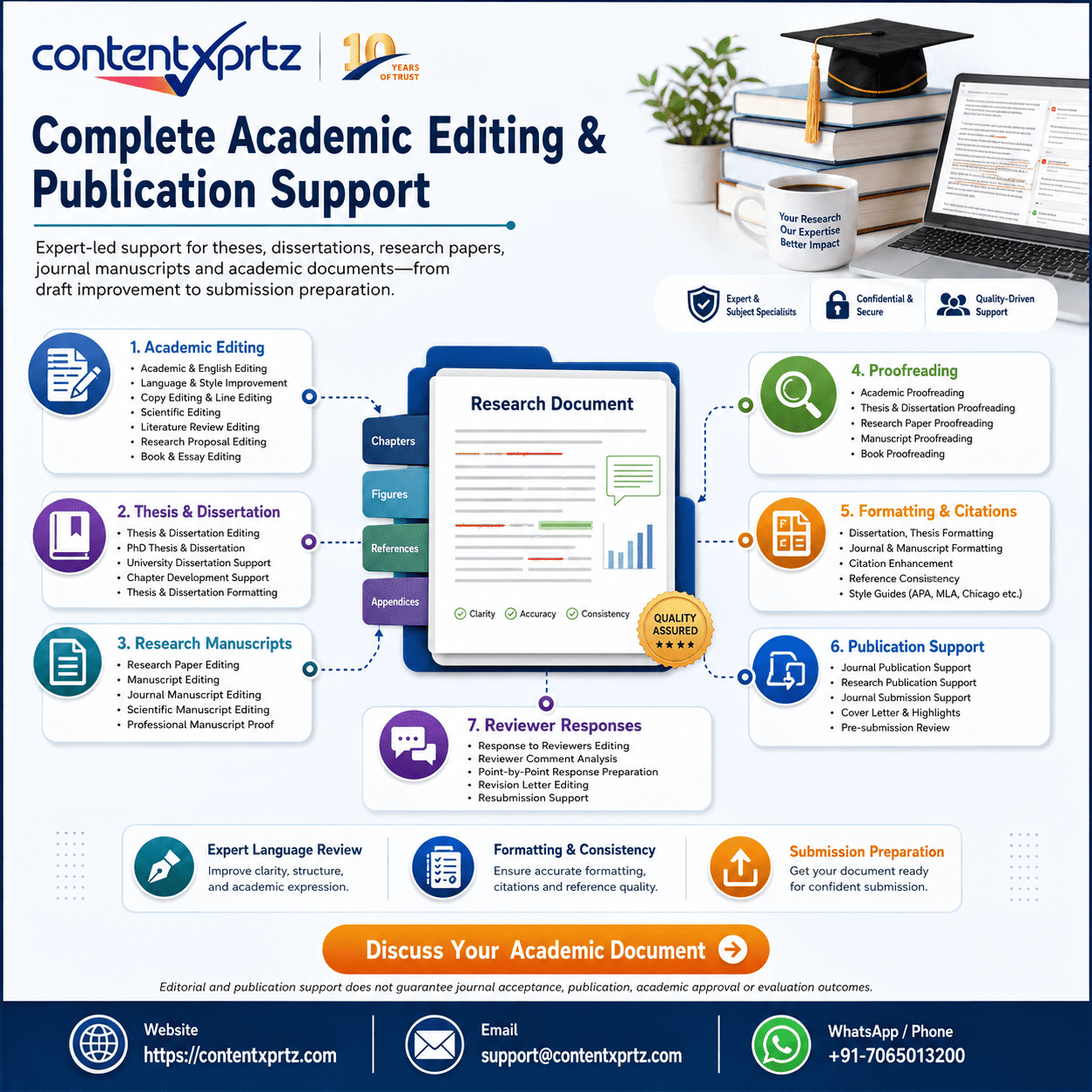
When the research is complete but the manuscript needs clearer academic communication, Contentxprtz can support language editing, structure, consistency, formatting, and publication readiness. The most relevant service for this topic is research paper editing. Researchers who need a broader pre-submission review may also consider manuscript assessment.
Good editorial support should make the author's meaning easier to understand, not replace the author's scientific judgment. Editors can query unclear claims, inconsistent terminology, missing transitions, or confusing presentation. Authors should decide how to resolve scientific questions and verify every final change.
Summary: Scientific Paper Writing and Preparation
A scientific paper turns research into a transparent scholarly argument. Most original empirical papers use a sequence similar to Introduction, Methods, Results, and Discussion, supported by a precise title, accurate abstract, appropriate figures and tables, traceable references, and required declarations.
The most reliable writing process starts with the study's evidence and target journal requirements. Organize figures and methods, report results faithfully, interpret them with calibrated confidence, and write the introduction and abstract to match the final paper. Then revise for logic, language, consistency, reporting completeness, and submission details.
Self-editing and peer feedback may be enough for some manuscripts. Professional editing is most useful when scientific meaning is sound but language, organization, consistency, or journal readiness makes the paper harder to evaluate. In every case, authors remain responsible for the research, citations, decisions, and final submission.
Frequently Asked Questions
What is a scientific paper?
A scientific paper is a structured written report that communicates a research question, the methods used to investigate it, the evidence produced, and the interpretation of that evidence. In many empirical fields, the core follows an Introduction, Methods, Results, and Discussion sequence, often called IMRaD, although exact headings vary by discipline and journal. A paper may also include an abstract, keywords, figures, tables, references, supplementary material, data or code availability statements, funding information, conflict-of-interest declarations, and author-contribution statements. The defining feature is not a particular length or template but transparent scholarly communication: readers should be able to understand what was asked, what was done, what was found, and how strongly the conclusions are supported. Before drafting, check the target journal's article type and author instructions because a clinical study, engineering experiment, qualitative paper, computational study, review, or short communication may require different reporting elements. Authors remain responsible for the accuracy of the data, claims, citations, and final submission.
What is the standard structure of a scientific paper?
A common scientific paper structure is title, abstract, introduction, methods, results, discussion, conclusion where appropriate, acknowledgements or declarations, and references. Many journals combine or rename some sections, and some disciplines use theory, materials and methods, experimental setup, findings, implications, or limitations as separate headings. The introduction should establish the problem, relevant background, gap, and research objective without becoming a full literature review. Methods should provide enough detail for informed evaluation and, where feasible, reproducibility. Results should report the evidence without hiding inconvenient outcomes. Discussion should interpret the findings in relation to the research question and prior work, explain limitations, and avoid claims that extend beyond the data. The abstract should accurately summarize the full paper rather than introduce new information. Always treat the journal's author guidelines as the controlling format. A strong structure helps readers follow the logic of the study, but good scientific writing also depends on precise evidence, transparent reporting, and consistent terminology.
How do I start writing a scientific paper?
Start with the study's central message, not with the first sentence of the introduction. Write one or two sentences stating the research question, the most important result, and the main interpretation that the evidence can reasonably support. Then gather the final figures, tables, analysis outputs, protocol or methods notes, and the target journal's instructions. Many researchers find it efficient to draft Methods and Results first because these sections are anchored in work already completed, then write the Discussion and Introduction, and prepare the title and abstract last. Build a paragraph-level outline before polishing sentences. Each paragraph should have one clear function and a logical link to the next. Keep a citation record as you write so references remain traceable. If coauthors are involved, agree early on who owns each section and how version control will work. Editing tools can help with grammar, but they cannot decide whether the scientific claim is justified. Final responsibility for interpretation, originality, citations, and submission remains with the authors.
How long should a scientific paper be?
There is no universal word count for a scientific paper. Length depends on the journal, article type, discipline, study complexity, and reporting standard. A brief report may be tightly limited, while a full research article can allow substantially more space for methods, results, figures, and discussion. Some journals impose separate limits for the abstract, main text, tables, figures, references, or supplementary information. The safest approach is to choose a plausible target journal early and read its current author instructions before writing to a fixed length. Within any limit, prioritize information needed to evaluate the research: the question, design, sample or data source, analytical approach, key results, uncertainty, limitations, and evidence-based interpretation. Cutting essential methodological detail merely to reduce words can harm transparency, while excessive background and repeated results can obscure the paper's contribution. If the manuscript is too long, remove repetition, compress generic background, use tables efficiently, and move appropriate technical detail to supplementary material only when the journal permits it.
What is the difference between a scientific paper and a research paper?
The terms scientific paper and research paper often overlap, but their scope can differ. A scientific paper usually refers to scholarly work that reports or synthesizes scientific research using methods and evidence expected in a scientific field. A research paper is broader and can include empirical studies, theoretical analyses, humanities scholarship, policy research, literature reviews, or student assignments. In journal publishing, people may use both terms informally for an original research article. What matters more than the label is the article type and the standards attached to it. An original empirical paper should make the study design, evidence, analysis, and limitations clear. A review paper synthesizes existing research rather than reporting a new experiment, while a methods paper may focus on a technique or protocol. Before drafting, identify what the target journal calls the article type and follow that journal's structure, reporting requirements, length limits, and disclosure rules rather than assuming that every 'research paper' follows the same template.
How should results and discussion be written in a scientific paper?
Results should present the evidence clearly and in an order that answers the research question, while the Discussion should explain what that evidence means. In Results, report the main findings, relevant estimates, uncertainty or statistical information, and references to figures and tables. Avoid repeating every number from a table in prose. Do not selectively omit outcomes simply because they are inconvenient or nonsignificant. In the Discussion, begin with the principal finding, relate it to the study objective and prior literature, explain plausible interpretations, and distinguish evidence from speculation. Address limitations, alternative explanations, generalizability, and practical or theoretical implications in proportion to the study design. Avoid claiming causation from data that support only association, and do not present a secondary or exploratory observation as if it were the prespecified primary result. A good Discussion is balanced: it explains the contribution without overselling it. Journals may combine Results and Discussion, particularly in some engineering and natural-science formats, so follow the target journal's convention.
How do I cite sources correctly in a scientific paper?
Cite the original and most relevant sources for claims that depend on prior work, and use the exact reference style required by the target journal. Citation quality is more important than citation volume. Read the source you cite, confirm that it actually supports the statement, and verify authors, title, journal, year, volume, pages or article number, and DOI where applicable. Reference-manager software can reduce formatting effort, but imported metadata can contain errors and still requires checking. Avoid citing a review as the sole support for a claim when the primary study is important to the argument and can be verified directly. Do not invent references or retain citations generated by AI systems without checking the original publication. Use consistent terminology when discussing previous findings, and distinguish a source's conclusion from your own interpretation. Publication ethics and journal policies also require appropriate attribution when text, data, figures, methods, or ideas come from other sources.
Can AI tools be used to write or edit a scientific paper?
AI tools can assist with limited tasks such as brainstorming wording, checking grammar, reorganizing sentences, or helping authors identify places that need clarification, but their use must comply with the policies of the university, funder, employer, and target journal. AI output can contain fabricated references, incorrect facts, distorted technical meaning, or confident but unsupported claims, so every suggestion requires human verification. Authors should never use an AI system as a substitute for understanding their own methods, data, analysis, or conclusions. Many publishers also have disclosure rules for generative AI use and do not allow AI tools to be listed as authors because authorship carries accountability that a tool cannot assume. Preserve confidential or unpublished material according to applicable data and publisher policies before uploading anything to an external system. If AI-assisted language editing is used, the authors remain fully responsible for the manuscript's accuracy, originality, citations, and compliance.
When is professional scientific paper editing useful?
Professional editing is most useful when the research is complete but the manuscript's language, organization, consistency, or journal readiness makes the science harder to evaluate. An editor can help improve sentence clarity, paragraph flow, terminology, figure and table callouts, reference consistency, and alignment with a journal's style. Deeper academic editing can also flag places where the argument is unclear, where methods are difficult to follow, or where claims appear stronger than the evidence described. Ethical editing should preserve the author's scientific meaning and should not fabricate data, invent references, conceal inappropriate authorship, or guarantee publication. Researchers writing in an additional language may especially benefit from language polishing once the scientific content is stable. Before commissioning help, define the scope: proofreading, language editing, substantive editing, formatting, or pre-submission review are different services. Authors should also check institutional and journal policies regarding external editing and disclosure where relevant.
What should I check before submitting a scientific paper to a journal?
Before submission, check scientific accuracy, journal fit, reporting completeness, language clarity, references, declarations, and file requirements. Confirm that the title and abstract match the actual study, all figures and tables are cited in order, units and terminology are consistent, and every major claim is supported by data or a traceable source. Recheck sample sizes, statistical values, figure labels, supplementary files, and references against the final manuscript. Confirm authorship order and contributions with all authors, obtain required approvals, and include funding, conflicts of interest, ethics, data availability, trial registration, or consent information when applicable. Compare the paper line by line with the target journal's author instructions and any relevant reporting guideline. Make sure the manuscript has not been submitted simultaneously elsewhere if the journal prohibits that practice. Finally, have each author review the exact submission version. A polished manuscript cannot compensate for weak or incomplete research, but careful pre-submission checks reduce avoidable editorial delays and communication errors.
Conclusion: Make the Science Easy to Evaluate
The purpose of a scientific paper is not to sound complicated. It is to make a research contribution understandable, inspectable, and appropriately cautious. That requires more than grammar: the question, methods, evidence, interpretation, citations, and limitations must align.
Researchers with a clear draft can often improve it through structured self-editing, coauthor review, reporting checklists, and careful journal-guideline checks. Expert-assisted editing becomes useful when language, flow, consistency, or manuscript organization obscures otherwise sound work. Contentxprtz can help strengthen those communication layers while keeping authors responsible for the science and final decisions.
Explore research paper editing support when the manuscript needs focused academic language and publication-readiness review.
At Contentxprtz, we don’t just edit; we help ideas reach their fullest potential.