Science Magazine: A Practical Guide for Researchers and Authors
Science magazine is a common search phrase used by students, researchers, and first-time authors who are trying to understand the publication Science, find reliable scientific articles, judge whether a source is appropriate for academic work, or learn what it takes to prepare a manuscript for a highly selective multidisciplinary journal. The first point to clarify is terminology: Science is a scientific journal published by the American Association for the Advancement of Science (AAAS), not simply a popular magazine in the ordinary consumer sense. It also contains journalism, commentary, editorials, perspectives, and other editorial material, so readers need to identify the type of content before using it as evidence.
That distinction becomes especially important in a literature review, thesis, dissertation, research proposal, or journal manuscript. A peer-reviewed research article can support a technical claim in a way that a news report generally cannot, while a news feature can be valuable for policy context, scientific debate, or public communication. Researchers therefore need two skills at once: the ability to find and evaluate relevant Science content, and the ability to place that content in a wider evidence base rather than treating journal prestige as a shortcut for critical appraisal.
Authors searching for “Science magazine submission,” “how to publish in Science,” or “Science journal manuscript requirements” face a different problem. They need to separate the flagship journal from other titles in the Science family and from Science Partner Journals, then verify the current scope, article categories, editorial policies, authorship requirements, data expectations, and submission instructions for the exact journal. Requirements can change, so an old checklist copied from a blog or a previous submission should never replace the current journal instructions.
This guide brings those tasks together. It explains what Science is, how researchers can use its content responsibly, how to evaluate articles, how to approach citation and literature-review work, what manuscript-readiness questions matter before submission, and where ethical academic editing services can help without replacing author responsibility. The emphasis is practical: understand the source, verify the current rules, strengthen the manuscript, and avoid claims that the evidence cannot support.
Quick Answer: What Is Science Magazine?
Science magazine usually means Science, the multidisciplinary scientific journal published by AAAS. It has published major scientific work since the nineteenth century and also publishes science news, commentary, editorials, perspectives, reviews, and other material. For academic use, always identify which type of item you are reading before treating it as evidence.
If you are a researcher using Science for a literature review, read the original research article where possible, examine methods and limitations, trace important references, and compare the findings with work from other journals. If you are an author considering submission, verify the exact journal title and the latest author instructions. Do not assume that the flagship Science, other Science-family journals, and Science Partner Journals use identical policies.
The most important caution is simple: journal reputation does not remove the need for critical evaluation. Strong academic work still requires source fit, accurate citation, transparent interpretation, and a manuscript whose claims are supported by the underlying evidence.
Key Takeaways
- Science is a multidisciplinary scientific journal published by AAAS; “Science magazine” is an informal search phrase.
- Science publishes multiple content types, so distinguish research articles from news, editorials, perspectives, and commentary before citing them.
- Use Science as part of a broader literature search rather than as the sole evidence source for a thesis, review, or manuscript.
- For submission planning, confirm the exact journal title, scope, article category, policies, and current author instructions.
- Selective journals evaluate scientific contribution and significance, not merely grammar or formatting.
- Ethical editing can improve clarity, structure, concision, and consistency, but it cannot create novelty or guarantee publication.
- Authors remain responsible for data, claims, citations, authorship, disclosures, and the final submitted manuscript.
What This Page Covers
- What people usually mean by “Science magazine” in an academic context
- How to find and evaluate Science articles for research and literature reviews
- How to distinguish primary research from journalism and commentary
- What to check before targeting Science or another Science-hosted journal
- Common manuscript-readiness and submission mistakes
- Ethical use of editing, proofreading, and AI-assisted tools
- Practical examples for students, PhD scholars, and research authors
Table of Contents
- What Science magazine means
- How researchers should use Science
- Science content types and evidence value
- How to evaluate a Science article
- Preparing a manuscript for a selective journal
- Step-by-step manuscript-readiness workflow
- Common mistakes to avoid
- Practical examples
- Research and submission checklist
- Frequently asked questions
Methodology and Academic Sources
This guide is based on the current public-facing science.org ecosystem, AAAS information about the journal’s publishing role and history, and widely used academic-publishing principles for authorship, ethics, source evaluation, and manuscript preparation. The AAAS Science issue service identifies Science as an AAAS publication and notes its long publication history. Researchers should also consult the official Science website for the live journal and current publication information.
For ethical authorship and publication practice, this article also points readers to the Committee on Publication Ethics (COPE) and the ICMJE Recommendations. These sources provide general principles; the target journal’s own current instructions always take precedence for a specific submission.
What Science Magazine Means in an Academic Context
In academic use, “Science magazine” most often refers to the journal Science. Search behavior creates the confusion because readers may call any periodically published title a magazine, while scholarly publishing uses more specific categories. For researchers, the category matters because a peer-reviewed research paper, a review, a news feature, and an editorial have different purposes and should be cited for different reasons.
AAAS describes Science as one of its central publishing activities, and the journal traces its founding to 1880. Its reputation comes from its role in communicating important scientific discoveries across disciplines. Yet prestige should be understood as context, not as a quality certificate that removes the need to read a paper critically.
Another distinction is equally important. The science.org domain includes more than the flagship journal. It includes other journals and the Science Partner Journal program. The SPJ program explains that participating partner journals are editorially independent and that partner organizations are responsible for their content. A researcher should therefore avoid statements such as “published in Science” when the work actually appeared in a different journal hosted within the broader ecosystem.
When recording a source, capture the exact journal title, article title, authors, year, volume or article number, DOI, article type, and version. That habit prevents citation errors and helps you distinguish a research paper from a related news report or commentary.
How Researchers Should Use Science Magazine for Academic Work
Use Science as a discovery and evidence source, but not as a substitute for a complete literature-search strategy. A strong literature review asks a question first and chooses sources second. Start by defining the population, phenomenon, method, outcome, theory, or problem you need to understand. Then search across appropriate scholarly databases and publisher platforms.
Science can be especially useful in four situations. First, it can help you locate high-profile original research that has influenced later work. Second, perspectives and reviews can introduce a field or frame an emerging debate. Third, science journalism can reveal the policy, societal, or communication context around research. Fourth, reference lists and citation trails can lead you toward foundational studies or newer papers.
However, selective journals may publish only a small fraction of research relevant to your topic. If your dissertation concerns a narrow clinical population, a regional ecology question, a specialized engineering method, or a specific linguistic corpus, the strongest evidence may be scattered across subject journals rather than concentrated in Science.
A practical search workflow
- Write the research question in one sentence.
- Extract two to four core concepts and list synonyms for each.
- Search Science.org for combinations of those terms and for known authors or landmark titles.
- Repeat the search in discipline-specific databases or library resources.
- Screen titles and abstracts for relevance, then read the full text before relying on a source.
- Record inclusion decisions and the date of the search.
- Use backward and forward citation searching to map the research conversation.
This process is more defensible than collecting articles because their titles sound relevant. If you need help turning a large evidence set into a coherent manuscript, research support can focus on organization, evidence mapping, and clarity while leaving source judgment and conclusions with the researcher.
Science Content Types: What Can You Use as Evidence?
The value of a Science item depends on what kind of item it is and what claim you are trying to support. The following table gives a practical distinction for academic writers.
| Content type | Best academic use | Main caution |
|---|---|---|
| Original research article | Evidence for scientific findings, methods, and data-driven claims | Read methods, limitations, supplements, corrections, and later research |
| Review or synthesis | Understanding a field, major debates, and established evidence | Check search method, date range, and whether it is narrative or systematic |
| Perspective or commentary | Interpretation, agenda-setting, expert viewpoint, conceptual debate | Do not present opinion or interpretation as primary experimental evidence |
| News or feature article | Science communication, policy context, public discussion, research developments | Follow links to the original study for technical claims |
| Editorial | Institutional or editorial viewpoint, policy position, community issue | Recognize the authorial viewpoint and purpose |
A frequent academic-writing mistake is “citation laundering”: a student cites a news story that summarizes a study, then writes as if the news story itself produced the result. The safer approach is to cite the original research for the scientific finding and, if useful, cite the news piece separately for public interpretation or context.
How to Evaluate a Science Article Before Citing It
Evaluate the paper, not just the journal name. Start with relevance: does the study answer your question, use a comparable population or system, and measure what your argument says it measures? Then examine design, methods, sample size or dataset, statistical reasoning, uncertainty, limitations, and the relationship between results and conclusions.
Questions to ask while reading
- What is the research question? Can you state it without copying the abstract?
- What was actually measured? Distinguish observed outcomes from inferred mechanisms.
- How strong is the design? Consider controls, randomization, blinding, replication, model validation, and confounding where relevant.
- Do the conclusions match the evidence? Watch for causal language in observational work.
- What are the limitations? A paper that acknowledges limitations may be easier to interpret correctly than one you summarize uncritically.
- Has the paper been corrected, discussed, or challenged? Later scholarship can change how a landmark result should be understood.
- Is this the final version? Confirm the publisher version and DOI when citing.
For a literature review, record these points in an evidence matrix. Columns might include objective, design, sample, methods, key result, limitation, relevance, and quality notes. This forces you to synthesize rather than merely paraphrase abstracts.
Science Magazine, Journal Prestige, and Research Quality
Prestige can signal selectivity and visibility, but it is not a substitute for evidence appraisal. A paper may be influential because it introduced an important idea, used a powerful dataset, or opened a new field. It may also be heavily cited because it was controversial, challenged, or later revised. Citation counts and journal reputation therefore tell you something about attention, not everything about reliability.
For students and early-career researchers, this point protects against two common errors. The first is authority bias: assuming that a claim must be correct because it appeared in a famous journal. The second is reverse prestige bias: ignoring valuable specialist research because it appeared in a less famous title. A good literature review uses the best-fitting evidence available and explains why each source matters.
When writing, use precise verbs. “The study found,” “the authors observed,” “the analysis suggests,” and “the review concluded” are often safer than broad statements such as “Science proves.” Scientific conclusions are usually conditional on methods, data, and context.
Preparing a Manuscript for Science or Another Selective Journal
Before worrying about formatting, decide whether the manuscript has a credible journal fit. Selective multidisciplinary journals look for work that is scientifically rigorous and significant enough to interest readers beyond a narrow subfield. That does not mean every paper must be universal; it means the manuscript should make clear why the advance matters and who should care.
Start with the contribution, not the cover letter
Write a one-sentence statement of the main contribution. If that sentence is vague, promotional, or dependent on five qualifications, the manuscript probably needs more conceptual work before submission. Then write a second sentence explaining what was unknown before the study and a third explaining what the results change.
These three sentences should align with the title, abstract, final paragraph of the introduction, results narrative, discussion, and cover letter. Misalignment is a major readability problem. A title may promise a mechanism while the study only shows association; an abstract may overstate a secondary endpoint; a discussion may introduce claims that were not tested.
Check scope with recent content
Read recent papers and editorial material from the exact target journal. Look beyond topic similarity. Compare the scale of the question, the level of novelty, the evidence package, the breadth of significance, and the article type. A specialist study can be excellent science and still belong in a specialist journal.
Strengthen the manuscript before copyediting
Language editing works best after the scientific story is stable. If major analyses are still changing, deep copyediting may need to be repeated. First resolve data, figures, methods, authorship, and major interpretation issues. Then use academic editing or scholarly proofreading for clarity, consistency, grammar, concision, and presentation.
Step-by-Step Manuscript-Readiness Workflow
A staged workflow reduces avoidable submission errors because each pass has a different purpose.
- Scope pass: Confirm the exact journal, article type, readership, and editorial fit.
- Scientific pass: Check research question, design, analyses, figures, data, limitations, and the support for each major conclusion.
- Story pass: Make sure title, abstract, introduction, results, discussion, and conclusion tell the same scientific story.
- Ethics pass: Confirm authorship, conflicts, permissions, data/materials statements, human or animal ethics, funding, and required disclosures.
- Reference pass: Verify each citation against the source, remove unsupported citations, and ensure the reference list matches in-text citations.
- Language pass: Improve clarity, grammar, scientific tone, terminology, transitions, concision, and sentence-level readability.
- Technical pass: Apply the latest journal instructions for files, figures, supplementary material, metadata, and submission-system fields.
- Coauthor pass: Obtain final approval from all required authors before submission.
Authors often reverse this order and spend hours adjusting reference punctuation before they have resolved a weak abstract or inconsistent results section. Prioritize decisions that affect scientific meaning first.
Ethical Academic Editing and Author Responsibility
Ethical editing improves communication without taking ownership of the research away from the authors. Editors may improve grammar, terminology, logical flow, paragraph structure, clarity, concision, consistency, and formatting. They may flag unsupported claims, ambiguous methods, missing citations, or places where the argument is difficult to follow. The authors must decide the scientific content.
The COPE framework and discipline-specific guidance such as the ICMJE Recommendations are useful reference points for authorship and research integrity. Journal-specific rules still need to be checked, particularly for disclosure of writing assistance, conflicts of interest, data availability, image processing, and AI-assisted technologies.
Do not ask an editor or AI system to invent references, create results, alter data, hide negative findings, or rewrite text so extensively that authors can no longer defend the reasoning. If a tool or professional has made a contribution that the journal requires you to disclose, follow that rule transparently.
Common Mistakes to Avoid
- Calling every science.org title “Science.” Record and cite the exact journal.
- Citing journalism for a technical finding. Find and read the original study where possible.
- Using prestige as a quality shortcut. Evaluate methods, limitations, and later evidence.
- Targeting before checking scope. A strong specialist paper may still be a poor fit for a broad multidisciplinary journal.
- Overstating novelty. Describe the precise advance rather than using unsupported superlatives.
- Writing the abstract before the results are stable. Keep the abstract synchronized with the final analysis.
- Ignoring coauthor approval. Final submission should reflect agreed authorship and an approved manuscript.
- Using outdated author instructions. Check the current journal pages at the time of submission.
- Treating AI output as verified scholarship. Human authors must verify every claim, citation, and disclosure requirement.
- Expecting editing to create publication success. Editing improves communication; editorial decisions depend on the research and journal fit.
Practical Examples: Science Magazine in Real Research Work
Example 1: A PhD scholar finds a Science news story
A doctoral candidate studying climate adaptation finds a Science news feature describing a new modeling study. The initial mistake is to cite the news story as evidence for a quantitative projection. The better approach is to follow the story to the original research paper, examine the model assumptions and uncertainty, and cite the research for the numerical claim. The news story can still be cited separately if the thesis discusses public communication or policy interpretation. An academic editor can help the scholar make that distinction explicit so the literature review does not blur reporting and evidence.
Example 2: A researcher wants to submit because the topic looks similar
An early-career materials scientist sees several Science papers on energy storage and assumes a new battery manuscript is automatically in scope. A closer comparison shows that the published papers address broad mechanisms and cross-field implications, while the new study is a valuable optimization of a specific manufacturing parameter. The correct decision may be to target a strong specialist journal rather than forcing a multidisciplinary pitch. Expert manuscript assessment can help clarify contribution and fit, but the author should avoid interpreting a redirect to a specialist journal as a judgment that the science lacks value.
Example 3: An ESL author has strong results but a dense manuscript
A multilingual research team has a technically strong manuscript, but the abstract contains long sentences, the introduction mixes background with results, and the discussion repeats the same claim in several forms. The common mistake would be to add more technical language to sound “high impact.” A better solution is to simplify the argument, define the central advance early, align terminology across figures and text, and make limitations explicit. Professional editing for researchers is useful here because the problem is communication, not scientific ownership.
Example 4: A student builds a literature review only from famous journals
A master’s student collects ten papers from Science and Nature-family titles and concludes that the search is complete. The evidence set looks prestigious but misses key regional and methodological studies in specialist journals. The correct approach is to search databases systematically, record search terms and inclusion criteria, and then use high-profile papers as part of the synthesis. The strongest literature review is not the one with the most famous logos; it is the one with the most relevant, transparent, and critically evaluated evidence.
Science Magazine Research and Submission Checklist
For readers and literature reviewers
- Confirm the exact journal and content type.
- Read the full text rather than relying on headlines or summaries.
- Check methods, limitations, supplementary material, and later updates.
- Use the original research source for technical claims.
- Compare findings with relevant evidence from other journals.
- Verify the final citation metadata and DOI.
- Keep a search log and evidence matrix for major projects.
For prospective authors
- Confirm the target journal’s live scope and article type.
- State the main advance in one clear sentence.
- Make sure data and methods support the strongest claim.
- Align title, abstract, figures, results, and discussion.
- Verify authorship, conflicts, ethics, funding, data, and disclosure requirements.
- Check every reference against the source.
- Use editing or proofreading only after major scientific revisions are stable.
- Get required coauthor approval before submission.
- Run a final check against current author instructions.
How Contentxprtz Can Help
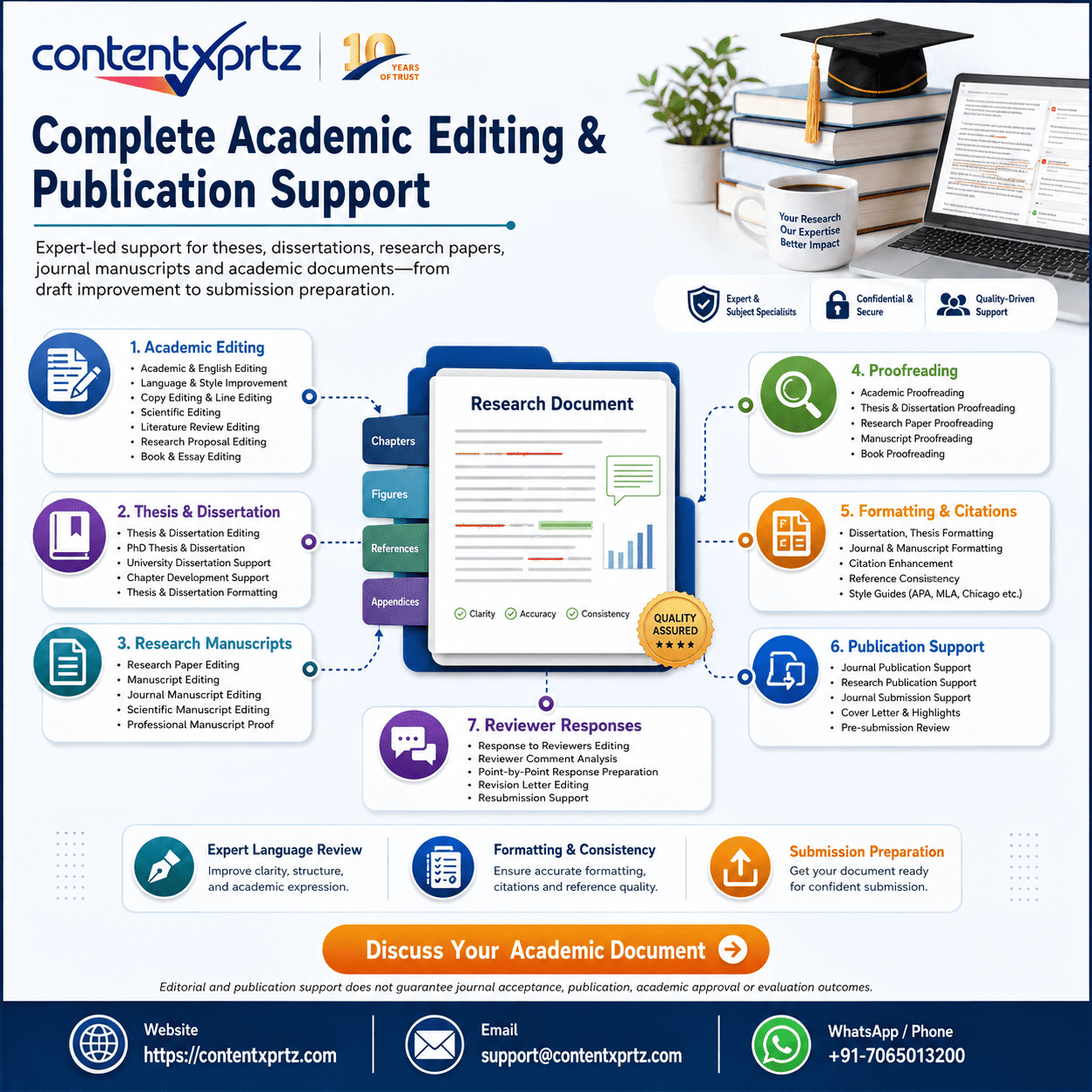
Contentxprtz can help when the scientific work is yours but the manuscript needs clearer academic communication. Relevant support may include research-paper editing, scholarly proofreading, structural review, language polishing, reference-consistency checks, figure-text consistency, and publication-readiness review. The appropriate level depends on the draft.
A near-final manuscript may only need proofreading. A manuscript with a strong study but a difficult narrative may benefit from deeper editing focused on logic, concision, transitions, terminology, and the relationship between claims and evidence. Researchers preparing a journal paper can review the research paper editing service for support aligned with manuscript clarity and submission readiness.
Contentxprtz does not guarantee journal acceptance, publication, indexing, grades, or reviewer outcomes. Authors remain responsible for scientific accuracy, source selection, data, citations, ethics, disclosures, and final submission decisions.
Summary: Science Magazine
“Science magazine” is best understood as a search phrase for the journal Science and its broader publishing context. Researchers should distinguish peer-reviewed research from news and commentary, evaluate each paper on its own methods and limitations, and use Science alongside a broader evidence search. Authors should distinguish the flagship journal from other Science-hosted titles, verify current policies, and assess fit before investing heavily in submission formatting.
For manuscript preparation, the most useful order is scientific fit, evidence, narrative, ethics, references, language, and technical checks. Professional editing can strengthen clarity and consistency, especially for multilingual authors or complex manuscripts, but it cannot substitute for research quality or author responsibility.
Frequently Asked Questions
What is Science magazine, and is it the same as the journal Science?
In everyday searches, “Science magazine” usually refers to Science, the multidisciplinary scientific journal published by the American Association for the Advancement of Science (AAAS). It is more accurate to call it a scientific journal than a general-interest consumer magazine, although it also publishes news, commentary, perspectives, editorials, and other material alongside peer-reviewed research. The distinction matters because a research article, a news story, an editorial, and a perspective do not carry the same evidentiary weight. When you use material from Science in a thesis, manuscript, policy brief, or literature review, identify the content type first, then cite and interpret it accordingly. For publication planning, also distinguish the flagship journal Science from other journals in the broader Science family and from independent Science Partner Journals. Always check the current journal page and author instructions before making submission decisions because article categories, formatting requirements, editorial policies, and access arrangements can change.
Why do researchers pay attention to Science magazine?
Researchers pay attention to Science because it publishes work intended to matter beyond a narrow specialty and because its research, commentary, and science news can shape discussion across disciplines. That visibility does not mean every item is automatically relevant to your project. A highly cited or widely discussed paper can still be methodologically unsuitable for your question, too old for a rapidly changing topic, or outside your population and context. Use Science as one part of a broader evidence workflow: read the original article, inspect the methods and limitations, trace key references, compare findings with other peer-reviewed studies, and check for corrections or later updates. For a literature review, do not build the entire evidence base from one prestigious journal. Good scholarship depends on fit, rigor, transparency, and synthesis rather than prestige alone.
How can I find relevant articles in Science for a literature review?
Start with a focused research question and convert it into two to four core concepts. Search Science.org for exact terms, close synonyms, author names, and topic phrases, then use broader scholarly databases to confirm that you are not missing relevant work outside the journal. When you find a promising Science article, examine its abstract, figures, methods, supplementary information, references, and cited-by links where available. Record the search date, keywords, article type, DOI, and why the source was included. For a thesis or systematic review, document the complete search strategy in the format required by your institution or reporting guideline. Avoid searching only the phrase in your thesis title; authors in the field may use different terminology. A search log and evidence matrix make later synthesis much easier and reduce accidental selective citation.
Can I cite a Science news article in an academic paper?
Yes, you can cite a Science news article when the news item itself is the appropriate source—for example, when discussing science communication, policy debate, research context, or how a development was reported. However, a news story should not usually replace the underlying research paper when you are making a technical scientific claim. If a Science news article summarizes a study, follow the link or citation to the original study and evaluate that primary source directly. Distinguish clearly between reported interpretation and research evidence. Your citation style should follow the journal, university, or publisher requirements for news or web content. If you are writing a literature review, dissertation, or research manuscript, prefer primary studies and high-quality review literature for scientific claims, while using journalism for context where it adds value.
Is publishing in Science the same as publishing in a Science Partner Journal?
No. The flagship journal Science, the Science family of journals, and Science Partner Journals are not interchangeable labels. The Science Partner Journal program involves collaborations in which partner journals are editorially independent from the Science family, and the participating organizations are responsible for their journal content. This distinction is important when evaluating scope, editorial processes, open-access arrangements, and submission instructions. A manuscript suitable for one journal may be a poor fit for another even if both are hosted within the broader science.org ecosystem. Before submission, verify the exact journal title, scope, article type, editorial policies, author instructions, fees or open-access terms, and submission system. Never describe a partner journal as the flagship Science journal, and do not assume that policies published for one title apply automatically to another.
What makes a manuscript potentially suitable for a journal like Science?
A potentially suitable manuscript normally needs more than technically correct writing. It should present a strong, well-supported advance with significance that can be understood beyond a very narrow specialty, while meeting the specific editorial scope and article-type requirements of the target journal. The evidence must support the conclusions, the methods must be transparent, and the narrative should make the contribution and limitations clear without exaggeration. Even an excellent study can be unsuitable if the question is too specialized for the journal’s editorial priorities. Before submission, compare your manuscript with recent work in the journal, read current author instructions, and ask whether the central claim is genuinely new, broadly meaningful, and rigorously supported. Professional editing can improve clarity, organization, and language, but it cannot create novelty or substitute for sound research design.
Do I need professional editing before submitting to Science?
Professional editing is not automatically required, but it can be useful when language, structure, concision, or presentation makes a strong study harder to evaluate. Authors who write clearly and have experienced coauthors may be able to prepare the manuscript themselves. Expert editing becomes more useful when the draft contains dense sentences, inconsistent terminology, weak transitions, unclear figure callouts, excessive wordiness, or language problems that obscure the scientific argument. Ethical editing should preserve the authors’ ideas, data, interpretations, and responsibility for the work. It should not invent results, fabricate citations, hide methodological weaknesses, or guarantee acceptance. If you seek external support, provide the target journal instructions, latest manuscript, figures, supplementary files, and any coauthor comments so the editor can work against the real submission requirements.
How should AI tools be used when preparing a manuscript for Science-related journals?
Use AI tools cautiously and only within the current policy of the exact journal you are targeting. Across scholarly publishing, AI systems are generally not treated as authors because they cannot take responsibility for the work. Some journals require disclosure when AI-assisted technologies are used in writing, presentation, analysis, or other parts of the research workflow. Policies continue to evolve, so do not rely on a policy remembered from an older submission. Verify the current author and publication-ethics pages immediately before submission. Human authors should check every factual statement, reference, quotation, calculation, interpretation, and image generated or modified with AI. Never use AI to fabricate sources or data. If a tool materially contributed to the manuscript, follow the journal’s disclosure instructions rather than concealing its use.
What common mistakes should authors avoid when targeting Science?
Common mistakes include treating journal prestige as a substitute for scope fit, submitting before the central claim is clear, overstating novelty, ignoring current author instructions, and using a title or abstract that hides the main contribution. Other problems include inconsistent figures and text, unsupported causal language, weak reporting of limitations, missing data or materials information, citation errors, and failure to explain why the work matters beyond a specialist audience. Authors also lose time when they format obsessively before confirming the journal’s actual submission requirements or submit a draft that has not been read by all coauthors. A better process is to perform a scope check, scientific-content check, ethics and authorship check, language and structure check, reference verification, and final technical submission check in sequence.
How can Contentxprtz help with a Science magazine-related manuscript?
Contentxprtz can support researchers who need ethical manuscript editing, proofreading, language polishing, structural review, reference-consistency checking, and submission-readiness support for a research paper they are preparing for a selective scientific journal. The most useful support depends on the draft. A technically strong manuscript may only need language editing and concision; another may need deeper work on logical flow, section coherence, figure-text alignment, or response-to-reviewer clarity. Contentxprtz does not replace the authors’ scientific judgment and cannot guarantee publication or editorial acceptance. Authors remain responsible for the research, data, claims, citations, authorship decisions, disclosures, and final submission. The goal of professional support is to help the manuscript communicate the authors’ work clearly, accurately, and in a form that is easier for editors and reviewers to evaluate.
Conclusion: Use Science as a Research Resource, Not a Prestige Shortcut
The useful question is not simply whether a paper appeared in Science. The better question is whether the source is the right type, the methods support the claim, the evidence fits your research problem, and your citation accurately represents what the authors found. For prospective authors, the equivalent question is whether the manuscript genuinely fits the target journal and communicates its contribution with rigor and restraint.
Self-service searching, coauthor review, and careful revision may be enough for many researchers. Expert-assisted editing becomes useful when language, structure, concision, consistency, or submission preparation makes the science harder to communicate. In that situation, Contentxprtz can help strengthen presentation while preserving the authors’ ideas and responsibility for the work.
At Contentxprtz, we don’t just edit; we help ideas reach their fullest potential.