Science Advances Scopus Journal: Profile, Scope, Indexing and Submission Guide
Science Advances is the open-access, multidisciplinary journal of the American Association for the Advancement of Science (AAAS). For researchers searching “Science Advances Scopus,” the most important starting facts are clear: the journal is a current online periodical, its confirmed ISSN is 2375-2548, the supplied Scopus Source Record ID is 21100457028, and authoritative ISSN information lists Scopus, Web of Science, PubMed/MEDLINE and DOAJ among the databases or services associated with the title.
The harder question is not simply whether the journal is indexed. It is whether a particular manuscript makes sense for a broad, selective, open-access journal that emphasizes meaningful advances in science and engineering. This guide therefore combines verified journal facts with practical journal-selection and submission-readiness guidance. Where a current metric, fee, timeline or acceptance rate cannot be safely verified from an authoritative source, it is marked for confirmation rather than estimated.
Quick Answer: What Is Science Advances?
Science Advances is an online, open-access, multidisciplinary scholarly journal published by AAAS. It began in 2015 as an expansion of the Science publishing family and is designed to publish impactful research across scientific disciplines, including work that is strongly disciplinary as well as research that crosses traditional subject boundaries.
AAAS describes the journal as publishing impactful research papers and reviews across science, while emphasizing fair, expert peer review and free reader access. This makes the journal relevant to researchers in life, physical, earth, environmental, materials, computational and applied sciences, as well as engineering, when the manuscript presents a sufficiently important advance.
For formal university or funding requirements, authors should verify the live Scopus source profile, the latest applicable Web of Science/JCR record, and the journal’s current author instructions immediately before submission.
Key Takeaways
- Publisher: American Association for the Advancement of Science (AAAS), United States.
- ISSN: 2375-2548 for the online journal; the ISSN record shows publication beginning in 2015.
- Scopus: the supplied Source Record ID is 21100457028; the ISSN record also lists Scopus indexing.
- Scope: broad and multidisciplinary, covering research across science and engineering rather than one narrow specialty.
- Access model: open access. DOAJ records publication charges and a waiver policy; the current fee should be checked with the journal.
- Core content: AAAS describes the journal as publishing impactful research papers and reviews.
- Selection principle: indexing alone is not a reason to submit; significance, rigor, novelty and fit with recently published work matter much more.
Science Advances Journal Information at a Glance
| Field | Journal Information |
|---|---|
| Journal name | Science Advances |
| Source type | Journal |
| Scopus Source ID | 21100457028 (supplied source record) |
| ISSN / EISSN | 2375-2548 (online ISSN and ISSN-L) |
| Publisher | American Association for the Advancement of Science (AAAS) |
| Country | United States |
| Language | English |
| Established | 2015 |
| Publication medium | Online |
| Scopus status | Indexed/listed; verify the live source profile for current coverage details |
| Other major indexing | ISSN record lists Web of Science, PubMed, MEDLINE, PubMed Central, DOAJ and others |
| Primary subject area | Multidisciplinary science and engineering |
| CiteScore / SJR / SNIP / Scopus quartile | Verify current values in the live Scopus source profile; not reproduced here without current authoritative metric access |
| Journal Impact Factor | Verify the current value in the latest Journal Citation Reports |
| Open access | Yes |
| APC | Current official fee should be reconfirmed; DOAJ record updated 30 Jan 2025 lists up to USD 5,450 and notes a waiver policy |
| Acceptance rate | Not publicly verified for this guide; no estimate is provided |
| Official website | science.org/journal/sciadv |
| Scopus profile | Scopus Source ID 21100457028 |
What This Page Covers
- Science Advances publisher, identifiers and scholarly position.
- Aims, scope and subject coverage.
- Scopus and other indexing signals.
- Metrics and how to verify them responsibly.
- Article types and manuscript-fit expectations.
- Peer review, open access, fees and ethics.
- Practical pre-submission and submission-readiness checks.
- How Contentxprtz can support authors without promising acceptance.
Methodology and Sources
This profile was prepared by prioritizing journal-specific and institutional sources. Identity and ISSN information were checked against the ISSN Portal; open-access and fee information was checked against DOAJ; the journal’s mission and publishing position were cross-checked against AAAS/Science material; and Scopus identification follows the supplied source record and source link.
Journal metrics, APCs, editorial teams, author requirements and database coverage can change. A researcher making a high-stakes decision should reconfirm the live journal website, current Scopus source profile, and current Journal Citation Reports entry immediately before submitting or reporting the journal’s status.
What Is Science Advances in the AAAS Publishing Portfolio?
Science Advances was launched in 2015 as an open-access expansion of the Science publishing ecosystem. Unlike a narrowly defined specialty journal, it is built around broad scientific coverage. AAAS has described it as publishing impactful work in any area of science, including both discipline-specific contributions and broad interdisciplinary studies.
That breadth does not mean that any technically correct paper is automatically a fit. In practical editorial terms, multidisciplinary journals still require a clear reason why the result matters. A manuscript may be highly competent but better suited to a specialized journal if its contribution is incremental, primarily local, or meaningful only to a very narrow methodological niche. Conversely, a specialized study can fit a broad journal when the advance is sufficiently important, the evidence is robust, and the implications are framed for a wider scientific audience.
Science Advances Aims and Scope
The journal’s stated mission centers on publishing significant advances across science and engineering while providing expert peer review and open reader access. Its multidisciplinary orientation allows research to be evaluated for both deep disciplinary value and wider scientific importance.
Author-facing AAAS descriptions and the journal’s publishing history indicate coverage across physical sciences, earth and space sciences, ecology and environmental biology, biomedical and biological research, neuroscience, computational and mathematical science, materials science, engineering, applied science, and other research areas. Cross-disciplinary work is particularly natural for a journal built to bridge traditional subject boundaries.
Research that may align well
- Work that demonstrates a substantial conceptual, empirical, methodological or technological advance.
- Studies with evidence strong enough to support claims that matter beyond a single experiment or local context.
- Interdisciplinary research that genuinely integrates fields rather than merely using a tool from another discipline.
- Research that opens a new line of inquiry, resolves an important uncertainty, or changes how a problem can be addressed.
- Engineering or applied work with strong scientific foundations and implications beyond a single implementation.
Research that may be less competitive
As an editorial interpretation rather than an official rejection checklist, manuscripts may be less competitive when the advance is incremental, validation is too limited for the breadth of the claims, the contribution is mainly descriptive without sufficient explanatory value, or the work is better addressed to a specialist community. Researchers should compare their paper with several recent articles in the closest subject area before deciding.
Science Advances Subjects and Research Areas
Because Science Advances is multidisciplinary, authors should not rely on one broad label such as “General” to judge fit. The more useful approach is to map a manuscript to the journal’s recent published content. Search the journal for your specific problem, method, system, population or technology and examine whether papers with similar scientific ambition have appeared.
For example, a materials paper may fit because it reveals a new mechanism with broad consequences, not merely because “materials science” is within scope. A biomedical paper may fit because it establishes a major biological insight with strong translational or conceptual importance, not merely because the journal publishes life sciences. The same logic applies to climate, physics, chemistry, computation, engineering and social-science-adjacent work.
Is Science Advances Scopus Indexed?
Yes. The supplied journal record identifies Science Advances with Scopus Source Record ID 21100457028, and the authoritative ISSN record for ISSN 2375-2548 lists Scopus among the journal’s indexing services. This establishes a strong basis for identifying the correct title and avoiding confusion with similarly named sources.
However, a researcher who needs proof for a PhD regulation, faculty appraisal, grant, promotion or institutional publication requirement should use the live Scopus source profile on the date the evidence is required. Database coverage periods and source status can change, and institutional rules may distinguish between “currently active,” “covered in a particular year,” and “indexed at any time.”
Other Indexing and Scholarly Visibility
The confirmed ISSN record lists Science Advances in Web of Science, PubMed, MEDLINE, PubMed Central and DOAJ, among other services. This breadth reflects the journal’s multidisciplinary visibility and is especially relevant for researchers whose institutions require database-specific evidence.
Indexing should still be interpreted carefully. PubMed/MEDLINE relevance is strongest for biomedical and life-science content; Scopus and Web of Science serve broader citation-indexing functions; DOAJ documents open-access publishing characteristics. A single “indexed/not indexed” label does not replace checking which database matters for your specific administrative or research purpose.
Science Advances Metrics: CiteScore, SJR, SNIP, Quartile and Impact Factor
Journal metrics are among the most searched Science Advances facts, but they are also among the easiest to report inaccurately when values are copied from old ranking websites. This page therefore does not invent or freeze a current CiteScore, SJR, SNIP, quartile or Journal Impact Factor without access to the live authoritative record.
For Scopus metrics, open the current Science Advances source profile and note the reporting year. For the Journal Impact Factor, use the latest Journal Citation Reports. Clarivate released the 2026 JCR in June 2026, based on 2025 data, so any formal claim should identify both the metric value and the reporting edition. Quartile can also vary by database, category and year; “Q1” in one subject classification is not automatically equivalent to “Q1” everywhere.
As a practical publication-readiness step, treat metrics as contextual signals rather than promises about acceptance, quality of every article, or the future citation performance of your own paper.
What Types of Articles Does Science Advances Publish?
AAAS describes Science Advances as publishing impactful research papers and reviews. These are the core article types that can be stated confidently from the available authoritative material. The journal has historically allowed flexible article formats, which suits work that may require substantial evidence, detailed figures, or extensive supporting information.
Because manuscript categories and formatting rules can be revised, authors should not build a submission around an old template. Before final formatting, check the journal’s current information-for-authors page for the active manuscript categories, limits, required sections, reference style, figure requirements, supplementary-material rules, reporting standards and submission files.
Who Should Consider Submitting to Science Advances?
Science Advances may be relevant to established researchers, postdoctoral scholars, research teams, faculty members, professionals and PhD scholars whose work reaches the journal’s expected level of significance and rigor. Career stage is not the deciding factor. A doctoral candidate can be an author on a strong paper, just as a senior researcher can submit a manuscript that is out of scope or insufficiently developed.
Before choosing the journal, ask three questions: Is the advance substantial? Is the evidence strong enough for the claim? Can the significance be explained to readers beyond a very narrow subfield? If the answer to any of these is weak, a more specialized journal may offer a better editorial fit.
Science Advances Manuscript and Submission Requirements
The safest rule is to use the current official author instructions as the controlling source. Requirements can change, and journal templates copied from repositories or third-party websites may be outdated. Authors should verify the latest requirements for manuscript organization, abstract, figures, tables, supplementary materials, references, data availability, competing interests, author contributions, acknowledgments and any reporting checklists relevant to the discipline.
Practical pre-submission file check
- Confirm the active article type.
- Use the current journal template or formatting instructions.
- Check title, abstract and introduction for a clear statement of the advance.
- Ensure methods and statistical reporting are complete enough to support reproducibility.
- Verify every figure, legend, table and supplementary item against the text.
- Audit references for accuracy and relevance.
- Prepare required declarations, data/code availability statements and author-contribution information.
- Review the cover letter for accurate, non-exaggerated positioning of novelty and significance.
Peer Review and Editorial Evaluation
AAAS has described the mission of Science Advances as providing fair, fast and expert peer review. DOAJ records the journal as using anonymous peer review. The exact current editorial workflow, anonymity arrangement and decision stages should be checked in the official author guidelines because editorial policies can evolve.
A journal of this breadth may reject manuscripts before external review when editors judge the advance, evidence or scope to be insufficient for the journal. That is a general feature of selective journal publishing, not a verified Science Advances acceptance-rate statement. This guide does not estimate an acceptance rate or average review duration.
Open Access, Licensing and Publication Charges
Science Advances is an open-access journal, so published articles are made available to readers without subscription access. The journal is supported in part by publication charges. DOAJ’s Science Advances record, updated on 30 January 2025, lists fees up to USD 5,450 and states that a waiver policy exists. Since pricing and waiver criteria can change, authors should verify the current official amount before budgeting or obtaining institutional approval.
Authors should also check the current licensing options, funder-mandated license requirements, and whether their institution or funding agency has an agreement that affects payment. Do not assume that the fee shown on an older webpage or third-party journal directory is still valid.
Publication Ethics and Research Integrity
Submission to a Science-family journal requires authors to treat research integrity as part of manuscript quality, not as a final administrative form. Authors should verify current AAAS editorial policies on authorship, conflicts of interest, image handling, data availability, duplicate publication, plagiarism, corrections, retractions, research involving humans or animals, and use of generative AI or other tools where applicable.
As general publication guidance, every listed author should meet the journal’s authorship criteria, all data and images should be traceable to legitimate research records, citations should support the claims they are attached to, and the manuscript should not conceal prior dissemination that the journal requires authors to disclose.
How to Decide Whether Science Advances Fits Your Manuscript
| Fit question | What to examine |
|---|---|
| Is the contribution significant? | State in one or two sentences what changes because of the finding. If the statement sounds incremental, reconsider fit. |
| Is the evidence proportional to the claim? | Check sample, controls, validation, uncertainty, statistics, replication and alternative explanations. |
| Does the paper match recent journal content? | Read multiple recent Science Advances papers in the closest field and compare scientific ambition, evidence and framing. |
| Is the audience broader than a narrow niche? | Explain why a researcher outside the immediate micro-specialty should care. |
| Are the methods and data transparent? | Ensure readers can understand how the result was obtained and what limitations remain. |
| Can the manuscript withstand selective peer review? | Pre-empt obvious questions about novelty, robustness, controls, generalizability and interpretation. |
Common Reasons a Manuscript May Be Unsuitable
The following are practical editorial-risk signals rather than an official Science Advances rejection list:
- The main result is incremental relative to recent literature.
- The manuscript claims broad importance but provides narrow or weak validation.
- The study fits a specialist journal better than a multidisciplinary one.
- Methods, controls, statistics or reproducibility information are incomplete.
- The abstract oversells conclusions that the data do not establish.
- The paper does not explain how it advances the field beyond confirming known work.
- Figures and supplementary material do not make the evidence easy to evaluate.
How to Prepare a Stronger Science Advances Submission
1. Build the paper around the advance, not the chronology
Readers should understand the central scientific contribution early. Avoid an introduction that spends most of its space reviewing the field without defining the unresolved problem.
2. Match claim strength to evidence
A broad journal can reward strong implications, but broad claims create a higher evidence burden. Distinguish what the data demonstrate from what they suggest.
3. Compare with recent Science Advances papers
Review several recent papers in the closest field. Look at how they frame novelty, organize figures, report limitations and connect specialist findings with wider significance.
4. Perform a reproducibility audit
Check methods, units, sample sizes, exclusions, statistical tests, code/data availability and supplementary files. A strong narrative cannot compensate for unclear evidence.
5. Treat language editing as scientific communication
Editing should improve clarity without changing the authors’ scientific meaning. Technical terminology should be precise, sentences should make relationships explicit, and the abstract should allow a multidisciplinary reader to understand the problem, approach, result and significance.
Submission Workflow: A Practical Researcher Checklist
- Open the current official Science Advances author guidelines.
- Confirm the correct manuscript category and required files.
- Verify all author names, affiliations, ORCID details and contribution statements.
- Check manuscript structure and format against the current instructions.
- Review figures, tables, captions and supplementary files for consistency.
- Complete ethics, conflict, data/code and funding declarations.
- Prepare a concise cover letter that accurately describes the contribution and fit.
- Submit through the official journal system only.
- Keep a dated copy of the submitted manuscript and all declarations.
- If revision is invited, answer reviewer points systematically and distinguish changes from reasoned disagreements.
How Contentxprtz Can Support Science Advances Publication Readiness
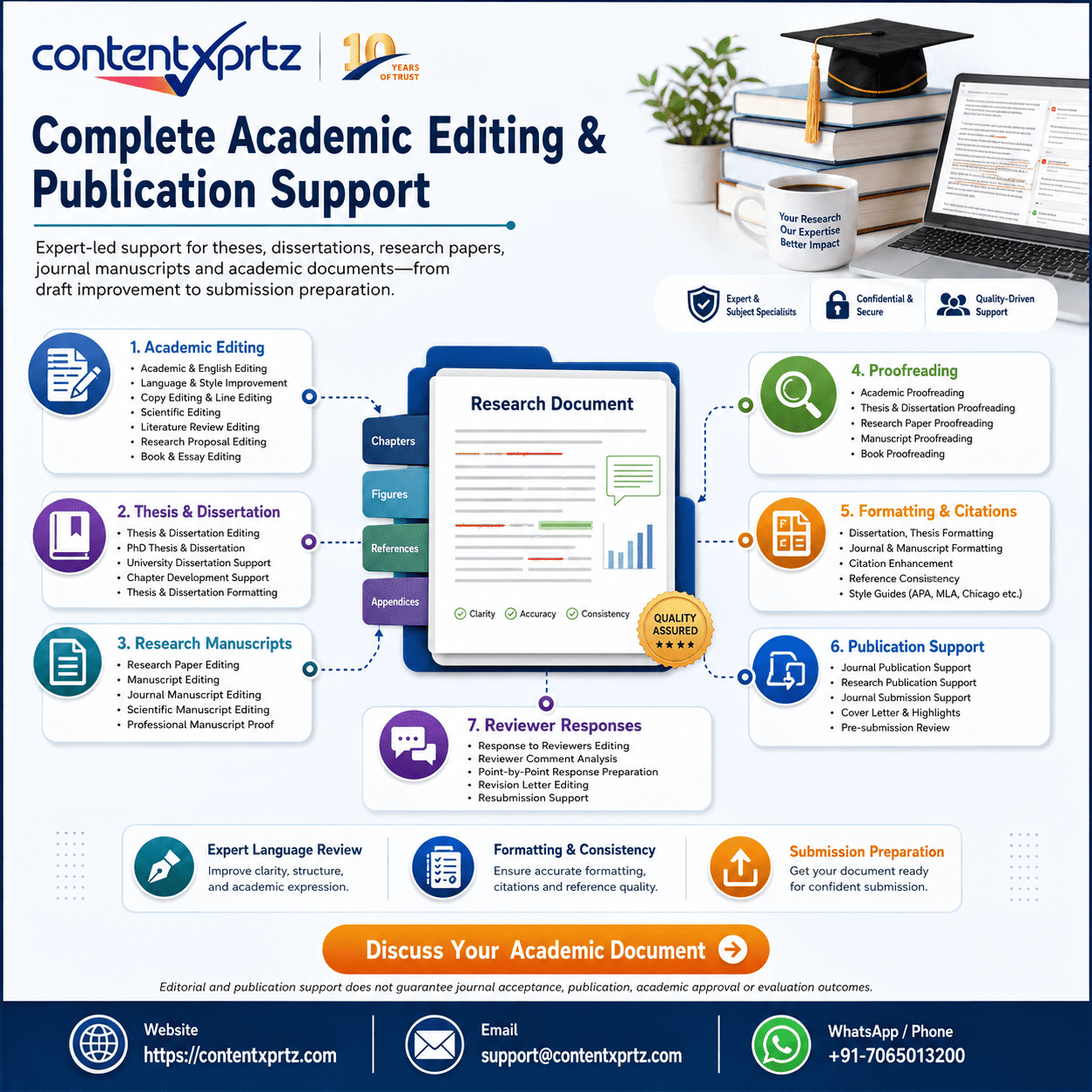
Contentxprtz can support researchers who want an independent publication-readiness review before submission. Relevant services may include academic editing, manuscript editing, proofreading, journal-format review, reference and citation checks, cover-letter editing, reviewer-response editing, and a structured assessment of whether the manuscript clearly communicates its novelty, methods, evidence and limitations.
For interdisciplinary Science Advances submissions, editorial support can be especially useful when the manuscript is technically sound but difficult for readers outside the immediate specialty to follow. Editing can help improve title and abstract clarity, strengthen logical transitions, reduce unnecessary jargon, and ensure the discussion separates demonstrated findings from interpretation.
Prepare your manuscript for journal submission
Get ethical publication-readiness support for clarity, structure, formatting and journal alignment. Editorial decisions always remain with the journal.
Final Journal-Selection Summary
Science Advances is a prominent AAAS open-access multidisciplinary journal with confirmed online ISSN 2375-2548 and supplied Scopus Source ID 21100457028. Authoritative indexing records associate the journal with Scopus, Web of Science, PubMed/MEDLINE and DOAJ. Its broad scope makes it relevant to many research fields, but the breadth should not be confused with low selectivity: manuscript significance, evidence, novelty and communication remain central fit questions.
Before submission, verify the live Scopus and JCR metrics, current APC and waiver rules, current author instructions, and the latest editorial policies. Then compare your manuscript with recent Science Advances articles in your field. This combination of verified journal facts and manuscript-specific fit assessment is more reliable than choosing a journal solely because of a metric or database label.
Science Advances FAQs
What is Science Advances?
Science Advances is an online, open-access, multidisciplinary scholarly journal published by the American Association for the Advancement of Science (AAAS). It launched in 2015 and publishes significant research and reviews across scientific and engineering disciplines, including disciplinary and interdisciplinary work.
Who publishes Science Advances?
Science Advances is published by the American Association for the Advancement of Science (AAAS), the nonprofit scientific organization that also publishes Science and other Science-family journals.
Is Science Advances indexed in Scopus?
Yes. The supplied Scopus Source Record ID is 21100457028, and the confirmed ISSN record for Science Advances lists Scopus among its indexing services. Authors should still check the current Scopus source profile before relying on indexing for a university, funder, or promotion requirement.
What is the Scopus Source ID for Science Advances?
The supplied Scopus Source Record ID is 21100457028. The corresponding source profile is https://www.scopus.com/sourceid/21100457028.
What is the ISSN of Science Advances?
The confirmed online ISSN and ISSN-L for Science Advances are 2375-2548. The source is an online periodical that began publication in 2015.
Is Science Advances open access?
Yes. Science Advances is an open-access journal. Its research is intended to be freely available to readers, and publication charges apply to accepted manuscripts under the journal’s current open-access pricing and licensing arrangements.
What is the Science Advances APC?
A current fee should be confirmed on the official Science Advances author-information page before submission. The DOAJ journal record, updated 30 January 2025, lists publication fees up to USD 5,450 and notes that a waiver policy exists. Fees and waiver rules can change.
What subjects does Science Advances cover?
Science Advances is multidisciplinary. Its coverage spans physical sciences, life sciences, earth and environmental sciences, materials science, engineering and applied science, computational and mathematical work, and other areas of science, including cross-disciplinary research.
What article types does Science Advances publish?
AAAS describes Science Advances as publishing impactful research papers and reviews. Authors should confirm the current list of manuscript categories and category-specific requirements on the official information-for-authors page before preparing a submission.
What peer-review model does Science Advances use?
AAAS describes the journal’s mission as providing fair, fast, expert peer review, while DOAJ records the journal as using anonymous peer review. Exact editorial routing and reviewer-anonymity details should be checked in the current official author guidelines.
What is the current Science Advances CiteScore or quartile?
Journal metrics change by reporting year and database. This guide does not reproduce an unverified current CiteScore, SJR, SNIP or Scopus quartile. Researchers should open the current Scopus source profile and, where relevant, the latest Journal Citation Reports record before using a metric in formal decision-making.
Does Science Advances have an Impact Factor?
Science Advances is listed in Web of Science according to the confirmed ISSN record. The exact current Journal Impact Factor should be verified in the latest Journal Citation Reports because annual values and category rankings change.
How can I tell whether my paper fits Science Advances?
Start with the journal’s multidisciplinary mission, then compare your manuscript with recent Science Advances papers in the same or adjacent field. A strong fit generally requires a clear scientific advance, rigorous evidence, significance to an active research community, and a presentation that explains why the advance matters beyond a narrow technical result.
Is Science Advances suitable for PhD researchers?
A PhD scholar may consider Science Advances when the work is mature, original, methodologically rigorous and sufficiently significant for the journal’s scope. Student status itself does not determine fit. The manuscript, evidence, contribution, authorship and compliance with journal policies are what matter.
Can Contentxprtz guarantee publication in Science Advances?
No. Contentxprtz can support ethical manuscript preparation, editing, proofreading, formatting, journal-fit review, cover-letter refinement and reviewer-response editing, but editorial decisions belong entirely to Science Advances and its peer-review process. No editing or publication-support service can guarantee acceptance.