Sadhana Journal: Scope, Submission, Indexing and Author Guide
Sadhana journal—styled Sādhanā by the publisher—is a multidisciplinary, peer-reviewed engineering journal published by the Indian Academy of Sciences and hosted by Springer Nature. For an author, the useful question is not simply whether the journal is “good” or “indexed.” The practical question is whether your engineering study fits its scope, has a contribution that matters to its readership, and can be presented with enough technical clarity for editors and reviewers to evaluate it efficiently.
The official Springer Nature page describes Sādhanā as covering major branches of engineering science and highlights computer and data sciences, electrical sciences, mechanical sciences, multidisciplinary relevance, critical reviews, and technical summaries of important projects. It currently lists a hybrid publishing model, a 2025 Journal Impact Factor of 1.6, a median submission-to-first-decision time of 57 days, and indexing that includes SCOPUS and Science Citation Index Expanded. Those details are time-sensitive, so authors should recheck the journal page before using them in institutional paperwork or a journal-selection decision.
This guide focuses on the decisions researchers usually face before submission: understanding the journal’s scope, checking indexing and metrics responsibly, preparing a technically coherent manuscript, avoiding common submission mistakes, responding to peer review, and deciding when manuscript editing or publication support is useful. It does not promise acceptance. Publication ultimately depends on research quality, fit, novelty, evidence, ethics, reviewer assessment, and editorial judgment.
Quick Answer: What Should Authors Know About Sadhana Journal?
Sādhanā is a peer-reviewed multidisciplinary engineering journal published by the Indian Academy of Sciences. It is currently hosted on Springer Nature, uses a hybrid publishing model, and states that it welcomes engineering work with technical quality and breadth of interest. Its scope spans multiple engineering branches rather than a single narrow specialty.
If you are considering submission, start by reading the official Sādhanā aims and scope. Then compare your paper’s problem, method, validation, and contribution with recent articles in your subject area. Only after scope fit is clear should you invest time in detailed formatting and submission preparation.
The most important caution is that journal metrics, indexing lists, processing times, and publishing charges can change. Use the current Springer Nature journal page as the primary checkpoint rather than relying on old screenshots, forum posts, or third-party journal directories.
Key Takeaways
- Sādhanā is a multidisciplinary engineering journal published by the Indian Academy of Sciences and hosted by Springer Nature.
- Scope fit should be checked before formatting: the journal emphasizes engineering quality, breadth of professional interest, technical project work, and critical reviews.
- The official journal page currently lists SCOPUS and Science Citation Index Expanded among its indexing services.
- Current metrics shown by Springer Nature include a 2025 Journal Impact Factor of 1.6 and a median 57 days from submission to first decision.
- A strong manuscript needs a clear engineering contribution, reproducible methods, appropriate validation, readable figures, and accurate references.
- Editing can improve clarity and compliance, but no legitimate service can guarantee publication or peer-review success.
- Always verify the latest author instructions, fees, ethics policies, and submission route immediately before submission.
What This Page Covers
- What Sādhanā is and what engineering research it aims to publish
- How to verify indexing, metrics, publishing model, and decision-time information
- A practical pre-submission fit test for engineering authors
- How to structure and polish a manuscript before uploading it
- Common reasons technically sound papers become difficult to review
- How to prepare for peer review and revise after reviewer comments
- When ethical manuscript editing and journal publication support may help
Table of Contents
Methodology and Academic Sources
This article is based primarily on the current Sādhanā pages on Springer Nature, including the journal overview, aims and scope, and submission-guideline area. The publisher page is treated as the source of truth for live journal facts such as publishing model, metrics, indexing display, editor information, submission links, and journal notices. For publication ethics, authors should also consult the journal’s own ethics pages and the Committee on Publication Ethics guidance where relevant.
Journal information changes over time. A metric can be updated, an indexing service can change coverage, an editor can change, and submission requirements can be revised. For that reason, this guide explains a verification workflow rather than treating any single statistic as permanent. Contentxprtz can provide ethical publication support and manuscript assessment, while the authors remain responsible for the research, claims, data, citations, disclosures, and final submission.
What Is Sadhana Journal and What Does It Cover?
Sādhanā is best understood as a broad engineering journal rather than a journal for one narrow technology. Springer Nature describes it as a peer-reviewed, multidisciplinary journal covering major branches of engineering science. The publisher specifically highlights computer and data sciences, electrical sciences, and mechanical sciences on the overview page, while the fuller aims and scope discusses engineering topics such as mechanics, computer science, electronics, energy, aerospace technology, materials science, nuclear engineering, systems analysis, and alternative technologies.
The journal’s stated editorial interest matters. It encourages work likely to interest more than one professional group, technically substantial accounts of special projects, and extensive critical reviews. That means a paper can be technically sophisticated yet still be a weak fit if it is so narrow that its contribution is difficult to place within the journal’s broader engineering readership.
Scope fit is more than matching keywords
Authors sometimes search a journal page for a single term—“machine learning,” “thermal,” “power,” “materials,” or “civil”—and assume that one matching word proves suitability. A better fit assessment asks four questions: What engineering problem is being solved? What is technically new? What evidence demonstrates improvement or insight? Why would a reader outside one micro-specialty care?
For example, a new optimization algorithm is not automatically a Sādhanā paper because it uses engineering data. The manuscript should explain the engineering context, justify the method, compare it with appropriate baselines, report performance honestly, and discuss limitations. Likewise, an experimental mechanical paper should do more than report measurements; it should clarify the engineering inference and its relevance.
Use recent articles as a reality check
After reading the formal scope, browse recent articles from the journal page. Look for similarities in problem scale, methodological depth, reporting style, validation, and interdisciplinary relevance. Do not copy structures mechanically. Instead, use recent papers to understand the level of technical explanation and evidence the journal’s readers are accustomed to seeing.
Is Sadhana Journal Indexed, and How Should You Read Its Metrics?
Yes, the current Springer Nature journal page lists Sādhanā as abstracted and indexed in services that include SCOPUS and Science Citation Index Expanded, along with several engineering and scholarly discovery databases. That is useful for authors whose institutions require specific indexing coverage, but the correct practice is to verify the title directly before submission when the requirement is high stakes.
| Item | Current publisher display | How an author should use it |
|---|---|---|
| Publisher relationship | Published by the Indian Academy of Sciences; hosted on Springer Nature | Use the official journal page for authoritative submission and policy links. |
| Publishing model | Hybrid | Check the current open-access, fees, funding, and licence options before budgeting. |
| Journal Impact Factor | 1.6 (2025) | Always state the metric year; do not present it as timeless. |
| 5-year Journal Impact Factor | 1.5 (2025) | Use only when your institution asks for this specific metric. |
| Submission to first decision | 57 days median | Treat as a historical median, not a guaranteed review time. |
| Selected indexing | SCOPUS; Science Citation Index Expanded; EI Compendex; INSPEC and others | Recheck the official database if eligibility depends on indexing. |
| Electronic ISSN | 0973-7677 | Use identifiers to distinguish the journal from similarly named publications. |
Metrics are filters, not verdicts. A journal impact factor says nothing by itself about whether your particular study fits the journal, whether reviewers will consider the method rigorous, or whether your institution accepts that journal for a specific purpose. For journal selection, combine scope, audience, indexing needs, publication model, recent article quality, editorial policies, and realistic timing.
Why third-party metric pages can mislead
Third-party journal sites may display outdated metrics, different database years, user-reported review times, estimated fees, or simplified quartile labels. Those pages can be useful for discovery, but they should not override the journal publisher or the original indexing database. If a promotion committee needs “current Scopus indexing,” verify it in Scopus. If it needs a Journal Impact Factor, use the relevant Clarivate source or the current publisher display with the year attached.
A Five-Part Fit Test Before You Prepare a Sadhana Submission
A fast scope check can save days of unnecessary formatting. Before adapting your paper to the journal, score the manuscript against five practical dimensions.
- Engineering relevance: The central question should solve, explain, model, evaluate, or review an engineering problem rather than use engineering language around a mostly unrelated study.
- Contribution: State in one or two sentences what changes because this work exists. Novelty may be a method, model, design, dataset application, experimental result, systems insight, or rigorous review—not simply a new combination of familiar terms.
- Evidence: The validation should match the claim. Simulation papers need appropriate baselines and assumptions; experiments need controls and uncertainty treatment where relevant; data-driven studies need transparent evaluation and leakage prevention.
- Reader breadth: Explain why the work matters beyond a tiny implementation detail. Sādhanā’s stated emphasis on broad professional interest makes this especially important.
- Presentation quality: The manuscript should be understandable without reviewers reconstructing missing logic from figures, code, supplementary files, or prior papers.
If two or more of these areas are weak, formatting is not the next task. The manuscript needs scientific or editorial development first. A structured academic editing service can help improve argument flow and technical readability, but it should not invent results, alter scientific claims without author approval, or hide limitations.
How to Prepare a Manuscript for Sadhana Journal
Manuscript preparation should move from scientific logic to presentation details, not the other way around. Authors often spend hours changing fonts and reference punctuation while the abstract, methods, or validation still leaves obvious questions. A more efficient sequence is contribution, evidence, structure, language, figures, references, and only then final journal formatting.
Title and abstract
The title should identify the engineering problem and, when useful, the method or system without overstating novelty. The abstract should allow an editor to answer four questions quickly: What problem was addressed? What was done? What was found? Why does the result matter? Avoid promotional adjectives such as “revolutionary,” “unprecedented,” or “perfect” unless the evidence and field usage genuinely justify them.
Introduction and literature positioning
The introduction should lead to a precise research gap rather than become a long catalogue of papers. Organize prior work by problem, approach, limitation, or engineering trade-off. Explain what previous studies cannot yet resolve and how the present work addresses that limitation. If the gap is only “few studies exist,” the rationale is often too weak; scarcity alone does not prove importance.
Methods and reproducibility
Readers need enough detail to understand how the results were generated. Define data sources, apparatus, models, boundary conditions, parameters, software where relevant, training and test procedures, inclusion criteria, uncertainty methods, or statistical analyses. If a method is standard, cite it accurately and state any adaptation. If code or data cannot be shared, explain the limitation transparently rather than implying full reproducibility.
Results and validation
Results should be organized around the research questions, not around the order in which experiments were performed. Use figures and tables for patterns, comparisons, and quantitative evidence. Compare against meaningful baselines. Report negative or mixed findings when they matter. For machine-learning and optimization studies, reviewers may look closely at dataset splits, tuning fairness, benchmark choice, ablation logic, robustness, and whether reported improvements are practically meaningful rather than merely numerically higher.
Discussion and limitations
A discussion explains what the results mean, how they compare with prior work, and where the method may fail. Limitations are not a sign of weak research; hiding them is. Clear boundaries help reviewers understand the contribution honestly and help future researchers build on it.
Figures, tables, equations, and units
Engineering manuscripts are often judged visually before they are read line by line. Make axis labels legible, define symbols, keep units consistent, avoid screenshots when vector or high-resolution artwork is possible, and ensure captions can be understood without searching through several paragraphs. Check that equations use consistent notation from first definition to final conclusion.
References and citation integrity
Every citation should support the sentence in which it appears. Verify author names, year, title, journal, volume, pages or article number, and DOI where available. Avoid citing papers you have not read merely because another paper cited them. Reference software can reduce formatting work, but imported metadata still needs human checking. If citation consistency is a recurring issue, professional proofreading support can help identify mismatches without replacing author responsibility.
Step-by-Step Sadhana Journal Submission Workflow
The exact interface can change, but the decision sequence remains stable. Use the official Sādhanā submission guidelines immediately before uploading files.
- Confirm scope: Re-read the aims and scope after the manuscript is complete, because a paper can drift away from the original target during revisions.
- Choose the correct article type: Use the current author instructions rather than assuming categories from another Springer journal are identical.
- Check authorship: Confirm author order, corresponding author, affiliations, contributions, and approval from all authors before submission.
- Prepare required files: Main manuscript, figures, tables, supplementary material, declarations, and any required cover information should use the current journal instructions.
- Prepare metadata: Enter the title, abstract, keywords, author details, affiliations, funding, conflicts, and other declarations consistently with the manuscript.
- Run a final technical check: Open every uploaded file, inspect figure quality, verify equations and symbols, and ensure no tracked changes or internal comments remain unless explicitly requested.
- Submit through the official system: Follow the journal page’s current submission link rather than a bookmarked third-party URL.
- Save confirmation: Retain the manuscript ID, submitted files, cover letter, and exact submitted version for future correspondence.
Simultaneous submission to multiple journals is not an acceptable shortcut. The COPE guidance library is a useful reference for broader publication-ethics questions, while the journal’s own policies control the specific submission.
What to Expect from Peer Review and Revision
Peer review is a technical conversation about the manuscript, not a simple proofreading stage. Reviewers may question novelty, assumptions, comparisons, experimental design, numerical stability, statistical analysis, interpretation, reproducibility, figure clarity, reference coverage, or the practical significance of results.
How to write a strong response to reviewers
Respond point by point. Quote or summarize each comment clearly, state what you changed, identify where the change appears, and explain respectfully when you do not make a requested change. Avoid defensive language. If a reviewer exposes a real weakness, fix the manuscript itself rather than only defending the original sentence in the response letter.
For complex revision rounds, an editor can help ensure that the revised paper and response letter stay aligned. Contentxprtz provides editing support for clarity and consistency, but authors should make all scientific decisions and verify every technical response.
When a reviewer seems wrong
First ask whether the manuscript caused the misunderstanding. A reviewer’s incorrect interpretation may still reveal that a definition, figure, method, or conclusion is unclear. If the reviewer truly asks for something inappropriate or impossible, explain why with evidence and propose a reasonable alternative. Editors generally respond better to a concise technical rationale than to claims that a reviewer “does not understand the field.”
Common Mistakes That Weaken a Sadhana Journal Submission
- Choosing the journal from a metric alone: A paper outside scope remains outside scope regardless of impact factor or indexing.
- Calling incremental parameter tuning “novel”: Novelty should be tied to a meaningful engineering contribution.
- Weak comparison design: New methods need relevant baselines, comparable conditions, and transparent evaluation.
- Overclaiming from limited evidence: Conclusions should match the experiment, dataset, model assumptions, and uncertainty.
- Unclear figures: Small labels, low resolution, unexplained acronyms, or inconsistent units create avoidable reviewer friction.
- Literature dumping: A long introduction is not strong if it does not synthesize what is known and identify a defensible gap.
- Reference errors: Incorrect metadata and citations that do not support the text reduce trust.
- Ignoring current author instructions: Requirements can change; an old template may no longer match the journal.
- Submitting before all authors approve: Authorship and submission approval should be resolved before the upload.
- Assuming editing guarantees acceptance: Language quality helps reviewers understand the work but cannot replace scientific quality or fit.
Practical Examples: Is Sadhana a Reasonable Target?
Example 1: A machine-learning paper with strong engineering validation
A researcher proposes a fault-diagnosis model for rotating machinery and compares it against accepted baselines across multiple operating conditions. The paper reports data splits, robustness tests, failure cases, and practical implications. This is a stronger candidate than a paper that simply reports higher accuracy on one small dataset, because the engineering validation supports the claimed contribution.
Example 2: A thermal experiment with unclear contribution
A PhD scholar measures heat-transfer behavior in a modified geometry but the introduction does not explain why the modification matters and the discussion mostly repeats numerical values. Before submission, the scholar should strengthen the research gap, uncertainty treatment, comparison with prior designs, and engineering interpretation. Language polishing alone would not fix the scientific positioning.
Example 3: A review paper that is only a list of studies
The official scope welcomes critical reviews, but a review needs synthesis. A manuscript that summarizes one paper per paragraph without a search rationale, taxonomy, comparison framework, or critical insight is unlikely to exploit the value of the review format. The author should organize evidence around engineering questions and unresolved trade-offs.
Example 4: A technically sound paper with difficult English
An ESL researcher has solid experiments and valid comparisons, but long sentences and inconsistent terminology obscure the logic. In this case, ethical academic editing can be genuinely useful because the research decisions already exist; the task is to communicate them accurately and consistently.
Final Sadhana Journal Pre-Submission Checklist
- I have read the current Sādhanā aims and scope.
- I can state the engineering problem and contribution in two sentences.
- The manuscript explains why the work matters to the journal’s readership.
- Methods, assumptions, datasets, apparatus, parameters, and validation are sufficiently clear.
- Claims in the abstract and conclusion do not exceed the evidence.
- Figures, tables, symbols, equations, units, and captions are consistent and legible.
- References have been checked against original sources.
- All authors have approved authorship order and the submitted version.
- Required funding, conflict-of-interest, ethics, data, and other declarations are complete where applicable.
- I checked the current submission guidelines rather than relying on an old template.
- I verified any indexing or metric requirement directly from an authoritative source.
- I saved a clean copy of every file that will be submitted.
Summary: Sadhana Journal Submission Readiness
Sādhanā can be a relevant target for multidisciplinary engineering research when the manuscript fits its scope, makes a defensible technical contribution, and communicates the evidence clearly. The journal’s current Springer Nature page lists a hybrid publishing model, SCOPUS and Science Citation Index Expanded among its indexing services, a 2025 Journal Impact Factor of 1.6, and a 57-day median to first decision. These are useful current facts, not permanent guarantees.
For authors, the highest-value work happens before clicking Submit: test the scope fit, strengthen the research gap, make methods reproducible, validate claims appropriately, refine figures and references, and check the latest author instructions. If the research is sound but the manuscript is difficult to follow, professional editing can improve presentation while preserving the author’s scientific ownership.
Frequently Asked Questions About Sadhana Journal
What is Sadhana journal?
Sādhanā is a peer-reviewed multidisciplinary engineering journal published by the Indian Academy of Sciences and hosted on Springer Nature. Its official journal overview says it covers major branches of engineering science, including computer and data sciences, electrical sciences, mechanical sciences, and other engineering areas. Authors should compare their manuscript’s central contribution with the current aims and scope before preparing a submission.
Is Sadhana journal indexed in Scopus and Web of Science?
The current Springer Nature journal page lists both SCOPUS and Science Citation Index Expanded among the services in which Sādhanā is abstracted and indexed. Because indexing coverage can change, researchers should verify the journal on the official Springer page and, when a university or funder requires a specific database, confirm the title directly in that database before submission.
What kind of papers does Sadhana journal publish?
The official aims and scope describes broad engineering coverage and emphasizes work that may interest more than one professional group, technically substantial summaries of special projects, and critical reviews, especially on subjects relevant to India. A strong submission therefore needs both technical quality and a clear fit with the journal’s multidisciplinary engineering readership.
How do I submit a manuscript to Sadhana journal?
Start on the official Sādhanā page and follow the Submit your manuscript link to the journal’s current submission system. Before uploading files, read the journal’s submission guidelines, download the current author instructions, check article type and scope, prepare metadata for every author, and verify that figures, tables, references, declarations, and supplementary files meet the journal’s requirements.
Does Sadhana journal charge an article processing charge?
Sādhanā currently uses a hybrid publishing model on Springer Nature. Charges can depend on the publication route, licence, institution, funding arrangement, and choices made after acceptance. Authors should not rely on old forum posts or third-party fee pages; use the journal’s current Fees and funding or Open access publishing information for the amount and conditions that apply to the submission.
What is the current impact factor of Sadhana journal?
Springer Nature currently displays a Journal Impact Factor of 1.6 for 2025 on the Sādhanā journal page. Metrics are time-sensitive and can be updated annually, so cite the year with the number and recheck the official journal page or the relevant Clarivate source if a current metric is required for evaluation, promotion, or funding paperwork.
How long does Sadhana journal take to make a first decision?
The current Springer Nature journal page displays a median submission-to-first-decision time of 57 days. A median is not a promise for an individual manuscript: timing depends on editorial screening, reviewer availability, revisions, subject area, and manuscript complexity. Authors with a deadline should plan conservatively and avoid treating a displayed median as a guaranteed review schedule.
How can I improve my manuscript before submitting to Sadhana?
Begin with scope fit and technical contribution, then check the manuscript at three levels: scientific logic, engineering presentation, and submission compliance. Make the research question and novelty explicit, connect the work to relevant literature, report methods and validation clearly, ensure figures and units are readable, check reference consistency, and revise the abstract and conclusion so they accurately represent the evidence.
Can professional editing guarantee acceptance in Sadhana journal?
No. Editing can improve language, structure, technical readability, formatting consistency, and response clarity, but it cannot guarantee acceptance. Editorial decisions depend on scope, novelty, research quality, methodology, evidence, reviewer assessment, ethics, and journal priorities. Ethical editing should preserve the authors’ scientific meaning and leave research decisions and final approval with the authors.
What should I do if Sadhana rejects my manuscript?
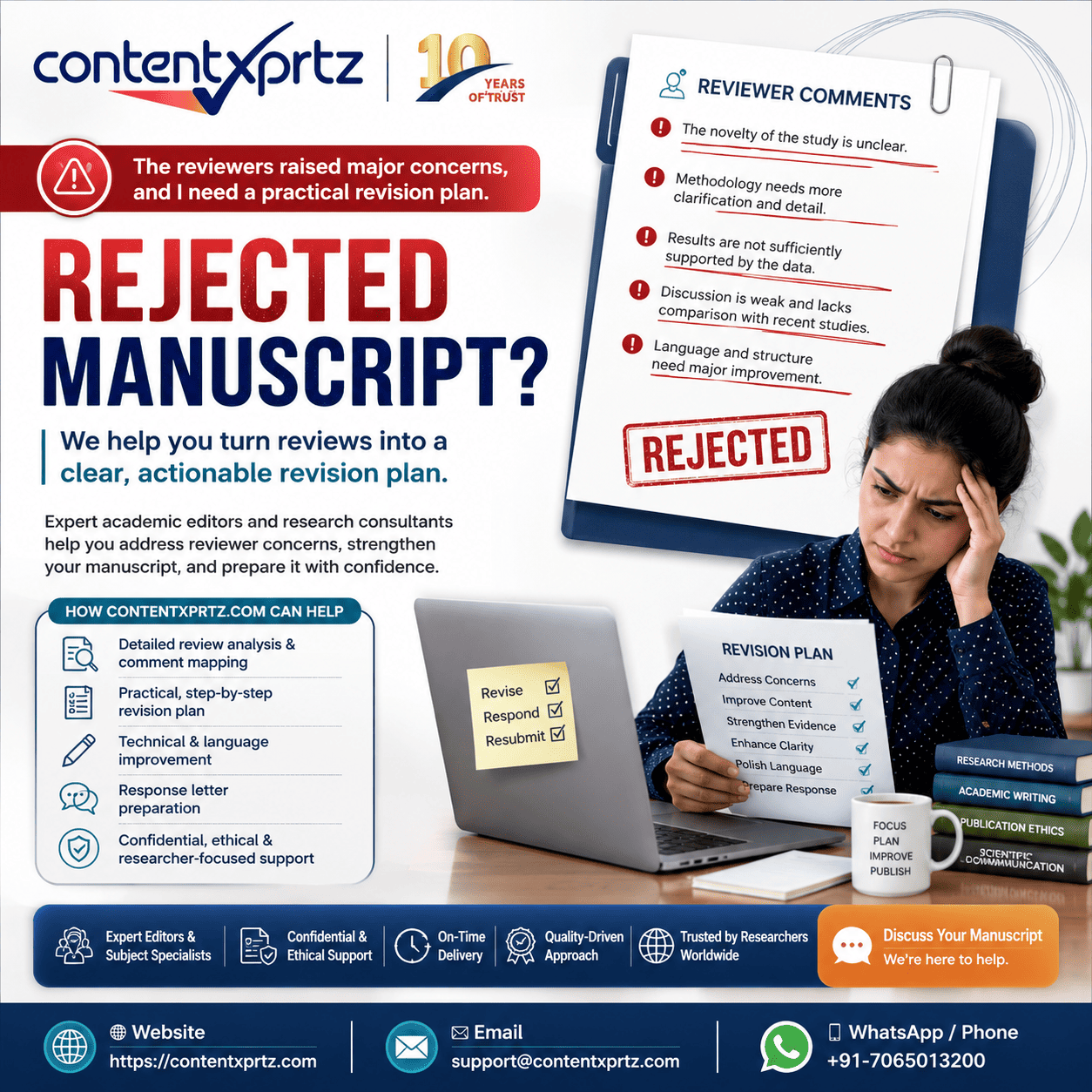
Read the decision letter and reviewer comments carefully, separate fixable presentation issues from substantive scientific concerns, and decide whether an appeal is justified under the journal’s policy or whether another journal is a better fit. Revise the manuscript before resubmitting elsewhere, update the cover letter and formatting for the new target, and never submit the same manuscript to two journals simultaneously.
Prepare Your Manuscript for an Ethical, Well-Organized Submission
If your paper is within Sādhanā’s scope but needs clearer technical writing, stronger manuscript organization, reference consistency, or a structured pre-submission review, Contentxprtz can help with ethical journal preparation. The aim is to make your existing research easier to evaluate—not to manufacture novelty, fabricate citations, or promise an editorial outcome.
Need a publication-readiness review before submission? Explore journal publication support for manuscript preparation, editing, and submission guidance aligned with author responsibility.