NEJM: A Practical Guide for Researchers, Readers, and Authors
NEJM usually refers to The New England Journal of Medicine, one of the best-known peer-reviewed medical journals in the world. For a student, clinician, PhD scholar, medical researcher, or first-time author, however, searching for “NEJM” can mean several different things: finding and reading influential clinical research, understanding whether a study is trustworthy, checking the journal’s article types, learning how to prepare a manuscript, or deciding whether a paper is realistically aligned with the journal’s scope and editorial expectations.
Those tasks require more than copying a citation or formatting a manuscript to resemble a published paper. NEJM states that its mission is to publish research and information at the intersection of biomedical science and clinical practice, and its Author Center describes rigorous editorial, peer, and statistical review. That makes research quality, clinical relevance, methodological transparency, and responsible reporting central. A polished title page cannot rescue a weak study design, and a strong study can still be disadvantaged by unclear reporting, inconsistent terminology, incomplete disclosures, poorly explained statistics, or failure to follow the current instructions for the chosen article type.
Readers face a different challenge. NEJM articles can influence clinical conversations, teaching, systematic reviews, protocols, and future research, but journal prestige should never replace critical appraisal. An abstract can simplify uncertainty. A statistically significant result may still have limited clinical importance. A trial population may not match your patients. A review can be authoritative yet still require interpretation in light of newer evidence, guidelines, local resources, or individual risk. The safest habit is to read the methods, results, tables, supplementary materials, limitations, funding, and disclosures before applying conclusions.
This guide brings those reader and author needs together. It explains what NEJM is, how to navigate its content, how to read research critically, what the journal currently says about major article types and manuscript preparation, how preprints and publication ethics fit into the process, and when ethical academic editing or research paper editing can improve clarity without replacing author responsibility. It is designed as a practical orientation, not as a substitute for the live NEJM Author Center or your institution’s research and ethics requirements.
Quick Answer: What Does NEJM Mean for Researchers?
NEJM is The New England Journal of Medicine. The journal publishes original clinical research and other medical content for physicians, researchers, educators, and the wider medical community. Its official About NEJM page explains its clinical and biomedical mission, while the Author Center provides current instructions for people considering manuscript submission.
If you are reading an NEJM paper, use it as high-value evidence that still requires normal critical appraisal. If you are preparing a submission, begin with study quality and article-type fit, not formatting. Match the manuscript to the correct category, verify current word and figure limits, follow reporting and ethics expectations, and make sure every claim, reference, table, and disclosure is accurate.
For authors, the most important caution is simple: publication readiness is not the same as acceptance likelihood. Editing can make a paper clearer and easier to evaluate, but no ethical editor can guarantee peer review, publication, indexing, or a particular editorial decision.
Key Takeaways
- NEJM is a peer-reviewed medical journal focused on high-quality clinical and biomedical research and clinically useful information.
- Readers should critically appraise NEJM studies rather than using journal reputation as a substitute for methods, results, limitations, and applicability.
- Authors should choose the correct article type before drafting to a target length because NEJM categories have different word, figure, reference, and authorship limits.
- The current Author Center is the source of truth for submission preparation, presubmission inquiries, rapid review requests, statistical reporting, and revised manuscripts.
- NEJM permits certain nonprofit preprints under its stated policies, but authors must disclose related preprints and follow the journal’s no-prior-publication and embargo requirements.
- Medical authors remain responsible for accuracy, data, citations, authorship, disclosures, ethical approval, and the final manuscript, including content prepared with AI assistance.
- Professional editing is most useful when it improves clarity, logic, reporting consistency, and instruction compliance without changing scientific meaning or inventing evidence.
What This Page Covers
- What NEJM is and why researchers search for it.
- How to read NEJM original research, reviews, cases, and commentary critically.
- How common NEJM article types differ and why category selection matters.
- A practical manuscript-preparation and submission-readiness workflow.
- Preprints, authorship, AI use, disclosures, and publication ethics.
- Common mistakes that weaken otherwise serious medical manuscripts.
- Examples, a readiness checklist, FAQs, and ethical editing options.
Table of Contents
Methodology and Academic Sources
This article is based on current public guidance from NEJM and established medical-publishing standards. The main factual references are the journal’s About pages, Author Center, article-type guidance, new-manuscript instructions, and editorial policies, supported by the ICMJE Recommendations for authorship, manuscript preparation, disclosure, and responsible AI use.
Because journal instructions can change, any numerical limit or submission step in this guide should be checked again on the live journal website immediately before submission. University, hospital, funder, ethics committee, trial registry, and reporting-guideline requirements may also apply independently of journal instructions. Contentxprtz can assist with ethical editing and manuscript presentation, but the research team remains responsible for scientific decisions and compliance.
What Is NEJM in an Academic and Clinical Context?
NEJM is the abbreviated name of The New England Journal of Medicine, a publication of NEJM Group owned and published by the Massachusetts Medical Society. The journal traces continuous publication to 1812 and describes its mission as publishing important research and information where biomedical science meets clinical practice. For researchers, that means the journal is not simply a place to deposit technically correct studies; it prioritises work that can advance medical understanding or patient care.
The journal publishes several content families. Original research reports new findings. Review articles interpret existing evidence. Clinical cases and problem-solving formats focus on diagnostic or management reasoning. Editorials and Perspectives analyse current evidence, policy, practice, and medical issues. Letters allow concise scholarly discussion. Visual formats highlight clinically meaningful images or procedures. Each serves a different communication purpose and therefore carries different expectations for structure, length, evidence, and authorship.
The journal’s own description also helps readers understand what NEJM is not. It is not a comprehensive database of all medicine, not a substitute for clinical guidelines, and not a guarantee that every published finding will apply to every setting. A major randomised trial may change practice; another study may be important mainly for a specific subgroup, disease stage, health system, or research question. Review articles can orient a clinician quickly but should not automatically replace specialist guidelines or systematic evidence synthesis.
| NEJM content | Primary purpose | Reader question | Author challenge |
|---|---|---|---|
| Original Article | Report original clinical research | Are the methods and results valid and clinically meaningful? | Concise, transparent reporting of a complete study |
| Review | Synthesise evidence and clinical understanding | How should I understand or manage this topic? | Balanced selection, interpretation, and up-to-date sourcing |
| Brief Report / Clinical Case | Communicate focused observations or reasoning | What does this case teach? | Clinical relevance without overgeneralising |
| Perspective / Editorial | Interpret evidence, policy, or current issues | What does this development mean? | Clear argument with proportionate evidence |
| Letter to the Editor | Comment on published work or a focused issue | What clarification or critique is being raised? | Precision, relevance, and strict length discipline |
This distinction matters because “writing for NEJM” does not describe one universal format. The first practical step is to define what contribution your manuscript actually makes and then match that contribution to a current article category.
Why Do Students, Clinicians, and Researchers Search for NEJM?
Most NEJM searches fall into four intentions: learning, evidence evaluation, citation, or publication preparation. A medical student may want to understand a landmark trial discussed in class. A clinician may be checking whether new evidence affects practice. A PhD scholar may be mapping influential clinical studies for a literature review. A research group may be studying journal requirements before deciding whether to submit.
For learning and literature reviews
NEJM can be an efficient starting point for highly visible clinical research and evidence-based reviews, particularly when a learner already knows the disease, intervention, trial name, author, or topic. However, a rigorous literature review should not be built from one journal alone. Search strategies should include databases and sources appropriate to the review question, and the selection process should be documented when reproducibility matters.
For critical evidence appraisal
High-impact publication can increase attention, but it does not remove the need to ask ordinary research questions: Was the design suitable? Was allocation concealed? Were outcomes prespecified? How much missing data occurred? Are confidence intervals compatible with clinically important benefit or harm? Did the analysis follow the protocol? Are subgroup claims credible? Is the observed effect transferable to the population you care about?
For manuscript targeting
Authors often look at NEJM because they believe their study is important, but journal fit is narrower than “good medical research.” The NEJM Author Center says the journal seeks work that advances medical science and improves patient care, and it evaluates originality, quality, and results. A technically sound study may therefore be better suited to a specialty journal if its question, audience, or likely clinical influence is narrower.
For writing models
Published NEJM articles are useful examples of concise scientific communication, but authors should not copy sentence structures or imitate a published paper so closely that their own study logic becomes distorted. Use published articles to learn conventions—such as economy of language, clear tables, disciplined discussion, and transparent limitations—while following the current instructions for your own article type.
How to Read an NEJM Research Article Critically
Read the paper as an argument supported by methods and data, not as an abstract with prestige attached. A structured reading sequence makes it easier to separate the authors’ interpretation from what the study actually demonstrates.
Step 1: Define the research question
Before looking at the conclusion, state the question in your own words. For an intervention trial, identify the population, intervention, comparator, outcomes, and timing. For an observational study, identify the exposure, outcome, design, and major confounders. If you cannot express the question clearly, you will struggle to judge whether the analysis answers it.
Step 2: Identify the design and evidence limits
Randomised trials, cohort studies, case-control studies, diagnostic studies, modelling studies, and secondary analyses answer different questions and have different vulnerability to bias. Do not use causal language simply because an association is statistically strong. Check whether the design can support the claim being made.
Step 3: Read eligibility and setting carefully
Clinical applicability depends on who was actually studied. Age, disease severity, prior treatment, comorbidity, geography, care setting, baseline risk, and exclusion criteria can all change how useful the result is for a different patient or health system. “Practice changing” in one context may be impractical or uncertain in another.
Step 4: Focus on effect sizes, not just p-values
Ask how large the difference is and how precisely it is estimated. Relative risk reductions can sound more dramatic than absolute differences. Confidence intervals reveal uncertainty. Composite outcomes deserve component-level review. For safety outcomes, consider whether the study was large or long enough to detect uncommon harms.
Step 5: Compare the paper with its protocol and supplements when relevant
Supplementary appendices often contain statistical details, subgroup definitions, sensitivity analyses, extended tables, protocol information, and other material that cannot fit in the main article. For a thesis or systematic review, relying only on the abstract and main figures may omit information that changes interpretation.
Step 6: Separate results from discussion
The results section tells you what the study observed; the discussion tells you how the authors interpret those observations. Strong academic reading preserves that distinction. Note where conclusions are directly supported, where extrapolation begins, and what limitations the authors acknowledge.
Step 7: Check funding and disclosures
Funding does not automatically invalidate research, and absence of commercial funding does not guarantee neutrality. The correct approach is transparent appraisal: understand who funded the work, what roles sponsors had, what authors disclosed, and whether study design or reporting raises concerns.
Step 8: Place one article inside the wider evidence base
Even a large trial is one piece of evidence. Compare it with previous studies, systematic reviews, clinical guidelines, biological plausibility, implementation constraints, and subsequent critiques. A dissertation or review should explain agreement and disagreement across sources rather than treating one famous paper as definitive.
NEJM Article Types: Choose the Format Before You Edit
NEJM article categories have different purposes and limits, so article-type selection should happen before detailed formatting. The journal’s current Article Types page lists the requirements for original research, clinical cases, reviews, commentary, visual articles, and other formats.
For example, the current guidance lists a 2,700-word maximum for an Original Article, with an abstract, up to five tables and figures, and up to 40 references. A Brief Report is substantially shorter. Clinical Practice Reviews and other reviews have different author and reference expectations. Perspectives and editorials are shorter still. These limits can change, so do not freeze them into an old internal template without rechecking the live page.
| Decision | Question to ask | Why it matters |
|---|---|---|
| Contribution | Are you reporting original research, a case, a review, or commentary? | Determines the correct article family. |
| Audience | Does the work have broad clinical relevance or mainly specialty relevance? | Helps assess journal fit and framing. |
| Evidence maturity | Are the primary analyses complete and defensible? | Prevents writing around incomplete evidence. |
| Length | Can the study be reported transparently within the current limit? | Forces prioritisation and clear supplementary material planning. |
| Visuals | Which tables and figures are essential to understand the result? | Reduces decorative or duplicative material. |
| References | Are citations selective, current, accurate, and traceable? | Supports context without overloading the manuscript. |
If the work does not fit cleanly, a presubmission inquiry may save time. NEJM indicates that presubmission inquiries can help authors assess suitability and are strongly recommended for certain unsolicited review proposals. Treat a positive response as permission to proceed with submission—not as a promise of review or acceptance.
How to Prepare a Manuscript for NEJM Submission
Prepare the manuscript by aligning scientific reporting, article-type requirements, and submission materials in that order. The journal’s New Manuscripts guidance recommends reviewing editorial policies, article types, statistical reporting guidance, and journal style elements before assembling submission materials.
1. Freeze the scientific story before polishing sentences
Confirm the primary question, prespecified outcomes, final sample, analysis set, effect estimates, uncertainty, and key limitations. If authors disagree about what the study shows, language editing is premature. Resolve scientific interpretation first.
2. Build the manuscript around evidence, not around a generic template
The introduction should establish the problem and gap without becoming a mini-review. Methods should make the study reproducible enough for expert assessment. Results should report findings without argumentative spin. Discussion should interpret results, compare them with evidence, describe limitations, and avoid claims that exceed the design.
3. Make tables and figures carry information efficiently
Tables should answer specific questions. Figures should reveal patterns that are difficult to see in prose. Avoid repeating the same data in the text, table, and figure. Verify denominators, units, confidence intervals, labels, footnotes, abbreviations, and consistency with the statistical output.
4. Check reporting guidance relevant to the study design
Journal instructions and reporting guidelines serve different functions. A randomised trial may need CONSORT-related reporting; an observational study may use STROBE; a systematic review may use PRISMA; diagnostic and prediction studies have other frameworks. Follow the guideline appropriate to the study and any NEJM-specific requirements.
5. Audit every reference
Reference errors undermine trust quickly. Confirm that each citation supports the sentence attached to it, author and title metadata are correct, retracted or superseded work is handled appropriately, and the cited version is the one actually read. Do not rely on AI-generated bibliographies or unchecked reference-manager imports.
6. Prepare submission materials consistently
The current new-manuscript guidance identifies a title page with the manuscript title, author names, degrees and affiliations, and corresponding-author information, alongside the main manuscript and supporting materials. Clinical research may also require protocols, statistical analysis plans, trial registration details, ethics statements, and other documentation. Keep names, sample sizes, dates, trial identifiers, and terminology consistent across files.
7. Use professional editing only after content is stable
A service such as Contentxprtz research paper editing can help reduce ambiguity, remove repetition, improve sentence logic, standardise terminology, and check presentation against stated instructions. For ESL authors, this can be especially useful when the science is sound but the English obscures relationships between methods, results, and interpretation. Ethical editing does not add unverified claims, fabricate citations, invent analyses, or conceal authorship.
Editorial Policies, Preprints, Authorship, Ethics, and AI
Publication policy is part of manuscript preparation, not an administrative step to leave until upload day. NEJM’s current Editorial Policies address prior publication, preprints, confidentiality, rapid review, and related matters that can affect whether a manuscript is eligible for consideration.
Preprints and prior dissemination
NEJM states that posting a manuscript on a nonprofit preprint server does not by itself violate its no-prior-publication policy, but authors should notify the journal about a related preprint. That distinction is important. A preprint can support rapid scholarly communication, yet other forms of public release may interact differently with journal policy and embargo requirements. Research teams should decide their dissemination plan before media announcements, sponsor communications, conference releases, or public posting.
Authorship
Authorship is an accountability role, not a reward. The NEJM article-type guidance points authors to ICMJE authorship criteria. Teams should discuss contributions early, document them, and ensure every listed author is able to take responsibility for the work at the level required. Contributors who do not meet authorship criteria should be acknowledged appropriately rather than added for status.
AI-assisted writing
Generative AI can help with language brainstorming or editing, but it introduces risks involving accuracy, fabricated references, undisclosed reuse, confidentiality, and loss of author oversight. ICMJE guidance says AI tools should not be listed as authors and that humans remain responsible for AI-assisted material. Authors should disclose use when required, check every factual statement and reference, and avoid uploading confidential unpublished manuscripts, patient information, or peer-review material into systems where confidentiality is not assured.
Research integrity and disclosure
Editing must preserve the record of what was actually done. Never “improve” methods by rewriting them to sound stronger than the protocol, remove inconvenient limitations, or change numerical results to match a preferred narrative. Confirm conflicts of interest, funding roles, ethics approvals, consent where applicable, trial registration, data availability, and other required statements. If there is uncertainty, resolve it with the responsible investigator, institution, or journal—not with guesswork.
Free, Low-Cost, and Professional Support: What Is Enough?
Self-editing is often enough for early drafts; professional support is most useful when the manuscript is scientifically stable but communication quality is limiting evaluation. Researchers can accomplish a great deal with co-author review, supervisor feedback, institutional writing centres, reporting checklists, reference managers, grammar tools, and structured proofreading.
Free tools are especially useful for typographical errors, repeated words, basic grammar, citation organisation, and consistency checks. They are less reliable for deciding whether a discussion overstates causality, whether the methods explain a complex analysis sufficiently, whether tables tell the right story, or whether a paragraph is logically coherent to an expert reader outside the immediate research team.
Professional editing can be appropriate when an ESL author’s sentence structure obscures the scientific meaning, a multicentre author group has produced inconsistent terminology, the manuscript must be shortened without losing necessary methodological detail, reviewer-facing explanations are unclear, or the team wants an independent language and presentation audit. Contentxprtz offers manuscript assessment and editing support for these communication problems. The research team should retain full control over substantive decisions.
Common NEJM Submission and Reading Mistakes to Avoid
The most damaging mistakes are usually conceptual, not cosmetic. A perfectly styled manuscript can still fail if its claims, article type, methods, reporting, or ethical documentation are weak.
- Targeting the journal before understanding the contribution. Start with the study’s real clinical or scientific value, then decide whether NEJM is a plausible audience.
- Copying a published article’s structure mechanically. Learn from conventions, but make your manuscript serve its own research question and current instructions.
- Reading only abstracts. Abstracts are for orientation, not complete appraisal. Important limitations and analyses often live in the full text and supplement.
- Confusing statistical significance with clinical importance. Report magnitude, uncertainty, absolute effects when useful, and patient or system relevance.
- Overstating observational evidence. Avoid causal language when the design cannot support it.
- Using old submission limits. Journal requirements evolve. Check the live Author Center immediately before submission.
- Ignoring protocol-to-manuscript consistency. Primary outcomes, analysis populations, time points, and sample numbers should align or deviations should be explained transparently.
- Submitting unchecked AI-generated text or references. AI can produce plausible but false citations and can flatten scientific nuance.
- Editing away uncertainty. Strong scientific writing states limitations clearly rather than making every finding sound definitive.
- Believing language editing guarantees publication. Editing improves communication; it cannot manufacture novelty, methodological strength, clinical relevance, or editorial priority.
Practical Examples: How Researchers Can Use NEJM Guidance
Example 1: A multicentre trial team has strong results but an overlong manuscript
Situation: A clinical research group has completed a multicentre randomised trial and initially writes a 5,000-word manuscript because each centre wants detailed background and secondary analyses in the main text.
Common mistake: The team begins line editing before deciding what belongs in the core article versus supplementary material. The manuscript becomes shorter sentence by sentence but remains conceptually crowded.
Better approach: First confirm the current Original Article requirements and identify the study’s primary question, prespecified outcomes, essential methods, and clinically important results. Move supporting detail appropriately, simplify duplicative discussion, and make tables carry structured information. Only then polish the prose. Ethical editing can help compress language while protecting necessary methodological transparency.
Example 2: A PhD scholar cites an NEJM trial as definitive proof
Situation: A doctoral candidate finds a widely discussed NEJM trial and uses it to support a broad statement that one treatment “is superior” for all patients with the condition.
Common mistake: The scholar relies on journal prestige and the abstract without checking eligibility criteria, comparator, endpoint definition, effect size, follow-up, subgroup uncertainty, or later evidence.
Better approach: Read the full paper and supplement, describe the population and outcome precisely, compare with related trials and guidelines, and write a bounded conclusion. A literature review should synthesise evidence rather than turn one influential paper into a universal claim.
Example 3: An ESL research group uses AI to rewrite the discussion
Situation: A non-native-English-speaking team uses a generative AI tool to “make the discussion sound like NEJM.” The output is fluent but introduces two citations that do not exist and strengthens “was associated with” into “caused.”
Common mistake: The group treats fluency as accuracy and fails to compare the rewritten text with the statistical design and original references.
Better approach: Restore scientifically correct causal language, verify every citation against the original source, disclose AI use if required, and use human academic editing to improve language while preserving the authors’ meaning. The authors remain responsible for every sentence.
Example 4: A review author starts drafting before checking whether the format is usually solicited
Situation: An experienced clinician spends weeks writing a long review and only later learns that certain NEJM review formats are usually commissioned or that a presubmission inquiry is strongly recommended.
Common mistake: The author assumes that a publishable topic automatically means the chosen journal wants an unsolicited full manuscript.
Better approach: Check current article-type guidance and use a presubmission inquiry where appropriate before investing heavily in a complete draft. The same principle applies to any highly selective journal: verify format and route before extensive production work.
NEJM Publication-Readiness Checklist
Use this checklist after the science is final and before uploading the manuscript. It is a communication and compliance aid, not a prediction of editorial outcome.
- The manuscript’s main research question and contribution can be stated in one or two precise sentences.
- The chosen NEJM article type matches the contribution and its current requirements have been rechecked.
- The title, abstract, methods, results, tables, figures, and discussion use consistent populations, endpoints, terminology, and numbers.
- Primary and secondary outcomes are distinguished clearly and align with the protocol or transparent explanations of changes.
- Effect sizes, confidence intervals, and clinically meaningful interpretation are reported appropriately.
- Limitations are specific and proportionate; causal language matches the study design.
- Every reference has been checked against the original source and supports the claim it is attached to.
- Ethics approval, consent, registration, funding, contributions, and disclosures are complete where applicable.
- Tables and figures are readable, non-duplicative, correctly labelled, and consistent with the underlying analyses.
- AI-assisted text or editing has been verified, disclosed where required, and contains no fabricated references or confidential material exposure.
- Co-authors have approved the final scientific interpretation, authorship list, disclosures, and submission version.
- A final language and formatting review has removed ambiguity without changing the research record.
How Contentxprtz Can Help with NEJM-Ready Communication
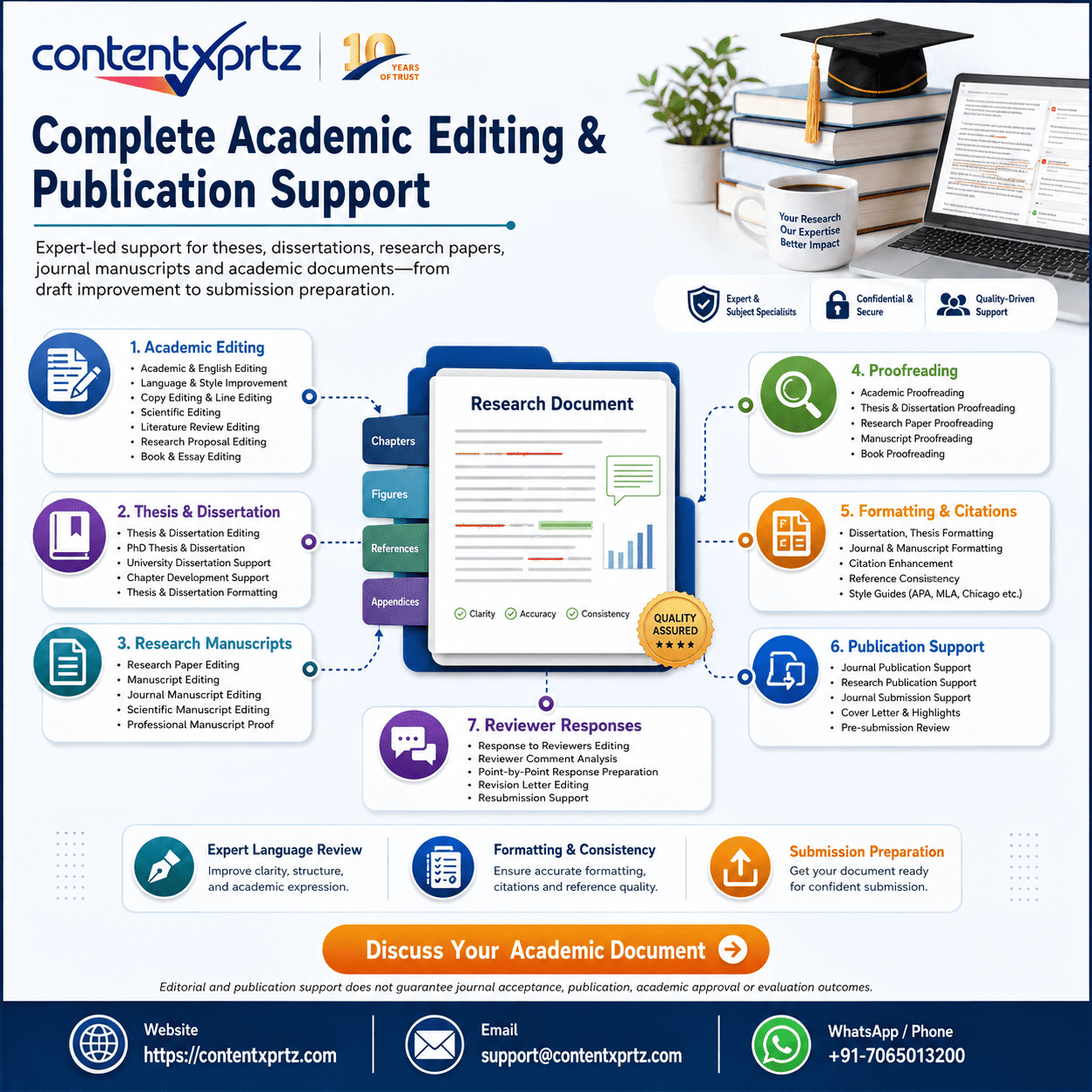
Contentxprtz can help research teams communicate completed science more clearly and consistently while preserving author ownership. Relevant support may include research-paper editing, language polishing for ESL authors, structural editing, consistency checks across sections, reference and citation presentation, table and figure language review, and manuscript assessment against the stated journal instructions.
The boundary is important. Editors should not invent data, write missing methods as if they happened, fabricate references, hide limitations, change authorship, or promise publication. For a manuscript intended for a selective medical journal, the goal is to make the science easier to evaluate—not to make it sound more certain than it is. Researchers who need a focused final review can use Contentxprtz research paper editing service for ethical language and presentation support.
Summary: NEJM
NEJM is both a major source of clinical evidence and a demanding publication venue, so readers and authors need different but complementary skills. Readers should appraise methods, populations, outcomes, effect sizes, limitations, disclosures, and applicability rather than relying on reputation alone. Authors should begin with a strong study and a clear contribution, select the correct article type, follow current Author Center requirements, report results transparently, and treat ethics and disclosure as part of the manuscript itself.
Self-editing, co-author review, reporting checklists, reference managers, and institutional support may be enough for many stages of preparation. Professional editing becomes most useful when the science is stable but language, structure, consistency, or presentation creates avoidable friction. The ethical objective is clarity without scientific distortion.
Frequently Asked Questions
What is NEJM?
NEJM is the common abbreviation for The New England Journal of Medicine, a peer-reviewed medical journal published by the Massachusetts Medical Society. It publishes original clinical research, reviews, clinical cases, perspectives, editorials, and other medical content. Researchers should use the journal’s official website and Author Center for current article, access, and submission requirements.
Is NEJM a peer-reviewed journal?
Yes. NEJM states that it uses editorial, peer, and statistical review processes to evaluate manuscripts for scientific accuracy, novelty, and importance. Peer review is only one part of the decision process: editors also assess fit, clinical significance, methodological quality, reporting, and priority.
How do I submit a manuscript to NEJM?
Start by identifying the correct NEJM article type, then read the current Editorial Policies, preparation instructions, and statistical reporting guidance in the Author Center. Prepare the required manuscript files and supporting materials, and submit through NEJM’s online submission system. A presubmission inquiry can be useful when you are uncertain about suitability, especially for proposed review topics.
What types of articles does NEJM publish?
NEJM publishes multiple categories, including Original Articles, Special Articles, Brief Reports, Clinical Problem-Solving articles, reviews, editorials, Perspectives, Letters to the Editor, Images in Clinical Medicine, and other specialised formats. Each type has its own word, figure, reference, and authorship expectations, so authors should confirm the current requirements before drafting or submission.
What is the word limit for an NEJM Original Article?
The NEJM Author Center currently lists a maximum of 2,700 words for an Original Article, excluding the abstract, figure legends, and table notes, with up to five tables and figures and up to 40 references. Requirements can change, so verify the live article-type page before final submission rather than relying on an old checklist.
Does NEJM allow manuscripts that were posted as preprints?
NEJM states that it accepts manuscripts previously posted on a nonprofit preprint server, provided authors notify the journal about the related preprint. Its no-prior-publication and embargo policies contain additional conditions, so authors should review the current policy before publicly releasing results or discussing a submission.
Can AI tools be used when preparing a manuscript for NEJM?
Authors should follow the journal’s current policies and applicable medical-publishing standards. ICMJE guidance says AI tools should not be listed as authors, humans remain responsible for accuracy and originality, and AI use should be disclosed when required. AI-generated references, claims, and edits should be checked against original sources before submission.
How should I read an NEJM research article critically?
Read beyond the abstract. Check the study question, design, population, intervention or exposure, comparator, outcomes, effect sizes, confidence intervals, missing data, limitations, funding, disclosures, and whether the conclusions match the results. Then consider whether the findings apply to your own clinical or research context.
Can Contentxprtz help prepare a paper for NEJM submission?
Contentxprtz can provide ethical research-paper editing focused on language, clarity, structure, consistency, references, tables, and alignment with stated author instructions. The authors remain responsible for the research, data, interpretation, authorship, disclosures, citations, and final submission, and editorial support cannot guarantee NEJM review or acceptance.
Does following NEJM formatting guarantee acceptance?
No. Correct formatting helps a manuscript enter review in a professional and compliant form, but it does not determine editorial priority or acceptance. NEJM evaluates scientific accuracy, novelty, importance, relevance, reporting quality, and other editorial considerations. Strong research and transparent reporting matter more than cosmetic compliance alone.
Conclusion: Use NEJM as Evidence Carefully and Target It Realistically
For readers, NEJM should be approached with respect and critical discipline: read beyond the abstract, evaluate the study design and applicability, and place individual articles inside the wider evidence base. For authors, the practical path is equally disciplined: confirm fit, choose the right article type, protect research integrity, follow current submission requirements, and make the manuscript as clear and transparent as the science allows.
Free and self-service tools can handle many early-stage writing and consistency tasks. When a complex medical manuscript is scientifically complete but needs clearer structure, tighter language, or an independent publication-readiness review, ethical expert editing can reduce communication barriers. It should never replace author judgment, invent evidence, or imply guaranteed acceptance.
Explore Contentxprtz research paper editing support if your team wants a focused language and presentation review before submission.
At Contentxprtz, we don’t just edit; we help ideas reach their fullest potential.