Journal of Retailing and Consumer Services: Scopus, Scope & Submission Guide
Journal of Retailing and Consumer Services is an Elsevier-published international, interdisciplinary journal focused on retailing, consumer services, consumer behaviour, and the managerial and policy decisions that shape these fields. Its official scope explicitly covers the retailing and selling of goods and the selling of consumer services, including areas such as transportation, tourism and leisure. The journal is indexed in Scopus and the Social Sciences Citation Index, and it currently supports both subscription publishing and optional open access.
For researchers deciding whether to submit, the most important point is not the journal's metrics alone. The official aims and scope emphasize research at the frontier of retailing and consumer services with generalisable empirical results from representative samples. The journal states that, in principle, it does not consider papers based on student or convenience samples. That makes research design, sampling quality, practical relevance, and fit with the retailing/services literature especially important.
Quick Answer: What Is the Journal of Retailing and Consumer Services?
The Journal of Retailing and Consumer Services (JRCS) is a peer-reviewed scholarly journal published by Elsevier. The journal describes itself as an international and interdisciplinary forum connecting research and practice in retailing and services studies. Its strongest recurring themes include consumer behaviour, retail management, services, technology-enabled retailing, marketing decisions, customer experience, tourism and leisure services, and other questions where consumer and managerial perspectives meet.
It is a visible journal in marketing and business research. Elsevier's journal page identifies Scopus and the Social Sciences Citation Index (SSCI) among its abstracting and indexing services. For Scopus, the supplied source record identifies Source ID 22992. Researchers should still check the live Scopus and Web of Science records before relying on indexing or quartile status for institutional, doctoral, promotion or funding requirements, because database coverage and metrics can change.
Potential authors should consider JRCS when their manuscript has a clear retailing or consumer-services contribution, uses a defensible methodology, produces results that can travel beyond a narrow convenience sample, and explains implications for theory and practice. A manuscript can be well written and statistically sophisticated yet still be unsuitable if it does not advance the journal's research frontier or if its sample design conflicts with the journal's stated expectations.
Key Takeaways for Prospective Authors
- Publisher: Elsevier; the journal is also associated with the Pergamon imprint on Elsevier's journal comparison information.
- ISSN: Print 0969-6989; Online 1873-1384.
- Scopus: Indexed; supplied Scopus Source ID 22992.
- Core focus: Retailing, consumer services, consumer behaviour, policy and managerial decision-making.
- Current submission type highlighted in the Guide for Authors: research papers with generalisable results, normally 4,000–6,000 words.
- Peer review: double anonymized; suitable submissions are typically sent to at least two independent reviewers.
- Publishing model: hybrid; subscription publication has no publication fee, while optional open access carries an APC shown by Elsevier as USD 4,630 excluding taxes at the time of this research.
- Critical fit issue: the journal states that it generally does not consider papers based on student or convenience samples.
Journal Information at a Glance
| Field | Journal information |
|---|---|
| Journal name | Journal of Retailing and Consumer Services |
| Common abbreviation | J. Retail. Consum. Serv. (commonly used bibliographic abbreviation) |
| Source type | Peer-reviewed scholarly journal |
| Scopus Source ID | 22992 |
| Print ISSN | 0969-6989 |
| Online ISSN | 1873-1384 |
| Publisher | Elsevier |
| Publisher imprint | Pergamon is shown on Elsevier's journal comparison information |
| Established | Volume 1 was published in 1994 |
| Publication language | English |
| Publication frequency | Elsevier Shop lists 6 issues annually |
| Primary subject area | Marketing; retailing and consumer services |
| Scopus status | Indexed; verify live coverage in Scopus before institutional use |
| Web of Science | Social Sciences Citation Index (SSCI) listed by Elsevier |
| 2024 CiteScore | 22.7 (Scopus metric reported by Wageningen University Library) |
| 2024 SJR | 3.439 (reported as Scopus journal metric by Wageningen University Library) |
| 2024 SNIP | 2.992 (reported as Scopus journal metric by Wageningen University Library) |
| 2024 CiteScore quartile | Q1 in Marketing; rank 5/215, 97th percentile (Wageningen University Library) |
| Impact Factor | Elsevier journal page retrieved for this guide displays 13.1; confirm the latest reporting year in current JCR |
| Open access | Optional open access supported (hybrid journal) |
| Open-access APC | USD 4,630 excluding taxes on the Elsevier journal page at research time; discounts may apply |
| Subscription route | No publication fee charged to authors under the subscription option |
| Official journal page | ScienceDirect journal homepage |
| Author guidelines | Official Guide for Authors |
| Scopus profile | Scopus Source ID 22992 |
How This Guide Was Prepared
This profile prioritizes the journal's official ScienceDirect and Elsevier information, including the aims and scope, Guide for Authors, journal insights, issue archive and publisher information. Scopus-related metric values are dated where possible; the 2024 CiteScore, SJR, SNIP, rank and quartile reproduced here are identified as 2024 Scopus metrics by Wageningen University Library. Clarivate's Journal Citation Reports is the appropriate source for the current Journal Impact Factor reporting year and category position.
Journal metrics, APCs, editorial teams, indexing status and submission policies can change. Researchers should therefore treat this page as a publication-readiness resource, not as a substitute for the live author instructions or database record checked immediately before submission.
What Does the Journal Aim to Publish?
JRCS frames its mission around “forging the link between research and practice.” In practical terms, that means a submission should do more than describe consumer attitudes or a retail trend. A strong paper should make a scholarly contribution while giving managers, policymakers, service providers or retail decision-makers something meaningful to learn from the results.
The official scope covers both the retailing and selling of goods and the selling of consumer services. That allows a broad range of settings: physical and digital retail, omnichannel environments, social commerce, service platforms, travel and tourism services, leisure, customer service, technology-mediated consumption and other contexts where retail or consumer-service decisions are central.
Topics that may align well
- Consumer behaviour in online, offline, mobile, social and omnichannel retail environments.
- Customer experience, satisfaction, trust, loyalty, engagement and switching behaviour.
- Retail technology, artificial intelligence, personalization, recommendation systems and digital interfaces.
- Service design, service encounters, customer-service agents and technology-enabled service delivery.
- Retail strategy, pricing, promotion, assortment, branding, channels and platform-based commerce.
- Tourism, transportation and leisure services where the consumer-service contribution is explicit.
- Sustainable, ethical or socially responsible retailing when linked to consumer or managerial outcomes.
- Cross-cultural or international retailing research with clear theoretical and practical implications.
Recent material on the journal homepage illustrates an active interest in technology and consumer decision-making, including topics such as generative AI, social shopping, app design, anthropomorphic products, influencers and digital service agents. These examples are useful signals of current conversations, but they should not be treated as a guarantee that any paper using AI, social media or digital retailing will fit.
A Major Scope Filter: Sampling and Generalisability
One of the journal's most consequential author-facing statements is that it seeks submissions with generalisable empirical results from representative samples and, in principle, does not consider papers based on student or convenience samples. Authors should take this seriously at the journal-selection stage rather than after the manuscript is complete.
For researchers evaluating fit, ask whether the sampling frame can support the claims being made. A highly polished manuscript based on an easily recruited student group may face a fundamental scope problem if the population is intended to represent general consumers. Similarly, online convenience samples need a clear justification, transparent recruitment description and a strong argument for why the resulting evidence can support the study's intended inferences.
This does not mean every acceptable study must be nationally representative. The practical question is whether the sample and design are defensible for the research question and whether the conclusions are proportionate to the evidence. Authors should compare their sampling strategy with recently published empirical papers in JRCS before deciding to submit.
Understanding Scopus, SSCI and Journal Metrics
The journal is listed by Elsevier as indexed in Scopus and the Social Sciences Citation Index (SSCI). This matters for researchers whose universities or doctoral programs require publication in recognized indexing databases. However, institutional rules differ: some require a journal to be active in Scopus on the exact date of submission or publication; others specify a quartile, JCR category, ABDC rating or local approved-journal list.
For 2024 Scopus metrics, Wageningen University Library reports CiteScore 22.7, SJR 3.439, SNIP 2.992, Q1 in the Marketing category, a 97th percentile and a rank of 5 out of 215. Elsevier's journal page also displays a CiteScore of 22.7 and an Impact Factor of 13.1 in the publisher information retrieved for this guide. Because metric releases are annual and the 2026 JCR reflects 2025 data, authors should verify the live 2026 JCR and current Scopus source profile when a specific metric year is important.
Interpretation: these indicators suggest a highly visible and competitive journal. They do not predict the acceptance probability of an individual manuscript, and they should not substitute for scope and methodological fit.
What Types of Articles Does JRCS Publish?
The current Guide for Authors explicitly describes research papers with generalisable results that contribute to the academic literature and remain relevant to practice. Full-length articles should normally be 4,000–6,000 words. The guide notes that papers longer than 6,000 words may occasionally be accepted where the topic requires fuller treatment.
Historical issues contain other content types, including book reviews, but researchers preparing a new submission should follow the current Guide for Authors rather than infer eligibility from archival material. If you are considering a review, conceptual article, short communication or another non-standard format, confirm its current acceptability with the journal before investing in journal-specific formatting.
Is This Journal a Good Match for Your Manuscript?
| Fit question | Stronger alignment | Possible concern |
|---|---|---|
| Core topic | Retailing or consumer services is central to the theory and contribution | Retail is only a convenient setting for a general management topic |
| Consumer relevance | Clear consumer behaviour, customer or service implications | Minimal connection to consumers or service delivery |
| Practice relevance | Results inform managerial or policy decisions | Purely descriptive findings with limited decision value |
| Sampling | Representative or carefully justified sample supporting intended inference | Student/convenience sample without strong justification |
| Novelty | Advances a live retail/services research conversation | Replicates familiar relationships with little added insight |
| Evidence | Methods and claims are proportionate and transparent | Overstated causal or general claims |
As a practical publication-readiness step, read at least 8–12 recent JRCS papers related to your topic, not only their abstracts. Compare how they frame theory, describe samples, report robustness, connect results to practice and position novelty. This is general publication guidance, not an official journal requirement, but it is one of the best ways to detect mismatch before submission.
Preparing the Manuscript: Core Requirements
The official Guide for Authors asks for editable source files. Word submissions should use .doc or .docx in single-column layout; LaTeX source files are also accepted, and PDF alone is not an acceptable source file. Authors should remove unnecessary underlining or strikethrough and complete spelling and grammar checks.
Title page and anonymized manuscript
Because JRCS uses double-anonymized review, the title page and anonymized manuscript should be uploaded separately. The title page should contain the article title, author names, affiliations, acknowledgements, declaration of interest, and the corresponding author's full address and email. The anonymized manuscript should contain the main paper, references, figures and tables but no author names, affiliations or other identifying information.
Abstract, keywords and highlights
- Abstract: concise and factual, maximum 250 words.
- Keywords: 1–7 English keywords for indexing.
- Highlights: encouraged as a separate editable file; 3–5 bullets, each no more than 85 characters including spaces.
Sections, tables, figures and references
The journal asks authors to divide manuscripts into clearly defined numbered sections and subsections. Tables should be editable text, numbered in order, cited in the manuscript and supplied with captions. Figures and other graphical media should be submitted as separate files, numbered and accompanied by captions.
At initial submission, the journal does not impose a strict reference-format requirement provided the style is consistent and core bibliographic information is complete. DOIs are recommended. The journal's style is applied after acceptance, and the Guide for Authors provides author–date citation conventions and an alphabetically arranged reference list.
Research Data, Declarations and Publication Ethics
JRCS follows Elsevier's publishing-ethics policies. Submission implies that the work has not been published elsewhere in the same form (subject to recognized exceptions such as preprints and theses), is not under consideration by another journal, and has been approved by all authors and responsible authorities where relevant. Elsevier may use screening tools to check compliance with publishing policies.
Authors must address competing interests and funding. The Guide for Authors also requires a research-data availability statement at submission and says that the journal follows Elsevier's Option C research-data instructions: authors are required to deposit research data in a relevant repository and cite/link the dataset, or explain why the data cannot be shared.
For generative AI, authors remain responsible for accuracy, originality, source verification, privacy and intellectual-property compliance. Where AI or AI-assisted tools have been used in manuscript preparation beyond basic grammar, spelling or reference checking, Elsevier requires a disclosure statement. AI tools cannot be listed as authors or co-authors.
What Happens After You Submit?
Submissions first undergo editorial assessment for suitability. If the manuscript is considered suitable, the journal says it will typically be sent to a minimum of two reviewers for independent expert assessment. The journal uses double-anonymized peer review, meaning reviewers do not see author identities and authors do not see reviewer identities. Editors make the final accept/reject decision.
Elsevier's journal page reports journal-level workflow indicators of approximately 1 day from submission to first decision, 23 days from submission to decision after review, 86 days from submission to acceptance, and 9 days from acceptance to online publication. These are descriptive journal indicators, not a promise for any manuscript. Individual papers can take longer depending on editorial screening, reviewer availability, revision rounds and author response time.
The journal does not publicly state an acceptance rate in the official material reviewed for this guide, so no acceptance percentage should be inferred or estimated.
Open Access, APCs and the Subscription Route
JRCS is a hybrid journal: authors may publish through the subscription route or choose open access. The official journal page retrieved for this guide shows an open-access APC of USD 4,630 excluding taxes, noting that the amount may be reduced during submission where applicable. Elsevier's pricing policy also explains that APCs are reviewed and may change.
Under the subscription option, the journal page states that no publication fee is charged to authors; published articles are immediately available to subscribers. Authors with funder or institutional open-access mandates should check licence requirements and any institutional agreements before selecting a route. Always reconfirm the live APC at submission rather than budgeting from an older secondary source.
Common Reasons a Manuscript May Be Unsuitable
- The topic does not make retailing or consumer services central to the scholarly contribution.
- The study relies on a student or convenience sample without a persuasive rationale, despite the journal's explicit sampling guidance.
- The results are statistically significant but add little theoretical or practical insight.
- The manuscript overstates generalisability, causality or managerial implications.
- The literature review does not engage with recent JRCS and adjacent retail/services scholarship.
- The anonymized file contains author-identifying information.
- Required declarations, data availability information, figures, editable files or supporting documents are incomplete.
- The paper is outside the journal's current article-type expectations or substantially exceeds normal length without a clear need.
A Publication-Readiness Checklist Before Submission
- Confirm scope: Write a two-sentence explanation of why the paper belongs specifically in JRCS.
- Audit the sample: Check whether recruitment and representativeness are consistent with the journal's stated expectations.
- Benchmark recent papers: Compare theory framing, methods, sample reporting and practical implications with recent JRCS research.
- Keep claims proportionate: Ensure conclusions match the design and evidence.
- Prepare double-anonymized files: Separate title page and anonymized manuscript and remove identifying traces.
- Check abstract and keywords: Stay within 250 words and 1–7 keywords.
- Prepare highlights: If used, supply 3–5 short bullets in a separate editable file.
- Verify references: Ensure every in-text citation appears in the reference list and bibliographic details are complete.
- Complete ethics and data statements: Funding, competing interests, data availability and AI disclosure where applicable.
- Recheck the live Guide for Authors: Policies, fees and submission-system requirements may change.
How Contentxprtz Can Support Publication Readiness
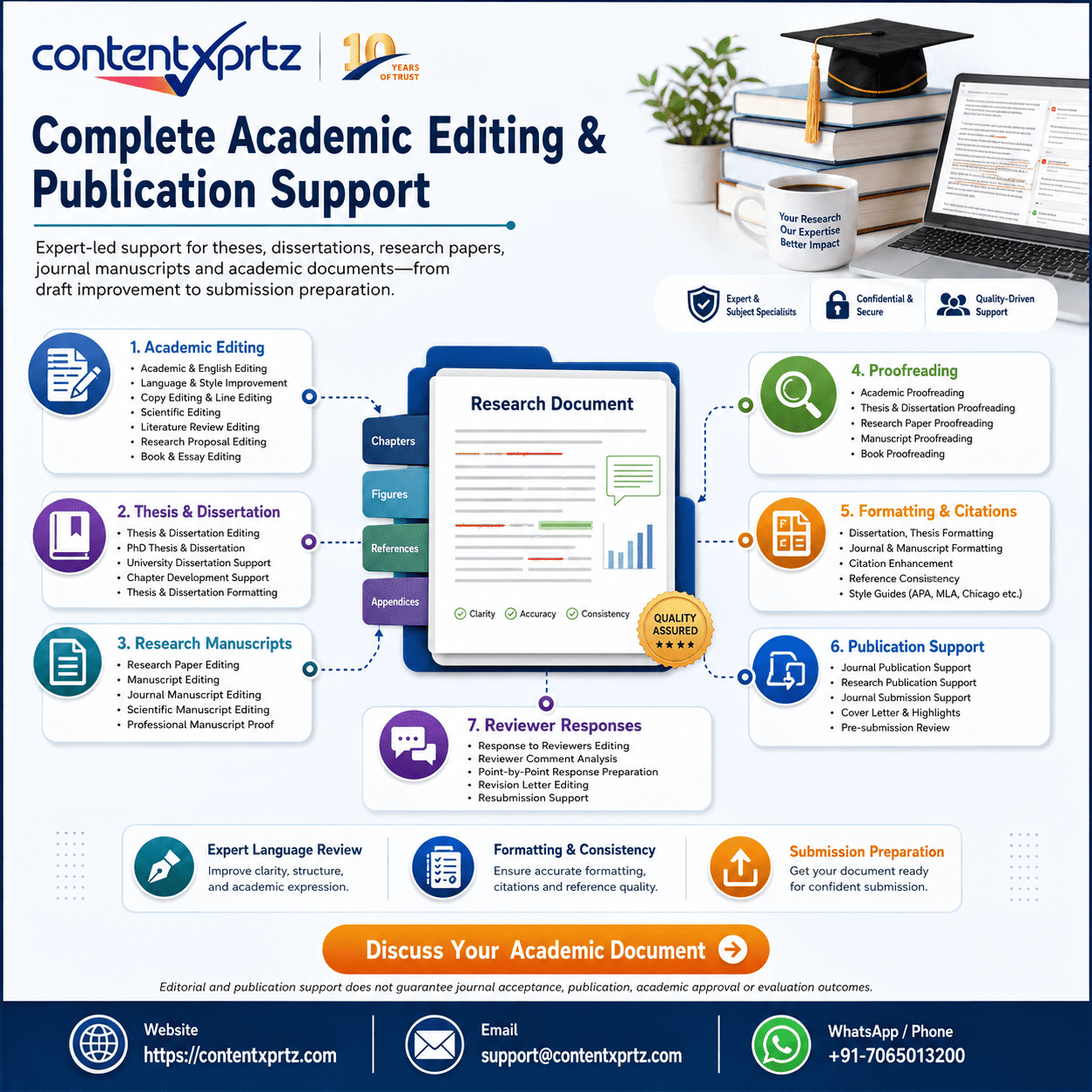
Contentxprtz can support researchers with ethical manuscript preparation before submission, including academic editing, proofreading, journal-format alignment, reference and citation consistency, abstract and title refinement, language polishing, cover-letter editing, reviewer-response editing and publication-readiness review. The purpose of this support is to improve clarity, consistency and alignment with stated journal requirements while preserving the author's research ownership and responsibility.
Professional editing cannot guarantee acceptance, peer-review success, indexing or publication. Editorial decisions remain with the journal and depend on scope, originality, research quality, ethics, evidence and reviewer/editor assessment.
Preparing a manuscript for Journal of Retailing and Consumer Services?
Explore academic manuscript editing and publication-readiness support if you need help aligning language, structure, formatting, references and submission files with the journal's current requirements.
Official Sources and Verification Links
- Journal of Retailing and Consumer Services — official ScienceDirect page
- Official Guide for Authors
- Elsevier Journal Insights
- Scopus source profile — Source ID 22992
- Clarivate Master Journal List
- Clarivate Journal Citation Reports
Frequently Asked Questions
Is the Journal of Retailing and Consumer Services indexed in Scopus?
Yes. Elsevier lists Scopus among the journal's abstracting and indexing services, and the supplied Scopus source record identifies Source ID 22992. Authors who need Scopus status for university or PhD requirements should verify the live source profile immediately before submission or publication.
What is the Journal of Retailing and Consumer Services Scopus quartile?
Wageningen University Library reports the journal's 2024 Scopus metrics as Q1 in the Marketing category, with a CiteScore rank of 5 out of 215 and a 97th percentile. Quartiles are year- and category-specific, so check the latest Scopus record for current institutional use.
What is the CiteScore of the Journal of Retailing and Consumer Services?
The 2024 Scopus CiteScore reported by Wageningen University Library is 22.7, and Elsevier's journal page retrieved for this guide also displays 22.7. CiteScore is updated periodically, so confirm the current reporting year in Scopus.
What is the Impact Factor of the Journal of Retailing and Consumer Services?
The Elsevier journal page retrieved for this guide displays an Impact Factor of 13.1. Because Journal Citation Reports releases new annual data and the publisher display may not show the reporting year next to every cached result, verify the current value and year directly in Clarivate JCR before using it in formal evaluation.
Who publishes the Journal of Retailing and Consumer Services?
The journal is published by Elsevier. Elsevier's comparison information also displays Pergamon in the publisher/imprint field for the title.
What topics are within the journal's scope?
The journal covers retailing and the selling of goods, consumer services such as transportation, tourism and leisure, consumer behaviour, and policy or managerial decisions in retailing and services. Recent papers also show active interest in digital retailing, AI, platforms, social commerce and customer experience.
Does the journal accept student or convenience samples?
The official aims and scope states that, in principle, the journal does not consider papers based on student or convenience samples. Authors should assess whether their sampling strategy supports generalisable results and compare it with recent JRCS papers before submission.
How long should a research paper be?
The current Guide for Authors states that full-length research papers should normally be 4,000–6,000 words. Papers longer than 6,000 words may be accepted occasionally where the topic requires the additional length.
What is the abstract word limit?
The journal requires a concise, factual abstract of no more than 250 words. It should state the purpose, principal results and major conclusions and should be able to stand alone.
How many keywords are required?
The Guide for Authors asks for 1–7 keywords in English for indexing. Authors are advised to avoid unnecessarily long multi-word phrases and to use abbreviations only when they are well established.
What peer-review model does JRCS use?
JRCS uses double-anonymized peer review. Suitable submissions are typically sent to at least two independent reviewers, with the editor making the final publication decision.
How fast is peer review?
Elsevier's journal page reports journal-level indicators of 1 day to first decision, 23 days to decision after review, 86 days to acceptance and 9 days from acceptance to online publication. These figures describe recent journal workflow and do not guarantee the timeline of an individual manuscript.
What is the open-access publication fee?
The official journal page retrieved for this guide shows an optional open-access APC of USD 4,630 excluding taxes, with possible reductions depending on author circumstances. APCs can change, so verify the current fee during submission.
Can I publish without paying an APC?
Yes. The journal's subscription option states that no publication fee is charged to authors. The published article is then available through subscription access rather than immediate gold open access.
Can Contentxprtz guarantee acceptance in this journal?
No. Contentxprtz can support manuscript editing, proofreading, formatting, reference consistency and publication readiness, but acceptance is determined only by the journal's editors and peer reviewers based on fit, originality, quality, ethics and evidence.
Final Guidance for Researchers
Journal of Retailing and Consumer Services may be a strong target for researchers whose work makes a clear contribution to retailing or consumer-services scholarship and can support meaningful practical implications. Its visibility in Scopus and SSCI, strong reported citation metrics and broad international readership make it attractive, but those same features also make journal fit and research design especially important.
Before submitting, confirm the live author guidelines, indexing record, current metrics and APC; assess your sampling strategy against the journal's explicit expectations; and make sure the paper communicates why its findings matter for both scholarship and practice. Careful journal selection and manuscript preparation can improve readiness, but no service or metric can guarantee acceptance.