Journal of Organizational Ethnography: Scopus, Metrics, Scope & Submission Guide
Journal of Organizational Ethnography (JOE) is an Emerald Publishing journal devoted specifically to organizational ethnography and to ethnographically informed studies of organization, organizing, work, management and related social settings. For researchers evaluating it as a publication venue, the most useful starting points are its specialist methodological identity, its verified Scopus presence, its hybrid open-access model, and its detailed Emerald author requirements.
The journal is relevant to researchers in organization and management studies as well as adjacent fields such as anthropology, sociology, psychology, labour and gender studies, education, healthcare, cultural and media studies, human geography, socio-legal studies, criminology, marketing and consumer research when the manuscript makes a substantive ethnographic contribution. It is not simply a general management outlet that happens to accept qualitative work; ethnography must be central to the paper's question, evidence, interpretation or contribution.
Quick Answer: What Is the Journal of Organizational Ethnography?
The Journal of Organizational Ethnography is a peer-reviewed academic journal published by Emerald Publishing. Emerald describes JOE as the only journal specifically dedicated to organizational ethnography. Its remit includes original ethnographic research, reviews of ethnography's development, critical and practical work on ethnographic theory and methods, and ethnographically informed research on organization and organizing in wider social and cultural contexts.
The journal is represented in Scopus under Source ID 21100446528. The supplied source record identifies ISSN 2046-6749; Emerald's official journal page also lists eISSN 2046-6757. Emerald currently reports a 2025 CiteScore of 2.1, a 2025 Journal Impact Factor of 1.0, and a 2025 five-year Impact Factor of 1.2. Metrics change by reporting cycle, so authors should reconfirm them before using them for institutional or PhD requirements.
Researchers should consider JOE when organizational ethnography is not merely a supporting technique but a meaningful part of the study's contribution. Before submission, compare the manuscript with the journal's aims and scope and recent papers, confirm current indexing or ranking requirements with your institution, and follow the latest Emerald author guidelines rather than relying on older third-party summaries.
Key Takeaways for Prospective Authors
- Publisher: Emerald Publishing.
- ISSN / eISSN: 2046-6749 / 2046-6757.
- Scopus: the supplied source record identifies Scopus Source ID 21100446528, and Emerald lists the journal as ranked by Scopus.
- Current citation metrics: Emerald reports CiteScore 2.1 for 2025, Journal Impact Factor 1.0 for 2025 and a five-year Impact Factor of 1.2 for 2025.
- Review model: double-anonymous peer review.
- Manuscript length: Emerald currently specifies 2,000–8,000 words, counting the structured abstract, references, tables, figures and appendices; 280 words should be allowed for each figure or table.
- Access model: hybrid, with gold and green open-access routes; there is no submission fee, while a gold OA APC is charged after acceptance if that route is selected.
- Best fit: manuscripts in which ethnography directly advances understanding of organization, work, management, organizing or closely related social and cultural phenomena.
Journal Information at a Glance
| Field | Journal information |
|---|---|
| Journal name | Journal of Organizational Ethnography (JOE) |
| Source type | Peer-reviewed scholarly journal |
| Publisher | Emerald Publishing |
| ISSN | 2046-6749 |
| eISSN | 2046-6757 |
| Scopus Source ID | 21100446528 |
| Scopus status | Indexed/ranked in Scopus; verify the live Scopus source profile for current coverage and category details |
| Primary areas | Organizational ethnography; social sciences; business, management and accounting |
| CiteScore | 2.1 (2025, as displayed by Emerald) |
| Impact Factor | 1.0 (2025, as displayed by Emerald) |
| 5-year Impact Factor | 1.2 (2025, as displayed by Emerald) |
| SJR / SNIP / quartile | Verify current values in the applicable live database; no current value is asserted here without an authoritative source |
| Peer review | Double-anonymous |
| Acceptance rate | 32% for submissions between 1 April 2024 and 31 March 2025, as reported by Emerald |
| Time to first decision | 43 days for submissions between 1 April 2024 and 31 March 2025, as reported by Emerald |
| Acceptance to publication | 36 days; Emerald notes this figure was last updated April 2025 |
| Open access | Hybrid: optional gold OA plus green self-archiving route |
| Gold OA licence | CC BY 4.0, according to Emerald's journal guidance |
| APC | Applicable only if gold OA is selected after acceptance; verify the current journal-specific amount on Emerald's APC list/editorial system |
| Submission system | ScholarOne, accessed through Emerald's official journal page |
| Official website | Emerald Journal of Organizational Ethnography |
What This Page Covers
- The journal's identity, publisher, aims and scope
- Scopus visibility and currently verifiable citation metrics
- Subjects, themes and emerging sections relevant to manuscript fit
- Article types and manuscript requirements
- Double-anonymous peer review and published editorial timelines
- Hybrid open access, APC timing and self-archiving
- Submission workflow, ethics and authorship responsibilities
- A practical fit checklist and publication-readiness steps
- Ethical ways Contentxprtz can support authors without guaranteeing acceptance
Methodology and Sources Used for This Journal Guide
This profile prioritises the official Emerald journal page and its author guidelines, the supplied Scopus source record and direct Scopus profile link, and Emerald's current indexing and metrics information. The journal's official page is also used for its peer-review model, open-access pathway, manuscript specifications, published acceptance rate and decision timelines.
Journal metrics, indexing coverage, editorial personnel, policies and fees can change. For that reason, values on this page are date-qualified where appropriate, and fields such as SJR, SNIP, quartile and the current gold-OA APC are not guessed. Researchers who must meet a university, funder or promotion rule should verify the live Scopus, Clarivate and Emerald records immediately before submission.
Understanding the Journal's Aims and Scope
JOE's central purpose is to create a dedicated venue for ethnographic scholarship about organizations, work, management and organizing. Emerald's official scope describes several overlapping contributions: original ethnographic research that develops qualitative knowledge of public- and private-sector work and management; reviews of the development of ethnography in social, organization and management research; work examining ethnography's intellectual, pedagogical or practical value; and studies that extend, critique or challenge theoretical and empirical claims through ethnographic inquiry.
The journal also welcomes ethnographically informed research on organization and organizing in wider cultural and social contexts. This broadens the potential settings beyond conventional companies. A manuscript may therefore focus on workplaces, professional communities, public institutions, healthcare environments, education, local government, non-profit organizations, consumer settings, social movements or other sites where organization is empirically visible.
Subjects and topics explicitly associated with the journal
Emerald's scope includes organizational behaviour, management practice, policy making, changing forms of employment, workplace cultures, accounting practices, consumption and consumer behaviour, healthcare, education, social and public policy, conflict and deviance, resistance and misbehaviour, unethical business practices, shop-floor ethnography, labour process and critical management studies, voluntary and non-profit organizations, emotional labour, visual ethnography, virtual or new-media-mediated ethnography, consumer marketing, architecture and art.
Interdisciplinary reach
The editors invite work from social and organizational anthropology, sociology, psychology, organization and management, labour and gender studies, education and healthcare, cultural, environmental and media studies, human geography, socio-legal studies, criminology, social movements, community relations, social class and ethnicity, emotions, consumer research and related fields. The practical implication is that disciplinary label alone does not determine fit; the paper's ethnographic engagement with organization and organizing is more important.
Newer areas of interest
Emerald has highlighted newer sections and themes including decolonizing organizational ethnography, navigating failure in ethnography and creative forms of ethnographic representation. An editor-in-chief message also encouraged work in multispecies ethnography and climate-crisis-related topics. Authors interested in these directions should read the latest call or section description because section-specific expectations can evolve.
Who Should Consider Submitting?
JOE may suit organizational ethnographers, qualitative management researchers, anthropologists, sociologists, workplace and labour scholars, critical management researchers, public-sector researchers, healthcare and education researchers, consumer or marketing ethnographers, and early-career scholars developing a clearly ethnographic contribution. Emerald has explicitly encouraged early-career researchers and submissions from researchers across different parts of the world.
For PhD scholars, the journal can be relevant when a dissertation chapter or study produces a standalone ethnographic argument that fits the journal's intellectual conversation. Thesis material normally requires substantial reworking into a journal article: a tighter research question, selective literature positioning, a self-contained methods account, focused evidence and a clear contribution. The fact that a study uses interviews or qualitative coding is not enough by itself; the ethnographic logic, field engagement and analytical contribution should be visible.
How to Judge Whether Your Manuscript Really Fits
Before formatting, test fit at three levels. First, ask whether the topic concerns organization, organizing, work, management or a related social setting. Second, ask whether ethnography is methodologically and intellectually central rather than decorative. Third, ask whether the manuscript offers a contribution likely to interest readers of organizational ethnography specifically.
| Fit question | Strong signal | Possible warning sign |
|---|---|---|
| Is ethnography central? | Field immersion, observation, reflexivity, ethnographic interpretation or a substantive methodological contribution shapes the paper. | The paper is mainly a questionnaire or interview study with only a brief ethnographic label. |
| Is organization/organizing central? | The analysis explains work, organizing practices, institutions, management, culture, power, resistance or related processes. | The setting is organizational but the paper's actual argument is unrelated to organizational processes. |
| Is there an original contribution? | The study develops, challenges or deepens theory, method, empirical understanding or practice. | The paper mainly describes a site without showing what the case changes or clarifies. |
| Does it engage the journal conversation? | Recent JOE articles and relevant ethnographic scholarship are used to position the contribution. | The manuscript could be sent unchanged to almost any generic management journal. |
As a practical publication-readiness step, read several recent JOE articles that resemble your topic or method and compare their problem framing, fieldwork description, analytical depth and contribution statements with your own. This is not a substitute for the journal's official scope, but it gives a more realistic sense of editorial fit.
Article Types and Manuscript Categories
Emerald's current submission guidance lists Research Paper, Viewpoint and Book Review as paper-type options in the submission system. Its broader classification guidance also explains categories such as research paper, viewpoint, technical paper, conceptual paper, case study, literature review and general review. Authors should select the option that best matches the actual manuscript and follow any section-specific instructions visible in ScholarOne.
JOE's scope also explicitly welcomes original research, review work on ethnography's history and development, and essay-style contributions that make an original practical or critical contribution to ethnographic theory and practice. The newer journal sections may create additional pathways for decolonizing, failure-focused or creative-format work. If a manuscript sits between categories, the official Emerald page advises authors who remain unsure about suitability to contact the editor with the title and structured abstract.
Manuscript Requirements Authors Should Check Before Submission
Emerald's author guidelines contain several concrete requirements that are easy to miss. The following are journal-facing requirements, not general writing advice.
| Requirement | What authors should prepare |
|---|---|
| File format | Microsoft Word is accepted; a PDF may accompany the Word file but a PDF alone is not acceptable. LaTeX may be used with an accompanying PDF. |
| Length | 2,000–8,000 words including structured abstract, references, text in tables, figures and appendices; allow 280 words for each figure or table. |
| Title | A concise title. |
| Author details | All contributing authors must be entered in ScholarOne in publication order, with email and affiliation details. |
| Biographies | If included, a brief professional biography of no more than 100 words per author, uploaded separately with acknowledgements. |
| Funding | External research funding must be acknowledged and the funder's role described. |
| Structured abstract | Required headings: Purpose; Design/methodology/approach; Findings; Originality. Optional headings include Research limitations/implications, Practical implications and Social implications. |
| Abstract length | Maximum 250 words in total, including keywords and article classification according to Emerald's guidance. |
| Keywords | Up to 12 short, appropriate keywords. |
| References | A recognised Harvard style; Emerald provides its own Harvard style and stresses completeness, accuracy and consistency. |
| Tables | Submitted in a separate file, with positions clearly labelled in the manuscript. |
| Figures | High-resolution electronic files with consecutive numbering, clear captions and required credits/attribution. |
Formatting is important, but editorial fit and research quality come first. A perfectly formatted manuscript can still be declined without external review if it falls outside the aims and scope.
What Happens After You Submit a Manuscript?
The journal uses a double-anonymous peer-review process. In practical terms, reviewers should not know the author's identity and authors should not know the reviewers' identities. Emerald therefore asks authors to remove identifying information from the manuscript and to upload acknowledgements and biographies separately. Self-references should also be phrased in a way that does not reveal authorship during review.
Emerald reports a 43-day time to first decision for submissions received between 1 April 2024 and 31 March 2025. It also reports an acceptance rate of 32% for that same submission period and an acceptance-to-publication time of 36 days, with the latter figure last updated in April 2025. These are historical operational indicators, not guarantees for any individual paper. Topic, reviewer availability, revision rounds and editorial complexity can all affect a specific manuscript's timeline.
The journal describes its review mission in terms of rigour and excellence, with constructive, respectful feedback and reviewer expertise matched to the manuscript. Authors should therefore prepare for substantive revision as well as language or formatting changes. A response to reviewers should address every point clearly, show exactly what changed and explain respectfully when a suggestion cannot be followed.
Submission Process: How to Send Your Paper Correctly
- Recheck scope. Read the latest aims and scope and recent JOE articles.
- Prepare an anonymous manuscript. Remove names and identifying details that could compromise double-anonymous review.
- Prepare separate author information. Ensure every author has approved the submission order, affiliations and authorship.
- Check structured abstract, keywords and references. Follow the current Emerald specifications.
- Review ethics, permissions and funding disclosures. Secure necessary permissions before submission.
- Submit through ScholarOne. Emerald states that the corresponding author should submit through the official editorial system accessed from the journal page.
- Add ORCID information where applicable. Emerald encourages authors to include ORCID during submission.
- Retain the manuscript number. The automated confirmation email provides the identifier for subsequent correspondence.
Emerald explicitly warns that journal submissions should be made by the authors through the official ScholarOne route, not by email, a third-party agent or a proxy submission service. Ethical publication support can prepare files and check readiness, but the author should retain control of the account and make the submission.
Open Access, APCs and Publication Charges
JOE is a hybrid journal. Emerald offers a gold open-access route and a green self-archiving route. If authors choose gold OA after acceptance, the version of record is made openly available and Emerald states that it is published under a CC BY 4.0 licence. The corresponding APC is charged after acceptance.
The journal's official guidance does not require a submission fee. Emerald states that the only payment requested for publication is the APC when an author has chosen the gold OA route (subject to sponsored arrangements where applicable). Because APC schedules can change, this guide does not state an amount that has not been independently verified for the journal on the current price list. Authors should check Emerald's live APC list and any institutional read-and-publish or waiver arrangements before making a funding decision.
For green OA, Emerald states that the author accepted manuscript can be made openly available without payment and without an embargo period under its current policy. Authors should still confirm repository, funder and licence requirements applicable to their institution.
Research Ethics, Authorship and Responsible AI Use
Emerald states that its publishing ethics approach follows guidance from the Committee on Publication Ethics (COPE). Authors are expected to submit original work that is not simultaneously under consideration elsewhere, declare conflicts of interest, secure third-party permissions, identify legitimate authorship contributions and acknowledge funding. Research involving human participants should address whether ethical approval and informed consent are required.
For organizational ethnographers, consent and confidentiality require particular attention because fieldwork may involve named organizations, employees, workplace routines, sensitive power relations or information unavailable in the public domain. Emerald notes that authors who write in detail about organizations or named/interviewed employees using non-public information may need a consent-to-publish form and relevant permissions.
Emerald's current AI policy says generative AI should not be credited as an author, and it distinguishes between generating new submission content and using tools to improve an author's own existing text. Authors should review the live policy before using AI-assisted tools because publisher policies can change and may be more restrictive than general university guidance. The researcher remains accountable for accuracy, originality, interpretation, citations and disclosure.
Why Papers May Be Unsuitable Even When the Topic Sounds Relevant
- Ethnography is peripheral. A qualitative study may be interesting but still lack the sustained ethnographic orientation expected by the journal.
- The organizational contribution is unclear. Rich field notes need an argument about organization, organizing, work, management or a closely connected social process.
- The paper is descriptive rather than analytical. A compelling site does not automatically produce a scholarly contribution.
- The manuscript ignores the journal's conversation. A paper should explain how it relates to organizational ethnography scholarship rather than treating the journal as a generic destination.
- Ethics or anonymity are inadequately handled. Sensitive field sites require careful consent, de-identification and disclosure decisions.
- The submission does not follow author instructions. Missing structured abstract elements, incorrect files or identifiable author information can create avoidable delays.
Publication-Readiness Checklist for JOE
Before you submit, confirm that:
- The research question and contribution clearly belong within organizational ethnography.
- The manuscript explains why ethnography was appropriate and how field engagement generated the evidence.
- The analysis moves beyond site description to a defensible conceptual, theoretical, methodological or practical contribution.
- Recent JOE articles have been reviewed for topic and methodological fit.
- The manuscript is within the current 2,000–8,000-word requirement after counting tables, figures, references and appendices as instructed.
- The structured abstract uses the required Emerald headings and stays within the specified maximum.
- References are complete, consistent and in a recognised Harvard style.
- Author-identifying details have been removed from the review manuscript.
- Authorship order, funding, conflicts, permissions, consent and ethical approval statements are resolved before submission.
- The current open-access option and any APC implications are understood.
- All authors have approved the final manuscript and submission.
How Contentxprtz Can Support Journal Readiness Ethically
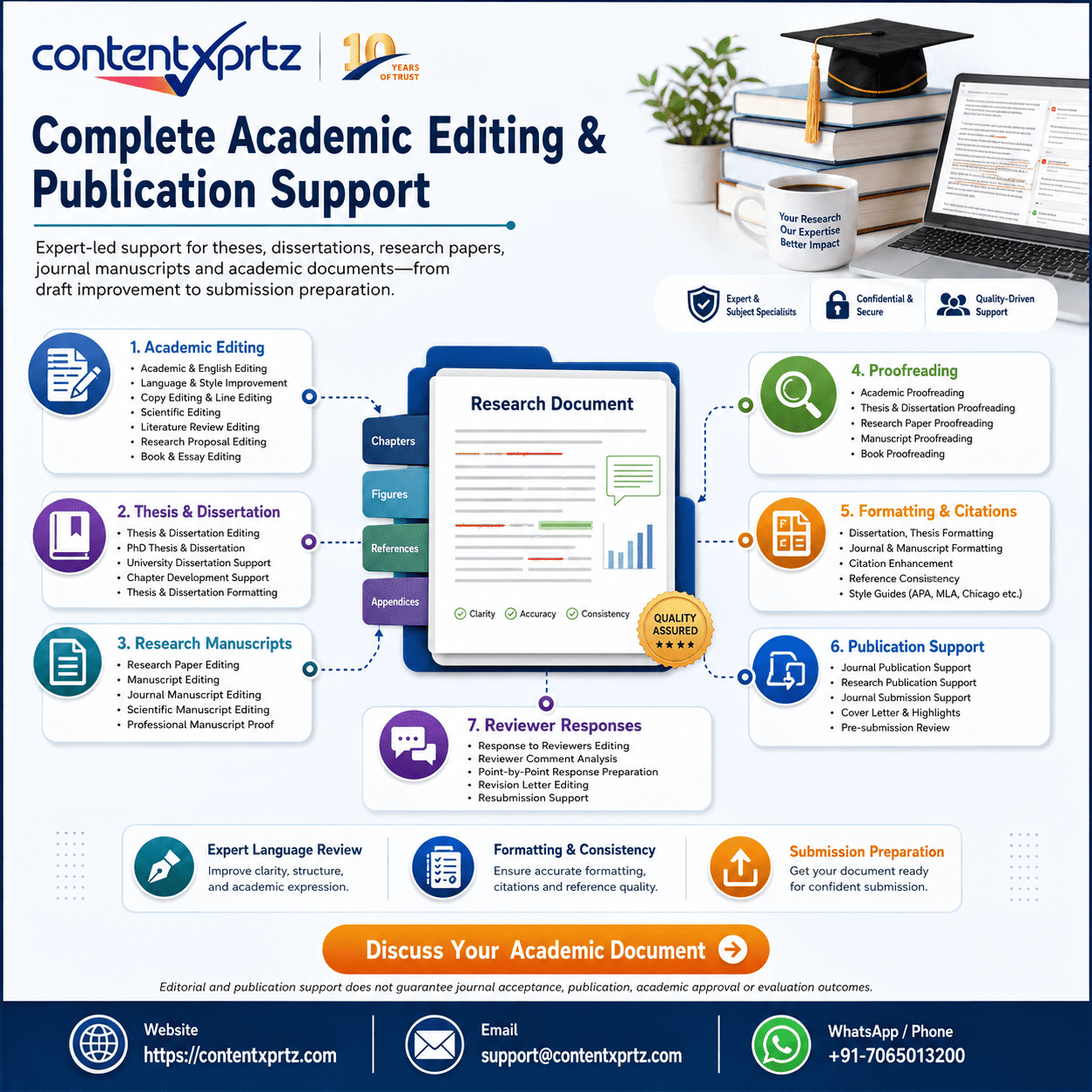
Contentxprtz can support authors preparing for the Journal of Organizational Ethnography through academic editing, manuscript editing, proofreading, journal formatting, reference and citation checks, structured-abstract review, cover-letter editing, journal-fit assessment and reviewer-response editing. For qualitative and ethnographic manuscripts, useful support often includes improving narrative clarity, strengthening the connection between evidence and claims, checking whether methods are explained transparently, reducing repetition and helping the argument remain accessible to an interdisciplinary readership.
Support should preserve authorship and research responsibility. Contentxprtz should not invent field observations, fabricate references, create unsupported findings, conceal conflicts, impersonate an author in ScholarOne or promise acceptance. The journal makes editorial decisions independently, and professional editing cannot guarantee peer-review success or publication.
Researchers seeking manuscript-preparation help can review Contentxprtz journal publication services. The goal is publication readiness: a clearer, more compliant and better-aligned manuscript that the author can submit and defend responsibly.
Frequently Asked Questions
What is the Journal of Organizational Ethnography?
It is a peer-reviewed Emerald Publishing journal dedicated specifically to organizational ethnography and ethnographically informed research on organization, organizing, work, management and related social and cultural settings.
Who publishes the Journal of Organizational Ethnography?
The journal is published by Emerald Publishing. Its official journal page contains the aims and scope, author guidelines, metrics, editorial information and ScholarOne submission link.
Is the Journal of Organizational Ethnography indexed in Scopus?
Yes. The supplied journal source record identifies Scopus Source ID 21100446528, and Emerald lists the journal as ranked by Scopus. Authors who need current coverage years or category-level quartiles should verify the live Scopus source profile before submission.
What are the ISSN and eISSN?
Emerald lists ISSN 2046-6749 and eISSN 2046-6757 for the Journal of Organizational Ethnography.
What is the current CiteScore?
Emerald currently displays a 2025 CiteScore of 2.1. CiteScore is updated by reporting cycle, so researchers should verify the latest value in Scopus when using it for institutional decisions.
Does the journal have an Impact Factor?
Yes. Emerald displays a 2025 Journal Impact Factor of 1.0 and a 2025 five-year Impact Factor of 1.2. These values should always be cited with their reporting year.
What is the journal's quartile, SJR or SNIP?
This guide does not assert a current quartile, SJR or SNIP value without a directly verified live record. These metrics can vary by year and subject category, so authors should check the current Scopus record or another institutionally accepted metric source required by their university.
What kinds of manuscripts does the journal accept?
Emerald's submission system lists Research Paper, Viewpoint and Book Review as paper-type options. The journal's scope also welcomes original ethnographic studies, review work and critical or practical essays, while newer sections address topics such as decolonizing organizational ethnography and failure in ethnographic work.
How long can a manuscript be?
Emerald currently specifies 2,000–8,000 words, including the structured abstract, references, text in tables, figures and appendices, and asks authors to allow 280 words for each figure or table.
What peer-review model does the journal use?
The Journal of Organizational Ethnography uses double-anonymous peer review. Authors should remove identifying information from the manuscript and upload biographies and acknowledgements separately.
How long does peer review take?
Emerald reports 43 days to first decision for submissions received between 1 April 2024 and 31 March 2025. This is an historical average, not a promise for any individual manuscript.
What is the journal's acceptance rate?
Emerald reports an acceptance rate of 32% for submissions between 1 April 2024 and 31 March 2025. Acceptance rates vary over time and do not predict the outcome of a particular paper.
Is the journal open access and does it charge an APC?
The journal is hybrid. Authors may choose gold open access after acceptance, in which case an APC applies, or use Emerald's green self-archiving route. There is no submission fee. Authors should confirm the current journal-specific APC in Emerald's live price list or editorial system.
How do I submit a paper?
The corresponding author should submit through the official ScholarOne system reached from Emerald's journal page. Emerald states that submissions should not be sent by email or submitted through a third-party proxy.
Can Contentxprtz guarantee acceptance in the Journal of Organizational Ethnography?
No. Contentxprtz can help with editing, proofreading, formatting, reference checks, journal-fit review and publication readiness, but editorial decisions and peer review remain entirely with the journal. No ethical service can guarantee acceptance or publication.
Final Assessment: Is JOE a Good Match for Your Research?
The Journal of Organizational Ethnography is most compelling when a manuscript makes ethnography central to an argument about organization, organizing, work or management. Its specialist identity can be an advantage for authors who want their paper to reach readers already interested in ethnographic theory, practice and representation. At the same time, that specialization means a generic qualitative management paper may be a weak fit even if its topic concerns an organization.
Use the journal's verified scope, recent articles and author instructions as the primary decision tools. Treat metrics as contextual information rather than a substitute for fit, and reconfirm live indexing, quartile or funding requirements when those details matter for a PhD programme, promotion framework or grant. A strong submission combines credible fieldwork, analytical depth, ethical transparency and close alignment with the journal's scholarly conversation.
Contentxprtz can help authors improve manuscript clarity, consistency and submission readiness while preserving the researcher's intellectual ownership. At Contentxprtz, we don't just edit; we help ideas reach their fullest potential.