Journal of Organizational Effectiveness: People and Performance: Scopus, Metrics, Scope & Submission Guide
Journal of Organizational Effectiveness: People and Performance (JOEPP) is an Emerald Publishing journal focused on the relationship between people management and organizational effectiveness. Its stated scope connects human resource management, organizational studies and wider social-science research with performance questions at individual, team, functional, organizational and societal or policy levels. For an author, the important point is that a manuscript normally needs more than a general HR or management theme: the paper should make a clear connection to performance, organizational effectiveness, business models, people-management processes, or strategically important capabilities.
The journal is currently indexed in Scopus and the official Emerald page reports a 2025 CiteScore of 8.1, a 2025 Journal Impact Factor of 3.3, and a 2025 five-year Impact Factor of 3.8. Emerald also reports a 10.4% acceptance rate and an average 34 days to first decision for submissions measured between 1 April 2024 and 31 March 2025. Those figures are useful context, but they should not be treated as predictions for an individual manuscript.
This guide brings together the journal’s identity, scope, indexing, current metrics, manuscript requirements, peer-review model, open-access routes and practical fit questions. Metrics, fees and editorial details can change, so authors should reconfirm time-sensitive information on the official Emerald journal page immediately before submission.
Quick Answer: What Is Journal of Organizational Effectiveness: People and Performance?
Journal of Organizational Effectiveness: People and Performance is a peer-reviewed Emerald Publishing journal in human resource management, organizational studies and related social sciences. It publishes work on people-management processes and performance, including empirical, conceptual and review-oriented research. Its scope explicitly asks authors to connect their work to performance or to processes and capabilities central to performance.
For researchers whose universities or doctoral programmes require Scopus-indexed outlets, the journal is currently listed by Emerald as indexed in Scopus. The task record supplied for this page identifies Scopus Source ID 21100872102. The journal is also indexed in Clarivate’s Emerging Sources Citation Index (ESCI), according to Emerald.
A good candidate manuscript is therefore one that does not merely discuss an HR phenomenon in isolation, but explains why the phenomenon matters for organizational effectiveness, performance, strategy, policy or practice. Before submitting, compare your study with recent JOEPP articles and verify the current author guidelines, because article requirements and metrics can change.
Key Takeaways
- Publisher: Emerald Publishing.
- ISSN / eISSN: 2051-6614 / 2051-6622.
- Scopus: indexed; source record supplied for this article is 21100872102.
- 2025 metrics: CiteScore 8.1; Journal Impact Factor 3.3; five-year Impact Factor 3.8.
- Scope: people management, organizational effectiveness and performance across multiple levels of analysis.
- Review model: double-anonymous peer review.
- Manuscript length: 5,000–9,000 words, including references, tables, figures and appendices under Emerald’s stated counting method.
- Open access: hybrid publishing routes are available; gold OA involves an APC after acceptance, while green self-archiving is also supported.
Journal Information at a Glance
| Field | Journal information |
|---|---|
| Journal name | Journal of Organizational Effectiveness: People and Performance |
| Abbreviation | JOEPP |
| Source type | Journal |
| Scopus Source ID | 21100872102 (supplied source record; link provided for verification) |
| ISSN | 2051-6614 |
| eISSN | 2051-6622 |
| Publisher | Emerald Publishing |
| Country / language | United Kingdom / English, according to the ISSN record |
| Publication frequency | Quarterly, according to the ISSN record |
| Scopus status | Indexed |
| Other major indexing | Emerging Sources Citation Index (ESCI), Cabell’s, Ex Libris Primo, ProQuest Summon, ReadCube Discovery |
| 2025 CiteScore | 8.1 |
| 2026 CiteScore Tracker | 6.8 at the time the Emerald page was checked; tracker values update monthly |
| 2025 Journal Impact Factor | 3.3 |
| 2025 five-year Impact Factor | 3.8 |
| SJR / SNIP / current quartile | Not stated on the official journal page reviewed for this article; verify in the current Scopus/SCImago or institutional database before using these values |
| Peer review | Double-anonymous |
| Acceptance rate | 10.4% for submissions between 1 April 2024 and 31 March 2025 |
| Time to first decision | 34 days for the same reporting window |
| Acceptance to publication | 34 days; Emerald states this figure was updated April 2025 |
| Open access | Hybrid: gold OA and green self-archiving routes |
| APC | Varies by journal and route; verify the current amount on Emerald’s APC list or editorial system |
| Official website | Emerald journal page |
| Scopus profile | Scopus Source ID 21100872102 |
| Submission portal | ScholarOne Manuscripts |
Because citation indicators and indexing records are revised periodically, use the year shown with every metric rather than describing a number as permanent.
What This Page Covers
- JOEPP’s aims, scope and subject emphasis
- Scopus and other indexing information
- Current, date-qualified citation and editorial metrics
- Paper categories and manuscript requirements
- Double-anonymous peer review and post-submission expectations
- Gold and green open-access routes and fee considerations
- A manuscript-fit framework for PhD scholars and researchers
- Ethical publication-readiness support from Contentxprtz
How This Journal Profile Was Prepared
The journal-specific facts in this guide were checked against the official Emerald journal page and author instructions, the ISSN Portal record, and the supplied Scopus source record. Emerald’s page is the primary source for scope, current metrics, peer review, indexing, editorial information and submission requirements. The ISSN Portal is used to corroborate the print and online ISSNs, country, language and quarterly frequency.
Where a current value could not be verified from those authoritative sources—particularly SJR, SNIP and a current subject-category quartile—the article does not estimate it. Authors should recheck these values in the database that matters to their institution, especially where a doctoral programme or promotion policy specifies a particular year, subject category or ranking system.
Understanding the Journal’s Aims and Scope
JOEPP is built around a specific intellectual connection: people management should be examined in relation to performance and organizational effectiveness. Emerald describes the journal as welcoming synthetic and state-of-the-art reviews, conceptual work, and quantitative and qualitative studies on performance and people-management process issues.
The scope is deliberately multi-level. Research may address the individual employee, teams, organizational functions, the organization as a whole, or societal and policy questions. This makes the journal potentially relevant to work in human resource management, organizational studies, management and adjacent social sciences, but the breadth does not remove the need for a clear performance contribution.
The journal’s stated expectations are especially useful when evaluating fit. Papers should have a performance connotation, either through hard performance data or by analysing processes and capabilities central to performance. They should address issues that matter to academics, practitioners and employees; contribute to strategic or policy thinking; and identify longer-term performance challenges facing workforces and organizations. The journal also states that papers include implications for Policy and Practice.
Topics that may fit well
- HRM systems and organizational performance
- People analytics, workforce analytics and data-informed HR decisions
- Talent acquisition, development, retention and capability building
- Employee wellbeing, engagement, job quality and performance outcomes
- Leadership, teams and organizational effectiveness
- Work design, hybrid work, digitalization and AI-enabled people management
- Sustainable HRM and responsible management
- Strategic workforce planning and future-of-work questions
- Cross-level research linking employee-level processes with organizational outcomes
This topic list is an interpretation of the official scope and current journal themes, not a closed list of accepted subjects. A paper on any of these themes can still be unsuitable if it lacks a meaningful organizational-effectiveness or performance contribution.
What Does JOEPP Publish?
The author instructions ask submitters to select “Research Paper” as the paper type, then choose the category that best describes the manuscript. The categories listed by Emerald include research paper, viewpoint, technical paper, conceptual paper, case study, literature review and general review.
| Category | What to demonstrate before submission |
|---|---|
| Research paper | A clearly designed study, model/framework test, survey, empirical analysis, action research or other evidence-based investigation with a performance connection. |
| Conceptual paper | A strong theoretical argument, propositions or hypotheses, and a clear explanation of how the conceptual development advances people-performance thinking. |
| Literature review | A critical, structured synthesis that clarifies the field, its main contributors, tensions and future research needs rather than a descriptive list of prior studies. |
| Viewpoint | A well-supported interpretive argument with clear relevance to the journal’s readership and organizational-effectiveness questions. |
| Technical paper | An evaluation of a product, process or service with a credible link to people management or performance. |
| Case study | An organizational intervention or experience that generates meaningful learning for theory, policy or practice. |
| General review | An overview or historical examination of a concept, technique or phenomenon with a clear reason for JOEPP readers to use it. |
Understanding Its Scopus Coverage and Current Metrics
Emerald currently lists JOEPP as abstracted and indexed in Scopus. The source record supplied with this article identifies Scopus Source ID 21100872102. Emerald also lists the journal in the Emerging Sources Citation Index (ESCI), alongside several discovery and library services.
The official journal page reports a 2025 CiteScore of 8.1 and a 2026 CiteScore Tracker of 6.8 at the time of checking. The tracker is updated monthly, so it should not be treated as a final 2026 CiteScore. Clarivate metrics shown by Emerald are a 2025 Journal Impact Factor of 3.3 and a 2025 five-year Impact Factor of 3.8.
For journal selection, these metrics provide evidence about citation visibility, but they are not substitutes for scope fit. A university may also require a particular Scopus quartile, ABDC category, CABS category or Web of Science index. JOEPP is listed by Emerald as ABDC B-ranked and in CABS resources, but authors should verify the exact edition their institution recognizes.
Current SJR, SNIP and quartile: these values were not displayed on the official Emerald page used for this article. Because they can vary by year and category, this guide does not supply an unverified figure.
Who Should Consider Submitting?
JOEPP may be a strong candidate for researchers studying how people-related systems, practices and experiences influence organizational outcomes. It is particularly relevant when a study bridges academic and practical questions—for example, examining how HR analytics affects trust and performance, how sustainable people practices influence outcomes, or how workforce design affects organizational capability.
PhD scholars and early-career researchers can consider the journal when their manuscript has a well-defined theoretical contribution, robust methods and a clear fit with the journal’s performance orientation. Scopus or ESCI coverage may matter for institutional requirements, but those requirements are local. A journal can be well matched intellectually yet still fail a university’s formal publication rule, so check both dimensions before submission.
A manuscript may be less suitable when
- the topic is about employees or HR but does not connect meaningfully to performance or organizational effectiveness;
- the manuscript is mainly descriptive and offers little theoretical, strategic, policy or practice contribution;
- the study’s main audience sits in a specialist discipline far removed from HRM or organizational studies;
- methods, sample justification or analytical transparency are too weak for the claims being made;
- the paper cannot clearly articulate policy and practice implications consistent with the journal’s stated format.
Preparing a Manuscript for JOEPP
Emerald’s current instructions specify a manuscript length of 5,000–9,000 words. That count includes the structured abstract, references, text in tables, figures and appendices, and Emerald asks authors to allow 280 words for each figure or table. Microsoft Word is accepted; a PDF may accompany the Word file but is not accepted alone. LaTeX may also be used when accompanied by a PDF.
Abstract, keywords and front matter
All submissions require a structured abstract. The mandatory headings are Purpose, Design/methodology/approach, Findings and Originality. Research limitations/implications, Practical implications and Social implications are optional where applicable. The abstract is limited to 250 words in total, including keywords and article classification, and the manuscript may include up to 12 keywords.
References, tables and figures
References must use a recognized Harvard style. Emerald permits its own Harvard variant and states that typesetters can adjust another recognized Harvard style after acceptance, but citation completeness, accuracy and consistency remain the author’s responsibility. Tables should be supplied separately from the main article file and their positions clearly marked. Figures should be high quality, numbered and captioned, with any required permissions or credit lines.
Anonymous review preparation
Because JOEPP uses double-anonymous review, the manuscript should not reveal author identities. Author biographies and acknowledgements are uploaded separately, and the journal asks authors to check that names do not appear in the manuscript, including in figures or captions. Self-references to unpublished work also need careful handling so the review copy does not disclose identity.
Submission Process and What Happens After Submission
Emerald states that manuscripts should be submitted by the corresponding author through the journal’s ScholarOne editorial system. It explicitly says submissions should not be emailed or submitted through a third-party agent, company or journal representative. Authors therefore retain control of the submission account and final submission.
- Prepare the files: anonymized manuscript, separate author information and any required tables, figures, supplementary files and declarations.
- Check the structured abstract and word count: ensure the required headings, keywords and article category are complete.
- Submit through ScholarOne: enter all author details accurately and upload the required files.
- Editorial screening: the editor checks fit, quality and readiness. A manuscript can be declined before external review.
- Double-anonymous review: suitable papers are sent to reviewers whose expertise matches the manuscript.
- Decision and revision: authors may receive a request for minor or major revisions, rejection, or an acceptance decision.
- Production: accepted papers move through production and can appear as EarlyCite articles with a DOI before assignment to a volume and issue.
Emerald’s reported average time to first decision is 34 days for the stated 2024–2025 window. This is a historical journal-level average, not a promised turnaround for a specific paper.
Peer Review, Acceptance Rate and Editorial Expectations
JOEPP uses double-anonymous peer review, meaning the journal seeks to keep author and reviewer identities concealed from one another during review. Emerald describes its review mission in terms of scholarly rigour, constructive feedback and matching reviewer expertise to the manuscript.
The official page reports an acceptance rate of 10.4% for manuscripts submitted between 1 April 2024 and 31 March 2025. That figure indicates selectivity at a journal level; it cannot be converted into an individual probability of acceptance. A paper that fits the scope can still be rejected for limited contribution, methodological weaknesses, unclear positioning, poor reporting or insufficient engagement with the relevant literature.
As a practical publication-readiness step, prepare the paper so an editor can quickly answer three questions: What is the problem? What new insight does this study add? Why does that insight matter for organizational effectiveness, people management and performance?
Open Access, APCs and Publication Charges
JOEPP operates as a hybrid journal. Emerald offers a gold open-access route, under which the version of record can be made freely available immediately after publication, and a green self-archiving route for the author accepted manuscript.
For gold open access, Emerald states that the APC is requested after acceptance and varies by journal. The current amount should be checked on Emerald’s APC price list or in the editorial system. This article does not quote a fee because an authoritative, journal-specific amount was not verified in the material reviewed.
Emerald also states that it does not charge authors merely to submit a manuscript; payment is relevant when an author chooses the gold OA route, subject to applicable agreements, waivers or funding arrangements. Before submission, check whether your university or funder has an Emerald open-access agreement that changes the author-facing cost.
Research and Publishing Ethics
Emerald states that its editors and employees follow guidance from the Committee on Publication Ethics (COPE) and maintains research and publishing ethics policies for authors. Submissions should be original and should not have been published previously in the same or substantially similar form, subject to the publisher’s stated preprint and conference-paper exceptions. The journal may use Crossref Similarity Check.
Author responsibility also covers accurate authorship, funding disclosure, permissions and research integrity. The publisher’s TOP Guidelines commitment encourages transparent citation of data, code and methods, and use of persistent identifiers for research objects where appropriate.
Professional editing can improve presentation, but it should not fabricate data, references, findings or author contributions; obscure the real authorship of research; or attempt to manipulate peer review. The researcher remains responsible for the study, its evidence and the final submission.
Is This Journal a Good Match for Your Research?
| Question | Strong-fit signal | Reason to reconsider |
|---|---|---|
| Is the research centrally about people management or organizational effectiveness? | Yes, and the connection is explicit. | The HR or people element is incidental. |
| Is there a performance connection? | Outcomes, capabilities, processes or effectiveness are central. | The paper cannot explain why its findings matter for performance. |
| Does the paper contribute beyond one local description? | It develops theory, tests a model, synthesizes evidence, or produces transferable implications. | It mainly reports a local situation without analytical contribution. |
| Are policy and practice implications credible? | Implications follow directly from results and are clearly stated. | Recommendations are generic or unsupported. |
| Do recent JOEPP papers resemble the manuscript’s conversation? | Recent issues publish related questions, theories or methods. | The topic and methodological community appear elsewhere. |
| Does the journal meet institutional rules? | Its current indexing/ranking is accepted by the university or funder. | Your institution requires a ranking or index not met or not yet verified. |
One of the most reliable fit tests is to read several recent articles, not only the aims-and-scope page. Look at how authors define contribution, what outcomes they treat as performance, and how they connect findings to practice and policy.
Publication-Readiness Checklist Before You Submit
- Scope fit is explicit in the title, abstract and introduction.
- The manuscript states a specific theoretical and/or practical contribution.
- Performance or organizational-effectiveness relevance is demonstrated rather than implied.
- Word count is within 5,000–9,000 words under the journal’s counting rules.
- Structured abstract uses all mandatory headings and stays within the stated limit.
- No more than 12 focused keywords are supplied.
- References use a recognized Harvard style and every citation is complete and accurate.
- Author names and identifying details are removed from the anonymous manuscript.
- Tables and figures follow the journal’s separate-file and caption instructions.
- Funding, conflicts, ethics approval and data statements are included where applicable.
- All authors meet authorship criteria and have approved the submission.
- The current OA/APC implications are understood before choosing an access route.
- The final submission is made by the author through the official ScholarOne portal.
How to Strengthen a JOEPP-Aligned Manuscript
Start with the journal’s distinctive requirement: performance. In the introduction, do not leave the reader to infer why your topic matters. State the organizational-effectiveness problem, explain what is missing from existing evidence, and show how your study changes understanding at the relevant level of analysis.
In the discussion, separate theoretical contribution from practical and policy implications. JOEPP’s scope gives special importance to strategic and policy thinking, so recommendations should be traceable to findings rather than added as generic management advice. If the study is cross-level, make the links between employee, team and organizational outcomes explicit.
For empirical papers, use methods strong enough for the claims made and report them transparently. For conceptual and review papers, demonstrate synthesis, critique and theory-building rather than description. For all categories, check recent JOEPP papers to see which debates are active and how the journal frames “organizational effectiveness” in practice.
How Contentxprtz Can Support Publication Readiness
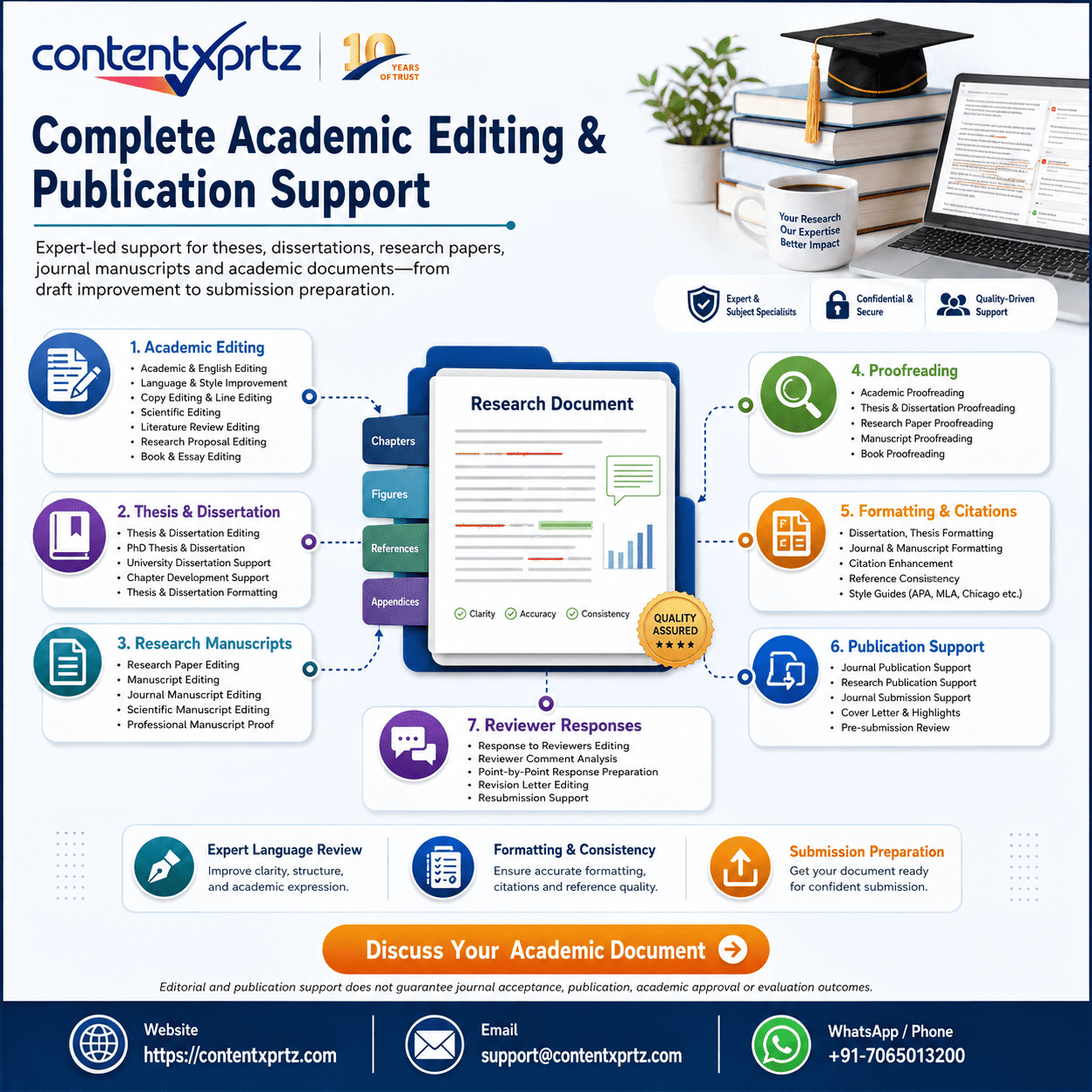
Contentxprtz can help authors prepare a clearer, more polished and journal-aligned manuscript while all editorial and publication decisions remain solely with the journal. For JOEPP-oriented work, support may include scope-alignment review, manuscript assessment, academic editing, proofreading, ESL language polishing, title and abstract refinement, journal formatting, Harvard-reference consistency checks, table and figure language review, cover-letter editing and reviewer-response editing.
Professional support is most useful when it improves the author’s own research communication: clarifying the contribution, strengthening logical flow, checking whether Policy and Practice implications are expressed clearly, and ensuring the manuscript follows the published author instructions. Contentxprtz does not control editors or reviewers and does not guarantee acceptance or publication.
Explore journal publication and manuscript-readiness support if you want an independent pre-submission review.
Summary: Journal of Organizational Effectiveness: People and Performance
Journal of Organizational Effectiveness: People and Performance is an Emerald Publishing journal focused on the people–performance relationship in organizational effectiveness. It is currently indexed in Scopus and ESCI, and its official page reports a 2025 CiteScore of 8.1 and a 2025 Journal Impact Factor of 3.3. JOEPP welcomes empirical, conceptual and review-oriented work with strong methodology and an explicit performance connection.
For prospective authors, the decisive issue is fit. The manuscript should contribute to HRM, organizational studies or related social science while showing why the question matters for performance, strategy, policy or practice. Before submission, confirm the current journal metrics, access route and author instructions on Emerald, then submit directly through the official ScholarOne system.
Frequently Asked Questions
What is Journal of Organizational Effectiveness: People and Performance?
It is an Emerald Publishing peer-reviewed journal focused on human resource management, people-management processes, organizational effectiveness and performance. It publishes empirical, conceptual and review-oriented work and addresses performance questions at multiple levels of analysis.
Who publishes Journal of Organizational Effectiveness: People and Performance?
Emerald Publishing publishes the journal. The official journal homepage, author instructions, editorial information and submission links are maintained on Emerald’s website.
Is Journal of Organizational Effectiveness: People and Performance indexed in Scopus?
Yes. Emerald currently lists the journal as abstracted and indexed in Scopus. The source record supplied for this article identifies Scopus Source ID 21100872102.
What are the ISSN and eISSN?
The ISSN is 2051-6614 and the eISSN is 2051-6622. The ISSN Portal record lists the journal as an English-language quarterly serial from the United Kingdom.
What is the journal’s 2025 CiteScore?
Emerald reports a 2025 CiteScore of 8.1. It also showed a 2026 CiteScore Tracker of 6.8 when this guide was prepared; the tracker updates monthly and is not the final annual CiteScore.
What is the journal’s Impact Factor?
Emerald reports a 2025 Journal Impact Factor of 3.3 and a 2025 five-year Impact Factor of 3.8. Always cite the reporting year because these values change annually.
What is the current quartile, SJR or SNIP?
The current SJR, SNIP and subject-category quartile were not displayed on the official Emerald page reviewed for this article. Verify them in the current applicable database and year before using them for a university or promotion requirement.
What types of manuscripts does JOEPP accept?
The submission system uses Research Paper as the paper type, with categories that include research paper, viewpoint, technical paper, conceptual paper, case study, literature review and general review.
How long should a manuscript be?
Emerald currently states 5,000–9,000 words, including the structured abstract, references, text in tables, figures and appendices, with an allowance of 280 words for each figure or table.
What abstract and keyword format is required?
A structured abstract is required with Purpose, Design/methodology/approach, Findings and Originality as mandatory headings. The total abstract limit is 250 words including keywords and article classification, and up to 12 keywords may be supplied.
What reference style does the journal use?
References must use a recognized Harvard style. Emerald provides its own Harvard guide but allows another recognized Harvard style, with consistency and accuracy remaining the author’s responsibility.
What peer-review model does JOEPP use?
The journal uses double-anonymous peer review. Authors therefore need to prepare an anonymous manuscript and keep identifying information in the separate submission fields or files requested by Emerald.
What is the acceptance rate and review time?
Emerald reports a 10.4% acceptance rate and 34 days to first decision for submissions between 1 April 2024 and 31 March 2025. These are historical journal-level averages, not guarantees for individual papers.
Is the journal open access and does it charge an APC?
JOEPP is a hybrid journal. Authors can choose gold open access after acceptance, in which case an APC may apply, or use Emerald’s green self-archiving route. The current APC amount should be verified on Emerald’s APC list or in the editorial system.
Is JOEPP suitable for PhD researchers?
It can be suitable when a doctoral manuscript matches the journal’s scope, makes a strong research contribution and meets the author guidelines. PhD scholars should also confirm whether the journal’s current indexing and ranking satisfy their university or supervisor requirements.

Planning to Submit Your Research to JOEPP?
Preparing for this journal involves more than grammar correction. A strong submission must fit the people-and-performance scope, communicate an original contribution, follow the structured abstract and manuscript requirements, present evidence clearly, and meet referencing and ethical standards.
Contentxprtz supports researchers, PhD scholars, academics and professionals with ethical manuscript preparation, including editing, proofreading, journal formatting, reference checks, manuscript assessment, cover-letter editing, reviewer-response support and publication-readiness review. Editorial decisions remain entirely with the journal, and no editing or publication-support service can guarantee acceptance.
Authoritative Sources and Official Links
- Emerald Publishing: JOEPP journal page, aims, metrics and author guidelines
- Scopus source profile: Source ID 21100872102
- ISSN Portal record for ISSN-L 2051-6614
- Official ScholarOne submission portal
- Committee on Publication Ethics (COPE)
Freshness note: journal metrics, acceptance statistics, editorial teams, indexing, APCs and author policies can change. Reconfirm current values on the official journal and database pages before making a submission or institutional-compliance decision.