Journal of Management & Organization: Scopus, Scope, Metrics & Submission Guide
Journal of Management & Organization (JMO) is an international peer-reviewed management journal published by Cambridge University Press in association with the Australian and New Zealand Academy of Management (ANZAM). Cambridge describes it as a Gold Open Access journal focused on research that improves understanding of management and organizational issues, with empirical and conceptual contributions both within its remit. For researchers evaluating the journal, the most useful questions are not only whether it is indexed in Scopus, but whether the manuscript fits its management audience, meets its double-anonymized review and formatting requirements, and is ready for a fully open-access publication route.
The supplied Scopus source record identifies the journal as Source ID 11700154614. Cambridge lists print ISSN 1833-3672 and online ISSN 1839-3527, with six issues per year. Current official Cambridge pages also show that its publishing model has changed: articles accepted from 3 February 2025 onward are published Gold Open Access. That change matters for authors because publication funding, institutional agreements, waivers and the listed article processing charge now form part of pre-submission planning.
This guide separates verified journal facts from practical publication advice. Metrics, fees, editorial roles and database classifications can change; verify time-sensitive details on the official journal and indexing pages before relying on them for university, PhD, promotion or funding requirements.
Quick Answer: What Is Journal of Management & Organization?
Journal of Management & Organization is the journal of ANZAM and is published by Cambridge University Press. It publishes international research on management and organizational questions, including empirical studies and conceptual work that advances or extends theory. The journal’s recent content spans organizational behaviour, leadership, human resource management, workplace well-being, entrepreneurship, SMEs, technology and AI in work, sustainability, innovation and other management topics.
For Scopus-focused researchers, the supplied source record gives Scopus Source ID 11700154614. A 2026 Cambridge-published bibliometric study describes the journal as indexed in both Scopus and Web of Science. Cambridge’s current journal metrics page displays an Impact Factor, CiteScore, SJR and SNIP, while a 2025 editorial reported Q1 positions in two Scopus management categories at that time. Because quartiles and metrics are reporting-year dependent, authors should confirm the live database record before using a ranking in formal institutional documentation.
JMO may be worth considering when a manuscript makes a clear contribution to management or organizational scholarship and can speak to an international research audience. Indexing alone is not enough: topic fit, theoretical positioning, methodological quality, contribution, manuscript length, anonymization, APA references, funding for open access and compliance with journal ethics all need to align.
Key Takeaways
- Publisher and society: Cambridge University Press publishes JMO in association with ANZAM.
- Identity: Print ISSN 1833-3672; online ISSN 1839-3527; supplied Scopus Source ID 11700154614.
- Scope: International management and organizational research, including empirical and conceptual contributions.
- Current Cambridge metrics: 2-year Impact Factor 3.2, 5-year Impact Factor 3.6, CiteScore 5.9, SJR 0.873 and SNIP 1.272, as displayed on the Cambridge metrics page checked in August 2026.
- Peer review: Double-anonymized; authors and reviewers do not know one another’s identities.
- Research Article length: 6,000–8,000 words excluding references, appendices, tables and figures; main document submitted in Word.
- Open access: Wholly Gold Open Access for current publication, with the listed APC applying when not covered or waived.
- No acceptance guarantee: neither indexing nor professional editing predicts an editorial outcome.
Journal Information at a Glance
| Field | Journal information |
|---|---|
| Journal name | Journal of Management & Organization (JMO) |
| Source type | Journal |
| Publisher | Cambridge University Press, in association with the Australian and New Zealand Academy of Management |
| Print ISSN | 1833-3672 |
| Online ISSN | 1839-3527 |
| Scopus Source ID | 11700154614 (supplied source record) |
| Frequency | 6 issues per year |
| Publication language | English |
| Peer review | Double-anonymized |
| Open access | Wholly Gold Open Access under Creative Commons licences |
| APC when required | GBP £2,610 / USD $3,655, plus applicable taxes; funding routes, waivers and discounts may apply |
| Research Article length | 6,000–8,000 words, excluding references, appendices, tables and figures |
| Reference style | APA 7th edition |
| Submission system | ScholarOne, linked from Cambridge Core |
Use this table as a screening aid rather than a substitute for the live author instructions. The journal has changed its access model recently, and metric values and editorial appointments are inherently time-sensitive.
What This Page Covers
- journal identity, publisher, society affiliation and publication frequency
- aims, scope and the kinds of management questions represented in recent content
- Scopus and Web of Science visibility, current Cambridge metrics and dated quartile context
- Research Article preparation, anonymization, abstract, keywords, tables, figures and APA references
- ScholarOne submission, ORCID and post-acceptance publishing steps
- double-anonymized peer review and what is not publicly stated about acceptance rate or review speed
- Gold Open Access, APCs, agreements, waivers and Creative Commons licensing
- journal-fit checks and publication-readiness guidance for researchers and PhD scholars
Methodology and Source Note
This profile was prepared from the official Cambridge journal homepage, journal information, author preparation instructions, peer-review information, fees page, the supplied Scopus source record, and recent Cambridge-published journal material discussing indexing and metrics. Where a current official value was not available or not clearly dated, this guide does not invent one.
Journal metrics, quartiles, APCs, waiver rules, editorial teams and submission policies may change between reporting cycles. The practical guidance below is publication-readiness advice, not an official Cambridge policy unless explicitly attributed to the journal.
What Does the Journal Aim to Publish?
JMO’s core aim is to publish research that deepens understanding of management and organizational issues. Cambridge explicitly invites novel empirical work and conceptual papers that extend understanding of existing theory. That combination makes the journal relevant to authors with data-driven studies as well as scholars developing, integrating or challenging management theory.
Recent JMO content illustrates a wide management canvas. Articles published or appearing in FirstView in 2026 include research on multiple job holding, managerial competencies and SME performance, psychological contracts and employee well-being, abusive supervision, psychosocial safety climate, hybrid work and dual-career couples, generative AI and creative process engagement, and organizational paradoxes. These examples should not be treated as a closed topic list. They show the type of management-and-organization framing that matters: the manuscript should illuminate behaviour, structures, practices, capabilities, relationships or outcomes that are meaningful to management scholarship.
Likely areas of fit
- organizational behaviour, leadership and employee experience
- human resource management, work design, well-being and workplace relationships
- strategy, entrepreneurship, SMEs and managerial capabilities
- technology, digital transformation, AI and changing work practices
- innovation, sustainability and governance where the management contribution is clear
- organizational theory, paradox, institutions and conceptual development
- international and comparative management questions with broader theoretical relevance
A paper may be less suitable when it treats a business topic descriptively without a meaningful management or organizational contribution, is primarily technical or disciplinary outside management, or offers a narrow local report without explaining why the findings matter to the journal’s broader scholarly audience.
Understanding Scopus, Web of Science and Journal Metrics
JMO has established visibility in major scholarly databases. The supplied source record identifies it in Scopus, and Cambridge-published scholarship describes the journal as indexed in Scopus and the Web of Science Core Collection. Cambridge also displays Journal Impact Factor and Scopus-derived metrics on its journal metrics page.
| Metric or status | Verified information | How to interpret it |
|---|---|---|
| Scopus Source ID | 11700154614 | Use this identifier to distinguish the correct journal in Scopus. |
| 2-year Impact Factor | 3.2 on Cambridge’s current metrics page | A journal-level citation indicator; do not use it to judge an individual paper or researcher. |
| 5-year Impact Factor | 3.6 on Cambridge’s current metrics page | Extends the citation window and may smooth short-term variation. |
| CiteScore | 5.9 on Cambridge’s current metrics page | Scopus-derived journal metric; value can change with reporting cycles. |
| SJR | 0.873 on Cambridge’s current metrics page | Weights citations based partly on the prestige of citing sources. |
| SNIP | 1.272 on Cambridge’s current metrics page | Normalizes citation impact for field differences. |
| Scopus quartile context | Q1 in Organizational Behavior & Human Resource Management and Q1 in Business & International Management reported by a JMO editorial for 5 May 2025 | Quartiles are category- and year-specific. Verify the current source profile before formal use. |
Researchers whose universities specify “Scopus Q1,” “Web of Science,” or a minimum Impact Factor should check the exact policy language. Some institutions recognise only a particular year, category or database snapshot. A journal’s index presence or quartile does not establish that every manuscript is a good fit, and it does not guarantee acceptance.
Who Should Consider Submitting?
JMO can be a plausible target for management researchers, doctoral scholars, faculty members and interdisciplinary teams whose central research question belongs to management or organization studies. A first-time or early-career author is not disqualified by career stage; what matters is whether the work is theoretically and methodologically credible, clearly communicated, and aligned with the journal’s readership.
A useful pre-submission test is to read several recent JMO articles that are close to your topic or method. Compare how they frame the management problem, establish a research gap, position theory, report methods and explain contribution. If your paper would feel out of place among those articles even after reasonable reframing, a different journal may be a stronger choice.
Three manuscript-fit examples
- Strong potential fit: a multi-wave study linking hybrid work arrangements to employee well-being through a clearly grounded organizational-behaviour mechanism.
- Potential fit if reframed: an AI adoption study focused mainly on software performance could become more relevant if the research question addresses managerial decision-making, employee behaviour, organizational capability or work design.
- Likely weak fit: a purely technical optimization paper with no substantive management or organizational question, even if tested in a business setting.
Preparing a Research Article for JMO
Cambridge’s current author instructions are specific enough that formatting mistakes can be prevented before submission. Research Articles should be 6,000–8,000 words excluding references, appendices, tables and figures. The main document is uploaded as a Word file, not a PDF, and the manuscript must be in English.
Title page and anonymized manuscript
Because JMO uses double-anonymized review, author details belong on a separate title page. Cambridge asks for author names, affiliations, addresses and email details, acknowledgements, competing-interest statements, a word count, short author biographies and ORCID information. The main manuscript should not reveal author identity.
Abstract, keywords and structure
The abstract should be no more than 150 words and the paper may include up to five keywords. Cambridge recommends concise headings; a conventional empirical structure may include literature review, method, results, discussion and references, but the intellectual logic of the paper should determine the exact organization.
Tables, figures and references
Tables and figures should be self-explanatory, correctly sourced, separately numbered and cited in the main text. Cambridge instructs authors to upload them separately from the main document and label them clearly. References must follow APA 7th edition, with complete and accurate bibliographic information and an alphabetical reference list containing only works cited in the manuscript.
| Check | Practical action |
|---|---|
| Scope fit | State the management or organizational contribution in one or two sentences and compare it with recent JMO papers. |
| Length | Keep the Research Article within 6,000–8,000 words excluding specified items. |
| Anonymization | Remove author-identifying information from the main document and use a separate title page. |
| Abstract | Limit to 150 words and make the problem, approach, principal result and contribution easy to identify. |
| Keywords | Use no more than five accurate terms that reflect the manuscript. |
| References | Check every in-text citation against the APA 7 reference list and verify DOI/details from original sources. |
| Declarations | Prepare competing-interest and other required statements honestly and completely. |
| ORCID | Ensure the corresponding author can identify themselves with ORCID in ScholarOne. |
How Submission and Peer Review Work
Submissions are made through the online system linked from Cambridge Core; JMO’s instructions refer to ScholarOne. Corresponding authors are required to identify themselves using ORCID during submission. Before uploading files, use the official Cambridge submission link rather than an unofficial third-party website.
The journal uses double-anonymized peer review. Neither authors nor reviewers know the identity of the other side during review. In practical terms, anonymization is not a cosmetic step: self-identifying acknowledgements, file metadata, institutional wording, self-citations written in a revealing way or author details left in figures can compromise the process.
The official review-process page reviewed for this guide states the review model but does not publish a journal-wide acceptance rate or a guaranteed average review time. Do not treat third-party estimates as official. If a deadline depends on review speed, ask the journal directly or check whether Cambridge later publishes journal-specific statistics.
Gold Open Access, APCs and Author Funding
JMO is currently a wholly Gold Open Access journal. Cambridge states that articles accepted from 3 February 2025 are published under a Creative Commons licence and made freely available online. This is a significant change from earlier subscription-supported publishing, so authors reading older articles or third-party journal profiles may encounter outdated descriptions.
The current fees page lists an APC of £2,610 GBP or $3,655 USD when an APC is required, with additional taxes potentially applicable. That headline price does not mean every author pays it personally. Cambridge describes multiple funding routes, including institutional open-access agreements, third-party funding, equity initiatives, waivers and discounts. Authors should use the journal’s current open-access options and eligibility tools before budgeting the full APC.
After acceptance, Cambridge requires a publishing agreement. JMO offers Creative Commons licence options including CC BY, CC BY-NC-ND and CC BY-NC-SA. Authors should select the licence that satisfies funder and institutional rules while understanding the reuse rights it grants readers.
Publication Ethics and Research Integrity
JMO operates within Cambridge’s publishing-ethics framework. Its author instructions require original work that is not simultaneously under consideration elsewhere, appropriate permissions for third-party material, accurate acknowledgements, competing-interest declarations and responsible authorship. Preprints are not automatically treated as prior publication, but authors should follow Cambridge’s current preprint policy.
For a publication-ready submission, ethics also means that citations genuinely support the claims made, data and methods are represented truthfully, contributor roles are defensible, and any use of editing or AI tools complies with relevant journal and institutional rules. Professional manuscript support should improve communication and compliance without fabricating data, references, authorship, peer reviewers or research contributions.
What Happens After Acceptance?
Once a manuscript is accepted, Cambridge asks the corresponding author to complete an Author Information Form and sign the publishing agreement before production. Copyediting, typesetting, proofing and publication then follow. JMO uses Cambridge’s FirstView system, allowing accepted articles to be published online with a DOI before assignment to a print issue.
FirstView is important for planning citations and institutional reporting because an online FirstView article is already a published article, not merely an accepted manuscript. Cambridge also warns that no further revisions can be made after FirstView publication except through the formal corrections process, so proof checking deserves careful attention.
How to Decide Whether JMO Is the Right Journal
A strong journal-selection decision combines scope, evidence of topic fit, readership, publication model and institutional recognition. Use the following sequence rather than choosing on a metric alone:
- Define the paper’s central contribution. Is it fundamentally about management or organizations?
- Inspect recent JMO articles. Look for conceptual and methodological neighbours, not only matching keywords.
- Check database requirements. Confirm current Scopus/Web of Science status and the applicable category or quartile if your institution mandates one.
- Check format feasibility. Can the paper fit the 6,000–8,000-word Research Article requirement without damaging the argument?
- Plan open-access funding. Determine whether your institution or funder has a Cambridge agreement or whether a waiver/discount route applies.
- Assess contribution strength. A technically correct paper can still be unsuitable if it does not advance a conversation that JMO readers care about.
For PhD scholars, the additional question is whether your university recognises this journal and this specific indexing/ranking year for degree requirements. University rules vary, so obtain written confirmation rather than relying solely on a journal webpage or general ranking list.
How to Strengthen a Journal-Aligned Manuscript
As a practical publication-readiness step, make the paper’s management contribution visible early. The introduction should explain the problem, the unresolved gap, why the gap matters, and what the study changes in the relevant literature. Avoid treating a fashionable context—AI, hybrid work, sustainability or another topical setting—as a contribution by itself. The contribution comes from what the study reveals, explains, tests, develops or challenges.
For empirical work, align the research question, theory, design, measures, analysis and claims. Avoid causal language when the design supports only association. Discuss limitations in a way that helps readers judge boundary conditions rather than treating the limitations section as a formality. For conceptual work, define constructs precisely, establish why current theory is insufficient, and show how the proposed framework creates genuinely new explanatory value.
Language editing can improve readability, especially for international or ESL authors, but clarity should not erase disciplinary precision or the author’s own scholarly voice. References should be audited rather than mechanically reformatted: verify that each cited source exists, was read, supports the sentence, and is represented accurately.
How Contentxprtz Can Support Publication Readiness
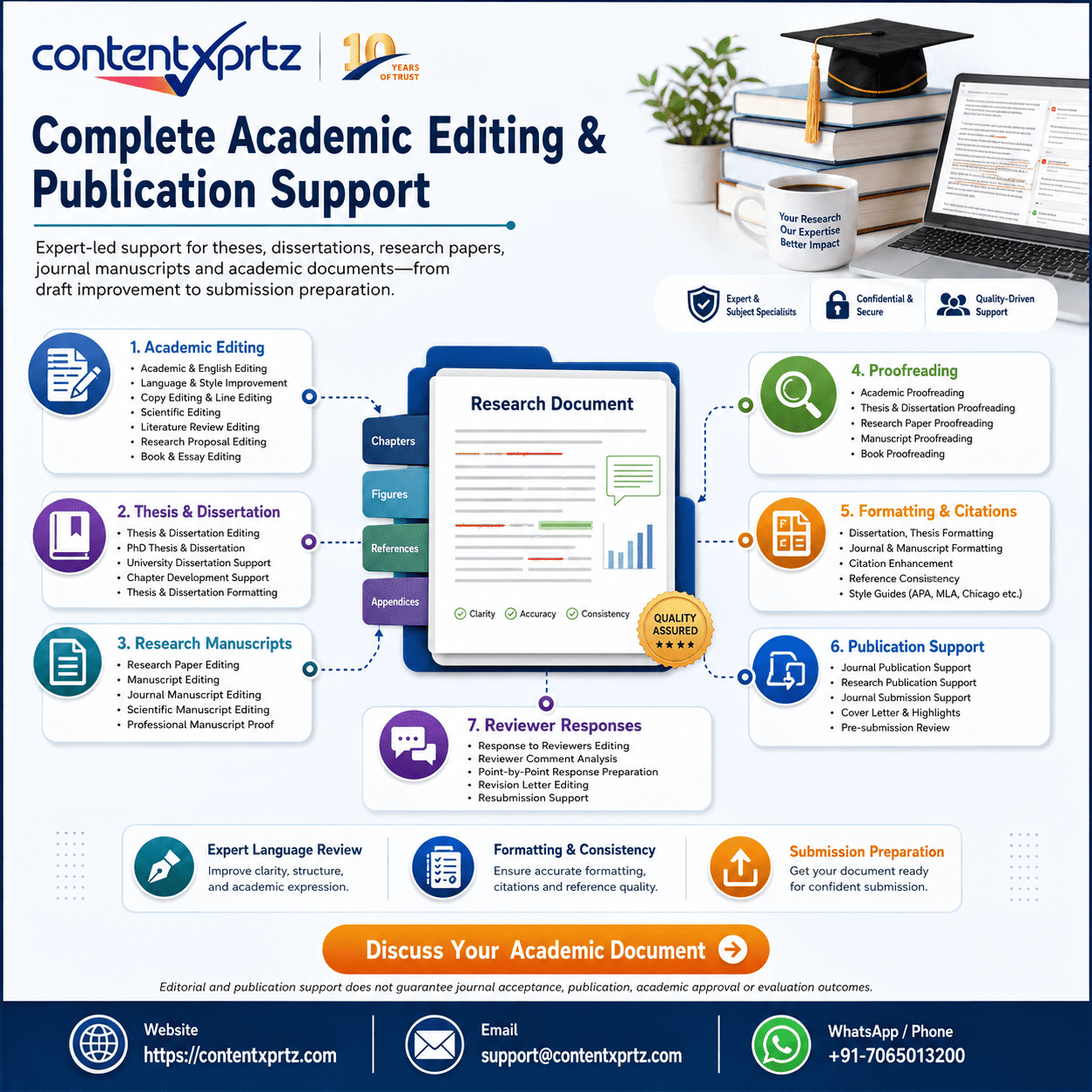
Contentxprtz can support authors preparing for JMO through ethical journal publication services, including manuscript assessment, academic editing, proofreading, journal-alignment review, APA reference checking, formatting support, cover-letter editing and reviewer-response editing. Support can also help a thesis chapter become a focused journal manuscript while keeping the underlying research, analysis and authorship responsibility with the researcher.
Professional support cannot guarantee acceptance, publication, peer-review success, indexing or citation impact. JMO’s editors and reviewers make independent decisions based on the submitted research. The safest objective is therefore to make the manuscript clearer, more accurate, more compliant and better aligned with the journal—not to promise an outcome.
Preparing a manuscript for Journal of Management & Organization?
Get publication-readiness support for structure, language, references, journal alignment and submission materials while preserving your research ownership and academic integrity.
Summary
Journal of Management & Organization is a Cambridge University Press management journal associated with ANZAM, with print ISSN 1833-3672, online ISSN 1839-3527 and supplied Scopus Source ID 11700154614. It publishes empirical and conceptual research on management and organizational issues, uses double-anonymized peer review, requires 6,000–8,000-word Research Articles in Word format, and uses APA 7th edition references.
Its current publication model is wholly Gold Open Access, and Cambridge lists an APC when required while also offering institutional funding arrangements and waiver or discount routes. Current metric values and quartiles should be treated as dated, changeable indicators rather than promises of prestige or acceptance. The most defensible submission decision is one that combines verified indexing with strong topic fit, a clear contribution, methodological rigour, ethical compliance and careful manuscript preparation.
Frequently Asked Questions
What is the Journal of Management & Organization?
Journal of Management & Organization (JMO) is an international, peer-reviewed management journal published by Cambridge University Press in association with the Australian and New Zealand Academy of Management. It publishes empirical and conceptual research intended to deepen understanding of management and organizational issues.
Who publishes the Journal of Management & Organization?
Cambridge University Press publishes Journal of Management & Organization in association with the Australian and New Zealand Academy of Management (ANZAM).
Is Journal of Management & Organization indexed in Scopus?
Yes. The journal is identified by Scopus Source ID 11700154614 in the supplied source record, and Cambridge-published journal material describes JMO as indexed in Scopus. Authors whose institution requires current Scopus coverage should still confirm the live Scopus source profile immediately before submission.
What is the Scopus Source ID of Journal of Management & Organization?
The supplied Scopus source record identifies Journal of Management & Organization with Source ID 11700154614. Use the source ID together with the journal title and ISSNs to avoid confusing it with similarly named journals.
What are the ISSN and EISSN of Journal of Management & Organization?
Cambridge lists ISSN 1833-3672 for print and 1839-3527 for online publication.
What subjects does Journal of Management & Organization cover?
The journal focuses on management and organizational issues. Recent publications and the journal’s scope show coverage spanning organizational behaviour, human resource management, leadership, workplace relationships and well-being, management practice, entrepreneurship and SMEs, technology and AI at work, sustainability, innovation, and related management questions.
What are the current metrics for Journal of Management & Organization?
Cambridge’s journal metrics page, checked in August 2026, displays a 2-year Impact Factor of 3.2, 5-year Impact Factor of 3.6, CiteScore of 5.9, SJR of 0.873 and SNIP of 1.272. Metrics change across reporting cycles, so authors should verify the latest values before using them for institutional decisions.
Is Journal of Management & Organization Q1?
A Cambridge journal editorial reported that on 5 May 2025 JMO was Q1 in Organizational Behavior and Human Resource Management and Q1 in Business and International Management in Scopus. Quartiles can change by year and category, so verify the latest Scopus classification for current university or PhD requirements.
Is Journal of Management & Organization open access?
Yes. Cambridge currently describes JMO as a wholly Gold Open Access journal. Articles accepted from 3 February 2025 are published open access under a Creative Commons licence, with institutional agreements, funded APCs, waivers and other Cambridge funding routes available depending on author circumstances.
What is the APC for Journal of Management & Organization?
Cambridge’s fees page currently lists an APC of GBP 2,610 or USD 3,655 when an APC is required, with possible additional taxes. Cambridge also states that institutional agreements, equity initiatives, waivers and discounts may cover or reduce the charge, so authors should check eligibility before assuming they must pay the full amount.
What manuscript length does Journal of Management & Organization require?
For Research Articles, Cambridge’s current author instructions specify 6,000–8,000 words excluding references, appendices, tables and figures. The main document must be uploaded as a Word document rather than a PDF.
What reference style does Journal of Management & Organization use?
The journal requires complete and accurate references formatted according to APA 7th edition. The reference list should include only works cited in the text and be ordered alphabetically by the first author’s surname.
What peer-review model does Journal of Management & Organization use?
Cambridge states that JMO uses double-anonymized peer review: authors and reviewers do not know each other’s identities. Authors therefore submit a separate title page and an anonymized main document.
Does Journal of Management & Organization publish an acceptance rate or review time?
The official pages reviewed for this guide do not publicly state a journal-wide acceptance rate or a guaranteed average peer-review duration. Authors should not rely on unofficial estimates; contact the journal or consult current official publishing statistics if those figures are important to a deadline.
Can Contentxprtz guarantee publication in Journal of Management & Organization?
No. Contentxprtz can ethically support manuscript assessment, language editing, proofreading, journal alignment, formatting, references, cover-letter preparation and reviewer-response editing, but editorial decisions remain entirely with the journal. Professional support cannot guarantee acceptance, peer-review success, indexing or publication.
Conclusion: Verify the Current Guidelines, Then Submit on Fit
JMO may be a strong target for research that speaks directly to management and organizational scholarship and can engage an international audience. Before submitting, confirm the current Cambridge author instructions, live Scopus or Web of Science record required by your institution, open-access funding route and any policy updates that have appeared since this guide was prepared.
Then focus on what editors and reviewers can actually assess: a clear research problem, credible methods or conceptual reasoning, a well-supported contribution, accurate references, ethical declarations and a manuscript that follows the journal’s technical requirements. Contentxprtz can provide optional publication-readiness support, but acceptance and publication remain entirely within the journal’s independent editorial process.