Journal of International Education in Business: Scopus, Metrics, Scope & Submission Guide
The Journal of International Education in Business (JIEB) is a peer-reviewed Emerald Publishing journal focused on international education in business schools and the implications of internationalised business education for students, institutions and workplaces. Its scope includes cross-cultural and intercultural dimensions of internationalisation, business-school teaching and learning, student engagement, international recruitment and marketing, quality processes, and the role of global organisations as stakeholders in international education.
For researchers asking whether the journal is legitimate, visible in major databases, suitable for a PhD publication requirement, or aligned with a manuscript on international business education, the strongest starting point is the official Emerald journal page. Emerald currently lists JIEB as indexed in Scopus and ERIC and ranked in Clarivate's Emerging Sources Citation Index. The journal page reports a 2025 CiteScore of 5.7, a 2025 Journal Impact Factor of 2.5, and a 26.9% acceptance rate for submissions received between 1 April 2024 and 31 March 2025.
Those indicators are useful, but they should not replace a manuscript-fit assessment. Researchers should compare their research question, context, theoretical framing, methods and contribution with JIEB's stated scope and recently published articles before submitting. Metrics, indexing coverage, editorial teams, fees and timelines can change, so the current official pages should always be reconfirmed immediately before submission.
Quick Answer: What Is the Journal of International Education in Business?
The Journal of International Education in Business is an Emerald Publishing journal covering research at the intersection of business education and internationalisation. It welcomes theoretical and empirical work, qualitative and quantitative studies, and case analyses that examine international education, intercultural learning, global business-school environments and related stakeholder or workplace implications.
Its print ISSN is 2046-469X and its online ISSN is 1836-3261. The supplied Scopus Source Record ID is 21100446217. Emerald identifies the title as indexed in Scopus and ERIC, and ranked in the Emerging Sources Citation Index. For authors, the journal is most relevant when the manuscript's central contribution is clearly connected to international or cross-cultural dimensions of business education rather than to general management research with only a peripheral education element.
Key Takeaways for Researchers
- Publisher: Emerald Publishing.
- Core subject: internationalisation and intercultural dimensions of business education, business-school teaching and learning, student engagement, quality and global stakeholder involvement.
- Scopus: Emerald lists JIEB as Scopus-indexed; supplied Source Record ID 21100446217.
- Current metrics displayed by Emerald: 2025 CiteScore 5.7; 2026 CiteScore Tracker 5.8; 2025 Impact Factor 2.5; 2025 five-year Impact Factor 2.6.
- Peer review: double-anonymous review, normally involving at least two independent referees after editorial screening.
- Article length: generally 6,000–8,000 words under the current author guidelines.
- Submission: directly by the corresponding author through the journal's ScholarOne system; Emerald explicitly says submissions should not be made through third-party proxies.
- Open access: hybrid model with optional gold OA and a green self-archiving route; current fees should be confirmed before choosing gold OA.
Journal Information at a Glance
| Field | Journal information |
|---|---|
| Journal name | Journal of International Education in Business (JIEB) |
| Source type | Peer-reviewed scholarly journal |
| Scopus Source ID | 21100446217 |
| Print ISSN | 2046-469X |
| eISSN | 1836-3261 |
| Publisher | Emerald Publishing |
| Publication language | English |
| Primary subject area | International business education; business, management and education |
| Scopus status | Listed by Emerald as abstracted and indexed in Scopus; verify current Scopus profile before submission |
| CiteScore | 5.7 (2025); CiteScore Tracker 5.8 for 2026 as displayed by Emerald |
| SJR / SNIP / current Scopus quartile | Verify current values directly in the latest Scopus source profile; not reproduced here without a directly verifiable current official value |
| Journal Impact Factor | 2.5 (2025) |
| Five-year Impact Factor | 2.6 (2025) |
| Acceptance rate | 26.9% for submissions 1 Apr 2024–31 Mar 2025 |
| Time to first decision | 60 days, based on the reporting period shown by Emerald |
| Acceptance to publication | 28 days, last updated by Emerald in April 2025 |
| Peer-review model | Double-anonymous; at least two independent referees for suitable submissions |
| Open access | Hybrid: optional gold OA plus green self-archiving |
| 2026 hybrid gold OA APC | Emerald standard rate: £3,222 / US$4,351 / €3,710 plus applicable tax; verify current rate and agreements |
| Official website | Emerald JIEB journal page |
| Scopus profile | Scopus Source ID 21100446217 |
What This Page Covers
- JIEB aims, scope and subject coverage
- Scopus and other indexing information
- current journal metrics that can be verified from Emerald
- article types and manuscript requirements
- double-anonymous peer review and editorial screening
- open-access routes, APC context and self-archiving
- journal-fit and publication-readiness checks
- ethical ways Contentxprtz can support preparation without promising acceptance
Methodology and Sources
This profile was prepared primarily from the official Emerald Publishing page for JIEB, its author guidelines, current journal metrics displayed by Emerald, and the supplied Scopus source record information. The guide distinguishes verified journal facts from practical publication guidance. Where a current value such as SJR, SNIP or Scopus quartile was not directly verified from an official accessible source during preparation, the article directs researchers to confirm it rather than reproducing a potentially stale third-party figure.
Because journal information changes, authors should reconfirm indexing, metrics, editorial leadership, open-access charges and manuscript instructions immediately before submission. A university's doctoral or promotion rules may also use a specific reporting year or database snapshot, so “currently indexed” does not automatically answer every institutional eligibility question.
Journal Aims and Scope
JIEB's stated scope centres on international education in business and the ways internationalisation shapes business schools, learners and stakeholders. Emerald specifically identifies international education; cross- and inter-cultural aspects of internationalisation; internationalisation of business schools; business-school teaching and learning; academic and social engagement of students; recruitment and marketing of business education in international contexts; quality processes related to internationalisation; and global organisations as stakeholders of internationalisation.
The journal invites theoretical and empirical research, including both qualitative and quantitative work, as well as case analyses. It also accepts micro- and macro-level perspectives. In practical terms, that creates room for studies ranging from individual student experiences and intercultural competence to institutional internationalisation strategies, curriculum design, global partnerships, recruitment systems, quality assurance and employer or organisational engagement.
Topics likely to align well
- international, transnational or cross-border business education;
- intercultural competence, cross-cultural learning and international student experience;
- business-school curriculum internationalisation and global learning design;
- student engagement, employability and learning in internationally diverse cohorts;
- international student recruitment, marketing and mobility in business education;
- quality assurance, accreditation and internationalisation processes in business schools;
- global project learning, virtual collaboration and international experiential education;
- relationships between business schools, employers and global organisations.
Potentially weak fit
A manuscript may be less suitable when it is primarily about a general business topic—such as consumer behaviour, finance, operations or entrepreneurship—without a meaningful education, internationalisation or cross-cultural dimension. Likewise, a general higher-education paper may require a clear business-school or business-education connection to fit JIEB's identity. This is an editorial-fit interpretation, not an exhaustive list of exclusions.
What Types of Articles Does JIEB Publish?
During submission, Emerald's guidelines list classifications including Research Paper, Book Review, Editorial, Technical Paper, Viewpoint, Conceptual Paper, Case Study and Literature Review. The appropriate classification should match what the manuscript actually does rather than being selected for strategic reasons.
For a research article, authors should make the international-business-education contribution explicit in the title, abstract, literature review and discussion. A literature review should do more than catalogue prior publications: it should articulate a defensible review method, synthesise the field and identify a meaningful conceptual or research agenda. A case study should explain why the case yields insight beyond the local institution. Conceptual papers should establish a clear theoretical contribution and connection to the journal's audience.
Who Should Consider Submitting?
JIEB may be a reasonable candidate for academics and researchers in international business education, management education, higher education internationalisation, cross-cultural management education, student engagement and related areas. It may also suit professionally oriented researchers whose studies examine how global organisations influence or benefit from internationalised business education.
For PhD scholars, the journal's Scopus listing and Clarivate metric visibility may be relevant to institutional publication requirements. However, doctoral candidates should verify the exact rule used by their university—such as the required database, quartile, indexing year, authorship position or acceptance/publication date—before deciding that a journal satisfies a formal milestone.
Indexing and Scholarly Visibility
Emerald currently states that JIEB is abstracted and indexed by the Australian Education Index, Australian Business Deans Council, Chartered Association of Business Schools Academic Journal Guide, Scopus, Publication Forum (Finland), and ERIC. It also states that the journal is ranked by the Emerging Sources Citation Index (Clarivate Analytics) and Scopus.
For researchers whose primary concern is “Is JIEB Scopus indexed?”, the answer based on the official publisher page is yes. The supplied source record identifies Scopus Source ID 21100446217. Nevertheless, Scopus coverage can be updated over time, and institutional committees sometimes require evidence from a particular date. Save or record the official source profile used for your decision.
Journal Metrics: CiteScore, Impact Factor and Timelines
Emerald reports a 2025 CiteScore of 5.7 and a 2026 CiteScore Tracker of 5.8. The tracker is updated monthly and should be treated as an interim indicator rather than a completed annual metric. Emerald also displays a 2025 Journal Impact Factor of 2.5 and a 2025 five-year Impact Factor of 2.6.
The journal page lists a 60-day time to first decision, based on submissions between 1 April 2024 and 31 March 2025. It also lists 28 days from acceptance to publication, last updated in April 2025. These are journal-level historical averages or targets, not guarantees for a particular paper; review complexity, reviewer availability, revisions and editorial decisions can lengthen or shorten an individual manuscript's path.
Emerald also reports a 26.9% acceptance rate for the same April 2024–March 2025 submission period. Authors should not interpret that rate as an individual probability. Editorial fit, novelty, methodological quality, ethical compliance, clarity and reviewer assessment remain manuscript-specific.
Manuscript and Formatting Requirements
| Requirement | Current Emerald guidance for JIEB |
|---|---|
| File format | Microsoft Word is expected. A PDF may accompany the Word file but PDF alone is not acceptable. LaTeX can be used with an accompanying PDF. |
| Article length | 6,000–8,000 words, including structured abstract, references, tables, figures and appendices; allow 280 words for each figure or table. |
| Abstract | Structured abstract with Purpose, Design/methodology/approach, Findings and Originality; optional Research limitations/implications, Practical implications and Social implications. Maximum 250 words including keywords and classification. |
| Keywords | Up to 12 short, appropriate keywords. |
| References | Recognised Harvard style; references should be complete, accurate and consistent. |
| Author information | Author details are entered in ScholarOne. Biographies and acknowledgements, if used, should be separate files to protect anonymous review. |
| Funding | External research funding must be acknowledged, including the funder's role in the research process. |
| Anonymisation | Remove author-identifying information from the review manuscript, including self-identifying wording and names in figures or captions. |
Before uploading, compare every component of the manuscript against the live author-guidelines page. Small deviations—especially missing anonymisation, an unstructured abstract, excessive length or incomplete references—can create avoidable delays or editorial screening problems.
Submission Process and Peer Review
Emerald states that JIEB submissions must be made through the journal's ScholarOne system by the corresponding author. The publisher explicitly says the journal does not accept submission by email or through a third-party agent, company, journal representative or proxy. Professional support may help an author prepare files and understand requirements, but the author should control and complete the actual journal submission.
After submission, the editorial office screens the manuscript for policy compliance, aims and scope, language and overall manuscript quality. Papers that pass this stage are sent to at least two independent referees under a double-anonymous peer-review model. Following the reports, the editor may accept, request minor or major revision, or reject the paper.
For publication readiness, anonymisation deserves a final dedicated check. Author names should not appear in the review manuscript, acknowledgements and biographies should be separate, and self-citations should be phrased so they do not directly identify the author. Links to repositories or supplementary files should also be checked for identity leakage when anonymity matters.
Open Access and Publication Fees
JIEB operates as a hybrid journal. Authors can publish conventionally under the journal's subscription model or choose gold open access. Emerald states that gold OA can be selected after acceptance and uses a Creative Commons CC BY 4.0 licence. The publisher's 2026 standard APC for hybrid journals is £3,222 / US$4,351 / €3,710, plus VAT or other applicable tax.
Because publishing agreements, institutional coverage, waivers and pricing can change, authors should verify the actual amount and their eligibility before committing funds. The journal page also describes a green open-access route: after the article is published, the author accepted manuscript can be made openly available without payment or an embargo period, subject to Emerald's current policy terms.
Research and Publication Ethics
Emerald states that its journals follow research and publishing ethics guidance informed by the Committee on Publication Ethics (COPE). Submissions should be original, should not be under consideration elsewhere, and should disclose conflicts of interest. Authors are responsible for appropriate permissions, research integrity and, where human participants are involved, considering and reporting the required ethical approval.
The guidelines also address AI use. Large language models cannot be credited as authors. Where AI-created or AI-modified content falls within Emerald's disclosure guidance, authors must describe its use and appropriately identify the tool; routine spelling and grammar tools are treated differently. Researchers should check the current publisher policy because AI disclosure rules continue to evolve.
Similarity checking may be used as part of editorial assessment. Ethical manuscript preparation therefore means correcting source attribution, paraphrasing faithfully, citing primary evidence and eliminating accidental text overlap—not trying to “beat” a detector or disguise copied material.
How to Decide Whether JIEB Fits Your Manuscript
- Write your contribution in one sentence. It should state what your study adds to international business education, intercultural learning or business-school internationalisation.
- Map the manuscript to at least one explicit scope area. If the connection is indirect, desk-rejection risk is likely higher.
- Review recent JIEB papers. Compare research questions, populations, theories, methods and the level of practical or pedagogical implication.
- Check audience fit. Ask whether readers concerned with international business education would learn something material from the paper.
- Assess method-to-claim alignment. Qualitative, quantitative and case methods are within scope, but the evidence must support the strength of the conclusions.
- Confirm institutional eligibility separately. Do not rely on a journal's broad indexing status to infer compliance with a specific PhD or promotion rule.
If uncertainty remains after reading the aims and scope, Emerald's guidance says authors may contact the editor with the paper title and structured abstract to ask about suitability.
Publication-Readiness Checklist Before Submission
- The title signals the international business-education contribution rather than only the broad management topic.
- The structured abstract follows JIEB's required headings and stays within the current limit.
- The literature review explains a genuine gap and connects it to JIEB's readership.
- The methodology is transparent enough for reviewers to assess design, sample, analysis and limitations.
- Findings are distinguished from interpretation and are not overstated.
- The discussion explains theoretical, pedagogical, institutional or practical implications that follow from the evidence.
- References are complete and consistent in a recognised Harvard style.
- Ethics approval, consent, funding and conflicts are disclosed where applicable.
- The review manuscript is fully anonymised.
- Word count, tables, figures, appendices and supplementary files conform to the current instructions.
- The corresponding author is ready to submit directly through ScholarOne and respond to editorial queries.
Common Reasons a Manuscript May Be Unsuitable
Even technically sound research may struggle if the international-education connection is weak, the business-school context is incidental, the paper offers limited theoretical or pedagogical contribution, or the manuscript does not make its relevance to JIEB's readership explicit. Other avoidable problems include incomplete anonymisation, excessive word count, unclear English, weak abstract structure, inconsistent citations, insufficient methodological detail, unsupported claims and missing ethics or permission information.
These are practical risk indicators rather than an official rejection checklist. Editorial decisions remain the journal's responsibility, and a manuscript can be declined for reasons that are not predictable from public information.
How Contentxprtz Can Support Ethical Publication Readiness
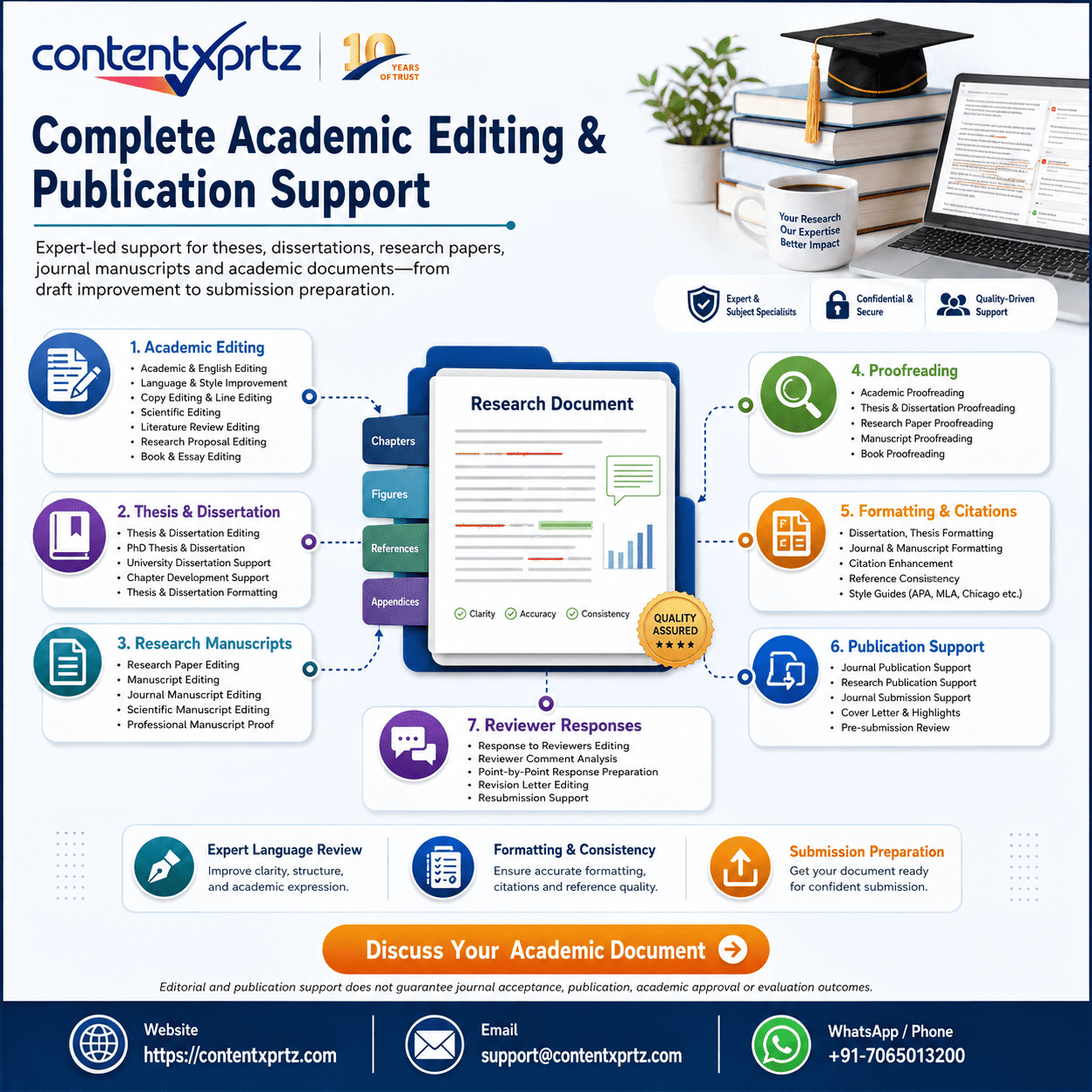
Contentxprtz can support researchers with academic editing, proofreading, journal-format alignment, reference and citation consistency, structured-abstract refinement, manuscript assessment, cover-letter editing, reviewer-response editing and publication-readiness review. For authors working in English as an additional language, editing can also improve sentence clarity and academic tone while preserving the researcher's intended meaning.
Support should remain transparent and author-led. Contentxprtz does not replace the researcher's responsibility for study design, data, analysis, source verification, ethical approval, authorship decisions or final submission. Because Emerald requires authors to submit directly through ScholarOne, Contentxprtz should not act as a proxy submitter. No editing or publication service can guarantee acceptance, peer-review success, indexing or publication.
Preparing a manuscript for JIEB?
Use professional support to improve clarity, formatting, references and journal alignment—while keeping authorship, evidence and submission decisions with the researcher.
Explore Journal Publication ServicesAuthoritative Sources Used
- Emerald Publishing — Journal of International Education in Business: aims and scope, author guidelines, editorial process, metrics, indexing and journal information.
- Scopus — Source ID 21100446217: supplied journal source record for verification.
- Emerald Publishing — Open access journals and APCs: current hybrid-journal gold OA fee and OA routes.
Frequently Asked Questions
Is the Journal of International Education in Business indexed in Scopus?
Yes. Emerald lists Scopus among the databases that abstract and index the Journal of International Education in Business. The supplied Scopus Source Record ID is 21100446217. Authors should still verify current indexing status in Scopus before using the journal for institutional or doctoral requirements.
What is the 2025 CiteScore of the Journal of International Education in Business?
Emerald reports a 2025 CiteScore of 5.7 and a 2026 CiteScore Tracker of 5.8, updated monthly. Citation metrics can change with each reporting cycle.
What is the Journal of International Education in Business Impact Factor?
Emerald reports a 2025 Journal Impact Factor of 2.5 and a 2025 five-year Impact Factor of 2.6, sourced from Clarivate metrics displayed on the journal page.
What is the acceptance rate for the Journal of International Education in Business?
Emerald reports a 26.9% acceptance rate based on submissions received between 1 April 2024 and 31 March 2025. This is historical journal data, not a prediction of acceptance for any individual manuscript.
How long does peer review take at the Journal of International Education in Business?
Emerald lists 60 days as the time to first decision for the reporting period shown on the journal page. The journal uses double-anonymous peer review and normally sends suitable manuscripts to at least two independent referees.
What is the word limit for Journal of International Education in Business articles?
The current Emerald author guidelines state that articles should normally be 6,000 to 8,000 words, including the structured abstract, references, tables, figures and appendices, with 280 words allowed for each figure or table.
What reference style does the journal use?
The journal accepts recognised Harvard referencing styles. Emerald provides its own Harvard guide, while noting that other recognised Harvard variants are acceptable if references are complete, accurate and consistent.
Is the Journal of International Education in Business open access?
It is a hybrid Emerald journal. Authors may choose gold open access after acceptance or use Emerald green open access/self-archiving. Emerald states that its author accepted manuscript may be made openly available after publication without an embargo.
What is the APC for gold open access?
Emerald lists a 2026 standard hybrid-journal APC of £3,222, US$4,351 or €3,710, plus applicable tax. Authors should verify the current price, agreements, waivers and funding eligibility at the time of submission or acceptance.
Can Contentxprtz guarantee acceptance in this journal?
No. Ethical editing and publication-readiness support can improve clarity, structure, formatting and compliance, but neither Contentxprtz nor any legitimate service can guarantee peer-review success, acceptance or publication.
Conclusion: Is JIEB a Good Journal Choice for Your Research?
The Journal of International Education in Business is a credible, peer-reviewed Emerald title with explicit Scopus indexing on the publisher page, current Clarivate and Scopus citation metrics, and a clear specialist focus on international and intercultural dimensions of business education. For a manuscript whose main contribution sits squarely within international business-school education, cross-cultural learning, student engagement, internationalisation strategy or related stakeholder issues, JIEB can be a logically aligned journal to evaluate.
The final decision should depend on fit rather than metrics alone. Compare your manuscript with recent papers, follow the 6,000–8,000-word and structured-abstract requirements, anonymise carefully for double-anonymous review, verify the live author instructions, and submit directly through ScholarOne. If you choose publication-readiness support, use it to strengthen clarity and compliance—not as a promise of acceptance.
At Contentxprtz, we don’t just edit; we help ideas reach their fullest potential.