Journal of Air Transport Management: Scopus, Scope & Submission Guide
Journal of Air Transport Management (JATM) is an Elsevier journal for research and informed commentary on the economic, management and policy questions shaping air transport. Its official scope spans airlines, airports and air traffic management, while also connecting aviation with tourism management, logistics, regulation, strategy, operations, marketing, finance and sustainability.
For an author evaluating this journal, the key question is not simply whether a paper is “about aviation.” A stronger fit is a manuscript that explains a meaningful air-transport problem, uses a defensible research design, and makes a contribution that matters to researchers, industry decision-makers or policy stakeholders. Elsevier currently lists the journal in Scopus and the Social Sciences Citation Index (SSCI), and the supplied Scopus source profile identifies Source ID 20532.
This guide combines verified journal facts with clearly labelled publication-readiness guidance. Metrics, fees, editorial roles and submission instructions can change, so use the linked official sources to reconfirm critical details before submitting.
Quick Answer: What Is Journal of Air Transport Management?
Journal of Air Transport Management is an international journal of research, policy and practice published by Elsevier. It addresses major economic, management and policy issues affecting the air transport industry and is intended to connect academic research with real-world aviation practice.
The official scope includes the major industry sectors—airlines, airports and air traffic management—and related areas such as tourism management and logistics. The journal is currently listed by Elsevier as indexed in Scopus and SSCI. Researchers working on aviation strategy, regulation, operations, markets, finance, sustainability, customer behaviour, innovation or industry structure may find it relevant when their research question is clearly anchored in air transport.
Before submission, verify the latest Guide for Authors, the live submission options, current APC, indexing status and any university or PhD requirements that apply to your publication.
Key Takeaways for Researchers
- Publisher: Elsevier; ScienceDirect lists Pergamon as the journal imprint.
- Core focus: air transport economics, management, policy and practice.
- Industry coverage: airlines, airports, air traffic management, tourism-management links and logistics.
- Indexing: Elsevier lists Scopus and Social Sciences Citation Index (SSCI), among other services.
- Identifiers: print ISSN 0969-6997; online ISSN 1873-2089; supplied Scopus Source ID 20532.
- Peer review: official policies state double-anonymized review; the journal notes papers are normally reviewed by two specialist referees.
- Publishing model: hybrid. Open access is available for an APC; the subscription route is listed with no publication fee for authors.
- Fit matters: a transportation paper is not automatically a JATM paper; the air-transport contribution must be central and explicit.
Journal Information at a Glance
| Field | Journal information |
|---|---|
| Journal name | Journal of Air Transport Management (JATM) |
| Source type | Journal |
| Publisher | Elsevier |
| Publisher imprint | Pergamon (as displayed in ScienceDirect Journal Insights) |
| Print ISSN | 0969-6997 |
| Online ISSN | 1873-2089 |
| Scopus Source ID | 20532 |
| Official platform | ScienceDirect journal homepage |
| Scopus profile | Scopus Source ID 20532 |
| Official subject areas displayed | Law; Transportation; Decision Sciences (General); Strategy and Management |
| Scopus status | Elsevier currently lists the journal as indexed in Scopus; verify coverage years in the live Scopus Sources profile |
| CiteScore | 9.4 displayed on ScienceDirect when checked in August 2026; confirm current reporting-year value before formal use |
| Impact Factor | 3.6 displayed on ScienceDirect when checked in August 2026; confirm the current JCR reporting-year value where required |
| SJR / SNIP | Publisher lists SJR and SNIP among journal metrics/indexing resources, but numeric values were not verified in the official extract used for this article |
| Current quartile | Verify in the latest Scopus Sources profile by category and reporting year |
| Peer review | Double-anonymized; normally two specialist referees according to the journal scope/policy pages |
| Open access | Hybrid / supports open access |
| Open-access APC | USD 3,090 excluding taxes, displayed when checked in August 2026; verify current fee before submission |
| Subscription route | Publisher states no publication fee is charged to authors under the subscription option |
| Publication pattern | Elsevier shop currently lists 8 volumes / 8 issues annually |
| Publication language | English on the official platform; follow the live Guide for Authors for language requirements |
How This Guide Was Researched
The journal facts in this page were checked primarily against the official ScienceDirect journal page, its Journal Insights, the editorial board page, official policies and guidelines, and the supplied Scopus source identifier. Where a value could not be verified from an authoritative current extract—particularly numeric SJR, SNIP and a reporting-year-specific quartile—this article does not manufacture one.
Journal metrics, APCs, review-time insights, indexing, editorial membership and author instructions can change. Treat this page as a research and selection aid, then reconfirm the live official record immediately before submission.
Journal of Air Transport Management Aims and Scope
The journal's stated purpose is to publish high-quality research and authoritative commentary on major economic, management and policy issues facing air transport. A notable feature of that positioning is the explicit link between research and practice: JATM is not framed only as a theoretical transportation outlet, but as a forum where scholarly analysis can speak to aviation decision-making.
Its core domain is the air transport system. The official scope names airlines, airports and air traffic management as major sectors and also recognises related areas such as tourism management and logistics. Within that domain, the journal highlights six broad analytical areas:
- policy, regulation and law;
- strategy;
- operations;
- marketing;
- economics and finance; and
- sustainability.
The scope also points to changing government approaches to aviation, evolving competition and industry structures, emerging and mature markets, changing customer needs, sustainability and security challenges, and innovation and technological development. For manuscript selection, this breadth is useful but should not be read as unlimited scope. A technically sophisticated paper on a generic optimisation, tourism or logistics problem may still be a weak fit if its contribution to air transport management is peripheral.
What kinds of questions are likely to be relevant?
Based on the stated scope and recent journal content, potentially relevant questions include airline network and competition decisions, airport performance and risk, air traffic management efficiency, passenger behaviour, industry consolidation, sustainability and emissions, urban or regional air mobility, aviation innovation, service quality, policy interventions and financial resilience. These examples are publication-fit guidance derived from the journal's scope; they are not an exhaustive official topic list.
Subject Areas and Research Themes
ScienceDirect currently displays the journal under Law, Transportation, Decision Sciences (General), and Strategy and Management. That classification mirrors the journal's interdisciplinary character: many JATM papers sit at the intersection of transport systems and managerial, economic, behavioural or policy analysis.
| Research theme | Why it may fit |
|---|---|
| Airline competition, alliances and mergers | Connects with strategy, industry structure, economics and finance |
| Airport operations and performance | Directly addresses a core air-transport sector and operational management |
| Air traffic management and controller workload | Falls within a named core sector and operational/decision-science concerns |
| Passenger choice, service and behaviour | Aligns with marketing, customer needs and transport demand |
| Regulation, policy and aviation law | Explicitly named in the official scope |
| Aviation sustainability and emissions | Sustainability is a named scope area; operational and policy consequences matter |
| Urban and regional air mobility | Can fit when linked to adoption, policy, demand, operations or industry development |
| Airline and airport finance | Economics and finance are explicit journal areas |
| Aviation safety, security and risk management | The scope welcomes work on security challenges; managerial relevance should be clear |
| Tourism-air transport relationships | Tourism management is expressly recognised as a related field |
| Air cargo and logistics | Logistics is expressly recognised as a related field when air transport is central |
| Technology, automation and innovation | The scope welcomes industry innovation and technological developments |
Understanding Its Scopus Coverage and Journal Metrics
For researchers whose university, doctoral programme or funding body requires Scopus coverage, Elsevier currently lists Journal of Air Transport Management as indexed in Scopus. The source record supplied with this task is Scopus Source ID 20532, matching the journal's ISSN identity.
Elsevier also lists the journal in the Social Sciences Citation Index (SSCI). On the official ScienceDirect journal pages checked for this article, the journal displayed a CiteScore of 9.4 and an Impact Factor of 3.6. Because the extracted publisher display does not attach a reporting year beside those values, this page does not relabel them as a specific 2025 or 2026 metric. Verify the latest reporting-year values in Scopus and Journal Citation Reports when your institution requires a dated metric.
The publisher's insights page also references SJR and SNIP, but the official page extract used here did not provide their current numeric values. The same caution applies to quartiles: a journal can have different quartiles across subject categories, and category positions can change. Check the live Scopus Sources profile rather than relying on an undated third-party ranking page.
Publisher, Editorial Leadership and Academic Reach
Journal of Air Transport Management is published by Elsevier and hosted on ScienceDirect. The Journal Insights comparison table identifies the imprint as Pergamon. The current editorial board page lists V. Bilotkach of Purdue University and G. Martini of the University of Bergamo as Co Editors-in-Chief, with William Morrison of Wilfrid Laurier University serving as Special Issues Editor.
The same official board page shows editors and board members distributed across multiple countries and regions. For an author, that international composition is relevant because the journal's subject matter is inherently global: airline markets, airport systems, regulation, sustainability and passenger behaviour often require comparisons across institutional and geographic contexts.
What Does the Journal Publish?
The official aims-and-scope description explicitly refers to high-quality research articles and authoritative commentary. Recent ScienceDirect issues prominently contain research articles, including work on air traffic complexity, passenger behaviour, airport operational risk, urban air mobility, airline mergers and emissions efficiency.
Do not assume that every article type used elsewhere in Elsevier's portfolio is available here. Before submission, open the live Guide for Authors and submission system to confirm which manuscript categories are currently selectable, whether special-issue article types are available, and whether any category has separate length or structure requirements.
Recent research signals
Recent 2026 content visible on ScienceDirect illustrates the breadth of the journal: terminal-area traffic complexity, passenger attitudes toward national and foreign airlines, flight-attendant turnover, airport operational risk, public acceptance of urban air mobility, airline mergers, low-altitude transport adoption and flight-efficiency emissions. That mix suggests room for quantitative modelling, behavioural analysis, risk methods and strategic/economic research—provided the manuscript remains anchored in a substantive air-transport management question.
Is This Journal a Good Match for Your Research?
A strong JATM submission should pass three tests: air-transport centrality, managerial or policy relevance, and scholarly contribution. If aviation is only a setting in which a generic method is demonstrated, editors may reasonably ask whether the paper belongs in a method-focused or broader management journal instead.
- Strong scope match: an empirical study of airport congestion pricing that evaluates operational and policy consequences for airports, airlines and passengers.
- Strong interdisciplinary match: a passenger-choice study linking behavioural evidence to airline marketing and route strategy.
- Potential match requiring careful framing: a machine-learning model for delay prediction. It should explain the management or operational decision enabled by the model, not only algorithmic accuracy.
- Potentially weak match: a generic tourism-demand paper in which aviation is mentioned but air transport is not analytically central.
- Potentially weak match: a pure aircraft-engineering paper with no meaningful management, policy, economic or operational-management contribution.
Journal-fit checklist
- Does the research question clearly concern air transport, not merely transportation in general?
- Can the contribution be connected to policy, regulation, strategy, operations, marketing, economics, finance or sustainability?
- Would airline, airport, air traffic management, aviation-policy or related researchers understand why the result matters?
- Has the journal recently published work using a related problem framing or methodology?
- Does the live submission system accept your intended article type?
- Can you comply with double-anonymized review and the current author instructions?
Preparing and Submitting a Manuscript
The definitive requirements are the live Guide for Authors and the journal's online submission workflow. Elsevier's journal pages provide a “Submit your article” route, while the publisher's standard electronic system collects manuscript metadata and files for editorial processing.
Build the paper around the air-transport contribution
As a practical publication-readiness step, make the manuscript's air-transport problem visible in the title, abstract, introduction and conclusion. The introduction should establish the decision, policy or managerial problem; the literature review should position the gap within air-transport scholarship; and the discussion should translate results back into the aviation context rather than ending with method performance alone.
Prepare for double-anonymized review
Official policy information states that the journal uses double-anonymized peer review. Follow the live Guide for Authors on separating author-identifying information from the anonymized manuscript. Check self-citations, acknowledgements, file metadata and supplementary materials so they do not inadvertently disclose identity where anonymity is required.
References, figures and supporting files
Do not rely on a remembered citation style or a template from another Elsevier journal. Confirm the current reference instructions, acceptable file formats, figure specifications, table conventions, data statements, highlights or graphical-abstract requirements directly in the journal guide. A consistent manuscript may still need technical changes if the journal has updated its submission requirements.
What Happens After You Submit?
Authors can expect an initial technical and editorial assessment followed, where appropriate, by external peer review. The journal's official policy page describes double-anonymized review, and its scope page notes that papers are normally reviewed by two referees selected for specialist expertise.
ScienceDirect Journal Insights currently displays the following journal-level timing indicators: 26 days from submission to first decision, 111 days to decision after review, 286 days from submission to acceptance, and 8 days from acceptance to online publication. These figures are useful planning indicators, not promises for an individual paper. Reviewer availability, revision cycles, methodological complexity and editorial decisions can make any one manuscript faster or slower.
If revisions are requested, respond point by point. Quote or summarise each reviewer comment, state exactly what changed and where, and give a reasoned evidence-based explanation when you do not make a requested change. The revised manuscript and response letter should remain fully consistent.
Open Access, APCs and Publication Fees
Journal of Air Transport Management is a hybrid journal: the official page states that it supports open access while also offering a subscription publication route. When checked for this article, the publisher displayed an open-access Article Publishing Charge of USD 3,090 excluding taxes, with the possibility of reductions where applicable.
For the subscription route, Elsevier currently states that no publication fee is charged to authors and that articles are immediately available to subscribers. Authors should still confirm the live fee page during submission because APCs, tax treatment, agreements, waivers or institutional funding arrangements can change.
Publication Ethics and Generative-AI Use
Elsevier's author policies apply alongside the journal's own instructions. Authors should review current requirements covering originality, duplicate or concurrent submission, authorship, competing interests, funding disclosure, data integrity, permissions and research ethics where human participants, animals or sensitive data are involved.
Elsevier also maintains publisher-level policies on generative AI in scientific writing. Because AI policies evolve, do not rely on a generic rule copied from another journal or an old submission. Check the live Guide for Authors for disclosure expectations, limits on AI authorship, and the author's continuing responsibility for accuracy, originality, confidentiality and citation integrity.
Professional language editing or manuscript support should not fabricate data, citations, authorship or reviewer identities, and it should never be represented as a route to influence editorial decisions.
Common Reasons a Manuscript May Be Unsuitable
The journal does not publish an official rejection-reason distribution on the pages used for this guide, so the following are practical editorial-risk checks rather than journal-specific rejection statistics:
- the paper is about transport generally but makes no distinct air-transport contribution;
- aviation is used only as a dataset or case setting for a generic method;
- the introduction does not explain why the research matters to air-transport policy, management or practice;
- the literature review overlooks recent work in the journal's core research community;
- methods are insufficiently justified or conclusions go beyond the evidence;
- the manuscript does not comply with double-anonymized review requirements;
- ethical declarations, funding, competing-interest or data statements are incomplete;
- the writing obscures the contribution or the paper is not aligned with the current Guide for Authors.
Pre-Submission Checklist for JATM Authors
| Check | What to confirm |
|---|---|
| Scope | Air transport is central and the contribution aligns with policy, strategy, operations, marketing, economics/finance, sustainability or a closely related area |
| Recent fit | You reviewed several recent JATM papers to understand current topics, framing and methods |
| Indexing | Your institution accepts the journal's current Scopus/SSCI status for your purpose |
| Article type | The live submission system currently offers the manuscript category you intend to submit |
| Anonymization | The review manuscript and files meet double-anonymized requirements |
| Author instructions | You downloaded or checked the latest Guide for Authors rather than using an old template |
| Figures and tables | All are cited, readable, correctly captioned and supplied in acceptable formats |
| References | Every in-text citation has a matching reference and bibliographic details are accurate |
| Ethics | Required approvals, consent, competing-interest, funding and data statements are complete |
| Open access | You understand the subscription and open-access routes and have verified the current APC if choosing OA |
| Authorship | All authors have approved the submission, order and corresponding-author responsibilities |
| Language | The paper communicates methods, results and contribution clearly in consistent academic English |
How Contentxprtz Can Support Publication Readiness
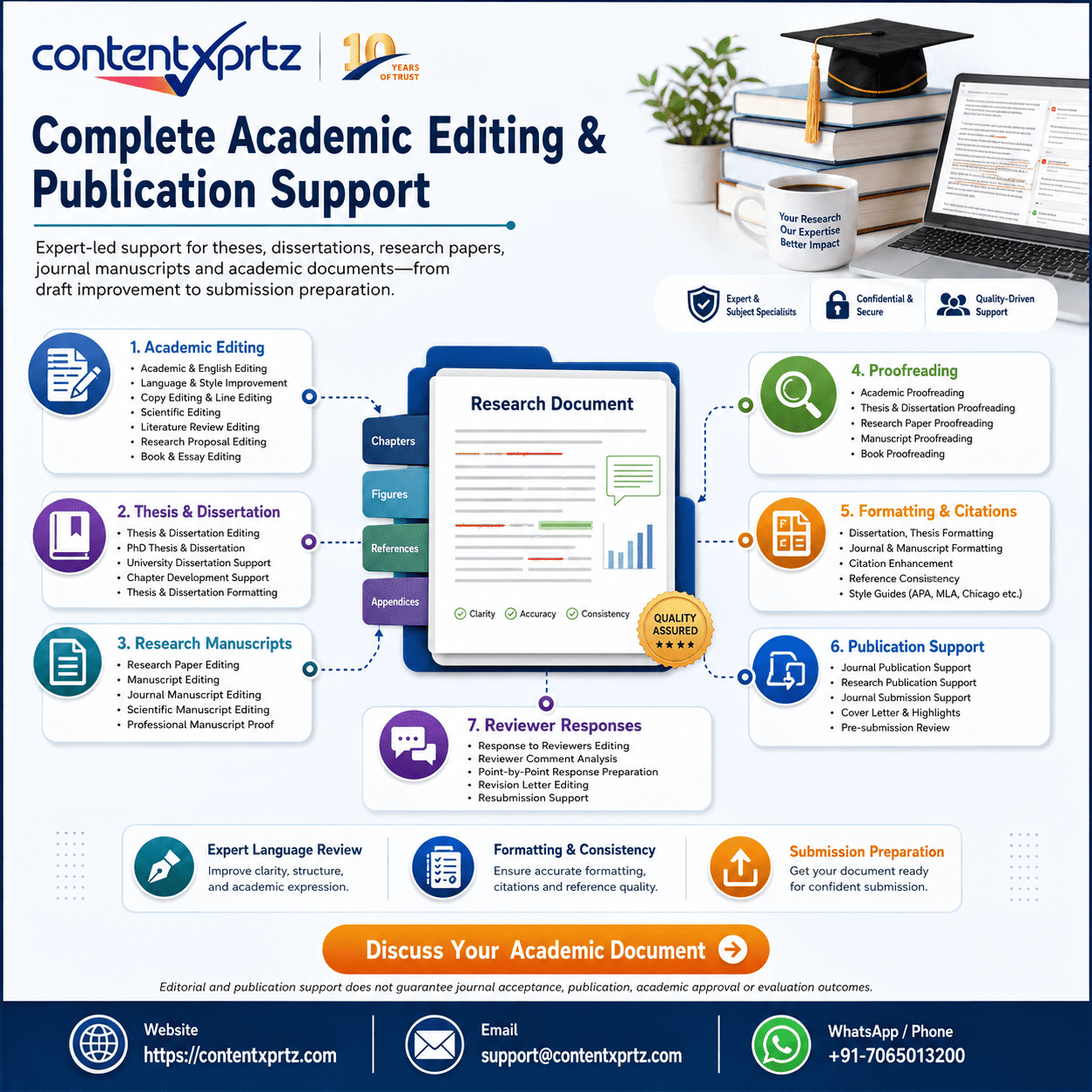
Preparing for Journal of Air Transport Management involves more than surface-level proofreading. Depending on the manuscript, Contentxprtz can support scope-alignment review, manuscript assessment, academic editing, ESL language polishing, title and abstract refinement, journal formatting, reference consistency, figure and table language review, cover-letter editing, revision-stage proofreading and reviewer-response editing.
The purpose of that support is to help authors present their own research clearly, accurately and ethically. Contentxprtz does not control the journal's editorial process, cannot influence reviewers or editors, and does not guarantee acceptance or publication.
Explore ethical journal publication and manuscript-readiness support if you need help checking whether your files, structure, language and references are ready for submission.
Summary: Journal of Air Transport Management
Journal of Air Transport Management is an Elsevier journal focused on the economic, managerial, operational, policy and sustainability dimensions of air transport. Its core sectors include airlines, airports and air traffic management, with related work in tourism and logistics where the aviation contribution is substantive.
Elsevier currently lists the journal in Scopus and SSCI. The supplied Scopus Source ID is 20532, the print ISSN is 0969-6997 and the online ISSN is 1873-2089. ScienceDirect pages checked in August 2026 displayed a CiteScore of 9.4 and an Impact Factor of 3.6, while the journal operates a hybrid publishing model with a displayed open-access APC of USD 3,090 excluding taxes. Because these values and policies can change, confirm current reporting-year metrics, quartiles, fees and author instructions on the official pages before relying on them.
For authors, the strongest selection criterion remains fit: the manuscript should make a clear, defensible contribution to air transport research, policy or practice and be prepared for the journal's double-anonymized peer-review process.
Frequently Asked Questions
What is the Journal of Air Transport Management?
Journal of Air Transport Management (JATM) is an Elsevier journal focused on economic, management, policy and practice issues in air transport. Its scope spans airlines, airports and air traffic management, with related coverage such as tourism management and logistics.
Who publishes the Journal of Air Transport Management?
The journal is published by Elsevier; the ScienceDirect journal insights page identifies Pergamon as the journal imprint. The official journal platform is ScienceDirect.
Is the Journal of Air Transport Management indexed in Scopus?
Yes. Elsevier's journal insights page lists Scopus among its abstracting and indexing services. The supplied Scopus source profile is Source ID 20532.
What is the ISSN of the Journal of Air Transport Management?
The print ISSN is 0969-6997 and the online ISSN is 1873-2089, as listed on the official ScienceDirect journal page.
What subjects does the journal cover?
The official scope emphasizes policy, regulation and law; strategy; operations; marketing; economics and finance; and sustainability across airlines, airports, air traffic management and related fields.
What are the current journal metrics?
On the official ScienceDirect pages checked for this article in August 2026, the journal displayed a CiteScore of 9.4 and an Impact Factor of 3.6. Because metric reporting cycles change, authors should confirm the latest reporting-year values immediately before relying on them for institutional requirements.
What quartile is the Journal of Air Transport Management?
This article does not assign a current quartile because the official publisher extract used here does not display the current Scopus quartile by reporting year and category. Check the current Scopus Sources profile for Source ID 20532 before submission or institutional reporting.
Is the Journal of Air Transport Management open access?
It is a hybrid journal that supports open access. Authors may choose an open-access route with an APC, or publish under the subscription route, for which the publisher currently states that no publication fee is charged to authors.
What is the open-access APC?
The official ScienceDirect journal page checked in August 2026 displayed an open-access APC of USD 3,090 excluding taxes, with possible reductions where applicable. Fees can change, so verify the current amount during submission.
What peer-review model does the journal use?
The journal's official policies state that submissions undergo double-anonymized peer review. The aims-and-scope page also notes that papers are normally reviewed by two referees selected for specialist knowledge.
How long does the journal take to make decisions?
The publisher's Journal Insights page currently displays 26 days from submission to first decision, 111 days to decision after review, 286 days from submission to acceptance, and 8 days from acceptance to online publication. These are publisher-displayed journal insights rather than guarantees for an individual manuscript.
What types of manuscripts does the journal publish?
The journal primarily presents research articles and authoritative commentary, and its recent issues prominently contain research articles. Authors should verify the currently available article-type choices in the live submission system and Guide for Authors before preparing files.
Is the journal suitable for PhD researchers?
It may be suitable when a doctoral manuscript makes a clear contribution to air transport policy, management, economics, operations, sustainability or related practice and fits the journal's audience. Institutional rules, supervisor guidance and current indexing requirements should also be checked.
How can I tell whether my manuscript fits the journal?
Compare your research question with the official aims and scope, inspect several recent papers using similar methods or contexts, confirm that the contribution matters to air transport researchers or practitioners, and verify that the journal currently accepts your article type.
Can Contentxprtz guarantee acceptance in this journal?
No. Contentxprtz can support ethical manuscript assessment, editing, proofreading, formatting, reference checks and publication-readiness work, but editorial decisions and publication outcomes remain solely with the journal.
Conclusion: Evaluate Fit Before You Submit
Journal of Air Transport Management may be a strong option for researchers whose work addresses meaningful aviation management, economics, policy, operations, sustainability or related industry questions. Its indexing and citation indicators provide useful context, but they should not replace a close reading of the journal's scope and recent publications.
Before submitting, reconfirm the live author instructions, current metrics, fee choices and institutional requirements. Then make sure the manuscript clearly communicates why the research matters to the air-transport community. Professional editing or publication-readiness support can improve clarity and compliance, but the scientific contribution and all editorial decisions remain with the authors and the journal.