A Researcher-Focused Profile of Journal of Accounting & Organizational Change
Journal of Accounting & Organizational Change is published by Emerald Publishing and occupies a focused space between accounting scholarship and the study of organizational transformation. Researchers commonly encounter the journal when they are asking practical questions: Is it indexed in Scopus? Does my study on management control, sustainability, digitalization or public-sector accountability fit its scope? What are its current citation metrics? What does Emerald require before submission?
The official journal page answers many of these questions clearly. JAOC lists ISSN 1832-5912 and eISSN 1839-5473, uses ScholarOne for submissions, applies double-anonymous peer review, and accepts interdisciplinary empirical and review work as well as case studies and replications. Emerald currently reports a 2025 CiteScore of 7.1 and a 2025 Journal Impact Factor of 3.0. These numbers are useful context, but scope and readership remain more important than metrics when deciding whether a manuscript belongs in the journal.
This profile separates verified journal facts from practical publication guidance. Metrics, fees, indexing, editorial teams and policies can change, so authors should reconfirm time-sensitive details on the official JAOC page and the live database records immediately before submitting.
Quick Answer: What Is Journal of Accounting & Organizational Change?
JAOC is an interdisciplinary accounting journal published by Emerald. Its stated purpose is to advance research on organizational change and accounting practices in private-sector, public-sector and nonprofit organizations. The journal welcomes empirical and review work, case studies and replications, with particular interest in research that connects accounting with broader organizational, social, technological and sustainability questions.
The journal is associated with Scopus Source ID 19900191757 in the supplied source record. Emerald currently displays a Scopus CiteScore and Clarivate Impact Factor for the title. Researchers considering JAOC should verify that their topic, article type and intended contribution match the journal’s scope and then check the latest author instructions before preparing the final submission package.
Key Takeaways
- Publisher: Emerald Publishing; ISSN 1832-5912; eISSN 1839-5473.
- Core focus: accounting practices in relation to organizational change across business, public and nonprofit settings.
- Scopus source record supplied: 19900191757; Emerald reports 2025 CiteScore 7.1.
- Emerald reports 2025 Impact Factor 3.0 and five-year Impact Factor 2.9.
- Publisher-reported acceptance rate: 20.9% for submissions between 1 April 2024 and 31 March 2025.
- Peer review: editorial screening followed by at least two independent referees using double-anonymous review when the paper proceeds.
- Standard article length: 6,000–10,000 words; structured abstract capped at 250 words; up to 12 keywords.
- Publishing model: hybrid, with optional gold OA after acceptance and a green self-archiving route.
| Field | Verified / current information |
|---|---|
| Journal | Journal of Accounting & Organizational Change (JAOC) |
| Source type | Journal |
| Publisher | Emerald Publishing |
| ISSN / eISSN | 1832-5912 / 1839-5473 |
| Scopus Source ID | 19900191757 (supplied source record) |
| Primary field | Accounting, organizational change, management control and related interdisciplinary business/social-science research |
| Editor | Professor Zahirul Hoque, RMIT University |
| 2025 CiteScore | 7.1 |
| 2025 Impact Factor | 3.0 |
| 2025 five-year Impact Factor | 2.9 |
| Current SJR / SNIP / quartile | Not stated on the official Emerald page consulted; verify in the latest applicable database |
| Submission system | ScholarOne, accessed from the official Emerald journal page |
| Peer review | Double-anonymous; at least two independent referees for manuscripts sent to review |
| Open access | Hybrid: optional gold OA plus green self-archiving route |
| APC | Applies only if gold OA is chosen; verify current amount on Emerald’s APC price list/editorial system |
What This Guide Covers
Methodology and Source Approach
This profile was prepared from the supplied Scopus source identifiers and the current Emerald journal page, including its aims and scope, author guidelines, editorial team, indexing and metrics, review process, open-access guidance and ethics policies. Where the official page does not provide a current value—such as SJR, SNIP or a quartile—this guide does not invent one.
Journal of Accounting & Organizational Change Aims and Scope
JAOC positions accounting as part of wider organizational change rather than as an isolated technical function. Its official scope emphasizes accounting practices in organizations undergoing social, technological, managerial and institutional change, and it invites interdisciplinary theoretical and methodological perspectives.
Emerald identifies several evaluation themes: interdisciplinarity; co-creation with those affected by research; mission-driven research; community engagement; contribution to sustainable-development goals; synthesis of research, theory and practice; and responsiveness to industry. This makes the journal especially relevant when accounting is being studied as a mechanism, practice or language through which organizations adapt, govern, measure performance or become accountable.
Representative subject areas
- Accounting and management control in digitalized organizations
- Social and environmental accounting and reporting
- Accountability and performance across sectors
- Data analytics and accounting mechanisms in Industry 4.0
- Triple-bottom-line reporting and social accountability
- Culture, performance measurement and performance management
- Accounting change in transitional and developing economies
- Auditing, value-for-money and performance audits
- Sustainability-linked organizational change
Based on that scope, a manuscript that is purely technical accounting work with no meaningful organizational-change contribution may be less well aligned. Conversely, a general organizational-change paper with little accounting relevance may also struggle to establish fit.
Understanding Its Scopus Coverage and Journal Metrics
The supplied source row identifies JAOC with Scopus Source ID 19900191757. On Emerald’s current indexing-and-metrics panel, the journal has a 2025 CiteScore of 7.1 and a 2026 CiteScore Tracker of 6.8 at the time this guide was prepared. Because the tracker changes monthly, it should not be treated as a final annual score.
Emerald also reports a 2025 Journal Impact Factor of 3.0 and a 2025 five-year Impact Factor of 2.9. The official page lists abstracting or indexing services including the British Library, EBSCO, ProQuest and ReadCube Discover, and it displays several discipline-specific ranking systems. Those systems measure different things and should not be collapsed into a single quality label.
| Indicator | Value | Reporting context |
|---|---|---|
| CiteScore | 7.1 | 2025 completed-year CiteScore |
| CiteScore Tracker | 6.8 | 2026 tracker; updated monthly |
| Journal Impact Factor | 3.0 | 2025 |
| Five-year Impact Factor | 2.9 | 2025 |
| Time to first decision | 48 days | Submissions 1 Apr 2024–31 Mar 2025 |
| Acceptance to publication | 36 days | Publisher’s previous-12-month measure, last updated Apr 2025 |
| Acceptance rate | 20.9% | Submissions 1 Apr 2024–31 Mar 2025 |
A quartile, SJR or SNIP is not displayed on the Emerald page consulted for this article. Authors with institutional requirements tied to those measures should verify the current values directly in the relevant live database.
What Does the Journal Publish?
The official scope explicitly welcomes empirical and review papers, case studies and replications of previously published studies. During submission, Emerald lists paper-type options including Research Paper, Book Review and Doctoral Abstract, with categories covering research papers, viewpoints, technical papers, conceptual papers, case studies, literature reviews and general reviews.
For fit, article labels matter less than whether the manuscript makes a credible contribution to the journal’s accounting-and-change conversation. A qualitative case study of management-control transformation, an empirical analysis of sustainability accounting, an interdisciplinary review of digital accounting change, or a replication testing an established accounting-change relationship could all be plausible directions if executed rigorously.
Is This Journal a Good Match for Your Research?
A strong fit begins with the research question, not the metric. Before formatting the manuscript, compare the study with the journal’s scope and several recent JAOC articles. Ask whether accounting is central to the argument, whether organizational change is analytically meaningful, and whether the intended contribution will matter to the journal’s interdisciplinary readership.
Likely stronger fit
Research that links accounting or control practices to organizational transformation, digitalization, accountability, sustainability, performance, institutional change or cross-sector practice.
Potentially weaker fit
Work with only a peripheral accounting connection, purely descriptive organizational-change studies, or manuscripts that do not explain their interdisciplinary contribution.
Journal-fit checklist
- Does the research question sit clearly inside JAOC’s stated aims and scope?
- Is accounting, management control, auditing, reporting or accountability central rather than incidental?
- Does the manuscript explain the organizational-change contribution?
- Does JAOC publish the chosen paper type and comparable methodological approaches?
- Can the contribution be explained to both accounting and organizational audiences?
- Have you reviewed recent articles instead of relying only on the scope statement?
- Does the journal meet your university, funder or doctoral-program indexing requirements?
- Are you comfortable with the hybrid publishing model and any optional OA cost?
Preparing a Manuscript for JAOC
Emerald’s current author instructions are detailed and should be followed closely. Standard articles should be 6,000–10,000 words, including the structured abstract, references and text in tables, figures and appendices; authors are instructed to allow 250 words for each figure or table.
Structured abstract and keywords
Every submission requires a structured abstract. The mandatory subheadings are Purpose, Design/methodology/approach, Findings and Originality. Research limitations/implications, practical implications and social implications are optional when applicable. The full abstract is capped at 250 words, including keywords and article classification, and the submission may include up to 12 keywords.
Files, tables, figures and references
Article files should be supplied in Microsoft Word format; a PDF can accompany the Word file but cannot be the only manuscript file. LaTeX is permitted when accompanied by a PDF. Figures should be high-quality and supplied in accepted electronic formats. Tables are submitted separately and their placement marked in the manuscript. References must use a recognized Harvard style, with DOI details where available.
How to Submit and What Happens After Submission
The corresponding author must submit through the journal’s ScholarOne editorial system accessed from Emerald. Emerald states that manuscripts should not be submitted by email or through a third-party agent, company or proxy. Authors need their own journal-specific ScholarOne account, and Emerald asks authors to add an ORCID during submission.
- Confirm scope and article-type fit.
- Prepare an anonymized manuscript and separate author information where required.
- Check word count, structured abstract, keywords, tables, figures, references and ethics declarations.
- Submit directly through ScholarOne as the corresponding author.
- Pass editorial-office screening for policy, scope and manuscript quality.
- If suitable, enter double-anonymous review with at least two independent referees.
- Respond to revision requests point by point where applicable.
- After acceptance, complete licensing, proofing and production steps.
Emerald reports a 48-day time to first decision for its stated 2024–2025 reporting window and separately states a general goal of informing authors of a first decision within 60 days. These are publisher-reported statistics, not guaranteed timelines for any individual submission.
What Editors and Reviewers Are Likely to Look For
JAOC’s official page says the editorial office can decline or return a manuscript if it does not meet submission policies, aims and scope, or if language/manuscript quality is too low. Beyond those explicit checks, standard scholarly review typically considers the clarity of the research problem, adequacy of the method, quality of evidence, logic of interpretation, originality of contribution and ethical compliance.
Common readiness risks therefore include an accounting connection that is too weak, an unclear organizational-change contribution, insufficient engagement with relevant literature, unsupported conclusions, inadequate methodological transparency, inconsistent references, identifying information in an anonymous manuscript, or missing ethics and funding declarations. These are practical publication-readiness considerations rather than official rejection statistics.
Open Access, APCs and Publication Costs
JAOC is a hybrid journal. Emerald allows authors to choose gold open access after acceptance; an article processing charge is then payable and the article is published under a CC BY 4.0 licence. Emerald also provides a green open-access/self-archiving route in which the author accepted manuscript can be made openly available.
The journal’s page does not provide a static APC amount in the author-guideline text; instead, it directs authors to Emerald’s current APC price list or the editorial system. Because charges and waiver arrangements can change, verify the current fee before making funding commitments. Emerald also states that authors who do not choose gold OA should not be asked to pay publication, processing or review fees.
Publication Ethics and Emerald’s Generative-AI Policy
Emerald states that its journals follow COPE guidance and requires original work, disclosure of relevant prior publication, no simultaneous submission elsewhere, declaration of conflicts of interest, respect for copyright and permissions, and appropriate ethics approval and informed consent for research involving human participants where required.
Its current AI policy is especially important. Large language models cannot be credited as authors. Emerald says authors remain accountable for accuracy and integrity, and AI use must be responsible and transparent. The policy permits generative-AI copy-editing of an author’s own original existing work for structure, clarity, language and grammar, but does not permit generative-AI copywriting that creates or drafts new submission material. Authors should read the live Emerald publishing-ethics policy before using AI-assisted workflows because policy details may change.
Publication-Readiness Checklist Before You Click Submit
- Scope match confirmed against the current JAOC aims and scope.
- Recent JAOC papers reviewed for topic, theory and methodology fit.
- Manuscript within the 6,000–10,000-word guideline.
- Structured abstract uses the mandatory headings and stays within 250 words.
- No more than 12 concise keywords prepared.
- Review manuscript anonymized for double-anonymous peer review.
- Tables and figures follow Emerald’s file and caption requirements.
- Harvard references checked for completeness, accuracy and DOI inclusion.
- Funding, conflict-of-interest and ethics statements prepared where applicable.
- Permissions and consent-to-publish requirements addressed.
- ORCID information ready for ScholarOne.
- All authors have agreed authorship and order before submission.
- Open-access route and possible APC implications understood.
Is JAOC Suitable for PhD and Early-Career Researchers?
It can be, provided the manuscript fits the scope and meets the required standard. Scopus indexing or a citation metric does not automatically make a journal appropriate for every doctoral programme. A PhD researcher should check supervisor guidance, university rules, indexing requirements, journal fit and any funding conditions for open access.
For an early-career author, the most useful question is whether the paper genuinely participates in the conversation JAOC is building. A well-aligned, methodologically sound manuscript with a clear accounting-and-organizational-change contribution is more defensible than choosing the journal primarily because of its metrics.
How Researchers Should Evaluate the Journal
Rather than asking whether JAOC is simply a “good journal,” evaluate it against your publication objective. Its official publisher identity, transparent author guidelines, stated review process, current citation metrics and ethics policies are positive evidence of a structured scholarly publishing process. But the decisive issue is still manuscript fit.
| Question | What to check |
|---|---|
| Scope | Does the study connect accounting meaningfully to organizational change? |
| Indexing | Does current Scopus/other coverage satisfy your institution? |
| Metrics | Are the dated 2025 metrics relevant to your goals without becoming the sole criterion? |
| Audience | Will accounting and organization researchers value the contribution? |
| Article type | Does the submission fit an accepted classification/category? |
| Cost | Do you need gold OA, and can the current APC be funded if chosen? |
| Timeline | Are publisher-reported decision times compatible with genuine deadlines? |
| Ethics | Can you meet authorship, consent, disclosure and AI-use requirements? |
How Contentxprtz Can Support Authors Preparing for JAOC
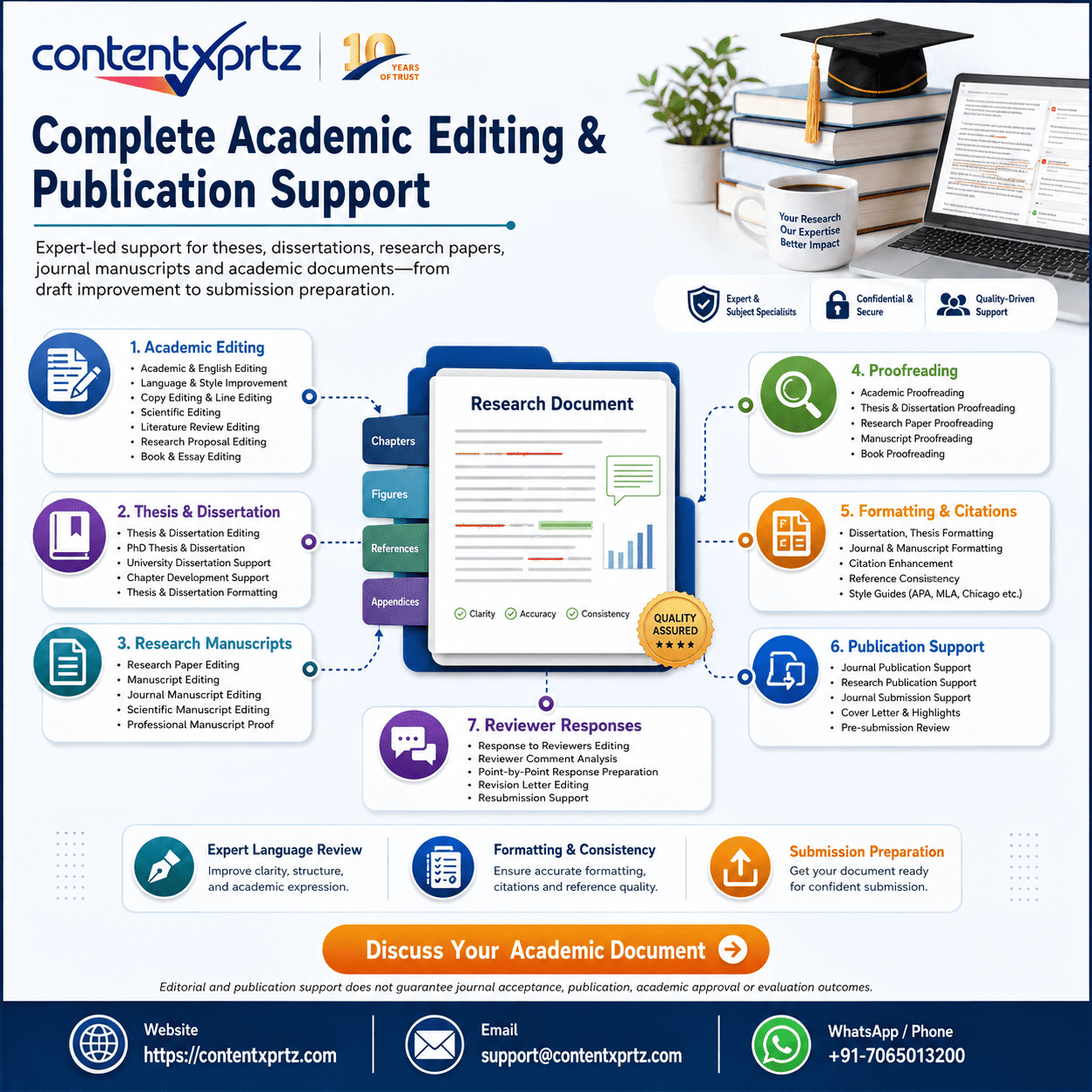
Contentxprtz can support authors who already own and control their research by helping them present it more clearly and in closer alignment with JAOC’s published requirements. Support may include journal-scope alignment review, manuscript assessment, academic editing, substantive editing, proofreading, ESL language polishing, title and abstract refinement, manuscript structure review, journal formatting, reference formatting, figure/table language review, cover-letter editing, reviewer-response editing and revision-stage proofreading.
For this journal specifically, a useful readiness review can check whether the accounting-and-organizational-change contribution is visible early, whether the structured abstract uses the required headings, whether the manuscript stays within the stated length, whether references follow a recognized Harvard style, and whether anonymous-review files are clean.
Planning to Submit to Journal of Accounting & Organizational Change?
Prepare a clearer, journal-aligned manuscript while keeping the research, authorship and scholarly decisions fully yours.
Contentxprtz does not control editorial decisions and does not guarantee journal acceptance or publication. Professional support is intended to improve clarity, consistency, formatting and publication readiness while preserving ethical authorship.
Summary: Journal of Accounting & Organizational Change
JAOC is an Emerald Publishing journal focused on interdisciplinary research connecting accounting with organizational change in private, public and nonprofit contexts. Its official identifiers are ISSN 1832-5912 and eISSN 1839-5473; the supplied Scopus source record gives Source ID 19900191757. Emerald reports a 2025 CiteScore of 7.1, a 2025 Impact Factor of 3.0, a 20.9% acceptance rate for its stated reporting window and 48 days to first decision.
Submissions are made directly through ScholarOne. Standard articles are 6,000–10,000 words and require a structured abstract with mandatory Purpose, Design/methodology/approach, Findings and Originality headings. Peer review is double-anonymous and uses at least two independent referees when a manuscript proceeds beyond editorial screening. The journal is hybrid; gold OA carries an APC, while green self-archiving is also available.
Before submission, authors should verify the live Emerald author guidelines, current Scopus status, time-sensitive metrics, current APC and any institutional publication requirements.
Journal of Accounting & Organizational Change FAQs
The answers below summarize the same verified facts and practical guidance covered above.
What is Journal of Accounting & Organizational Change?
It is an Emerald Publishing journal focused on the relationship between organizational change and accounting practices across private, public and nonprofit settings, with an explicitly interdisciplinary orientation.
Who publishes Journal of Accounting & Organizational Change?
The journal is published by Emerald Publishing. Its official journal page lists ISSN 1832-5912 and eISSN 1839-5473.
Is Journal of Accounting & Organizational Change indexed in Scopus?
Yes. The supplied Scopus source record identifies Source ID 19900191757, and Emerald currently displays a Scopus CiteScore for the journal. Authors whose institutions require Scopus coverage should still check the live Scopus source profile before submission.
What is the 2025 CiteScore of the journal?
Emerald reports a 2025 CiteScore of 7.1. It also displays a 2026 CiteScore Tracker that changes monthly, so the completed-year 2025 value is the more stable comparison point.
What is the 2025 Impact Factor?
Emerald reports a 2025 Journal Impact Factor of 3.0 and a 2025 five-year Impact Factor of 2.9. These values should always be interpreted with their reporting year.
What is the journal's current quartile, SJR and SNIP?
The official Emerald page consulted for this guide does not state a current quartile, SJR or SNIP. Researchers should verify these values in the latest applicable Scopus or other authoritative database record rather than relying on undated third-party listings.
What topics does the journal cover?
Its scope includes accounting and management control in digitalized settings, social and environmental reporting, accountability and performance, Industry 4.0 and data analytics, sustainability and triple-bottom-line reporting, culture and performance management, accounting change in developing economies, and auditing or value-for-money audits.
What manuscript types can be submitted?
The ScholarOne classification options include Research Paper, Book Review and Doctoral Abstract. Emerald also provides categories such as research paper, viewpoint, technical paper, conceptual paper, case study, literature review and general review.
What are the main manuscript requirements?
Articles should normally be 6,000–10,000 words including references, tables, figures and appendices. A structured abstract is required and is capped at 250 words including keywords and article classification, with up to 12 keywords.
What reference style does the journal use?
Emerald requires references to be formatted using a recognized Harvard style and permits authors to use Emerald's Harvard style. DOI information should be included where available.
How does peer review work?
The journal screens submissions editorially and, when suitable, sends them to at least two independent referees using double-anonymous peer review. The editor may then accept, request minor or major revision, or decline the manuscript.
How long does the journal take to make a first decision?
Emerald reports 48 days to first decision for submissions in its stated 1 April 2024 to 31 March 2025 reporting window, while its author guidance states a general goal of communicating a first decision within 60 days.
What is the acceptance rate?
Emerald reports a 20.9% acceptance rate for submissions between 1 April 2024 and 31 March 2025. This is a historical reporting-window metric, not a guarantee or prediction for an individual manuscript.
Is the journal open access and does it charge an APC?
The journal is hybrid. Authors may choose gold open access after acceptance, in which case an APC applies, or use Emerald's green self-archiving route. The current APC should be confirmed on Emerald's live APC price list or editorial system because charges can change.
Can Contentxprtz guarantee publication in this journal?
No. Contentxprtz can support manuscript assessment, scope alignment, editing, proofreading, formatting, references, cover letters and reviewer-response preparation, but editorial decisions belong solely to the journal and publication cannot be guaranteed.
Choose JAOC for Fit, Not for a Metric Alone
JAOC offers a clearly defined interdisciplinary home for research in which accounting practices and organizational change are genuinely connected. Its current metrics, transparent author instructions and established review workflow can help researchers evaluate it, but none of those features substitute for a strong topic match, rigorous method and clearly communicated contribution.
Before submitting, compare your manuscript with the current scope and recent papers, follow the live Emerald instructions carefully, and verify any time-sensitive database or fee information.
“At Contentxprtz, we don’t just edit; we help ideas reach their fullest potential.”