Should You Consider the International Journal of Manpower?
The International Journal of Manpower is most relevant to researchers working where human resource management, workforce behaviour and labour economics meet. Emerald describes the journal as a fully refereed, double-blind interdisciplinary outlet concerned with how human resources are utilised, managed and planned, and with the economics of labour markets. A defining feature is its preference for strong empirical and analytical quantitative work.
For a PhD scholar or academic author, that methodological emphasis matters as much as the journal’s indexing. The journal is indexed in Scopus, is listed by Emerald as ranked in the Social Sciences Citation Index, and currently carries strong citation indicators. Yet an otherwise rigorous paper may still be a poor fit if it is a bibliometric review, a literature review, purely conceptual, based on fuzzy-type methodology, or insufficiently connected to workforce and labour-market questions.
This page separates verified journal facts from practical publication guidance. Metrics, fees, editorial teams and database coverage can change, so use the linked official sources for a final check immediately before submission.
Quick answer: what is the International Journal of Manpower?
It is an Emerald Publishing journal focused on quantitative and empirically grounded research in HRM, management, workforce planning, labour markets and labour economics. Emerald lists print ISSN 0143-7720, eISSN 1758-6577, Scopus indexing and SSCI ranking.
Researchers should consider it when the paper asks a clear workforce or labour-market question, uses a defensible empirical design and speaks to an international scholarly audience. Before submission, confirm the current aims and scope, latest metrics, word limit, author guidelines and open-access terms on the official journal page.
Key takeaways for researchers
- Publisher: Emerald Publishing; Editor-in-Chief currently listed as Professor Adrian Ziderman.
- Core scope: HRM, workforce utilisation/planning, management, labour markets and labour economics.
- Methodological preference: strong empirical/analytical quantitative research; exceptional qualitative studies may occasionally be considered.
- Scopus: indexed; supplied Source ID 20201. Emerald also lists SSCI among the journal’s rankings/indexing context.
- Metrics: CiteScore 2025 = 12.3; Impact Factor 2025 = 3.5; five-year Impact Factor 2025 = 5.2.
- Peer review: double-anonymous, normally with at least two independent referees after editorial screening.
- Acceptance rate: Emerald reports 10% for submissions received 1 April 2024–31 March 2025.
- Manuscript length: normally 6,000–8,000 words, with a structured abstract and up to 12 keywords.
International Journal of Manpower at a glance
| Field | Journal information |
|---|---|
| Journal name | International Journal of Manpower (IJM) |
| Source type | Peer-reviewed scholarly journal |
| Scopus Source ID | 20201 |
| ISSN / eISSN | 0143-7720 / 1758-6577 |
| Publisher | Emerald Publishing |
| Editor-in-Chief | Professor Adrian Ziderman |
| Primary fields | Human resources, management and labour economics |
| Scopus status | Listed by Emerald as indexed in Scopus; verify current source profile before institutional reporting |
| Other major indexing/ranking | Emerald lists Social Sciences Citation Index (SSCI), EconLit, EBSCO databases, RePEc and others |
| CiteScore | 12.3 (2025); 2026 tracker shown separately by Emerald and updated monthly |
| Impact Factor | 3.5 (2025); five-year Impact Factor 5.2 (2025) |
| Quartile | Emerald described IJM as Q1 in Scopus CiteScore and Web of Science SSCI JCR in April 2026; verify latest category/year |
| SJR / SNIP | Not stated on the current Emerald journal page; verify the latest values in the official Scopus source profile |
| Peer review | Double-anonymous; at least two independent referees for suitable manuscripts |
| Acceptance rate | 10% for 1 Apr 2024–31 Mar 2025 submissions |
| Typical article length | 6,000–8,000 words, including structured abstract, references, tables/figures text and appendices |
| Open access | Hybrid: optional gold OA after acceptance; green self-archiving also available |
| 2026 hybrid APC | Emerald standard rate: £3,222 / US$4,351 / €3,710, plus applicable tax; confirm current price |
| Official journal page | Emerald International Journal of Manpower |
| Submission portal | ScholarOne submission site |
What this page covers
How this profile was researched
This guide prioritises the official Emerald journal page and author instructions, the supplied Scopus source profile, Emerald’s current open-access policy and the journal’s current publication pages. Where a value such as SJR or SNIP was not directly visible in an authoritative accessible source, it is marked for verification rather than estimated.
Aims, scope and research areas
IJM’s official scope connects two broad research traditions: human resource management and workforce planning on one side, and labour markets and labour economics on the other. The journal considers questions at corporate, local, national and international levels. Emerald emphasises empirical and analytical quantitative work, with only occasional consideration of qualitative studies of very high quality.
This creates a distinct editorial identity. A paper on employee behaviour is more likely to fit when it produces a clear manpower, HRM, employment or labour-market contribution rather than simply using employees as a convenient sample. Likewise, an economics paper should connect its findings to employment, wages, skills, productivity, labour supply, workforce allocation or related policy/management implications.
Officially stated scope areas
Human-resource utilisation, management and planning; labour markets; labour economics; corporate to international workforce perspectives; strong empirical/analytical quantitative research.
Explicit current exclusions
Emerald states that the journal no longer entertains fuzzy-type methodologies, bibliometric and literature reviews, or purely conceptual papers.
Representative topics that can align with the scope
- Wages and pay gaps
- Job satisfaction and turnover
- Skills and educational mismatch
- Workforce productivity
- Human capital
- Employee wellbeing
- Labour-market segmentation
- Workforce diversity
- Flexible work and scheduling
- Employment and unemployment
- HR practices and performance
- Technology and work
These are practical examples inferred from the stated scope and recent Emerald-listed articles, not a closed official topic list. Recent journal pages show work on overeducation and wages, flexible scheduling and turnover, service robotics and working time, employment mismatch, firm pay dispersion and employee wellbeing.
Understanding Scopus coverage, rankings and journal metrics
The International Journal of Manpower is listed by Emerald as indexed in Scopus, and the supplied Scopus Source ID is 20201. Emerald also lists Social Sciences Citation Index (SSCI), EconLit, EBSCO products, RePEc, Current Contents: Social & Behavioral Sciences and several specialist abstracting services.
| Indicator | Current verified value | Researcher interpretation |
|---|---|---|
| CiteScore | 12.3 (2025) | A completed-year Scopus citation indicator; compare within relevant categories rather than across unrelated disciplines. |
| CiteScore Tracker | 6.5 (2026 tracker shown by Emerald when checked) | A monthly current-year tracker, not the final 2026 CiteScore. |
| Journal Impact Factor | 3.5 (2025) | Clarivate metric reported by Emerald; use the reporting year when citing it. |
| Five-year Impact Factor | 5.2 (2025) | Longer citation window that can smooth short-term variation. |
| Quartile | Q1 stated by Emerald in April 2026 for both SSCI JCR and Scopus CiteScore | Quartiles are category- and year-dependent. Confirm the applicable category for institutional requirements. |
| SJR / SNIP | Verify current value in Scopus | Do not substitute third-party values when the official source profile can be checked. |
For PhD publication requirements, the practical question is not simply “Is it Q1?” but “Does my university recognise this database, reporting year and subject category?” Institutional rules differ. Save a current source-profile record if you need to document indexing or quartile status for a doctoral milestone.
Is this journal a good match for your manuscript?
A strong fit begins with research question + method + contribution. IJM is particularly selective about method and article form, so authors should test alignment before investing time in formatting.
| Your manuscript | Likely fit | Why |
|---|---|---|
| Econometric study of wage inequality, employment or skills mismatch | Potentially strong | Direct labour-economics and manpower relevance with quantitative analysis. |
| Quantitative HRM study linking workforce practices to employee or organisational outcomes | Potentially strong | Fits the HRM/management side of the journal when the manpower contribution is explicit. |
| High-quality qualitative study on a major workforce issue | Possible but selective | Emerald says exceptional qualitative studies may occasionally be considered. |
| Bibliometric review or literature review | Poor fit | The current aims and scope explicitly says these are no longer entertained. |
| Purely conceptual HR model without empirical testing | Poor fit | Purely conceptual papers are explicitly excluded by the current scope. |
| Fuzzy-type methodology as the central approach | Poor fit | Explicitly excluded in the current aims and scope. |
What does the journal publish?
The Emerald submission system asks authors to choose a paper type/category. Its general classification menu includes research paper, viewpoint, technical paper, conceptual paper, case study, literature review and general review. For IJM, however, the journal-specific aims and scope is more restrictive: it explicitly rules out bibliometric and literature reviews and purely conceptual papers. That journal-specific rule should govern manuscript planning.
Recent publications illustrate the journal’s empirical orientation: topics include the wage consequences of overeducation, service robotics and working time, paid time off and voluntary turnover, educational mismatch, firm pay dispersion, unemployment, employee wellbeing and workplace practices. Authors can use recent issues as a reality check for both topic fit and the expected level of analysis.
Preparing a manuscript for International Journal of Manpower
Emerald’s current author instructions specify a 6,000–8,000-word article, with the count including the structured abstract, references, text in tables and figures, and appendices. Authors are asked to allow 280 words for each figure or table.
Core manuscript requirements
- Provide the article in Microsoft Word; a PDF may accompany it but is not accepted alone. LaTeX may be used with an accompanying PDF.
- Use a concise title and upload complete author details through ScholarOne rather than leaving identifying information in the anonymous manuscript.
- Include a structured abstract of no more than 250 words in total, including keywords and article classification.
- Required abstract headings are Purpose, Design/methodology/approach, Findings and Originality; research limitations, practical implications and social implications are optional when relevant.
- Supply up to 12 short, appropriate keywords.
- List research funding and explain the funder’s role in the acknowledgements.
- Upload author biographies and acknowledgements separately when used; biographies should be no more than 100 words per author.
- Use the Emerald reference style shown in the journal guidelines, with alphabetical references and DOI information where available.
Double-anonymous preparation
The manuscript itself should not reveal author identity. Emerald advises removing names from the text, figures and captions; handling self-citation neutrally; and uploading acknowledgements and biographies as separate files. This is not cosmetic—identifying details can compromise the review process.
What happens after you submit?
Submission is made by the corresponding author through the journal’s ScholarOne editorial system. Emerald explicitly says authors should submit directly and not through a third-party proxy. After submission, the editor checks fit and manuscript quality. Suitable papers are sent to at least two independent referees for double-anonymous review.
Emerald reports a 34-day time to first decision based on submissions from 1 April 2024 to 31 March 2025, while the author guidance states a general goal of informing authors of the first decision within 60 days. It also reports an average 30 days from acceptance to publication based on the previous 12 months as last updated April 2025. These are historical service metrics, not guarantees for a new submission.
The current acceptance rate shown by Emerald is 10% for submissions received between 1 April 2024 and 31 March 2025. Treat this as context about selectivity, not as a personal acceptance probability; manuscript fit, research quality, novelty, reporting and reviewer evaluation remain decisive.
Open access, copyright and publication charges
IJM is a hybrid journal. Authors can publish through the normal subscription route or choose gold open access after acceptance. Emerald’s 2026 standard APC for hybrid journals is £3,222 / US$4,351 / €3,710, plus applicable VAT or other taxes. The publisher also supports green open access, allowing the accepted manuscript to be self-archived without an embargo after publication.
APC policies can change and institutional publishing agreements may cover or discount open-access charges. Confirm your eligibility and the current amount on Emerald’s open-access page before making a funding decision. Choosing professional editing or paying an APC does not influence editorial acceptance.
Publication ethics and responsible research expectations
Emerald says its journals follow guidance from the Committee on Publication Ethics (COPE). Authors must submit original work that is not simultaneously under consideration elsewhere, disclose conflicts of interest, identify all legitimate contributors, secure third-party permissions and address ethical approval or informed consent where human participants are involved.
The publisher also states that large language models cannot be credited as authors. Emerald’s current AI policy permits certain forms of editing or language refinement of an author’s own work when used responsibly and transparently, but does not permit generative AI to copywrite new submission content. Because AI rules can evolve, review the current journal author guidelines immediately before submission.
A publication-readiness checklist for IJM
Before formatting
- Your research question clearly concerns HRM, workforce planning, management, labour markets or labour economics.
- Your method matches IJM’s strong preference for empirical/analytical quantitative research.
- Your paper is not a bibliometric review, literature review, purely conceptual paper or fuzzy-type methodology paper.
- You have compared your paper with several recent IJM articles for topic, method and contribution fit.
Before submission
- Word count is within 6,000–8,000 words after accounting for tables and figures.
- Structured abstract follows Emerald’s required headings and stays within the stated 250-word total.
- Keywords, references, funding statement, ethics declarations and permissions are complete.
- The anonymous manuscript contains no author-identifying details.
- All authors are listed accurately in ScholarOne and can take responsibility for the work.
- You have rechecked current metrics, APCs and author instructions on the official site.
Common reasons a manuscript may be unsuitable
For IJM, desk-rejection risk is especially high when the paper misses the journal’s scope or ignores its methodological direction. Common problems include a generic management paper with no manpower contribution, a weak empirical design, a paper built mainly around a prohibited review format, an anonymous manuscript that exposes author identity, failure to follow the structured-abstract or word-limit rules, or language/reporting quality that prevents a fair assessment of the research.
As a practical publication-readiness step, write a two-sentence “fit statement” before submission: one sentence explaining the workforce/labour problem, and one explaining how the empirical evidence advances IJM’s research conversation. If that statement feels forced, the manuscript may need reframing—or a different journal.
Preparing a manuscript for International Journal of Manpower?
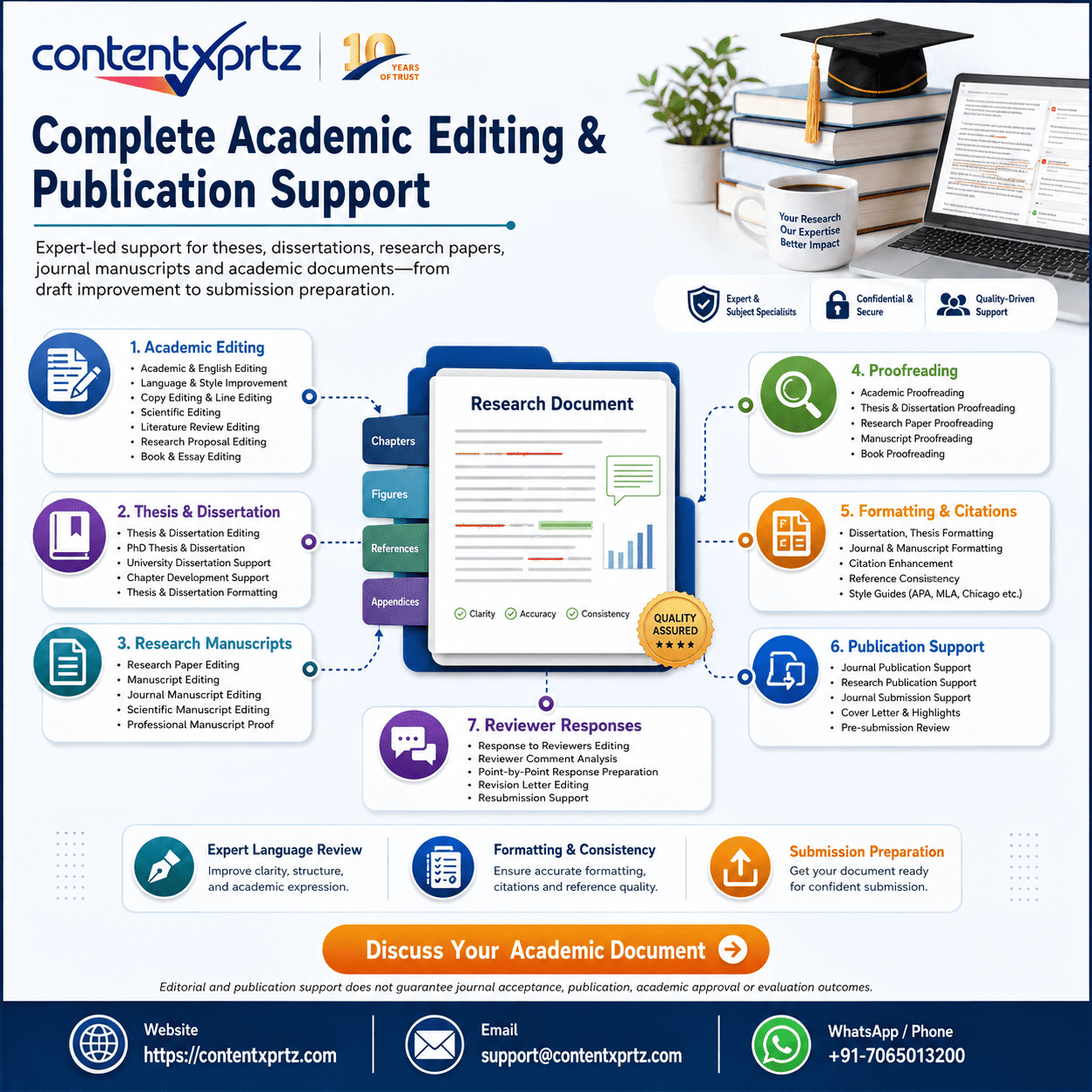
Contentxprtz can support language polishing, journal-format alignment, reference checking, structured-abstract review and publication-readiness assessment—without promising or implying acceptance.
How Contentxprtz can support ethical publication readiness
Professional support is most useful when it removes avoidable presentation and compliance problems while leaving research ownership and scholarly judgement with the authors. For an IJM submission, Contentxprtz may assist with academic editing, ESL language polishing, manuscript-format review, reference and citation consistency, abstract refinement, cover-letter editing, response-to-reviewer editing and journal-selection guidance.
These services do not guarantee editorial screening, peer-review success, acceptance, indexing or publication. The editor and reviewers independently assess the manuscript, and the corresponding author should submit directly through the official ScholarOne system.
Official links and final verification points
- Emerald journal page, aims and scope, author guidelines and metrics
- Official Scopus source profile (Source ID 20201)
- International Journal of Manpower ScholarOne submission portal
- Emerald open-access routes and 2026 APC information
Before submitting, verify the latest author instructions, current indexing status, metric reporting year, editorial team, APC and any special-issue requirements. Journal information can change between the time a manuscript is prepared and the time it is submitted.
International Journal of Manpower FAQs
These answers summarise the verified journal facts and practical guidance discussed above.
What is the International Journal of Manpower?
The International Journal of Manpower (IJM) is an Emerald Publishing journal focused on human resource management, workforce planning, labour markets and labour economics. Its scope is interdisciplinary but methodologically selective: Emerald says the journal mainly prioritises strong empirical and analytical quantitative research, while exceptional qualitative studies may sometimes be considered.
Who publishes the International Journal of Manpower?
The journal is published by Emerald Publishing. The current Emerald journal page identifies Professor Adrian Ziderman as Editor-in-Chief and provides the editorial team, author guidelines, journal metrics and submission links.
Is the International Journal of Manpower indexed in Scopus?
Yes. Emerald lists Scopus among the databases in which the journal is abstracted and indexed, and the supplied Scopus Source ID is 20201. Authors whose institution requires Scopus coverage should still check the current Scopus source profile before submission because indexing status and coverage can change.
What is the Scopus Source ID of the International Journal of Manpower?
The Scopus Source ID supplied for the International Journal of Manpower is 20201. The official Scopus source link should be used to verify the latest source status, coverage and category information.
What are the ISSN and eISSN of the International Journal of Manpower?
Emerald lists the print ISSN as 0143-7720 and the electronic ISSN as 1758-6577.
What subjects does the International Journal of Manpower cover?
The journal covers human resource management, human resource utilisation and planning, management, labour markets and labour economics from corporate, local, national and international perspectives. Recent publication themes also include wages, job satisfaction, turnover, workforce diversity, employee wellbeing, productivity, employment mismatch and technology-related workforce change.
What is the current CiteScore of the International Journal of Manpower?
Emerald currently reports a CiteScore of 12.3 for 2025. It also displays a 2026 CiteScore Tracker, which is updated monthly and should not be confused with the completed-year CiteScore.
Does the International Journal of Manpower have an Impact Factor?
Yes. Emerald currently reports a 2025 Journal Impact Factor of 3.5 and a 2025 five-year Impact Factor of 5.2. Metric values can change each annual reporting cycle.
What quartile is the International Journal of Manpower?
In an April 2026 Emerald call for associate editors, the journal was described as Q1 in both Web of Science SSCI JCR and Scopus CiteScore. Quartile depends on database, reporting year and subject category, so authors should verify the latest category-specific position before using it for institutional reporting.
What types of manuscripts does the International Journal of Manpower accept?
The author-guideline classification lists Research Paper as the submission type and provides categories including research paper, viewpoint, technical paper, conceptual paper, case study, literature review and general review. However, the journal-specific aims and scope now explicitly states that it no longer entertains bibliometric and literature reviews or purely conceptual papers. Authors should therefore treat the current aims and scope as the controlling journal-specific guidance.
How long should a manuscript be for the International Journal of Manpower?
Emerald states that articles should normally be 6,000 to 8,000 words, including the structured abstract, references, text in tables, figures and appendices. The guideline asks authors to allow 280 words for each figure or table.
How does peer review work at the International Journal of Manpower?
After editorial screening, suitable submissions are sent to at least two independent referees for double-anonymous peer review. The editor may then accept, request minor or major revisions, or decline the manuscript. Emerald states a goal of informing authors of the first decision within 60 days and currently reports a 34-day time to first decision based on submissions from 1 April 2024 to 31 March 2025.
What is the acceptance rate of the International Journal of Manpower?
Emerald currently reports a 10% acceptance rate based on submissions received between 1 April 2024 and 31 March 2025. This is a historical reporting-period measure, not a probability of acceptance for any individual manuscript.
Is the International Journal of Manpower open access and what is the APC?
The journal operates as a hybrid title: authors may publish through the usual subscription route or choose gold open access after acceptance. Emerald’s 2026 standard APC for hybrid journals is £3,222, US$4,351 or €3,710, plus applicable tax. Green open access self-archiving is also available, and authors should confirm current pricing and eligibility for institutional agreements before submission.
Can Contentxprtz help prepare a manuscript for the International Journal of Manpower?
Contentxprtz can ethically support publication readiness through manuscript editing, language polishing, journal-format alignment, reference formatting, structured-abstract review, cover-letter editing and reviewer-response editing. These services can improve clarity and compliance, but they cannot guarantee peer-review success, acceptance or publication.
Final summary
The International Journal of Manpower may be a strong option for empirically grounded research in HRM, workforce planning, management and labour economics, particularly when the paper uses robust quantitative analysis and delivers a clear manpower or labour-market contribution. Its current Scopus indexing, 2025 CiteScore of 12.3, 2025 Impact Factor of 3.5 and Q1 context may matter for institutional evaluation, but journal selection should still begin with scope and methodological fit.
Authors should work from the current Emerald instructions, prepare a properly anonymised 6,000–8,000-word manuscript with a structured abstract, and submit directly through ScholarOne. If specialist editorial support is useful, Contentxprtz can help improve clarity, formatting and publication readiness, but no editing service can guarantee acceptance or publication.
Make the journal-fit decision before the submission decision
IJM’s scope is broad enough to cover diverse workforce questions but narrow enough in method and article form to make early fit assessment essential. A manuscript that aligns with the journal’s empirical focus, recent literature and author requirements gives editors and reviewers a clearer basis on which to assess its contribution.
Use indexing and metrics to understand visibility; use aims, scope, methods and recent articles to decide fit.