What Researchers Need to Know Before Choosing IJCHM
International Journal of Contemporary Hospitality Management (IJCHM) is a peer-reviewed Emerald Publishing journal devoted to management questions in hospitality and tourism businesses. The journal is especially relevant to researchers whose work connects theory with managerial practice across areas such as strategy, operations, marketing, finance, human resources, innovation and research methodology. Its official scope explicitly encourages an interchange between researchers and managers and asks contributors to identify clear theoretical and practical implications.
For authors evaluating visibility, IJCHM is listed by Emerald as ranked in Scopus and indexed in the Web of Science Social Sciences Citation Index, among other services. The official publisher page currently reports a 2025 CiteScore of 22.1 and a 2025 Journal Impact Factor of 11.3. Those numbers can be useful for institutional evaluation, but they should not replace the more important question: does the manuscript address a problem that IJCHM's hospitality-management readership is likely to value?
The journal also has demanding submission requirements. Emerald currently specifies 6,000–9,000 words, a structured abstract, up to 12 keywords, recognized Harvard referencing, anonymized files for double-anonymous peer review and direct submission by the corresponding author through IJCHM's official ScholarOne site. This guide separates verified journal facts from practical publication guidance so that researchers can evaluate fit without treating any metric, editing service or checklist as a promise of acceptance.
Quick Answer: What Is the International Journal of Contemporary Hospitality Management?
IJCHM is an Emerald Publishing journal covering hospitality and tourism management research with clear theoretical and practical relevance. Its official scope includes applied and empirical research, critical review/theoretical work, case studies, marketing, methodology, strategy, accounting and finance, and management innovation.
The journal is currently presented by Emerald as ranked in Scopus; the supplied Scopus record is Source ID 144742. Its print ISSN is 0959-6119 and eISSN is 1757-1049. Emerald reports a 2025 CiteScore of 22.1 and 2025 Impact Factor of 11.3.
Researchers should still check the live Scopus source profile, the official IJCHM page and the latest author guidelines immediately before submitting, because metrics, database coverage, fees and editorial instructions can change.
Key Takeaways
- Publisher: Emerald Publishing; Editor-in-Chief listed by Emerald: Professor Fevzi Okumus.
- Journal identifiers: ISSN 0959-6119; eISSN 1757-1049; supplied Scopus Source ID 144742.
- Emerald lists IJCHM as ranked in Scopus and indexed in Web of Science Social Sciences Citation Index.
- Current publisher-reported metrics: CiteScore 22.1 (2025), Impact Factor 11.3 (2025), five-year Impact Factor 11.7 (2025).
- Manuscripts should be 6,000–9,000 words with a structured abstract of up to 250 words and up to 12 keywords.
- The journal uses double-anonymous peer review and sends suitable manuscripts to at least two independent referees.
- Gold and green open-access routes are available; Emerald states there is no submission fee, while a gold-OA APC applies after acceptance.
- Submission must be made directly by the authors through the official IJCHM ScholarOne system.
Journal Information at a Glance
The table brings together facts that can be verified from Emerald or the supplied Scopus record. Items not confirmed by those authoritative sources are marked for live verification rather than guessed.
| Field | Journal information |
|---|---|
| Journal name | International Journal of Contemporary Hospitality Management (IJCHM) |
| Source type | Journal |
| Publisher | Emerald Publishing |
| ISSN / eISSN | 0959-6119 / 1757-1049 |
| Scopus Source ID | 144742 |
| Primary field | Hospitality and tourism management; business, management and accounting |
| Scopus status | Emerald lists the journal as ranked by Scopus; confirm live coverage in Scopus before submission |
| Web of Science | Emerald lists Social Sciences Citation Index |
| CiteScore | 22.1 (2025, publisher-reported) |
| Impact Factor | 11.3 (2025, publisher-reported) |
| 5-year Impact Factor | 11.7 (2025, publisher-reported) |
| SJR / SNIP / Quartile | Verify current values in the applicable live database; not stated on the authoritative Emerald page used here |
| Peer review | Double-anonymous; at least two independent referees for manuscripts sent to review |
| Article length | 6,000–9,000 words, including specified manuscript elements |
| Reference style | Recognized Harvard style |
| Open access | Gold and green routes available |
| Submission portal | Official IJCHM ScholarOne |
Methodology and Sources
This profile was prepared primarily from the official Emerald journal page and author guidelines, the supplied Scopus source record, Emerald's indexing and metrics information, its open-access guidance and its research-and-publishing ethics policies. Recent Emerald-hosted IJCHM articles were also reviewed to understand current topic patterns.
Metrics, editorial teams, indexing coverage, calls for papers and publication charges can change. Values in this article are dated where possible. Where the official evidence reviewed did not state an SJR, SNIP or category-specific quartile, this guide deliberately avoids importing an undated figure from a third-party ranking site.
IJCHM Aims, Scope and Subject Areas
IJCHM focuses on management research relevant to hospitality and tourism businesses and explicitly encourages work that links scholarly contribution with managerial implications. Emerald describes the journal as facilitating interchange between researchers and managers, from single-unit concerns to larger organizations.
The official scope includes annual reviews of trends, applied research, empirical research papers, critical review/theoretical papers and case studies. It also identifies marketing, research methodology, hospitality management strategies, methods and principles, new management techniques and innovations, hospitality strategic management, and accounting and finance.
Strategic and Organizational Management
Competitive strategy, business models, organizational design, innovation, leadership and management practices in hospitality and tourism organizations can align when the research question is clearly grounded in the sector.
Marketing and Consumer Research
Customer experience, engagement, social media, service brands, digital channels, market behavior and related hospitality marketing questions fit the journal's stated marketing remit.
Operations, Finance and People
Operational performance, accounting, finance, workforce and HR management are specifically relevant to the journal's management orientation.
Methods, Theory and Applied Evidence
IJCHM accepts empirical and applied studies as well as critical review/theoretical work; methodological contribution matters when it advances hospitality-management knowledge rather than functioning as a method exercise alone.
Based on that verified scope, potentially relevant themes may include hospitality strategy, service innovation, hotel and restaurant management, tourism-business operations, employee behavior, customer engagement, digital platforms, sustainability management, pricing and revenue questions, hospitality finance, technology adoption and research methodology. These examples are interpretive guidance, not an exhaustive official topic list.
Understanding IJCHM's Scopus Coverage and Journal Metrics
IJCHM has strong visibility indicators on its official publisher page, but authors should interpret each metric by year and database. Emerald lists the journal as ranked by Scopus and abstracted/indexed in the Web of Science Social Sciences Citation Index.
| Indicator | Verified value/status | How to interpret it |
|---|---|---|
| Scopus Source ID | 144742 | Use this identifier to verify the correct journal in Scopus. |
| CiteScore | 22.1 (2025) | A completed Scopus-based citation metric for the reporting year. |
| CiteScore Tracker | 21.5 (2026, updated monthly on the checked Emerald page) | A provisional current-year tracker, not the completed annual CiteScore. |
| Journal Impact Factor | 11.3 (2025) | Clarivate metric reported by Emerald for the latest completed year shown. |
| 5-year Impact Factor | 11.7 (2025) | Longer citation window reported by Emerald. |
| SSCI | Listed by Emerald | Confirms presence in the Social Sciences Citation Index according to the publisher page. |
| Quartile / SJR / SNIP | Verify current value | These can vary by year, subject category and database and were not displayed on the authoritative page used here. |
For PhD and institutional requirements, do not assume that a high citation metric automatically satisfies a university rule. Some institutions specify Scopus coverage, a particular quartile source, Web of Science collection, approved-journal list or date of coverage. Check the exact rule and then verify the journal in the corresponding live database.
Publisher and Editorial Leadership
IJCHM is published by Emerald Publishing. The official journal page lists Professor Fevzi Okumus of the University of South Carolina as Editor-in-Chief, supported by coordinating editors, associate editors and an international editorial advisory board.
The breadth of the editorial structure reflects the journal's coverage across multiple hospitality-management subfields. For a prospective author, the practical implication is not to target an individual editor, but to make the manuscript's contribution legible to a broad management audience while remaining specific to hospitality and tourism.
Emerald also displays a warning about an unauthorized website imitating its journals and directs authors to the official IJCHM ScholarOne platform. That warning is especially relevant when checking submission links or unexpected payment requests.
What Does IJCHM Publish?
The official scope supports multiple scholarly forms, including empirical research, applied research, critical review/theoretical papers and case studies. Recent journal content also includes research articles and viewpoint or critical-reflection contributions. The exact article classification available for a new submission should be checked in the current ScholarOne workflow.
- Empirical hospitality-management research
- Applied research with managerial relevance
- Critical review and theoretical papers
- Case-study research
- Methodologically rigorous management studies
- Critical reflection or viewpoint-style work when currently invited
Method alone is unlikely to be sufficient. A quantitative, qualitative, mixed-method, experimental, econometric, text-analytic or modeling paper still needs a research question and contribution that make sense for IJCHM's management readership.
Is This Journal a Good Match for Your Research?
A strong IJCHM fit combines a hospitality or tourism management problem, a defensible theoretical or conceptual contribution, appropriate evidence and a clear implication for management practice. Before writing to the journal's format, compare your manuscript with recent IJCHM articles in the same topic area.
| Fit question | Strong signal | Warning signal |
|---|---|---|
| Subject match | The central research problem concerns hospitality or tourism management. | The sector is only a sample source and the contribution is generic to another discipline. |
| Theory and contribution | The paper advances or meaningfully tests theory in a way that changes understanding of the management problem. | The paper mainly repeats a familiar model with a new geographic sample. |
| Managerial relevance | Implications follow directly from the findings and are meaningful for hospitality decision-makers. | Practical implications are generic statements added after the analysis. |
| Article form | The current IJCHM guidelines and ScholarOne classification accommodate the manuscript. | The manuscript type is not supported or its length cannot reasonably fit the journal requirements. |
| Recent publication pattern | Recent IJCHM papers show interest in related questions or methods without duplicating the proposed contribution. | The manuscript has little connection to recent conversations in the journal. |
For a PhD scholar, Scopus indexing may be relevant, but suitability still depends on the dissertation topic, institutional publication rules, supervisor guidance and whether the paper can make a sufficiently strong contribution to IJCHM's readership.
Preparing and Submitting a Manuscript to IJCHM
IJCHM's current author instructions are detailed enough that formatting should be treated as part of submission readiness, not a final cosmetic step. The journal requires article files in Microsoft Word; a PDF can accompany the Word file but a PDF alone is not acceptable. LaTeX files may be used only with an accompanying PDF.
Length, Abstract and Keywords
Articles should be 6,000–9,000 words. Emerald states that this count includes the structured abstract, references, text in tables and figures, and appendices, with an allowance of 250 words for each figure or table. The structured abstract must include Purpose, Design/methodology/approach, Findings and Originality. Optional headings include Research limitations/implications, Practical implications and Social implications. The abstract is limited to 250 words in total, including keywords and article classification, and authors may provide up to 12 short keywords.
Anonymization and Author Information
Because IJCHM uses double-anonymous review, the manuscript file should not disclose author identities. Emerald advises removing names from the manuscript, figures and captions; using neutral wording when referring to one's previous research; and uploading acknowledgements or author biographies separately. Author details are entered in ScholarOne, and each contributing author needs an author account.
References and Files
References must follow a recognized Harvard style. More important than minor stylistic variation is complete, accurate and consistent citation information. Tables, figures and supplementary material should follow the current Emerald file instructions. Where a dataset, code or supplementary resource is used, check anonymity and long-term accessibility before linking it.
Submission Route
The corresponding author should submit through the official IJCHM ScholarOne site. Emerald explicitly states that this is the only submission route and warns authors not to submit by email or through a third-party agent, company or journal representative.
What Happens After You Submit a Manuscript?
IJCHM first screens submissions for policy compliance, scope and manuscript quality before sending suitable papers to at least two independent referees for double-anonymous peer review. Emerald states that the editor can then accept, request minor or major revisions, or decline the manuscript.
The official page currently reports 28 days to first decision for submissions between 1 April 2024 and 31 March 2025. It also reports 29 days from acceptance to publication based on the previous 12 months, last updated April 2025. The publisher-reported acceptance rate is 7.7% for submissions between 1 April 2024 and 31 March 2025.
Responding to Reviewers
For a revision, prepare a point-by-point response that reproduces each comment, explains the action taken and identifies where the manuscript changed. When you disagree, explain why with evidence rather than tone. Check that the response letter and revised manuscript tell the same story.
Open Access, APCs and Publication Fees
IJCHM offers both gold and green open-access routes. Under Emerald's gold route, authors can make the version of record openly available under a CC BY 4.0 licence after acceptance, at which point an article processing charge applies. Emerald also offers green open access through self-archiving.
Emerald states that there is no submission fee and that authors who have not chosen gold open access should not be asked to pay for publication, processing or review. Because APC rates and institutional agreements can change, this guide does not freeze a currency amount. Check Emerald's current open-access and APC page and the amount shown in ScholarOne before making a funding decision.
Publication Ethics, Originality and Responsible AI Use
Emerald's author guidelines require original work, no simultaneous submission elsewhere, disclosure of conflicts of interest and compliance with copyright, permissions, consent and research-ethics responsibilities. The publisher states that its editors follow COPE guidance and may use Crossref Similarity Check.
Authors are accountable for the accuracy and integrity of the work. That includes appropriate authorship, disclosure of substantial prior publication, permissions for non-public company or participant information, lawful use of figures and data, and transparent handling of corrections when necessary. For human-participant or sensitive organizational research, applicable consent, ethics approval and privacy obligations should be addressed before submission.
Generative AI
AI policies can evolve quickly, so authors should consult Emerald's current research-and-publishing ethics and AI guidance before submission rather than relying on a fixed summary. As a general publication-readiness principle, AI tools should not be treated as accountable authors, confidential peer-review material should not be placed into unapproved systems, and authors remain responsible for every factual claim, citation, analysis and wording in the submitted manuscript.
Recent IJCHM Research Themes
Recent 2026 IJCHM content shows the journal continuing to publish management research across digital engagement, methodological quality and contemporary organizational questions. Examples on Emerald include work on social-media engagement using survey and eye-tracking methods, a paper developing a framework for research-setting criticality, and a viewpoint addressing merit, diversity, equity and inclusion.
These examples do not define the complete scope, but they illustrate a useful pattern: IJCHM can accommodate contemporary managerial problems, methodological discussion and critical reflection when the work remains relevant to hospitality and tourism management. A prospective author should review several recent papers closest to the proposed topic rather than relying only on a broad scope statement.
Practical Journal-Fit Examples
Hotel Employee Turnover Study
A study develops and tests a theoretically grounded model of inclusive leadership, employee experience and turnover intentions across hotel organizations. The hospitality context is central, the managerial implications are specific and the analysis advances an active management conversation. The author should still compare novelty with recent IJCHM work and meet the 6,000–9,000-word format.
Generic AI Adoption Model
A paper tests a familiar technology-acceptance model using respondents who happen to work in restaurants, but the theory and implications could apply unchanged to any sector. The author would need to explain what is distinct about hospitality management and why the findings change understanding of the sector; otherwise another technology or general-management journal may fit better.
Good Study, Wrong Submission File
A strong empirical paper includes author names in the manuscript, uses an unstructured abstract and exceeds the word range. These are avoidable readiness problems. Before submission, the team should anonymize the file, rebuild the abstract using IJCHM's required headings, check the total word count and verify Harvard-style references.
IJCHM Pre-Submission Checklist
Journal Fit
- The core problem is genuinely about hospitality or tourism management.
- The theoretical contribution is explicit and not limited to a new sample or location.
- Practical implications follow from the evidence and matter to managers.
- Recent IJCHM articles have been reviewed for topic and methodological fit.
Manuscript Requirements
- Total length is within the current 6,000–9,000-word range.
- Structured abstract uses the required headings and remains within the current 250-word limit.
- No more than 12 concise keywords are supplied.
- References are complete, accurate, consistent and in a recognized Harvard style.
- Tables, figures, appendices and supplementary files meet current Emerald requirements.
Anonymous Review and Ethics
- Author names and identifying metadata have been removed from the review manuscript.
- Acknowledgements and biographies are separated as instructed.
- Authorship, conflicts, funding, permissions, ethics approval and consent are addressed where applicable.
- The manuscript is original and not under consideration elsewhere.
- All authors have approved the final submission.
Submission
- The corresponding author uses the official IJCHM ScholarOne site.
- No third party is submitting as a proxy.
- Current open-access implications and any APC are understood before selecting gold OA.
- A copy of the final files and submission confirmation is retained.
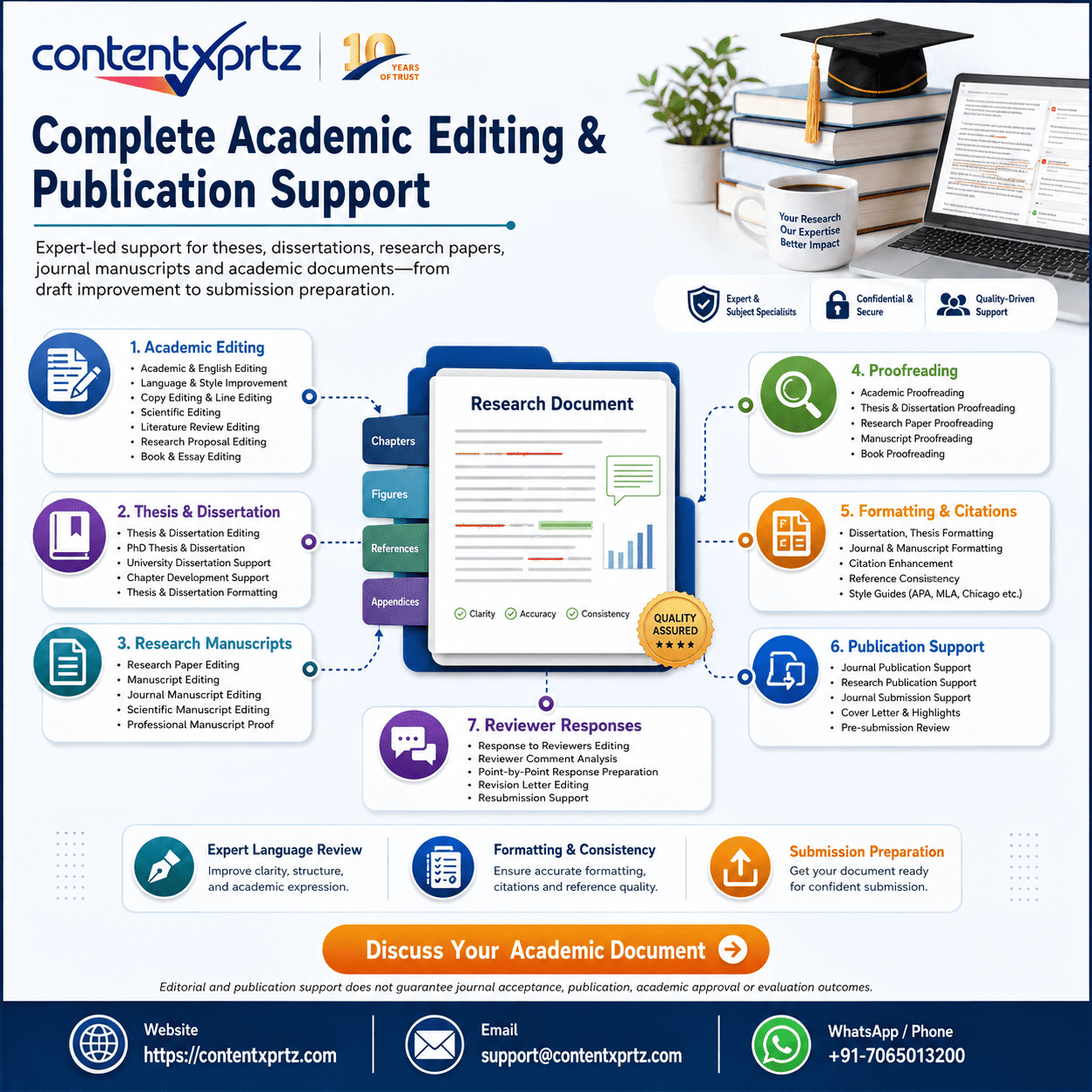
How Contentxprtz Can Support Authors Preparing for IJCHM
Preparing for IJCHM involves more than correcting grammar. A manuscript has to communicate a contribution that fits hospitality management, follow the journal's structured abstract and word-length rules, remain anonymous for peer review, use consistent Harvard references, present tables and figures clearly, and address ethics and declarations accurately.
Contentxprtz can support authors with journal-scope alignment review, manuscript assessment, academic editing, ESL language polishing, title and abstract refinement, structure improvement, journal formatting, reference consistency checks, cover-letter editing and reviewer-response preparation. The work should remain author-led: editors can improve communication and readiness, but they should not fabricate research, invent citations, manipulate peer review or submit through the author's account.
Preparing a Manuscript for IJCHM?
Improve clarity, structure, formatting and publication readiness while keeping editorial decisions entirely with the journal.
Contentxprtz does not guarantee acceptance or publication. The purpose of professional support is to help authors present their own research clearly, accurately, ethically and in line with applicable journal requirements.
Summary: International Journal of Contemporary Hospitality Management
IJCHM is an Emerald Publishing journal focused on hospitality and tourism management, with an explicit emphasis on research that can speak to both scholarship and management practice. Its supplied Scopus Source ID is 144742; Emerald lists ISSN 0959-6119, eISSN 1757-1049, Scopus ranking and Social Sciences Citation Index coverage.
The official publisher page reports a 2025 CiteScore of 22.1, a 2025 Impact Factor of 11.3 and a 2025 five-year Impact Factor of 11.7. Authors should verify live database values if their institution requires a specific quartile, SJR, SNIP or coverage date.
Submission preparation is specific: 6,000–9,000 words, structured abstract, up to 12 keywords, recognized Harvard references, anonymization for double-anonymous review and direct ScholarOne submission. Gold and green open-access options are available; any gold-OA APC should be checked immediately before submission. The journal may suit researchers with a clear hospitality-management contribution, but indexing and metrics alone do not establish manuscript fit.
Questions About IJCHM Indexing, Metrics and Submission
These answers summarize the journal facts and submission decisions researchers most often need to verify.
What is the International Journal of Contemporary Hospitality Management?
The International Journal of Contemporary Hospitality Management (IJCHM) is a peer-reviewed Emerald Publishing journal focused on hospitality and tourism management. Its scope connects research with management practice and covers strategic management, operations, marketing, finance, human resources, methods, innovation, applied research and related hospitality-management questions.
Who publishes the International Journal of Contemporary Hospitality Management?
IJCHM is published by Emerald Publishing. The official journal page identifies Emerald Publishing as the publisher and lists Professor Fevzi Okumus as Editor-in-Chief.
Is the International Journal of Contemporary Hospitality Management indexed in Scopus?
Yes. Emerald lists Scopus among the journal's ranking and indexing services, and the supplied Scopus source record identifies Source ID 144742. Authors whose institutions require Scopus coverage should still check the live Scopus source profile immediately before submission because database status can change.
What is the Scopus Source ID for IJCHM?
The Scopus Source ID supplied for the International Journal of Contemporary Hospitality Management is 144742. The associated print ISSN is 0959-6119 and the journal's official page also lists eISSN 1757-1049.
What are IJCHM's current citation metrics?
Emerald's current journal page reports a 2025 CiteScore of 22.1, a 2025 Journal Impact Factor of 11.3 and a 2025 five-year Impact Factor of 11.7. Emerald also shows a 2026 CiteScore Tracker, which is updated monthly and should not be confused with the completed 2025 CiteScore.
What quartile is the International Journal of Contemporary Hospitality Management?
This guide does not state a quartile because the authoritative Emerald page used for verification does not provide a category-specific Scopus quartile. Quartiles can differ by database, year and subject category, so authors should check the live Scopus or relevant institutional database rather than relying on an undated third-party value.
What types of papers does IJCHM publish?
The official scope lists applied research, empirical research papers, critical review/theoretical papers and case studies, among other hospitality-management content. Recent issues also show research articles and viewpoint or critical-reflection style contributions, but authors should confirm the currently available article classifications in ScholarOne before submission.
How long should an IJCHM manuscript be?
Emerald's author guidelines state that articles should be 6,000 to 9,000 words, including the structured abstract, references, text in tables and figures, and appendices. The guidance asks authors to allow 250 words for each figure or table.
What abstract and keyword format does IJCHM require?
IJCHM requires a structured abstract with Purpose, Design/methodology/approach, Findings and Originality. Research limitations/implications, Practical implications and Social implications are optional where relevant. The abstract can be up to 250 words in total, including keywords and article classification, and the submission may include up to 12 short keywords.
What reference style does IJCHM use?
The author guidelines require references to use a recognized Harvard style. Emerald's own Harvard style is acceptable, and the publisher emphasizes completeness, accuracy and consistency of citations.
What peer-review model does IJCHM use?
IJCHM uses double-anonymous peer review. After editorial screening, suitable submissions are sent to at least two independent referees. The editor may then accept the paper, request minor or major revisions, or decline it.
What is IJCHM's reported acceptance rate and timeline?
Emerald reports a 7.7% acceptance rate for submissions received between 1 April 2024 and 31 March 2025. The journal page also reports 28 days to first decision for that submission cohort and 29 days from acceptance to publication based on the previous 12 months, last updated April 2025. These are publisher-reported historical indicators, not guarantees for a new submission.
Is IJCHM open access and does it charge an APC?
IJCHM offers both gold and green open-access routes. Gold open access is selected after acceptance and uses a CC BY 4.0 licence; an APC then applies. Emerald states that there is no submission fee and that authors who do not choose gold open access should not be asked to pay for publication. Because APC prices can change, authors should verify the current rate on Emerald's official APC page or in ScholarOne.
How do I submit a paper to IJCHM?
The corresponding author should submit directly through the official IJCHM ScholarOne site linked from Emerald. Emerald explicitly states that manuscripts should not be submitted by email, through a third-party agent, or through an unofficial journal representative. Each contributing author needs a ScholarOne author account.
Can Contentxprtz guarantee acceptance in IJCHM?
No. Contentxprtz can help with manuscript assessment, academic editing, proofreading, journal formatting, reference consistency, cover-letter editing and reviewer-response preparation. Editorial decisions remain entirely with IJCHM and its reviewers, and professional editing does not guarantee peer-review success, acceptance or publication.
Choose IJCHM for Fit, Not for a Metric Alone
IJCHM may be a strong option for researchers whose work makes a clear contribution to hospitality or tourism management and can speak convincingly to both theory and practice. Its Scopus and SSCI visibility and current citation metrics may matter for institutional requirements, but the journal's scope, readership and demanding manuscript standards are more useful predictors of whether a submission is sensible.
Before submitting, recheck the live Emerald author guidelines, Scopus profile, open-access terms and ScholarOne instructions. Then make the manuscript easy for editors and reviewers to evaluate: state the research problem early, make the contribution explicit, keep implications evidence-based and remove avoidable formatting or anonymity problems.
Where professional support is useful, Contentxprtz can help improve clarity and publication readiness without replacing the author's intellectual responsibility or the journal's independent editorial process.
“At Contentxprtz, we don’t just edit; we help ideas reach their fullest potential.”