Innovation and Green Development: Scopus Indexing, Scope, Metrics & Submission Guide
Innovation and Green Development is an international, peer-reviewed, fully open-access journal focused on the relationship between innovation, environmental responsibility and sustainable development. It is published by Elsevier B.V.; the journal page also identifies the Business School, Zhengzhou University in the copyright statement. Its online ISSN is 2949-7531, and the supplied source record identifies Scopus Source ID 21101180570.
For researchers, the journal is especially relevant when a manuscript connects technological, economic, financial, corporate, policy or social innovation with a credible green-development outcome. The journal’s official scope covers green technologies, environmental and climate policy, green finance and markets, corporate sustainability and ESG, and the socio-economic dimensions of green development. That makes it multidisciplinary, but not unlimited: a paper still needs a clear sustainability or green-transformation contribution rather than a generic management, economics or technology topic with only a superficial environmental framing.
Elsevier’s current journal pages list the title as open access, indexed in Scopus and the Directory of Open Access Journals (DOAJ), and display a CiteScore of 19.6. Elsevier and DOAJ currently list an article processing charge of USD 1,900. Journal metrics, fees, indexing status and editorial information can change, so they should be reconfirmed on the live source pages before a submission or institutional decision.
Quick Answer: What Is Innovation and Green Development?
Innovation and Green Development is an Elsevier-published, peer-reviewed open-access journal that examines how innovation can support environmentally responsible, low-carbon, resilient and inclusive development. Its official aims emphasise the intersection of social, economic, political, technological and environmental responsibility, with theoretical, empirical and policy-oriented work all represented within its scope.
The journal is a plausible target for research on renewable energy and green technology, climate and environmental policy, circular economy, pollution and waste management, green finance, carbon markets, ESG, corporate sustainability, sustainable business, green jobs, just transition and related socio-economic questions. A strong submission should do more than mention sustainability: it should show a clear research problem, rigorous method or critical scholarly argument, and a novel contribution to knowledge about green transformation or sustainable development.
As of this review, Elsevier lists Scopus and DOAJ indexing and displays a CiteScore of 19.6. The journal is open access and currently lists a USD 1,900 APC. Before submitting, authors should verify the live author guide, APC, indexing record and metric year because these are time-sensitive.
Key Takeaways for Researchers
- Publisher: Elsevier B.V.; the journal is associated with the Business School, Zhengzhou University on its ScienceDirect copyright statement.
- Online ISSN: 2949-7531; Scopus Source ID: 21101180570.
- Indexing: Elsevier currently lists Scopus and DOAJ.
- Current Elsevier-displayed CiteScore: 19.6, checked for this guide on 10 August 2026; verify the reporting year on the live profile.
- Open access/APC: fully open access; Elsevier and DOAJ currently list USD 1,900, with DOAJ indicating a waiver policy.
- Peer review: double anonymized; suitable submissions are typically assessed by at least two independent reviewers.
- Article length: full-length articles are recommended at 6,000–10,000 words; reviews at 5,000–8,000 words.
- References: APA style, Seventh Edition; abstract up to 250 words and 1–7 keywords.
Journal Information at a Glance
| Field | Verified / practical information |
|---|---|
| Journal name | Innovation and Green Development |
| Source type | Journal |
| Scopus Source ID | 21101180570 |
| ISSN / EISSN | Online ISSN 2949-7531; no separate print ISSN verified in the sources used for this guide |
| Publisher | Elsevier B.V. |
| Associated organisation | Business School, Zhengzhou University |
| Publication language | English |
| Publication model | Open access, online via ScienceDirect |
| Scopus status | Elsevier currently lists Scopus indexing; verify current coverage years on the live Scopus profile |
| DOAJ | Listed in DOAJ |
| Current displayed CiteScore | 19.6 on Elsevier’s journal pages; reporting year should be verified on the live profile |
| SJR / SNIP / Quartile | Current official values not verified in the authoritative accessible sources used here; check current Scopus source profile |
| Journal Impact Factor | Not claimed here; Elsevier’s accessible comparison currently shows “-” in the Impact Factor field |
| Open-access APC | USD 1,900 currently listed by Elsevier and DOAJ; verify before submission |
| Peer review | Double anonymized; typically at least two independent reviewers for suitable manuscripts |
| Official website | ScienceDirect journal homepage |
| Author guidelines | Official Guide for Authors |
What This Page Covers
- the journal’s identity, publisher, aims and multidisciplinary scope;
- Scopus and DOAJ indexing plus the current Elsevier-displayed CiteScore;
- article types, word-length guidance and manuscript-fit considerations;
- double-anonymized peer review and the journal’s published decision timelines;
- open-access fees and what authors should verify before committing funds;
- formatting, abstract, keyword, reference, data and ethics requirements;
- a practical fit checklist and publication-readiness workflow; and
- ethical ways Contentxprtz may assist without promising acceptance.
Methodology and Sources Used for This Journal Profile
This guide prioritises authoritative journal and publisher information. The principal sources are the official ScienceDirect journal page, the official Guide for Authors, Elsevier’s Journal Insights page, the supplied Scopus source record, DOAJ, and Elsevier’s author policies and ethics guidance.
Journal facts were checked for this article on 10 August 2026. Indexing, metrics, APCs, editorial teams, review statistics and policies may change. Where an authoritative current value was not verified, this guide says so rather than estimating it.
What Does Innovation and Green Development Aim to Publish?
The journal’s mission is built around a specific question: how can innovation help societies and economies move toward environmentally responsible and sustainable development? Its aims and scope connect climate change, resource depletion and environmental degradation with technological, economic and policy innovations that can support green transformation. The journal explicitly welcomes theoretical, empirical and policy-oriented research, so the methodological doorway is broad while the substantive focus remains green development.
The strongest fit is likely to occur when the manuscript contains a meaningful link between an innovation mechanism and a sustainability outcome. For example, a study of fintech may fit if it explains green finance, clean investment or sustainability outcomes; a corporate-governance paper may fit if ESG, environmental performance or green innovation is central; and an energy-policy paper may fit when it advances understanding of clean-energy transition, carbon mitigation or environmental governance.
Core scope areas
- Green technologies and innovation: renewable energy, clean technologies, pollution control, circular economy, waste management, resource and energy efficiency, climate mitigation and adaptation, and carbon-management solutions.
- Environmental and climate policy: regulation, governance, greenhouse-gas reduction, clean-energy transition, institutional design and social support for green development.
- Green finance and markets: green bonds, sustainable investment, carbon markets, subsidies, incentives and climate-related financial disclosure.
- Corporate sustainability and ESG: ESG practice, corporate social responsibility, sustainability reporting, sustainable business, accountability and environmental outcomes.
- Socio-economic dimensions: equity, economic transformation, labour markets, green jobs, just transition and social consequences of sustainability policies.
Understanding Its Scopus Coverage and Journal Metrics
Institutional publication rules often make indexing the first screening question. Elsevier’s current Journal Insights page lists Scopus and DOAJ under abstracting and indexing, while the supplied source record identifies Scopus Source ID 21101180570. This supports the conclusion that Innovation and Green Development is currently presented by its publisher as Scopus-indexed.
Researchers should still distinguish “indexed in Scopus” from “meets my university’s exact requirement.” Universities may specify an active source, a particular coverage year, an allowed quartile or a metric threshold. The accessible source material used here did not provide a current official coverage-year range or category-specific quartile, so those values should be checked directly in the live Scopus source profile.
CiteScore, quartile, SJR and SNIP
Elsevier currently displays a CiteScore of 19.6 for the journal. The accessible summary does not display the reporting year beside that figure, so this guide deliberately describes it as the current Elsevier-displayed value checked on 10 August 2026 rather than assigning a year that was not verified.
This guide does not publish an unverified SJR, SNIP or quartile. Those metrics are useful only when tied to the correct reporting year and subject category. The same caution applies to Impact Factor: Elsevier’s comparison table currently shows a dash rather than an Impact Factor value, so this article does not claim a Journal Impact Factor. If a JCR Impact Factor is an institutional requirement, confirm it directly in the current Clarivate record.
What Types of Articles Does the Journal Publish?
The official Guide for Authors describes two principal article categories: full-length articles and review articles. The aims and scope also states that the journal welcomes original research articles, reviews and policy analyses. Full-length papers should demonstrate a rigorous approach to research and new knowledge creation and may take the form of a research article or an essay that uses critical reasoning and scholarship to make a clear contribution.
| Article type | Official guidance | Practical fit question |
|---|---|---|
| Full-length article | Around 8,000 words; recommended range 6,000–10,000 words. May be a research article or critical scholarly essay. | Does the paper present rigorous new knowledge or a clearly argued original contribution related to innovation and green development? |
| Review article | Recommended length 5,000–8,000 words; should critically analyse existing publications and contribute knowledge on sustainable development and innovations. | Does the review synthesise, critique and advance the field rather than merely list previous studies? |
| Policy-oriented analysis | Welcomed in the aims and scope when it provides novel insight into sustainable development drivers, mechanisms or outcomes. | Are the policy claims supported by appropriate evidence, method and a clear green-development contribution? |
Is This Journal a Good Match for Your Manuscript?
A suitable manuscript should align at four levels: topic, research question, method or scholarly approach, and contribution. Matching keywords alone is not enough. A paper on corporate performance, for example, becomes more journal-aligned when environmental performance, ESG practice, green innovation or sustainable transition is part of the research model rather than a late-stage implication.
Journal-fit checklist
- Is green development or sustainability central to the research question?
- Does the paper explain an innovation, policy, finance, technology, corporate or socio-economic mechanism?
- Is the contribution clearly connected to low-carbon, resilient, inclusive or environmentally responsible development?
- Does the methodology support the strength of the claims being made?
- Can the paper explain what is new beyond a country, dataset or time-period change?
- Do recent papers in the journal use related concepts, theories, data or methods?
- Would the journal’s interdisciplinary readership understand why the result matters?
- Does the manuscript fit the journal’s article type and recommended length?
As a practical publication-readiness step, compare the manuscript with several recent papers from the journal—not to imitate them, but to test whether your framing, contribution and evidence speak to the same scholarly conversation. Recent ScienceDirect content shows work on governance and SDGs, carbon regulation and green innovation, energy efficiency and emissions, fintech and sustainability, renewable-energy innovation and related themes.
Preparing the Manuscript to Match the Author Guidelines
The journal requests editable source files, using Word (.doc/.docx) or LaTeX (.tex); a PDF alone is not an acceptable source file. Word submissions should use a single-column layout, while double-column formatting is permitted for LaTeX. The guide also asks authors to remove strikethrough and underlining unless scientifically meaningful and to use spelling and grammar checks.
Double-anonymized submission files
Because the journal uses double-anonymized peer review, the title page and anonymized manuscript should be supplied separately. The title page should include the article title, author names, affiliations, acknowledgements, declaration of interest, and the corresponding author’s full address and email. The anonymized manuscript should contain the paper body, references, figures and tables but no identifying author names or affiliations.
Abstract, keywords and highlights
- Abstract: concise and factual, no more than 250 words.
- Keywords: 1–7 English keywords for indexing.
- Highlights: encouraged; 3–5 bullets, maximum 85 characters per bullet including spaces, submitted as a separate editable file.
- Graphical abstract: encouraged and submitted as a separate file when used.
Article structure and references
The guide asks authors to divide the article into clearly defined, numbered sections and subsections. References use APA style, Seventh Edition. The reference list should be alphabetical and then chronological; authors should check that every in-text citation appears in the reference list and vice versa. DOI links are encouraged because they support persistent linking and discoverability.
Research Data, Ethics and AI-Use Requirements
Innovation and Green Development follows Elsevier’s publishing-ethics framework. Submission implies that the work has not been published previously except in permitted forms such as a preprint, abstract, thesis or registered report; that it is not simultaneously under consideration elsewhere; and that all authors and responsible authorities have approved submission.
All authors are expected to make substantial intellectual contributions, approve the submitted version and accept accountability for the work. Competing interests must be disclosed. The journal’s guide also explains that authorship changes after submission are generally restricted and require editorial approval and documented agreement.
Research data
The journal follows Elsevier’s Option B research-data guidance. Authors are encouraged to deposit data in a relevant repository, cite and link the dataset in the article and, where sharing is not possible, explain why. A data-availability statement is encouraged at submission. These practices can strengthen transparency and reproducibility even when a dataset contains legitimate confidentiality or sensitivity constraints.
Generative AI disclosure
Elsevier requires a declaration when generative AI or AI-assisted technologies are used in manuscript preparation beyond basic tools used for grammar, spelling or references. The statement should identify the tool or service, explain its purpose and confirm that the authors reviewed and edited the content and take responsibility for the final work. This is a policy area that can change, so the live guide should be checked before submission.
What Happens After You Submit a Manuscript?
The process begins with an editorial suitability assessment. If the submission is considered appropriate for the journal, the guide states that it is typically sent to a minimum of two independent reviewers. The journal uses double-anonymized peer review, meaning author identities are concealed from reviewers and reviewer identities are concealed from authors. Editors make the final decision on acceptance or rejection.
Elsevier’s Journal Insights page currently publishes indicative timeline statistics of 2 days from submission to first decision, 48 days from submission to decision after review, 181 days from submission to acceptance, and 15 days from acceptance to online publication. These are publisher-displayed journal statistics, not guarantees for an individual manuscript. Review complexity, reviewer availability, revisions and editorial decisions can make a particular paper faster or slower.
The journal does not publicly state an acceptance rate in the authoritative sources used for this guide, so no acceptance percentage is estimated here.
Open Access, APCs and Publication Costs
Innovation and Green Development is presented by Elsevier as an open-access journal. Elsevier’s Journal Insights and DOAJ currently list an article processing charge of USD 1,900. DOAJ also indicates that a waiver policy exists. Authors should verify the current fee, taxes, currency treatment, waiver eligibility and any institutional or funder agreement before submission because charges can change.
An APC is normally relevant after acceptance rather than as a payment for editorial consideration. It should never be interpreted as purchasing acceptance or favourable peer review. The scientific and editorial assessment remains separate from payment arrangements.
Common Reasons a Manuscript May Be Unsuitable
The journal does not publish a simple checklist of “rejection reasons,” but its scope and author instructions make several readiness risks clear. A manuscript may struggle if the green-development connection is weak, the contribution is incremental, the method cannot support the claims, the paper does not fit an accepted article type, or the submission fails anonymization and file requirements.
- Environmental or sustainability language is added superficially to an otherwise unrelated topic.
- The paper describes a local dataset without explaining a broader theoretical, empirical or policy contribution.
- The abstract and introduction do not clearly identify the problem, gap, method and contribution.
- Claims about causality, policy or generalisation exceed what the design supports.
- A review article summarises literature but does not critically synthesise or advance knowledge.
- References are inconsistent, incomplete or not aligned with APA 7th style.
- The anonymized manuscript contains author names, affiliations or obvious identifying information.
- Ethics, competing interests, funding, data or AI-use declarations are missing where required.
A Practical Publication-Readiness Workflow
- Confirm scope first. Write one sentence explaining how the paper advances understanding of innovation and green development. If this sentence is vague, journal fit needs more work.
- Benchmark against recent papers. Review several recent journal articles for topic, contribution style, method and discussion—not just title keywords.
- Choose the correct article type. Align the manuscript with full-length or review expectations and the recommended length range.
- Strengthen the contribution statement. Distinguish what the study adds theoretically, empirically, methodologically or for policy.
- Check evidence discipline. Make sure every major conclusion is supported by the analysis actually performed.
- Prepare double-anonymized files. Separate the title page from the anonymized manuscript and remove identifying details.
- Reconcile citations and references. Apply APA 7th consistently and verify DOIs and bibliographic details.
- Complete declarations. Confirm competing interests, funding, data availability, authorship and generative-AI disclosure where applicable.
- Run a final language and formatting review. Correct clarity, grammar, terminology, tables, figures and submission-file naming.
- Recheck live journal information. Verify the current APC, author guide, indexing status and submission link immediately before uploading.
How Contentxprtz Can Support Ethical Publication Readiness
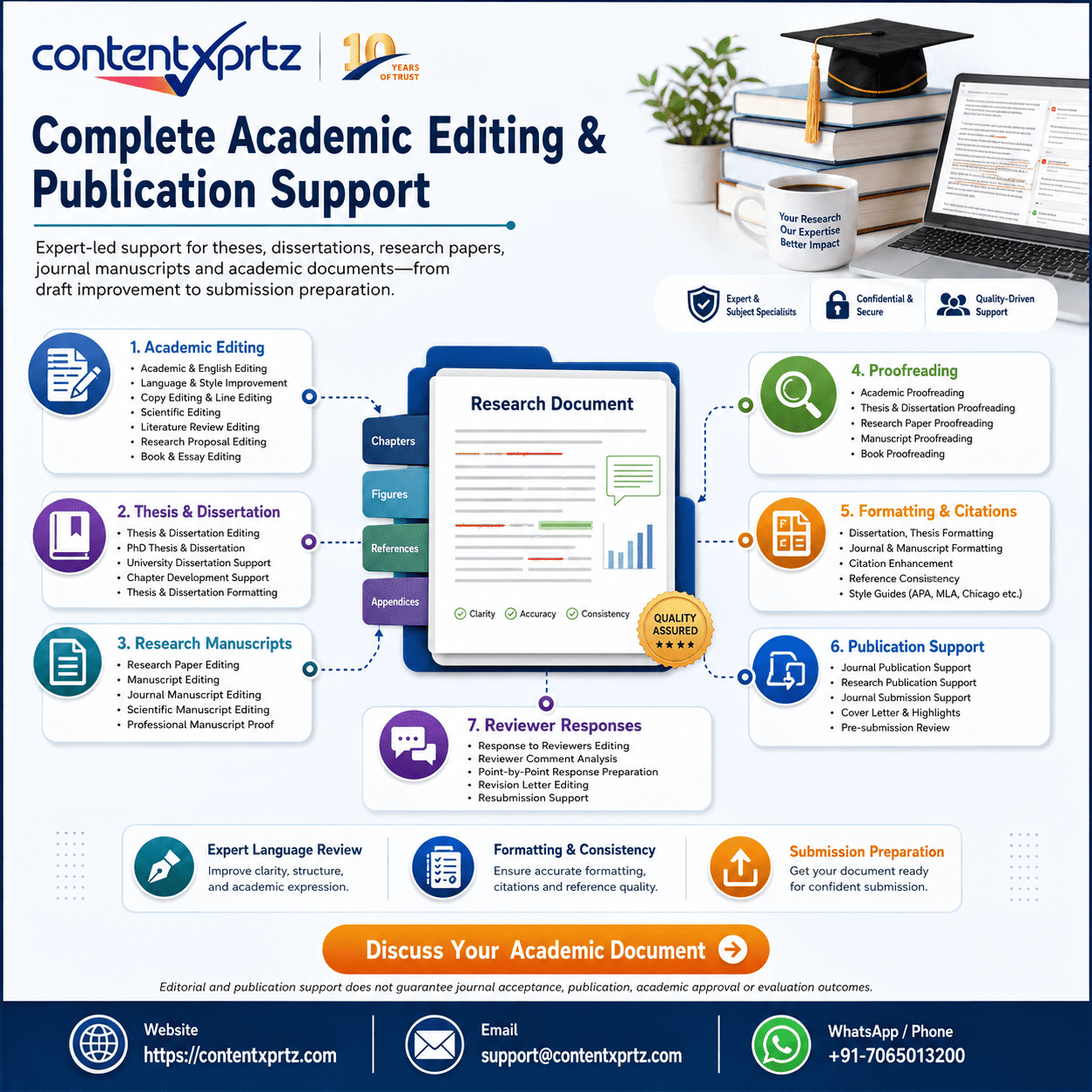
Professional support is most useful when it improves communication and compliance without replacing the researcher’s responsibility for the science. Contentxprtz can help with academic editing, language polishing, journal formatting, reference and citation consistency, manuscript assessment, cover-letter editing, reviewer-response editing and publication-readiness review.
For this journal, support may include checking whether the manuscript clearly connects its contribution to green development, tightening the abstract, improving section flow, reviewing APA 7th reference consistency, preparing a clean anonymized version and checking that required declarations and submission files are present. The researcher remains responsible for the research question, data, analysis, interpretation, citations, authorship and final submission decisions.
Preparing a manuscript for Innovation and Green Development?
Explore ethical manuscript editing, journal-formatting and publication-readiness support. Contentxprtz does not guarantee acceptance or influence editorial decisions.
Explore Journal Publication ServicesFrequently Asked Questions
Is Innovation and Green Development indexed in Scopus?
Yes. Elsevier’s current Journal Insights page lists Scopus among the journal’s abstracting and indexing services. The supplied source record identifies Scopus Source ID 21101180570. Researchers whose institutions require Scopus coverage should still open the live Scopus source profile before submission to confirm current status and coverage years.
What is the ISSN of Innovation and Green Development?
The journal’s online ISSN is 2949-7531. The official ScienceDirect journal page and DOAJ both display this online ISSN.
Who publishes Innovation and Green Development?
The journal is published by Elsevier B.V. ScienceDirect also states that copyright is held by the Business School, Zhengzhou University. DOAJ lists Elsevier as publisher and the Business School, Zhengzhou University as another organisation associated with the journal.
What is the current CiteScore of Innovation and Green Development?
Elsevier’s accessible journal pages currently display a CiteScore of 19.6. Because metrics can change and the accessible summary does not expose the reporting year beside that number, authors should verify the current metric and reporting period on the live Elsevier or Scopus profile before using it for institutional decisions.
Is Innovation and Green Development Q1?
This page does not assign a quartile because a current official category-and-year quartile was not verified from the accessible authoritative sources used here. Quartiles can differ by subject category and reporting year, so check the live Scopus source profile for the latest applicable quartile.
Does Innovation and Green Development have an Impact Factor?
The Elsevier Journal Insights comparison currently shows a dash in the Impact Factor field while displaying the journal’s CiteScore. This guide therefore does not claim a Journal Impact Factor. If an Impact Factor is important for your university or funder, verify the latest record directly in Clarivate’s Journal Citation Reports.
What article types does the journal publish?
The Guide for Authors describes full-length articles and review articles. Its aims and scope also welcomes original research, reviews and policy analyses. Full-length papers may be research articles or critically reasoned essays that make a clear contribution to knowledge.
How long should a manuscript be?
The Guide for Authors recommends around 8,000 words for full-length articles, with a range of 6,000–10,000 words. Review articles are recommended at 5,000–8,000 words. These are journal-specific recommendations and should be checked again before submission.
What peer-review model does the journal use?
Innovation and Green Development uses double-anonymized peer review. Editors first assess suitability; manuscripts considered suitable are typically sent to at least two independent reviewers for expert assessment, and editors make the acceptance or rejection decision.
What is the article processing charge?
Elsevier’s Journal Insights and DOAJ currently list an article processing charge of USD 1,900 for this open-access journal. DOAJ also indicates a waiver policy. Fees and waiver eligibility can change, so authors should confirm the live amount and any institutional or funder arrangements before submission.
What abstract and keyword limits apply?
The Guide for Authors requires a concise factual abstract of no more than 250 words and 1–7 English keywords for indexing. The journal also encourages highlights of 3–5 bullet points, with each bullet limited to 85 characters including spaces.
Which reference style does Innovation and Green Development use?
The Guide for Authors instructs authors to use American Psychological Association referencing style and refers to the APA Publication Manual, Seventh Edition. The reference list should be arranged alphabetically and then chronologically.
Can authors use generative AI when preparing a manuscript?
Elsevier requires disclosure when generative AI or AI-assisted technologies are used in manuscript preparation beyond basic tools such as grammar, spelling and reference checks. The disclosure should describe the tool and purpose, and authors remain responsible for the final content. Policies can evolve, so confirm the live guide before submission.
Can Contentxprtz guarantee acceptance in Innovation and Green Development?
No. Contentxprtz can ethically support language editing, journal formatting, reference consistency, manuscript assessment and publication readiness, but editorial decisions belong to the journal. No editing or publication-support provider can responsibly guarantee acceptance, peer-review success or indexing outcomes.
Conclusion: Should You Consider Innovation and Green Development?
Innovation and Green Development may be a strong journal candidate for researchers whose work sits genuinely at the intersection of innovation and sustainable or green development. Its scope spans technology, policy, finance, ESG, corporate sustainability and socio-economic transition, making it suitable for interdisciplinary research when the environmental and developmental contribution is substantive.
The journal is currently presented by Elsevier as open access and indexed in Scopus and DOAJ, with an Elsevier-displayed CiteScore of 19.6 and a listed APC of USD 1,900. Its double-anonymized review process, manuscript-length recommendations, APA 7th reference style and detailed ethics and data guidance should be built into preparation rather than handled at the last minute.
Before submission, verify the current author guide, APC, Scopus coverage and any institution-specific journal criteria. A careful match between scope, contribution, evidence and formatting is more useful than choosing a journal on a single metric. Contentxprtz can assist with ethical editing and publication readiness, but acceptance remains entirely with the journal’s editors and peer-review process.