Finding the Right Journal: A Practical Guide for Researchers
Finding the right journal is one of the most consequential decisions in the publication process because a strong manuscript can still be delayed or rejected when it reaches the wrong audience, article category, or editorial scope. Researchers often begin with a familiar journal name, a metric, a recommendation from a colleague, or a search result. Those signals can be useful, but none of them alone shows whether a journal is suitable for a specific study. The real task is to match the manuscript’s question, methods, evidence, contribution, and intended readers with a credible journal’s aims, recent content, submission requirements, access model, and publication practices.
The difficulty is practical as well as academic. A PhD scholar may need a journal recognised by a university. An early-career researcher may be balancing visibility, cost, and realistic editorial expectations. An interdisciplinary team may discover that no single subject label describes the work. An ESL author may have a valuable study whose title and abstract do not yet communicate the contribution clearly enough for journal-matching tools or editors. At the same time, authors must evaluate indexing claims, article processing charges, peer-review information, copyright terms, data policies, reporting guidelines, and possible warning signs of deceptive publishing.
A good decision therefore requires more than asking, “Which journal has the highest impact factor?” It requires a transparent process: define the manuscript accurately, build a shortlist, verify scope and readership, inspect comparable articles, confirm indexing through official sources, compare fees and policies, and assess whether the journal’s editorial practices are trustworthy. Metrics may inform the decision, but they do not replace fit. Open access may improve availability, but it does not automatically indicate quality. A fast first-decision estimate may be convenient, but it is not a promise and should not outweigh ethical and scholarly considerations.
This guide provides a step-by-step journal selection workflow, practical comparison tables, a shortlist scorecard, common mistakes, and realistic examples for students, PhD scholars, researchers, and first-time authors. It also explains when self-service selection is sufficient and when ethical journal publication support, manuscript assessment, or academic editing may help. The purpose is not to guarantee acceptance—no responsible service can do that—but to help authors make a defensible choice and present their research clearly, accurately, and in line with the selected journal’s requirements.
Quick Answer: How Do You Find the Right Journal?
Find the right journal by matching the manuscript—not just the topic—to a journal’s scope, readership, article types, methods, and recent publications. Start with journals that publish studies you cite, then expand the shortlist through trusted databases, publisher journal finders, subject experts, or librarians.
For every candidate, verify the official aims and scope, recent articles, indexing status, peer-review process, editorial board, ethics policies, fees, licences, open-access options, decision-time information, and submission requirements. Use the journal title and ISSN when checking official indexing sources. Compare three to five candidates with a written scorecard rather than choosing by reputation or one metric alone.
The most important principle is fit before prestige. A credible specialist journal read by the right community may be more suitable than a broader, higher-metric journal that rarely publishes your methods or article type. Submit to only one journal at a time and follow its current author instructions closely.
Key Takeaways
- Journal selection begins with the manuscript’s question, method, contribution, article type, and intended audience.
- Aims and scope should be checked against recent published papers, not interpreted from the journal title alone.
- Metrics can provide context, but scope fit, readership, transparency, and author requirements are more fundamental.
- Indexing claims should be verified through official source lists using the correct title and ISSN.
- Fees, waiver policies, licences, and open-access routes must be understood before submission.
- Journal finder tools generate candidates; authors must still conduct human due diligence.
- No journal, editor, or support provider can ethically guarantee acceptance or publication.
What This Page Covers
- A practical definition of journal fit and why it matters
- A step-by-step method for building and ranking a shortlist
- How to evaluate scope, readership, article types, indexing, metrics, fees, and timelines
- How to assess peer review, transparency, and possible deceptive practices
- How to use journal finder tools without outsourcing the final decision
- Three realistic journal-selection examples
- A pre-submission checklist and ten detailed FAQs
Table of Contents
Methodology and Academic Sources
This article combines established journal-selection and publication-readiness workflows with current guidance from recognised scholarly publishing organisations and official database or publisher resources. The Think. Check. Submit. journal checklist supports due diligence when assessing a journal. The Principles of Transparency and Best Practice in Scholarly Publishing identify information that credible journals should make clear, including peer review, ownership, fees, licensing, editorial governance, and ethics policies.
Authors can verify open-access titles and transparency information through the Directory of Open Access Journals transparency guidance, and can confirm Web of Science coverage through the Clarivate Master Journal List. Publisher tools such as the Elsevier Journal Finder can suggest candidates from manuscript text, but every recommendation still requires manual verification. Journal policies and database coverage can change, so researchers should recheck the official sources near the time of submission.
What Finding the Right Journal Means in Academic Publishing
Finding the right journal means identifying a credible venue in which the manuscript is relevant, understandable, technically compliant, and valuable to the journal’s actual readers. It is a multidimensional fit, not a single ranking decision.
The strongest match connects five elements: the research problem, the evidence and methods, the contribution, the article format, and the audience. A paper on artificial intelligence in medical diagnosis may fit a clinical informatics journal, a machine-learning methods journal, a radiology journal, or a health-policy journal depending on what the study actually contributes. The keywords may overlap, but the editorial questions and expected evidence differ.
Journal fit has several layers
- Topical fit: the subject falls within the stated aims and scope.
- Methodological fit: the journal publishes the study design, analytical approach, or evidence type.
- Article-type fit: the journal accepts original research, reviews, brief reports, protocols, case studies, methods papers, or other relevant formats.
- Audience fit: the readers are likely to understand, use, debate, or build on the findings.
- Contribution fit: the level of novelty, generalisability, practical relevance, or theoretical development matches the journal’s expectations.
- Operational fit: the authors can meet the formatting, ethics, data, budget, licence, and timeline requirements.
A journal can be reputable but unsuitable for a particular paper. Conversely, a specialised or regional journal can be an excellent choice when it reaches the correct community and operates transparently. The target should be the most appropriate scholarly home, not merely the most recognisable title.
Why Researchers Struggle with Journal Selection
Researchers struggle because journal information is distributed across many pages and because different priorities can conflict. The journal that offers the widest visibility may charge a fee the project cannot cover. The fastest journal may not reach the right specialists. A required index may include several titles, but only a few publish the relevant methods. A publisher’s matching tool may suggest a journal based on abstract similarity even though the paper does not meet its article-type or data requirements.
Publication pressure also encourages shortcuts. Authors may submit to a famous journal without examining recent content, or choose a journal from an invitation email because the process sounds easy. Co-authors may use different definitions of “good journal.” Supervisors may recommend titles based on past experience, while editorial scope has since shifted. A manuscript may also be difficult to match because its title and abstract are too broad, omit the method, or overstate the contribution.
The solution is a recorded decision process. A shortlist table makes assumptions visible, separates verified facts from preferences, and allows the team to discuss trade-offs. It also reduces repeated work after rejection because the next candidate has already been assessed.
Step-by-Step Process for Finding the Right Journal
The most dependable workflow moves from manuscript definition to discovery, verification, comparison, and pre-submission compliance.
Step 1: Describe the manuscript in one precise paragraph
Write a neutral summary containing the discipline, research question, study design, population or dataset, main contribution, article type, and intended users. Do not begin with the desired journal. Begin with what the paper actually is. This paragraph can later support database searches, journal finder tools, co-author discussions, and the cover letter.
Step 2: Identify journals already present in the manuscript
Review the references and list journals that published the closest conceptual, methodological, and contextual studies. Pay particular attention to papers that the manuscript directly extends, challenges, replicates, or applies. A journal cited frequently may be relevant, but confirm that the citations are recent and that the journal still publishes similar work.
Step 3: Search beyond familiar titles
Use subject databases, library catalogues, publisher portfolios, journal finder tools, and recommendations from supervisors, collaborators, or librarians. Search the manuscript title and distinctive keywords to see where comparable papers appear. For interdisciplinary work, search from each disciplinary angle because different communities may frame the same problem differently.
Step 4: Build a shortlist of three to five candidates
Record the journal title, ISSN, publisher, official website, scope statement, article type, recent comparable articles, indexing, access model, fees, licence, peer-review information, timelines, and special requirements. Do not submit yet. The shortlist is a research document, not a list of preferences.
Step 5: Read recent content closely
Read at least five recent abstracts and two or three full articles from each leading candidate. Check the studies’ methods, scale, geographic breadth, theoretical contribution, data presentation, and writing style. Look for editorials or special issues that reveal current priorities. Aims and scope provide the formal boundary; recent content shows how editors apply it.
Step 6: Verify trustworthiness and external claims
Confirm indexing in the official database, not only on the journal website. Check the editorial board, peer-review description, publication ethics, correction and retraction policy, complaints process, fees, ownership, contact details, copyright, and licensing. For open-access journals, review DOAJ information where applicable. Use the Think. Check. Submit. questions as a structured second check.
Step 7: Score the shortlist and discuss trade-offs
Rate each journal against criteria agreed by all authors. Scope and readership should carry more weight than prestige alone. Add non-negotiable requirements, such as a funder licence, recognised index, maximum fee, or acceptance of a registered report. Document uncertainties rather than treating missing information as favourable.
Step 8: Rework the manuscript for the selected journal
After the target is chosen, revise the title, abstract, keywords, article structure, tables, figures, references, statements, and cover letter to meet the journal’s current instructions. This is not merely formatting. The introduction and discussion should explain the contribution in a way that is relevant to the journal’s readers without changing the research findings or overstating novelty.
Journal Selection Criteria: What to Check and Why
The table below separates essential fit questions from supporting considerations. Each item should be verified from the journal’s official pages or an authoritative external source.
| Criterion | What to verify | Why it matters | Warning sign |
|---|---|---|---|
| Scope | Aims, exclusions, subject boundaries, special priorities | Reduces desk rejection for topic mismatch | Scope is vague or unrelated to recent content |
| Readership | Who reads and applies the research | Determines whether the work reaches the right community | Audience cannot be identified |
| Article type | Accepted formats, structure, length, evidence expectations | Confirms the manuscript is eligible | Desired format is absent or discontinued |
| Recent articles | Comparable topics, methods, populations, and contribution levels | Shows how scope is applied in practice | No relevant content despite broad claims |
| Indexing | Current status in required official databases | Supports discoverability and institutional compliance | Unverifiable badges or outdated claims |
| Peer review | Model, process, editorial responsibility, appeals | Indicates transparent quality control | Guaranteed acceptance or implausibly rapid review |
| Fees and access | APC, taxes, waivers, subscription or OA route, licence | Prevents unexpected cost and mandate conflicts | Charges are hidden or explained only after acceptance |
| Ethics and policies | Authorship, conflicts, data, corrections, misconduct, AI use | Protects research integrity and author responsibility | Policies are missing, copied, or internally inconsistent |
| Timelines | Stated first decision, review, production, and publication times | Helps with planning | Speed is promised as a certainty |
A journal does not need to be perfect on every preference. It must satisfy the manuscript’s essential scholarly and ethical requirements, while any trade-offs should be explicit and acceptable to the authors.
How to Evaluate Scope, Readership, and Article Type
Scope evaluation is the centre of journal selection because editorial teams first decide whether the manuscript belongs in the journal before considering detailed quality.
Read the scope for verbs and boundaries
Look for words such as develops, tests, evaluates, translates, reviews, applies, or debates. These verbs reveal the kind of contribution the journal values. Also note exclusions: some journals cover a broad disease area but exclude case reports; some education journals welcome interventions but not local satisfaction surveys; some engineering journals require methodological novelty rather than routine application.
Use recent articles as evidence
Search the journal site for your method, population, and central concept. Compare article titles, abstracts, and methods. If every related paper uses large multicentre datasets and your manuscript is a small exploratory study, the topical match may be superficial. If the journal regularly publishes focused regional studies with clear practical implications, the fit may be stronger than its global title suggests.
Identify the primary reader
Ask who should act on or cite the findings: laboratory scientists, clinicians, policy specialists, teachers, engineers, managers, historians, or interdisciplinary researchers. A paper can be reframed for different audiences, but the evidence and contribution must remain accurate. Choose the journal where the manuscript’s main message is central rather than peripheral.
Confirm the exact article category
Article categories can have different limits, review processes, and evidence requirements. A “brief communication” may not simply be a shorter original article. A narrative review, scoping review, systematic review, protocol, methods paper, case study, registered report, and data paper each has distinct expectations. Confirm eligibility before investing in journal-specific formatting.
How to Check Indexing, Metrics, and Discoverability
Indexing should be verified as a current fact, while metrics should be interpreted as contextual indicators rather than guarantees of article quality or success.
Use the journal title and ISSN on the official database source page. For Web of Science, note the exact collection. For Scopus, review the source record and coverage information. For open-access journals, DOAJ inclusion can support transparency checks but does not replace manuscript fit. Discipline-specific indexes such as PubMed or MEDLINE, ERIC, PsycINFO, EconLit, or engineering databases may matter more to the intended audience than broad multidisciplinary coverage.
Questions to ask about metrics
- Is the metric issued by a recognised provider and shown for the correct journal?
- Is it current, and does the journal clearly state the year?
- How do citation patterns differ in this discipline and article type?
- Does an institutional rule require a particular index, quartile, or metric?
- Would the journal’s actual readership be more valuable than a marginal metric difference?
Beware of unfamiliar “global impact” labels, invented scores, or metrics that cannot be verified. Even recognised metrics can be misused when authors compare fields directly or assume that a journal average predicts an individual paper’s impact.
Open Access, Article Processing Charges, and Licensing
Access and cost should be assessed early because they affect compliance, readership, and budget, but they should not override journal credibility or scope.
A fully open-access journal makes its articles available without subscription barriers, often under a Creative Commons licence. Some charge an article processing charge, while others are funded by institutions, societies, or consortia and charge authors nothing. Hybrid journals combine subscription access with an optional open-access route. Subscription journals may permit authors to deposit an accepted manuscript in a repository after an embargo.
Verify these details before submission
- The exact APC, currency, taxes, and what the fee covers
- Whether payment is due only after acceptance
- Institutional agreements, funder arrangements, discounts, and waiver eligibility
- The available licence options and any funder-required licence
- Repository deposit rules and embargo periods
- Additional charges for colour, pages, figures, or supplementary material
A legitimate journal should state charges clearly. Payment should not influence the editorial decision. Authors should also avoid assuming that “free to publish” is always the best option or that a high APC signals higher quality. The correct question is whether the model is transparent, affordable, compliant, and suitable for the intended readers.
How to Assess Peer Review, Ethics, and Journal Trustworthiness
A trustworthy journal explains how it operates and provides enough evidence for authors to verify its identity, editorial responsibility, peer-review process, and business practices.
| Area | Credible information to look for | Questions for the author |
|---|---|---|
| Journal identity | Consistent title, ISSN, publisher, ownership, contact details | Can the journal be distinguished from similarly named titles? |
| Editorial board | Named editors with relevant affiliations and roles | Do the people and affiliations appear authentic and current? |
| Peer review | Clear model, reviewer process, confidentiality, decisions, appeals | Is the process plausible and free from acceptance guarantees? |
| Publication ethics | Authorship, conflicts, misconduct, data, corrections, retractions | Are policies visible, specific, and consistent? |
| Business model | Fees, advertising, sponsorship, waivers, refunds, licences | Are costs and commercial relationships transparent? |
| Publishing record | Regular issues, readable articles, DOI use, correction history | Does recent content match the stated field and quality expectations? |
Warning signs should be considered together. An unsolicited email is not automatically deceptive, and a new journal may not yet have established metrics. More serious concerns include false indexing claims, copied editorial boards, hidden fees, fabricated metrics, a misleading journal title, acceptance promises, a scope covering almost every discipline, or a website that cannot explain ownership and review.
Authors should retain screenshots or notes of key policies used in the decision, especially when institutional compliance matters. If facts remain unclear, contact the journal using the official address and ask a specific question before submitting.
How to Use Journal Finder Tools Responsibly
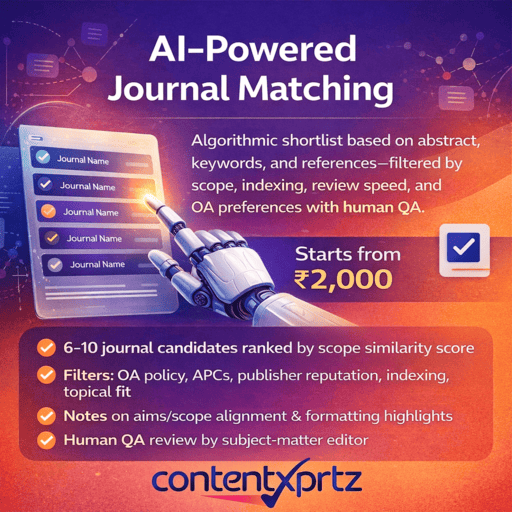
Journal finder tools work best as discovery aids that produce an initial candidate list from a title, abstract, keywords, or subject classification.
Before using a tool, improve the abstract so it states the problem, method, population or dataset, major result, and contribution accurately. Vague abstracts generate vague matches. Review whether the tool covers multiple publishers or only one portfolio. Do not treat the highest-ranked suggestion as the best journal, and never assume a recommendation indicates editorial interest or likelihood of acceptance.
A safe tool-assisted workflow
- Remove confidential information if the tool’s privacy terms are unclear.
- Enter a clear title, abstract, and keywords.
- Save a broad list of plausible journals.
- Add journals found through references, databases, and expert recommendations.
- Verify every candidate through its official website and authoritative external sources.
- Score scope, readership, article type, trustworthiness, indexing, fees, and requirements.
- Discuss the final shortlist with co-authors.
Publisher finders can be excellent within their own catalogues, but they cannot compare every journal in the field. Library support is especially useful when a manuscript crosses disciplines or must meet a specific indexing requirement.
Free, Institutional, and Professional Support Options
Many authors can complete journal selection independently, especially when the field is familiar and journal requirements are straightforward. Free and institutional resources should usually be used first.
| Option | Best use | Strength | Limitation |
|---|---|---|---|
| Reference and database review | Finding journals that publish related work | Grounded in the manuscript’s literature | Can reinforce a narrow existing network |
| Publisher journal finder | Generating candidates from title and abstract | Fast and easy to compare within a portfolio | Usually limited to that publisher |
| University librarian | Indexing checks, database discovery, trust verification | Independent and discipline-aware | Availability may vary |
| Supervisor or senior collaborator | Field norms, audience, realistic contribution level | Contextual scholarly judgement | Advice may reflect personal publishing history |
| Professional publication support | Complex shortlist analysis and manuscript-journal alignment | Structured comparison and editorial feedback | Quality and ethics of providers vary |
Expert support is most useful when the manuscript is interdisciplinary, the shortlist is disputed, the abstract does not represent the paper clearly, or the authors must compare detailed policy, indexing, and formatting requirements. Ethical support informs the decision; it does not make undisclosed submissions or promise outcomes.
Ethical Academic Editing and Author Responsibility
Journal-selection assistance and manuscript editing should improve clarity and decision quality without replacing the author’s intellectual responsibility.
Authors remain responsible for the research question, methods, data, analysis, claims, citations, authorship, conflicts of interest, ethical approvals, and final submission. An editor may point out that the abstract does not state the method, that the discussion overclaims generalisability, or that the paper does not yet meet the target journal’s structure. The editor should not invent results, manufacture citations, conceal the use of prohibited assistance, or alter meaning without author review.
AI-assisted tools require similar caution. Authors should check the journal’s current policy, verify every generated statement and reference, protect confidential manuscript content, and disclose use where required. A journal finder powered by text matching can support discovery, but the authors must assess whether the recommendation is scholarly, ethical, and practical.
Where language or structure obscures the study’s contribution, Contentxprtz academic editing services can improve readability and journal alignment while preserving the author’s ideas and technical meaning.
Common Mistakes When Choosing a Journal
Most journal-selection errors come from using a shortcut as a substitute for evidence.
- Choosing by journal title alone: broad titles can hide narrow methodological or article-type preferences.
- Prioritising one metric: a metric does not prove scope fit, readership, ethical practice, or acceptance likelihood.
- Trusting a matching tool without verification: text similarity can miss policy, evidence-level, and audience differences.
- Relying on the journal website for indexing: confirm coverage through the official database using the ISSN.
- Ignoring recent articles: formal scope may remain broad while actual editorial priorities evolve.
- Discovering fees after acceptance: verify APCs, waivers, licences, taxes, and extra charges in advance.
- Formatting too early: first establish strong fit; then invest in journal-specific formatting.
- Submitting simultaneously: standard scholarly practice normally requires one active journal submission at a time.
- Overstating novelty to fit a prestigious journal: journal alignment should not distort the evidence.
- Failing to agree with co-authors: discuss non-negotiable requirements and approve the final target before submission.
Practical Examples of Finding the Right Journal
Example 1: A first-time researcher with a technically sound regional study
Situation: A public-health researcher has a cross-sectional study from one region and initially selects a highly visible international clinical journal.
Common confusion: The disease topic appears in the journal, but recent papers are multicentre trials and major guideline studies. The author assumes topic overlap is enough.
Better approach: The researcher searches recent articles using the study design and region, then identifies journals that publish epidemiological surveys, health-service evidence, and context-specific implications. The shortlist is compared for readership, indexing, open-access cost, and reporting requirements.
Ethical expert help: A manuscript assessment can clarify the paper’s contribution and whether the abstract accurately represents the study. Contentxprtz manuscript assessment can flag scope and presentation mismatches without promising acceptance.
Example 2: An interdisciplinary PhD paper between engineering and sustainability policy
Situation: The paper models energy efficiency but devotes much of the discussion to policy implementation.
Common confusion: Engineering journals consider the technical novelty limited, while policy journals find the modelling too specialised.
Better approach: The authors decide which contribution is primary and revise the abstract accordingly. They search both disciplines, identify journals that regularly publish applied modelling with policy implications, and compare whether the expected audience can understand the assumptions and use the conclusions.
Ethical expert help: An academic editor can improve transitions between the technical and policy sections and ensure that the claims remain proportionate to the model. The authors retain control over the disciplinary positioning.
Example 3: An ESL author deciding between open-access journals
Situation: Two journals appear to fit the topic. One has a lower APC but unclear waiver information; the other has transparent policies and stronger readership among practitioners.
Common confusion: The author initially equates lower cost with better value and assumes both journals are equally discoverable.
Better approach: The author verifies indexing, licence terms, peer review, editorial board, practitioner readership, waiver eligibility, and repository options. A funding agreement covers part of the transparent journal’s APC, making it the more suitable choice.
Ethical expert help: Journal-selection guidance can organise verified facts and identify unanswered questions. The final financial and publishing decision remains with the author and institution.
A Practical Shortlist Scorecard
Use a weighted scorecard to make the reasoning visible. A score should support judgement, not replace it. Any journal that fails an essential ethics, scope, or institutional requirement should be removed even if its total is high.
| Criterion | Suggested weight | Scoring question |
|---|---|---|
| Scope and recent-content fit | 25% | Does the journal routinely publish this question, method, article type, and contribution level? |
| Readership and relevance | 20% | Will the intended scholarly or professional audience encounter and use the work? |
| Trustworthiness and ethics | 20% | Are identity, editorial governance, peer review, policies, and fees transparent? |
| Indexing and discoverability | 15% | Is current coverage verified in databases important to the field and institution? |
| Access, licence, and cost | 10% | Are the publishing route, APC, waiver, and licence acceptable and compliant? |
| Requirements and feasibility | 10% | Can the manuscript meet the format, data, reporting, and timeline requirements? |
Teams can change the weights. For example, a funder-mandated licence may become non-negotiable, while a thesis requirement may give indexing greater weight. Record the source and date for each factual entry.
Journal Selection and Pre-Submission Checklist
Manuscript definition
- The research question, method, article type, main finding, contribution, and intended reader are stated clearly.
- The title and abstract accurately represent the manuscript without exaggeration.
- All co-authors agree on essential and preferred journal criteria.
Scope and audience
- The aims and scope have been read in full.
- At least five recent abstracts and two full articles have been reviewed.
- The journal publishes the manuscript’s methods, evidence level, and article category.
- The primary readers can use or build on the findings.
Verification and trust
- The journal title, ISSN, publisher, ownership, and contact details are consistent.
- Indexing has been checked through official database sources.
- The editorial board and peer-review process are clearly described.
- Ethics, authorship, conflicts, data, corrections, and retractions policies are visible.
- Fees, licences, waivers, and access routes are transparent.
Submission readiness
- The current author instructions and article-type requirements have been followed.
- Word count, abstract, references, figures, tables, and supplementary files comply.
- Ethics approval, reporting guideline, registration, data, funding, and conflict statements are complete.
- Every co-author has approved the manuscript, author order, declarations, and target journal.
- The manuscript is not under consideration by another journal.
How Contentxprtz Can Help with Journal Selection
Contentxprtz can support authors who need a structured comparison of target journals or whose manuscript is not yet communicating its contribution clearly. Relevant support may include manuscript assessment, journal shortlist development, scope and requirement comparison, title and abstract refinement, academic editing, reference consistency, and submission-readiness checks.
The process should begin with the manuscript and the author’s genuine constraints: discipline, article type, intended audience, institutional indexing requirements, open-access mandate, budget, timeline, and journals already considered. Recommendations should explain why each journal may fit, what remains uncertain, and what must be verified before submission.
Support cannot guarantee peer review, acceptance, indexing, publication speed, citations, or career outcomes. Those depend on research quality, novelty, journal scope, editorial priorities, reviewers, ethics compliance, and the final decisions of the authors and journal. Contentxprtz focuses on clearer communication and more informed preparation through ethical manuscript editing and publication support.
Summary: Finding the Right Journal
Finding the right journal is a structured matching and verification process. The best target aligns with the manuscript’s subject, methods, article type, contribution, and intended readers; operates transparently; satisfies relevant indexing or funder requirements; and offers practical terms the authors can meet.
Start with the manuscript, not the metric. Generate candidates from references, databases, publisher tools, librarians, and subject experts. Read recent articles, verify indexing and ethics claims through official sources, compare access and fees, and document the shortlist. Once a journal is selected, revise the manuscript and submission files to its current requirements.
A careful process cannot guarantee acceptance, but it can reduce avoidable scope mismatches, hidden-cost surprises, policy conflicts, and technical returns. It also helps co-authors make a reasoned decision that can be explained and revisited if the manuscript needs a new destination.
Frequently Asked Questions
What does finding the right journal actually involve?
Finding the right journal means identifying a publication whose aims, scope, readership, article types, editorial standards, access model, and practical requirements align with your manuscript. Topic similarity alone is not enough. You should compare your research question, methods, study population, evidence level, and intended contribution with recently published articles in the journal. Then verify whether the journal accepts your manuscript type, word length, figures, supplementary files, data statements, reporting guidelines, and reference style. Check the journal’s official website for peer-review information, publication ethics, fees, licensing, and typical editorial timelines. Confirm any claimed indexing through the relevant official database rather than relying only on badges or search results. A suitable journal should reach the readers who can use your work and should offer a transparent, credible route to publication. The final decision also depends on institutional requirements, funder mandates, co-author priorities, and the maturity of the manuscript. A journal-matching tool can create a starting list, but authors should make the final choice after reading the journal’s scope and recent content carefully.
How do I know whether my paper fits a journal’s scope?
Start with the journal’s aims and scope, then test the fit against recent articles rather than relying on one broad subject label. Compare the central problem, discipline, population, method, article type, and practical or theoretical contribution of your manuscript with papers published during the last one to three years. Read several abstracts and at least two full articles from the journal. Ask whether your study would feel familiar to its regular readers and whether the journal routinely publishes the type of evidence you provide. A clinical journal may cover your disease area but reject a laboratory-only study; a management journal may discuss innovation but prefer theory-building rather than a local descriptive survey. Also check exclusions, special collections, geographic emphasis, and whether interdisciplinary work is welcomed. If the fit is uncertain, review editorials, submission guidance, and calls for papers. Some journals allow brief pre-submission enquiries, but follow their stated procedure. Do not force the manuscript into a journal by changing the title and keywords while leaving the underlying research question unchanged. Scope fit should reflect the actual study, not cosmetic wording.
Should I choose a journal mainly by impact factor or CiteScore?
No. Journal metrics can provide context, but they should not be the main or only basis for journal selection. An impact factor, CiteScore, or similar indicator describes citation patterns at journal level; it does not guarantee that an individual article will be read, cited, accepted, or considered high quality. Metrics also vary across disciplines, article types, languages, and database coverage. A better priority order is scope fit, relevant readership, credible editorial and peer-review practices, discoverability in databases important to your field, author requirements, access model, fees, and realistic timelines. Then use metrics as one additional comparison point if your institution, funder, or career system requires them. Verify metrics on the official provider’s platform because journal websites may display outdated, selectively framed, or misleading numbers. Avoid invented metrics and unfamiliar badges that cannot be traced to a recognised source. A well-matched specialist journal may serve your research better than a higher-metric journal whose audience, methods, or article types do not align with your work.
How can I check whether a journal is indexed in Scopus or Web of Science?
Verify indexing through the database provider’s official source list, using the journal title and ISSN. For Web of Science, search the Clarivate Master Journal List and note the specific collection in which the journal is covered. For Scopus, use the Scopus Sources feature or the official source list and review the title’s current coverage status. Do not rely only on a journal logo, an old screenshot, a third-party blog, or a search-engine snippet. Journal titles can be similar, publishers can change, and coverage can be discontinued or altered. Match the ISSN or eISSN carefully, especially when a journal has print and online versions. Also distinguish between being discoverable in a database and being included in a particular index or collection required by your institution. If a university, funder, or promotion policy names a specific database, confirm its exact rule before submitting. Record the date on which you verified the journal because coverage information can change. Indexing is useful for discoverability and institutional compliance, but it does not replace checks of scope, editorial transparency, peer review, and publication ethics.
How do I avoid predatory or deceptive journals?
Use a positive verification process rather than relying on a single blacklist or one warning sign. Confirm that the journal clearly identifies its publisher, editorial leadership, contact information, peer-review model, publication ethics, ownership, copyright, licensing, fees, and correction or retraction procedures. Check whether editorial-board members are real and appropriately connected to the field. Read recent articles for quality, relevance, and consistent publication history. Verify indexing and memberships through official sources. Be cautious when a journal uses a title that closely imitates a respected publication, sends aggressive invitations unrelated to your expertise, promises unusually fast acceptance, hides charges until late in the process, or displays unverifiable metrics. The Think. Check. Submit. checklist and the COPE, DOAJ, OASPA, and WAME transparency principles provide practical due-diligence questions. No single feature proves that a journal is trustworthy, and newer or regional journals should not be dismissed merely because they lack famous metrics. The aim is to evaluate transparent evidence about how the journal operates and whether it is an appropriate scholarly venue.
What should I compare when shortlisting several journals?
Compare the journals with a written scorecard so that co-authors can see the reasons behind the decision. Include scope fit, target readership, recent publication of similar studies, accepted article type, methodological fit, indexing relevant to your institution, open-access options, article processing charges, waiver policies, copyright and licence terms, data-sharing requirements, word and figure limits, reporting guidelines, submission format, peer-review model, and stated editorial timelines. Add practical questions: Is the journal accessible to your intended audience? Does it publish work from your region or study context? Are preprints permitted? Are there restrictions on prior conference abstracts? Does the journal require specific ethics, registration, or data-availability statements? Separate verified facts from estimates and personal preferences. Avoid giving excessive weight to one metric or to an advertised decision time, because actual processing can vary by manuscript and reviewer availability. A shortlist of three to five journals is usually manageable, but submit to only one journal at a time unless the journals explicitly operate an approved coordinated submission model.
Are journal finder tools reliable for choosing a target journal?
Journal finder tools are useful for generating candidates, but they should be treated as recommendation systems rather than final authorities. Most tools compare the title, abstract, keywords, or subject area of a manuscript with journal content or publisher portfolios. This can reveal titles that an author has not considered, especially for interdisciplinary work. However, a tool may be limited to one publisher, may rank journals using text similarity, and may not fully account for study quality, article type, ethical requirements, geographic emphasis, novelty, negative results, data availability, or the editor’s current priorities. Use two or more discovery routes: publisher journal finders, reference lists from closely related papers, database searches, suggestions from supervisors or librarians, and journals that publish the studies you cite most often. Then verify every candidate on its official website. Never paste confidential or unpublished text into an unfamiliar service without checking privacy terms. The best workflow is tool-assisted discovery followed by human evaluation of scope, readership, trustworthiness, costs, and submission requirements.
When should I choose an open-access journal?
Choose an open-access route when it supports your audience, funder requirements, institutional policy, and budget without compromising journal fit or trustworthiness. Open access can make the final article available to readers without subscription barriers, which may be important for public-health agencies, practitioners, policymakers, participants, researchers in lower-resource institutions, or multidisciplinary audiences. However, open access is a publishing model, not a quality label. Some reputable journals charge article processing fees, some offer waivers or discounts, some are funded without author charges, and many subscription journals offer hybrid options or permit repository deposit under specific conditions. Check the exact licence, fee amount, taxes, waiver rules, and what services the charge covers before submission. Confirm whether your funder requires a particular Creative Commons licence or repository route. For open-access journals, the Directory of Open Access Journals can provide useful verification, but authors should still review the journal’s scope and policies. Do not assume that paying a fee guarantees acceptance; editorial decisions should remain independent of payment.
Can professional editing help me select the right journal?
Professional support can help when your shortlist is unclear, the manuscript is interdisciplinary, journal instructions are complex, or language and structure make the paper’s contribution difficult to evaluate. Ethical journal-selection support may review the manuscript’s topic, article type, methods, audience, references, and level of contribution; identify plausible journals; compare verified requirements; and explain the strengths and limitations of each option. Manuscript assessment and academic editing can also improve the title, abstract, logic, language, and presentation so that editors can understand the research accurately. The service should not guarantee acceptance, fabricate journal relationships, submit without author approval, or recommend a journal solely because it pays a referral fee. Authors and co-authors remain responsible for the final choice, declarations, data, citations, ethics compliance, and submission. Before seeking support, prepare a complete draft, list any institutional indexing requirements, state your budget and open-access needs, and identify journals already considered. This allows the guidance to focus on genuine fit rather than producing a generic list.
What should I do after finding the right journal?
Once you have selected the journal, pause before opening the submission system. Download or review the current author instructions and create a journal-specific compliance checklist. Confirm article type, word count, abstract structure, keywords, headings, reference style, figure resolution, table limits, supplementary files, reporting guideline, ethics approval, trial registration, data availability, funding, conflicts of interest, authorship contributions, acknowledgements, and cover-letter requirements. Check whether the journal permits preprints and whether any previous conference version needs disclosure. Read recent papers to align presentation and terminology without copying their language. Update the manuscript, references, and title page, and ask every co-author to approve the final version and author order. Proofread the files after formatting because conversion can introduce errors. Prepare a concise cover letter that explains scope fit and the study’s contribution without exaggerated claims. Submit to one journal at a time and retain copies of all files and correspondence. A careful pre-submission check reduces avoidable technical returns, although it cannot guarantee editorial review or acceptance.
Conclusion: Choose for Fit, Trust, and Readership
The central problem in journal selection is not a lack of titles. It is deciding which credible journal provides the strongest match between the manuscript and the community that should evaluate and use it. A defensible choice balances scope, article type, methods, readership, indexing, transparency, ethics, access, cost, and practical requirements.
Self-service selection is often enough when the field is familiar, recent comparable articles are easy to identify, and journal policies are clear. Expert-assisted publication support may be safer when the paper is interdisciplinary, the shortlist is contested, indexing rules are complex, the abstract does not represent the work clearly, or detailed compliance checks are needed. In every case, the authors retain responsibility for the research, claims, citations, policies, declarations, and final submission.
Contentxprtz helps researchers improve manuscript clarity, structure, ethical compliance, and publication readiness without promising outcomes that remain under editorial and peer-review control. “At Contentxprtz, we don’t just edit; we help ideas reach their fullest potential.”