Corporate Governance: An International Review: Scopus, Scope & Submission Guide
Corporate Governance: An International Review (CGIR) is an international business and management journal focused on comparative corporate governance across the global economy. The journal is published by Wiley (John Wiley & Sons Ltd), carries print ISSN 0964-8410 and online ISSN 1467-8683, and is indexed in Scopus as well as major Clarivate services including the Social Sciences Citation Index and Journal Citation Reports.
CGIR is designed for rigorous theoretical and empirical scholarship that advances understanding of how power, accountability, ownership, boards, executives, institutions, regulation and stakeholder relationships shape corporate entities. Its scope is explicitly interdisciplinary, drawing from accounting, economics, finance, law, management, sociology and political science rather than committing to a single theory or method.
For researchers considering submission, the central question is not simply whether a paper contains the phrase “corporate governance.” The manuscript should make a meaningful contribution to the journal’s international and comparative governance conversation, explain its fit relative to relevant literature—including work already published in CGIR—and satisfy the journal’s double-blind review and manuscript-preparation requirements.
Quick Answer: What Is Corporate Governance: An International Review?
Corporate Governance: An International Review is a Wiley-published scholarly journal for internationally relevant corporate-governance research. Its mission is to publish rigorous, relevant and original work on comparative corporate governance and to build knowledge useful to scholars as well as consultants, practitioners and public-policy makers.
The journal is currently listed in Scopus and in Clarivate’s Social Sciences Citation Index. Wiley’s journal page reports a CiteScore of 8.2 and a Journal Impact Factor of 5.5. Wiley also reports a 4% acceptance rate and a 10-day median from submission to first decision. These values are time-sensitive and should be rechecked before they are used for university, funding or promotion decisions.
Researchers should consider CGIR when their manuscript offers a strong theoretical, empirical or review-based contribution to corporate governance, particularly where the study has international, comparative, institutional or broadly generalisable relevance. Before submitting, authors should confirm the latest journal metrics, open-access charge if they select OnlineOpen, and any updated author instructions on the official Wiley pages.
Key Takeaways
- Publisher: Wiley / John Wiley & Sons Ltd; the supplied source row naming Emerald conflicts with the current official journal site, so Wiley is the appropriate current publisher reference.
- Scopus: Indexed; supplied Scopus Source ID 22009.
- Identifiers: Print ISSN 0964-8410; online ISSN 1467-8683.
- Current publisher-displayed metrics: CiteScore 8.2 and Journal Impact Factor 5.5.
- Review: Double-blind; papers are screened for quality and relevance before external review.
- Article types: High-quality theoretical and empirical research plus substantial review articles aligned with the journal mission.
- Typical manuscript: Structured abstract up to 250 words; main text normally no more than 10,000 words; APA references.
- Fees: No submission fee. The journal offers standard publishing or optional OnlineOpen; authors should verify the current OA charge with Wiley because a stable journal-specific APC was not publicly stated in the verified journal instructions.
Journal Information at a Glance
| Field | Journal information |
|---|---|
| Journal name | Corporate Governance: An International Review (CGIR) |
| Source type | Peer-reviewed scholarly journal |
| Scopus Source ID | 22009 (from supplied source record) |
| Print ISSN | 0964-8410 |
| Online ISSN | 1467-8683 |
| Current publisher | Wiley / John Wiley & Sons Ltd |
| Editors-in-Chief | Omrane Guedhami and Krista B. Lewellyn |
| Primary field | Business, management and corporate governance |
| Language | English |
| Scopus status | Indexed |
| Clarivate coverage | Social Sciences Citation Index; Journal Citation Reports / Social Science Edition; Current Contents: Social & Behavioral Sciences |
| CiteScore | 8.2 (publisher-displayed current value, checked August 2026) |
| SJR | 1.493 (2024 Scopus metric reported by Wageningen University Library) |
| SNIP | 2.104 (2024 Scopus metric reported by Wageningen University Library) |
| Scopus quartile | Q1 in listed Business, Management and Accounting categories for 2024, as reported by Wageningen University Library |
| Journal Impact Factor | 5.5 (publisher-displayed current value, checked August 2026) |
| Acceptance rate | 4% (publisher-displayed current value) |
| Submission to first decision | 10 days median (publisher-displayed current value; not the same as full peer-review duration) |
| Peer-review model | Double-blind |
| Open access | Hybrid: standard publishing agreement and optional OnlineOpen |
| Submission fee | No submission fee |
| Open-access APC | Verify current Wiley OnlineOpen charge at acceptance/submission; a stable journal-specific amount was not found on the verified journal instructions |
| Official website | Wiley Online Library journal page |
| Scopus profile | Scopus Source ID 22009 |
| Submission portal | Wiley Authors submission portal |
What This Page Covers
- The journal’s aims, scope and interdisciplinary position
- Scopus and Clarivate indexing plus current publisher-displayed metrics
- Types of manuscripts the journal says it considers
- Double-blind peer review and editorial screening
- Structured-abstract, word-limit, formatting and APA-reference requirements
- Open-access choices, submission fees and what must still be verified about APCs
- Publication ethics, authorship, ORCID, conflicts of interest and AI-related expectations
- A practical journal-fit and publication-readiness checklist for prospective authors
Methodology and Sources
This journal profile was prepared primarily from the official Wiley journal page, the journal’s official aims and scope, its official author guidelines, and the supplied Scopus source record. For SJR, SNIP and quartile details, this page uses 2024 Scopus metrics reported by Wageningen University Library. Metrics, editorial teams, database coverage, fees and policies can change; researchers should reconfirm time-sensitive details before submission or institutional reporting.
What Does CGIR Aim to Publish?
CGIR frames corporate governance broadly as the exercise of power over corporate entities in ways that affect value creation for stakeholders and accountability for the protection, generation and distribution of wealth invested in the firm. The journal’s stated ambition is not merely to catalogue governance practices but to advance rigorous and relevant theory that can explain corporate-governance phenomena across the global economy.
That breadth matters. The journal explicitly welcomes contributions grounded in accounting, economics, finance, law, management, sociology and political science, and it does not restrict authors to one theoretical lens or methodological paradigm. This creates room for agency, stewardship, institutional, stakeholder, political, sociological and other approaches where the research question genuinely advances corporate-governance knowledge.
International and comparative relevance is especially important. A single-country study can still be suitable, but authors should be able to explain why its mechanisms, institutional setting or evidence matter to an international readership or to broader governance theory. A paper that reports a local association without a persuasive governance contribution may struggle to demonstrate fit.
Topics that can plausibly fit the journal
- Boards of directors, board structure, board behaviour and board effectiveness
- CEO power, executive incentives, succession, monitoring and accountability
- Ownership structures, controlling shareholders and investor influence
- Shareholder rights, activism, proxy voting and governance mechanisms
- Stakeholder governance, responsibility and distribution of corporate value
- Governance regulation, codes, legal institutions and public policy
- Comparative governance systems and cross-country institutional differences
- Governance responses to technological, social, political or economic change
- Interdisciplinary governance questions linking finance, law, management, sociology or political science
These examples are an interpretation of the official scope, not an exhaustive journal taxonomy. Authors should compare their topic with the journal’s recent articles and current calls for papers before concluding that a manuscript is in scope.
How Established and Visible Is the Journal?
The journal is discoverable through major scholarly databases. Wiley lists Scopus among its abstracting and indexing services and also lists the Social Sciences Citation Index, Journal Citation Reports/Social Science Edition and Current Contents: Social & Behavioral Sciences. It is additionally covered in business, legal and multidisciplinary discovery services such as ABI/INFORM, ProQuest collections, RePEc and INSPEC.
Wiley’s current journal page displays a CiteScore of 8.2 and Journal Impact Factor of 5.5. For the 2024 Scopus metric year, Wageningen University Library reports SJR 1.493, SNIP 2.104 and Q1 placement in the listed Business, Management and Accounting categories. Because CiteScore, JIF, SJR, SNIP and quartile values are recalculated on different schedules, authors should always attach the metric year when citing them.
For PhD and institutional requirements: being indexed in Scopus or Web of Science may satisfy one condition, but universities often impose additional rules about quartile, journal category, publication date, corresponding authorship or approved lists. Researchers should check their own institutional policy rather than treating indexing alone as proof of eligibility.
Who Should Consider Submitting?
CGIR may be a strong candidate for scholars whose research makes a clear corporate-governance contribution and speaks beyond a narrowly local managerial problem. This includes faculty, doctoral researchers, interdisciplinary teams and professionals collaborating on academically rigorous governance research.
Prospective authors should be able to answer four questions before submission:
- What governance phenomenon is the paper explaining? The governance mechanism should be central, not incidental.
- What does the study add to theory or knowledge? Descriptive novelty alone is unlikely to be enough.
- Why does the evidence matter internationally? Explain comparative, institutional or generalisable relevance.
- How does the paper advance the conversation already present in CGIR? The journal specifically asks authors to discuss fit and contribution relative to extant literature, particularly studies published in the journal.
What Types of Articles Does the Journal Publish?
The official author guidelines solicit high-quality corporate-governance research making significant empirical or theoretical contributions. They also state that CGIR considers review articles that consolidate and advance knowledge in areas aligned with the journal’s mission. Such reviews are expected to be high-impact scholarly surveys of important streams of governance research rather than simple narrative summaries.
Recent Wiley listings use labels such as “Original Article” and “Review Article.” Special issues may set additional article expectations, so authors responding to a call for papers should follow the instructions for that specific call rather than assuming the general author guidelines are sufficient.
Manuscript Requirements Authors Should Know
According to the journal’s official author instructions, authors can initially upload the manuscript as one document containing text, tables and figures, or provide figures and tables separately. If a paper reaches revision, separate figure and table files are required. The journal supports Word and provides a Wiley workflow for LaTeX submissions.
| Requirement | What CGIR states |
|---|---|
| Cover letter | Explain fit with the journal’s aims and scope and the contribution relative to existing literature, especially studies published in CGIR. |
| Title page | Include informative title, running title under 40 characters, author names, affiliations, acknowledgments and conflict-of-interest statement. |
| Anonymisation | Required because the journal uses double-blind peer review; author details belong on a separate title page. |
| Abstract | Structured abstract, maximum 250 words. |
| Abstract headings | Research Question/Issue; Research Findings/Insights; Theoretical/Academic Implications; Practitioner/Policy Implications. |
| Main text | Typical manuscript should not exceed 10,000 words. |
| Formatting | English; 12-point standard font preferred; double-line spacing. |
| References | APA style. |
| Tables and figures | Placed on separate pages after the reference list under the stated guidance; tables should be editable, not images. |
| Supporting information | May be provided as separate files where it adds depth/background but is not essential to the article. |
| ORCID | Required for all authors. |
| CRediT | The journal mandates the CRediT contribution taxonomy. |
What Happens After You Submit a Manuscript?
New submissions are made through the Wiley Authors portal. The journal states that papers are sent for review only when the Editor-in-Chief determines that they meet appropriate quality and relevance requirements. This editorial screening means strong language and formatting alone cannot compensate for weak scope alignment or an unclear contribution.
CGIR uses a double-blind peer-review model. The journal’s overview states that submissions are comprehensively refereed using two or more anonymous reviewers who do not know the submitting authors’ names or affiliations. The journal describes reviewing as developmental, with the aim of improving paper quality.
Wiley currently displays a 10-day median from submission to first decision. Authors should interpret that metric carefully: a first decision can include an editorial outcome and is not the same as a guaranteed full external-review duration or time to publication. The journal does not provide a single guaranteed end-to-end publication timeline.
Open Access, Copyright and Publication Fees
CGIR is not presented as a fully open-access-only journal. Its author guidelines provide a choice between the journal’s standard publication agreement and OnlineOpen under an available Creative Commons licence. Wiley lists CC BY, CC BY-NC and CC BY-NC-ND among the licence options referenced for the journal, subject to funder and policy requirements.
The journal explicitly states that it does not charge submission fees. A stable journal-specific OnlineOpen APC amount was not publicly stated in the verified CGIR author-guideline page. Because Wiley open-access prices and institutional agreements can change, authors should use Wiley’s current Author Compliance/Open Access information at the point of submission or acceptance to confirm the applicable charge, waiver, discount or institutional coverage.
Authors should not confuse an optional open-access APC with an acceptance fee or a payment for peer-review success. Choosing professional editing or publication-readiness support is also independent of the journal’s editorial decision.
Publication Ethics and Author Responsibilities
CGIR states that it follows the core practices of the Committee on Publication Ethics (COPE) and uses iThenticate CrossCheck to identify overlapping or similar text. Authors are expected to disclose conflicts of interest, identify funding accurately, meet authorship criteria and provide ORCID identifiers.
The journal encourages data sharing and points authors to Wiley policies on data availability and citation. It also requires CRediT contribution roles. For AI-assisted work, the journal follows Wiley/COPE-aligned principles: AI tools cannot be listed as authors, and human authors remain accountable for the manuscript, research design, accuracy, rights and disclosure obligations.
As a practical publication-readiness step, authors should retain source files, analysis records, permissions, contributor agreements and any required ethics approvals. Those practices support research integrity even when a particular item is not explicitly demanded at initial submission.
Is This Journal a Good Match for Your Research?
Use the following checklist before investing time in journal-specific formatting.
- Your research question is centrally about corporate governance, power, accountability or governance mechanisms.
- The paper offers a defensible theoretical, empirical or integrative-review contribution.
- The contribution matters beyond one organisation or a purely local operational problem.
- You can explain international, comparative, institutional or broader theoretical significance.
- You have read several recent CGIR papers relevant to your topic and can position your contribution against them.
- Your methods and evidence are rigorous enough for an interdisciplinary governance readership.
- You can articulate both theoretical/academic and practitioner/policy implications, consistent with the journal’s structured abstract.
- The manuscript can meet the double-blind, 10,000-word, abstract, reference and disclosure requirements.
If several of these conditions are weak, a related management, finance, accounting, law or governance journal may be a better target. Journal selection should be based on fit rather than metrics alone.
Common Reasons a Manuscript May Be Unsuitable
The following are publication-readiness interpretations rather than an official rejection checklist:
- The paper uses governance variables but does not make a governance contribution.
- The contribution is mainly descriptive, confirmatory or context-specific without broader theoretical significance.
- The international relevance is asserted but not demonstrated.
- The manuscript does not engage with key prior governance research or recent CGIR scholarship.
- The theoretical logic and empirical design are disconnected.
- Claims extend beyond what the data, sample or identification strategy can support.
- The abstract, cover letter or discussion does not clearly state the research issue, insights and implications.
- The manuscript contains identifying information that compromises double-blind review.
A Publication-Readiness Workflow for CGIR
- Read the aims and scope first. Write a two-sentence explanation of why your research belongs in CGIR.
- Audit recent journal literature. Identify papers addressing similar theories, contexts or mechanisms and clarify what your work changes or adds.
- Strengthen the governance contribution. Make the mechanism and theoretical advance explicit in the introduction and discussion.
- Check international significance. Explain what readers can learn beyond the immediate sample or jurisdiction.
- Prepare the structured abstract. Use the four required components and stay within 250 words.
- Align format and references. Check the 10,000-word expectation, double spacing, APA style, tables, figures and supporting files.
- Anonymise for double-blind review. Move author details to the separate title page and remove identifying metadata or acknowledgments from the blinded manuscript.
- Complete disclosures. Confirm ORCID, CRediT roles, conflicts, funding, data-availability information and relevant ethics statements.
- Write a journal-specific cover letter. Explain fit and contribution with reference to the journal’s scholarly conversation.
- Recheck current policies. Confirm metrics, submission portal, licence options, fees and author instructions immediately before upload.
How Contentxprtz Can Support Ethical Publication Readiness
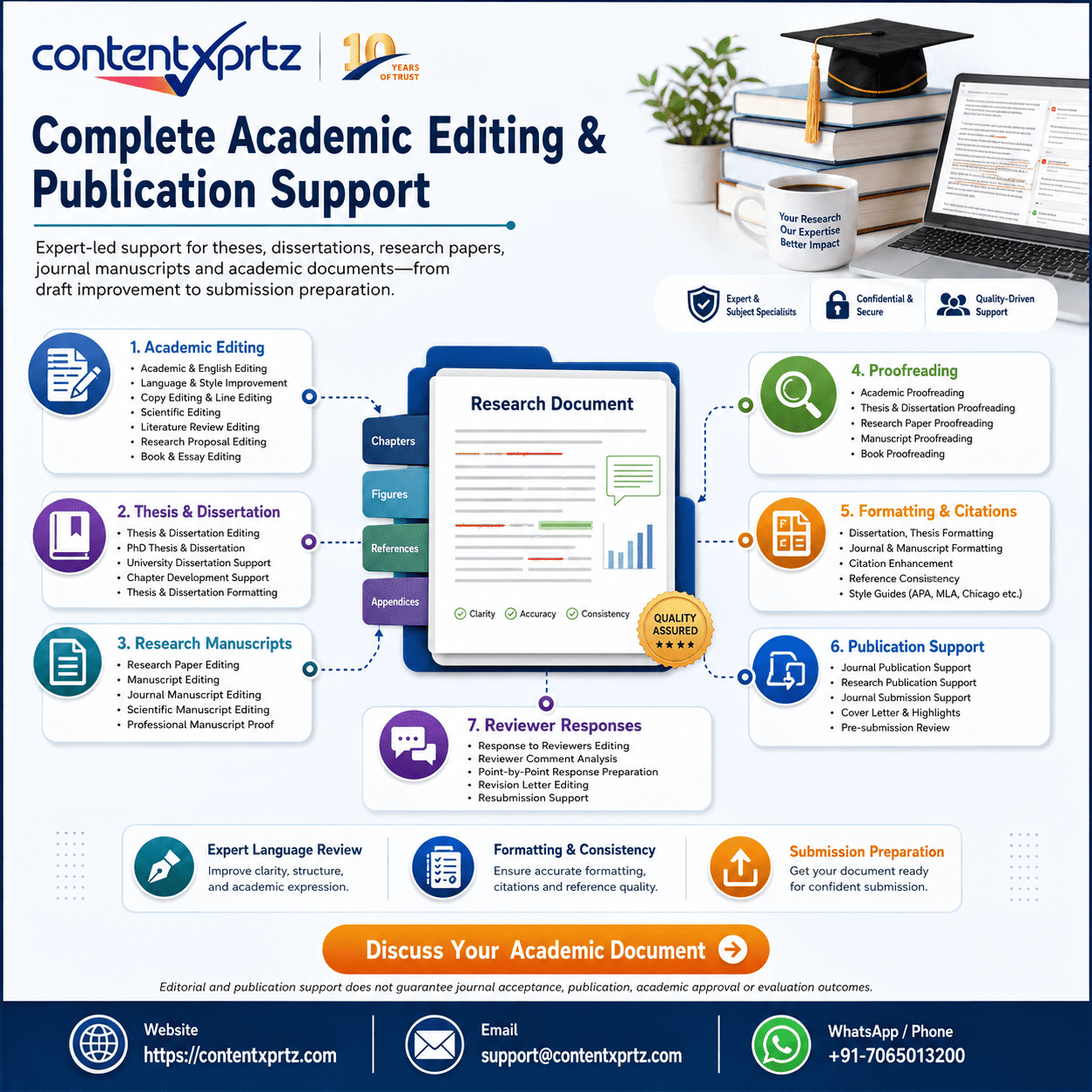
Researchers preparing a manuscript for Corporate Governance: An International Review may need support with clarity, structure, journal formatting, references or submission materials. Contentxprtz can provide ethical assistance such as academic editing, language polishing, manuscript assessment, APA-reference consistency, journal-format checking, cover-letter editing and reviewer-response editing.
The author remains responsible for the research question, data, methods, analysis, citations, conclusions, authorship, disclosures and final submission. Contentxprtz does not guarantee journal acceptance, peer-review success, indexing or publication. Professional support is most useful when it helps the researcher communicate rigorous work more clearly and meet stated journal requirements without altering the scholarly ownership of the research.
Preparing a manuscript for Corporate Governance: An International Review?
Explore publication-readiness support for journal alignment, academic editing, formatting and references while keeping authorship and editorial decisions fully independent.
Explore journal publication supportAuthor Submission Checklist
- Confirm scope fit and international/comparative governance relevance.
- Prepare a journal-specific cover letter.
- Keep the structured abstract within 250 words and use the required four headings.
- Keep the typical main manuscript within 10,000 words.
- Use APA reference style and verify every citation.
- Prepare a separate title page and anonymised main manuscript.
- Check author names, affiliations, acknowledgments and conflict-of-interest declaration.
- Provide ORCID IDs and CRediT contribution roles.
- Review data-sharing, funding, ethics and permissions requirements.
- Confirm tables are editable and figures meet Wiley requirements.
- Verify current OA options/APC if selecting OnlineOpen.
- Submit through the current Wiley Authors portal and retain all submission files.
Frequently Asked Questions
Is Corporate Governance: An International Review indexed in Scopus?
Yes. Wiley lists Scopus among the journal’s abstracting and indexing services, and the supplied Scopus source record identifies Source ID 22009. Authors who need proof for an institution should recheck the live Scopus source profile before submitting documentation.
Who publishes Corporate Governance: An International Review?
The current official journal site is on Wiley Online Library and identifies John Wiley & Sons Ltd as the publisher. The supplied source row naming Emerald appears inconsistent with the current official journal information, so this guide uses Wiley as the current publisher.
What are the ISSN and online ISSN?
The official Wiley journal page lists print ISSN 0964-8410 and online ISSN 1467-8683.
What is the current CiteScore?
Wiley’s journal page displays a CiteScore of 8.2 as checked in August 2026. CiteScore values can change by metric year, so cite the reporting year and reconfirm the live value when needed.
What is the Journal Impact Factor?
Wiley’s current journal page displays a Journal Impact Factor of 5.5. Impact Factor is a Clarivate metric and should not be confused with CiteScore, SJR or other citation measures.
Is the journal Q1?
For 2024 Scopus metrics, Wageningen University Library reports Q1 placement in the listed Business, Management and Accounting categories. Quartiles are category- and year-specific, so researchers should verify the exact category and latest year required by their institution.
What kinds of papers does CGIR publish?
The official author guidelines invite high-quality empirical and theoretical corporate-governance research making significant contributions. The journal also considers review articles that consolidate and advance important streams of governance knowledge.
Does CGIR use double-blind peer review?
Yes. Authors must anonymise the main manuscript and provide author information separately. The journal states that external review uses anonymous reviewers and that papers are screened for quality and relevance before review.
What is the manuscript word limit?
The author guidelines state that the main text of a typical manuscript should not exceed 10,000 words. Authors should check the latest guidelines for any article-type or special-issue exception.
What abstract format is required?
CGIR requests a structured abstract of no more than 250 words covering Research Question/Issue, Research Findings/Insights, Theoretical/Academic Implications, and Practitioner/Policy Implications.
What reference style does the journal use?
The journal uses APA reference style. Authors should follow the current Wiley/CGIR reference instructions and verify imported citation-manager records against the original sources.
Does the journal charge a submission fee?
No. The official author guidelines explicitly state that Corporate Governance: An International Review does not charge submission fees.
Is Corporate Governance: An International Review open access?
It is a hybrid journal: authors may use the standard publication agreement or choose Wiley OnlineOpen under an available Creative Commons licence. The applicable open-access charge and institutional coverage should be checked with Wiley when the author chooses that route.
What is the acceptance rate and review time?
Wiley’s journal page currently displays a 4% acceptance rate and a 10-day median from submission to first decision. The 10-day figure is not a guaranteed full peer-review or publication timeline.
Can Contentxprtz guarantee acceptance in CGIR?
No. Contentxprtz can support ethical manuscript preparation, editing, formatting, reference consistency and publication readiness, but acceptance is decided independently by the journal’s editors and peer reviewers.
Final Assessment
Corporate Governance: An International Review is a highly selective, internationally oriented corporate-governance journal with Scopus and major Clarivate coverage. It may suit researchers whose work makes a rigorous theoretical, empirical or integrative contribution to understanding governance across firms, institutions and jurisdictions.
Prospective authors should prioritise scope alignment, theoretical contribution, international relevance and methodological credibility before spending time on final formatting. Immediately before submission, recheck the official Wiley author guidelines, current metrics, OA options and submission portal. Optional professional editing can improve clarity and compliance, but it cannot substitute for scholarly contribution or guarantee an editorial outcome.
Authoritative Links for Final Verification