ASM Science Journal: Scopus, Scope & Submission Guide
ASM Science Journal is an open-access, peer-reviewed multidisciplinary research journal published by the Academy of Sciences Malaysia. Researchers commonly evaluate the journal for its broad scientific scope, Scopus visibility, no-fee publication model, double-blind peer review and suitability for multidisciplinary work. The supplied source record identifies it as a Scopus journal with Source Record ID 20300195074 and ISSN 1823-6782; the current journal homepage also lists eISSN 2682-8901.
The journal is not limited to a single discipline. Its official scope spans medical, engineering, earth, mathematical, physical, chemical and agricultural sciences, together with information and communication technology. It also provides space for research perspectives, reviews/commentaries and science-and-technology discussion. This breadth can make ASM Science Journal relevant to researchers whose work crosses conventional disciplinary boundaries, but it also means that a manuscript should demonstrate a clear scientific contribution rather than relying on general multidisciplinary positioning.
For authors considering submission in 2026, one practical detail deserves attention: some older author-instruction pages still refer to the journal’s Open Journal System, while the Academy announced a migration to ScholarOne Manuscripts in 2025. New submissions resumed on the newer platform after the migration period. Authors should therefore follow the journal’s current submission link rather than relying only on legacy OJS wording.
Quick Answer: What Is ASM Science Journal?
ASM Science Journal is the multidisciplinary research journal of the Academy of Sciences Malaysia. The journal describes itself as open access, peer reviewed and indexed, with a mission to disseminate significant research, science and technology work, R&D policy analysis and research perspectives.
Its official subject scope includes medical, engineering, earth, mathematical, physical, chemical and agricultural sciences as well as ICT. The current site lists Research Articles, Short Communications, Research Perspectives, Reviews/Commentaries and Science Forum among its publication categories, while recent issues demonstrate an active 2026 publication programme.
The supplied Scopus source record identifies ASM Science Journal under Source ID 20300195074. Researchers whose institution requires a Scopus-indexed publication should still check the live Scopus source profile before submission because database coverage and metrics can change.
Key Takeaways
- Publisher: Academy of Sciences Malaysia (Akademi Sains Malaysia).
- Scope: multidisciplinary science, engineering, technology and related research perspectives.
- ISSN: 1823-6782; eISSN: 2682-8901 on the current journal homepage.
- Scopus: supplied source record ID 20300195074; verify live status for institutional requirements.
- Open access: yes; the journal states that regular publication has no article processing charge.
- Peer review: double blind, with at least two expert reviewer evaluations for suitable manuscripts.
- Submission platform: migrated to ScholarOne Manuscripts in 2025; older OJS wording should be treated as legacy information.
- Language: the author instructions request good British English.
Journal Information at a Glance
| Field | Journal information |
|---|---|
| Journal name | ASM Science Journal |
| Source type | Journal |
| Publisher | Academy of Sciences Malaysia (Akademi Sains Malaysia) |
| Country/region | Malaysia |
| ISSN | 1823-6782 |
| eISSN | 2682-8901 |
| Scopus Source ID | 20300195074 (supplied source record) |
| Scopus status | Listed in the supplied Scopus source data; verify current live status before relying on it for institutional eligibility |
| Publication language | English; official instructions request good British English |
| Primary subject area | Multidisciplinary science and technology |
| Open access | Yes |
| APC/publication fee | Official About page states no publication/processing fee |
| Peer review | Double blind |
| Licence | CC BY-NC 4.0 according to the journal licensing page |
| Publication history | Official ASM factsheet states publication since 2007 |
| Current issues | Volume 21, No. 1 and No. 2 are listed for 2026 |
| CiteScore / SJR / SNIP / quartile | Not stated on the official journal pages reviewed here; verify current values in Scopus/SCImago as applicable |
| Impact Factor / JCR status | Not confirmed from an official Clarivate source during preparation of this guide |
| Acceptance rate | Not publicly stated in the official material reviewed |
| Official website | ASM Science Journal |
| Scopus profile | Scopus Source ID 20300195074 |
What This Page Covers
- The journal’s publisher, identity, ISSN/eISSN and Scopus source record
- ASM Science Journal aims, scope and likely manuscript fit
- Article categories and length/reference limits where officially stated
- Open-access model, copyright licence and publication fees
- Double-blind peer review and what happens after submission
- Current submission-platform guidance and the 2025 ScholarOne migration
- Formatting, abstract, language, tables, figures and reference requirements
- Publication ethics, similarity checking and authorship responsibilities
- A practical pre-submission checklist for PhD scholars and researchers
- How Contentxprtz can support ethical publication readiness without promising acceptance
Methodology and Sources
This journal profile was prepared from the supplied source record together with current official information from the Academy of Sciences Malaysia and ASM Science Journal. Priority was given to the official About and scope page, article-category guidance, submission instructions, peer-review policy, publication-ethics statement, and the journal’s licensing and copyright statement.
Journal information is time sensitive. Indexing, metrics, editorial responsibilities, submission systems, policies and fees can change. Where a current official metric could not be verified, this guide does not estimate it. Authors should recheck the relevant database and journal page immediately before submission.
ASM Science Journal Aims and Scope
The journal’s stated aim is to disseminate advances across a broad scientific spectrum while serving as a forum for research perspectives and significant science-and-technology discussion. The official scope covers medical, engineering, earth, mathematical, physical, chemical and agricultural sciences as well as ICT. The Academy also describes the journal’s mission as supporting dissemination of significant research, S&T and R&D policy analyses, and research perspectives.
For authors, that means “multidisciplinary” should not be interpreted as “anything scientific.” A suitable paper still needs a recognisable scientific question, sound methods, substantive results or analysis, and a contribution that matters to the journal’s research readership. Recent 2026 papers range from biomedical and food-related work to telecommunications, sensing, tourism-service modelling and health research, illustrating breadth but also a continuing emphasis on defined research problems and evidence.
Research that may fit well
- Original empirical or experimental research in the journal’s listed science and engineering fields
- Applied or methodological research with a clear scientific or technological contribution
- Interdisciplinary studies connecting two or more covered scientific domains
- Focused short communications reporting significant new data or findings
- Research perspectives that analyse achievements, research potential or strategic directions
- Reviews/commentaries addressing scientific development, S&T policy, education, R&D, innovation or competitiveness where aligned with journal categories
Work that may need a different journal
A manuscript may be poorly aligned when the principal contribution falls outside the stated scientific and technology remit, when it is mainly descriptive without a clear scholarly contribution, or when the article type does not match the journal’s categories. Researchers in business, humanities or social-science topics should not assume fit merely because an application uses technology; the scientific or technical contribution should be central.
What Does ASM Science Journal Publish?
The official article-category page gives useful limits that authors should use when planning a manuscript. These are journal-specific requirements rather than generic recommendations.
| Article category | Purpose | Stated limit |
|---|---|---|
| Research Article | Original research across the journal’s broad scientific fields | Up to 6,000 words and not more than 100 cited references |
| Short Communication | Significant new data or important findings within a narrow, well-defined scope | Up to 2,000 words and not more than 40 cited references |
| Research Perspective | Analysis of recent research, achievements, potential and strategic direction | Up to 2,000 words and not more than 40 cited references |
| Review / Commentary | Analytical overviews concerning scientific publication, S&T education, human resources, R&D, innovation, international comparisons and related themes | Up to 5,000 words and 40 cited references |
| Science Forum | Science news, significant events, patents, commercial products, conferences, technology upgrades and book reviews | Follow the current journal category guidance |
The current website also displays Editorial, Scientist in Profile and Special Issue categories. Authors should not assume every visible website category is open for unsolicited submission; use the current submission instructions or editorial contact where the category is unclear.
Understanding Its Scopus Coverage and Journal Metrics
The journal record supplied with this task identifies ASM Science Journal as a Scopus source under Source ID 20300195074. This identifier is useful because it distinguishes the journal from similarly named publications and allows researchers to open the relevant Scopus source profile.
Current CiteScore, SJR, SNIP and quartile values were not confirmed from an authoritative live metric page available during preparation of this article, so they are intentionally not reproduced here. Metrics change by reporting year and category, and a multidisciplinary journal may appear differently across classification systems. If a university requires Q1, Q2, Q3 or Q4 status, the researcher should check the exact database, category and year specified by the institution.
For PhD or university compliance
Do not rely on a screenshot, an old spreadsheet row or a third-party ranking page. Open the current Scopus source profile, record the source ID, active/coverage status and relevant metric year, and compare those details with your university’s publication rule. A journal can be reputable and suitable for the research while still failing a specific institutional metric threshold.
Open Access, Copyright and Publication Fees
ASM Science Journal states that it is open access and that it does not charge publication or processing fees. Its licensing statement says published articles are distributed under the Creative Commons Attribution-NonCommercial 4.0 International licence (CC BY-NC 4.0). Authors retain copyright while granting the journal a non-exclusive licence to publish the article.
This combination is particularly relevant to researchers working with limited publication budgets because the journal’s official regular policy does not require an APC. Nevertheless, authors should recheck the current fee statement before submission, especially for special issues or any publishing arrangement introduced after this guide was prepared.
The licensing policy also requires authors to ensure originality and to obtain permission for material they do not own. The corresponding author accepts responsibility for submission on behalf of all co-authors, and the journal states that changes to authorship or author order are not accepted after submission.
Preparing a Manuscript for ASM Science Journal
The author instructions set out a conventional scientific manuscript structure together with several journal-specific details. A strong submission should meet those requirements before it enters editorial screening.
Title, author details and abstract
The title should be concise and descriptive and preferably not exceed fifteen words. The first page should include author names, affiliations, email address and full address, with the corresponding author clearly identified. The abstract should be approximately 150–200 words and briefly state the objectives and main conclusions.
Core manuscript sections
The instructions describe an Introduction that establishes the study area, relevant prior work and objectives; Materials and Methods that explain materials, procedures, experimental design and data analysis; and Results that present data of significant interest. Animal experiments must comply with ethics in animal research.
Figures, tables and measurements
Line drawings and graphs should be high resolution with clear lettering. Tables should have short descriptive titles, be self-explanatory and concise, and use SI units. Authors should avoid unnecessary abbreviations and excessive numerical precision.
Language and references
The journal requests good British English. Its referencing guidance specifies the Harvard/ASM author-date style: in-text citations use author name and year, while the reference list is arranged alphabetically and gives full publication details. Authors should use accepted international abbreviations and spell out non-standard abbreviations on first use.
Submission Platform: Use the Current ScholarOne Workflow
ASM Science Journal’s older submission page still states that articles should be submitted through the journal’s Open Journal System. That instruction became outdated when the Academy announced migration of manuscript submission and review to ScholarOne Manuscripts (S1M) in 2025. An extended migration notice confirmed that new submissions would resume on 1 April 2025.
For a submission made in 2026, the safer approach is to start from the current journal website and follow its live submission link. This matters because uploading a manuscript to a retired or legacy endpoint can cause confusion even if the manuscript itself is correctly formatted.
- Review the latest aims, scope and article category.
- Download or review the current author instructions and any manuscript template.
- Prepare the manuscript and supplementary files in the required format.
- Confirm author names, affiliations, corresponding-author details and declarations.
- Run the required similarity check and prepare the report if requested.
- Open the live submission portal from the official ASM Science Journal site.
- Enter metadata carefully and ensure it matches the manuscript file.
- Retain the submission confirmation and manuscript ID.
Peer Review: What Happens After Submission?
ASM Science Journal states that it operates a double-blind review process. The author does not know the reviewer’s identity, and the reviewer does not know the author’s identity. The journal says manuscripts are first assessed by the Journal Manager for scope and formatting, then by Section Editors for suitability.
Suitable manuscripts are sent to independent expert reviewers. The policy says a minimum of three reviewers may be approached and at least two reviewers must evaluate the article; when reviewer decisions conflict, an editor may send the manuscript to a third reviewer. The Editor-in-Chief makes the final acceptance or rejection decision.
The journal’s reviewer policy gives reviewers one week to accept or decline an invitation and, after accepting, two weeks to submit a review, with extensions possible. These are reviewer targets, not a guaranteed overall decision time. The journal does not publicly state an acceptance rate in the official information reviewed for this guide.
Publication Ethics and Similarity Requirements
The journal’s publication-ethics statement is based on COPE best-practice principles and sets responsibilities for editors, reviewers and authors. Authors must present research accurately, use original work, acknowledge sources, avoid simultaneous submission of essentially the same manuscript to multiple journals and ensure that authorship reflects substantive contribution.
The journal states that it allows up to 15% similarity in plagiarism checking through Turnitin, iThenticate or a similar system, and its instructions advise authors to attach a similarity report with submission. Researchers should not interpret a percentage alone as proof of ethical compliance: properly quoted material, references, methods language and unavoidable terminology can affect reports, while undisclosed copying can remain problematic even below a numerical threshold.
As a practical publication-readiness step, authors should review every highlighted match, correct citation or quotation problems, remove duplicated wording that is not necessary, and make sure paraphrasing accurately represents the source. Ethical editing should improve clarity without concealing plagiarism, fabricating references or changing the scientific record.
Is ASM Science Journal a Good Match for Your Research?
The best journal-fit decision combines scope, article type, evidence quality, audience and institutional requirements. Scopus coverage can be important, but it should not be the only reason to submit.
| Question | Strong-fit signal | Warning sign |
|---|---|---|
| Does the topic match scope? | Core contribution falls within listed scientific, engineering, earth, agricultural or ICT fields | Technology is incidental and the principal research belongs outside the stated remit |
| Is the article type appropriate? | Research article, short communication, perspective or review/commentary matches the official category | Manuscript form does not correspond to an available category |
| Does the study add a significant contribution? | Clear question, sound methods, substantive evidence and explainable novelty | Mainly descriptive work with unclear scientific contribution |
| Can the manuscript meet language and formatting rules? | British English, structured abstract/sections, Harvard/ASM references, high-quality figures/tables | Major structural, language or citation problems remain unresolved |
| Does it meet institutional publication rules? | Current live indexing/metric status satisfies the specific university requirement | Author relies on an old quartile or unverified third-party metric |
Why Manuscripts May Be Returned or Rejected
The journal does not publish a simple “top rejection reasons” list, so the points below combine its stated screening criteria with standard publication-readiness interpretation. They should not be read as an official ranking of rejection causes.
- Scope mismatch: the paper’s main contribution is outside the journal’s scientific remit.
- Formatting non-compliance: the manuscript does not follow the journal’s structure, language, reference or file requirements.
- Weak originality or significance: the study does not demonstrate the originality, importance or scientific contribution expected by the journal’s scope statement.
- Methodological weaknesses: study design, analysis or reporting is insufficient for expert review.
- Ethics problems: plagiarism, redundant publication, inappropriate authorship, missing approvals or inaccurate reporting.
- Poor presentation: language, figures, tables or argument structure make the scientific contribution difficult to evaluate.
Pre-Submission Checklist for Researchers
Journal fit
- Read the current aims and scope rather than relying only on indexing.
- Compare your manuscript with several recent ASM Science Journal papers in the same or adjacent field.
- Select the correct article category and verify its word/reference limits.
Manuscript readiness
- Keep the title concise and preferably within the journal’s fifteen-word guidance.
- Use a 150–200-word abstract that states objectives and main conclusions.
- Use good British English and consistent scientific terminology.
- Ensure methods are reproducible and ethical approvals are reported where relevant.
- Use clear high-resolution figures, concise tables and SI units.
- Format references in Harvard/ASM author-date style and verify every citation.
Submission readiness
- Confirm all authors, affiliations and the corresponding author before upload.
- Review the similarity report and resolve problematic matches ethically.
- Use the current ScholarOne-linked workflow from the official journal website.
- Reconfirm current Scopus status and any metric required by your university.
- Keep copies of the final submitted files and submission confirmation.
How Contentxprtz Can Support Publication Readiness
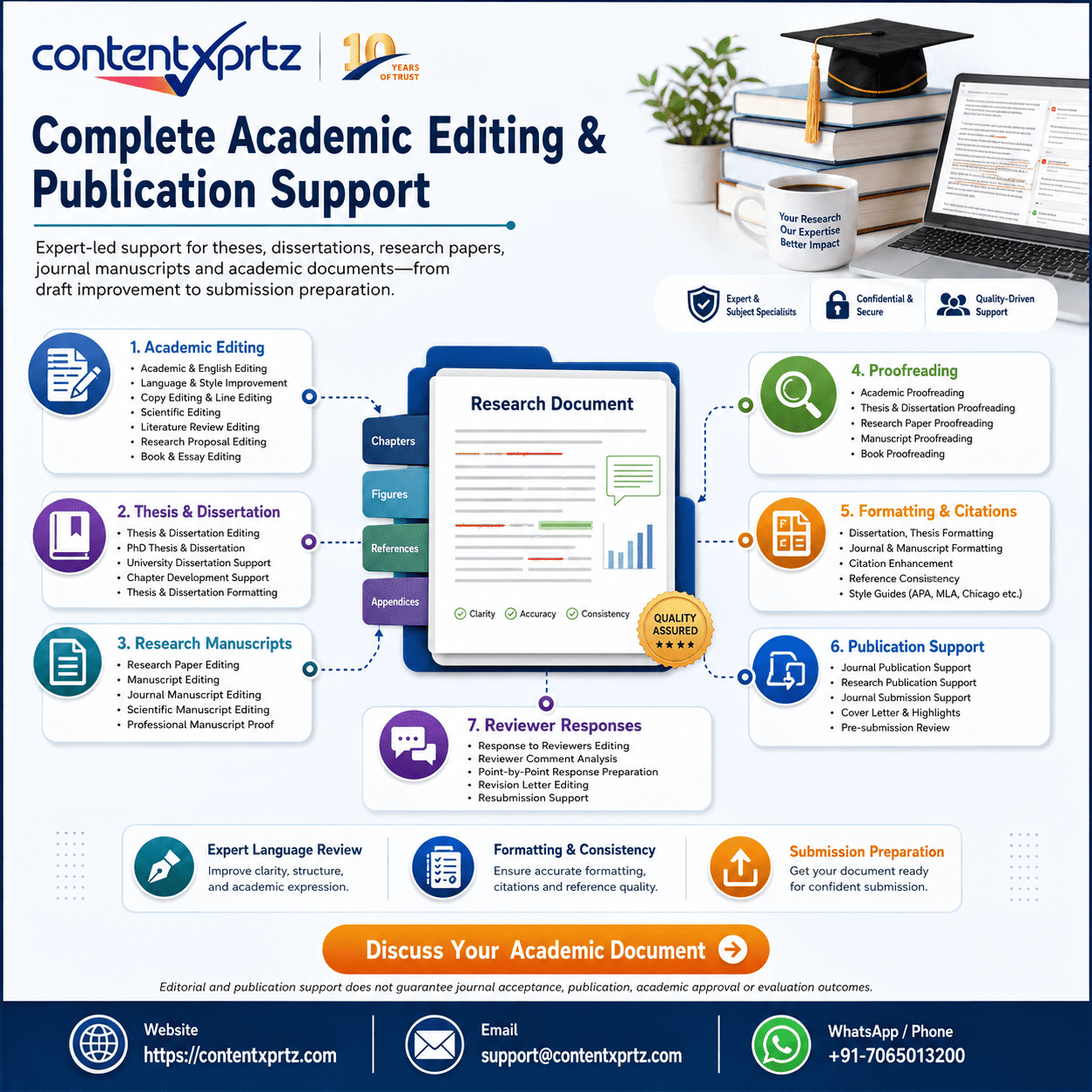
Contentxprtz can support researchers who have selected ASM Science Journal but need help bringing a manuscript to a clearer, more consistent and journal-aligned state. Support may include academic editing, manuscript assessment, proofreading, British-English language polishing, journal formatting, reference and citation consistency, abstract refinement, cover-letter editing and reviewer-response editing.
For authors converting a thesis or dissertation chapter into a journal article, support can also focus on reducing thesis-style background, sharpening the research question, restructuring results and discussion for article readers, and aligning the manuscript with the target article category. These services should preserve the author’s data, analysis, scholarly voice and responsibility for all scientific claims.
Professional support cannot guarantee acceptance or publication. Editorial decisions remain with ASM Science Journal and its reviewers. Contentxprtz does not influence peer review, fabricate citations or data, or promise a particular quartile, citation outcome or publication result.
Summary
ASM Science Journal is a multidisciplinary, open-access journal published by the Academy of Sciences Malaysia. Its official scope spans major scientific and technology fields, its peer-review policy is double blind, and its current publication-fee statement says there is no publication or processing charge. The supplied Scopus record identifies Source ID 20300195074, while the journal homepage lists ISSN 1823-6782 and eISSN 2682-8901.
Authors should give particular attention to article-category limits, British-English presentation, Harvard/ASM referencing, similarity and ethics requirements, and the current ScholarOne submission workflow. Where a doctoral programme or institution specifies a particular Scopus status, quartile or metric year, verify those details directly in the current database immediately before submission.
The strongest reason to choose ASM Science Journal is not indexing alone: it is a credible match between the manuscript’s scientific contribution and the journal’s actual scope, readership and article requirements.
Frequently Asked Questions
What is ASM Science Journal?
ASM Science Journal is an open-access, peer-reviewed multidisciplinary research journal published by the Academy of Sciences Malaysia. Its official scope covers medical, engineering, earth, mathematical, physical, chemical and agricultural sciences as well as information and communication technology, with additional space for research perspectives and science-and-technology policy analysis.
Who publishes ASM Science Journal?
ASM Science Journal is published by the Academy of Sciences Malaysia (Akademi Sains Malaysia, ASM), Malaysia’s national academy of sciences.
Is ASM Science Journal indexed in Scopus?
Yes. The supplied Scopus source record identifies ASM Science Journal under Source ID 20300195074. Because database coverage and source status can change, authors whose university or PhD requirement depends on Scopus should also open the current Scopus source profile before submission.
What are the ISSN and eISSN of ASM Science Journal?
The journal homepage currently lists print ISSN 1823-6782 and eISSN 2682-8901. The supplied older source record contains ISSN 18236782, which corresponds to the formatted ISSN 1823-6782.
What subjects does ASM Science Journal cover?
The official scope includes medical, engineering, earth, mathematical, physical, chemical and agricultural sciences as well as ICT. Its mission also includes significant research, science-and-technology and R&D policy analyses, and research perspectives.
What types of articles does ASM Science Journal publish?
The journal lists Research Articles, Short Communications, Research Perspectives, Reviews/Commentaries and Science Forum material. Its current website also displays categories such as Editorial and Scientist in Profile, while special issues are published from time to time.
Does ASM Science Journal charge an APC?
The journal’s official About page states that ASM Science Journal does not charge publication or processing fees for regular journal publication. Authors should still reconfirm the current policy immediately before submission, particularly for any special issue or exceptional publishing arrangement.
Is ASM Science Journal open access?
Yes. The journal states that it is open access and follows the DOAJ definition of open access. Its licensing page says published articles are distributed under the Creative Commons Attribution-NonCommercial 4.0 International licence (CC BY-NC 4.0), with authors retaining copyright and granting the journal a non-exclusive publishing licence.
What peer-review model does ASM Science Journal use?
ASM Science Journal states that it uses double-blind peer review. Manuscripts are first checked for scope and formatting, then assessed for suitability, and suitable papers are sent to expert reviewers. The policy states that at least two reviewers must evaluate an article, with a third reviewer possible when decisions conflict.
How do I submit a manuscript to ASM Science Journal?
The journal announced migration from its older Open Journal System workflow to ScholarOne Manuscripts in 2025, with new submissions resuming on the new platform from 1 April 2025 after an extended migration period. Authors should therefore use the current submission link provided by the journal website and not rely on older OJS-only wording that remains on legacy instructions.
What manuscript format does ASM Science Journal require?
The official instructions request an MS Word manuscript, good British English, a concise descriptive title preferably no longer than fifteen words, an abstract of about 150–200 words, and standard sections such as Introduction, Materials and Methods, Results and appropriate discussion/conclusion content. Figures should be high resolution, tables should be concise and self-explanatory, and SI units should be used.
What reference style does ASM Science Journal use?
The journal’s referencing page specifies the Harvard/ASM author-date style. In-text references use author name and publication year, and the reference list is arranged alphabetically with full bibliographic details.
Does ASM Science Journal publish an acceptance rate or guaranteed review time?
An official acceptance rate was not found in the journal information reviewed for this guide. The peer-review policy gives reviewer response targets—one week to accept or decline an invitation and two weeks after acceptance to submit a review—but that is not the same as a guaranteed end-to-end decision or publication time.
Is ASM Science Journal suitable for PhD researchers?
It may be suitable when a PhD researcher’s manuscript genuinely matches the journal’s scientific scope, article type, methodological expectations and institutional publication rules. Scopus coverage may be relevant to some doctoral requirements, but authors should confirm the current database status and their university’s exact eligibility criteria rather than relying on journal indexing alone.
Can Contentxprtz guarantee publication in ASM Science Journal?
No. Contentxprtz can ethically support manuscript assessment, academic editing, proofreading, language polishing, journal formatting, references, cover-letter preparation and reviewer-response editing, but acceptance decisions remain entirely with the journal’s editors and peer reviewers.