Advanced Series in Management: Scopus, Scope and Submission Guide
Advanced Series in Management is an Emerald Publishing book series in management and related disciplines, not a conventional journal. That distinction matters for researchers searching for “Advanced Series in Management Scopus,” because a Scopus source record does not automatically mean authors submit stand-alone journal articles through a permanent journal portal. Contributions are typically connected to a book, edited collection, series proposal, or a volume-specific call for chapters.
Emerald describes the series as a home for new perspectives on management that can influence theory and practice, including hybrid, unusual, exploratory, evidence-based, analytical and holistic approaches. The supplied source record identifies Scopus Source ID 21100258736, while Emerald records the series ISSN as 1877-6361. Researchers considering this outlet should therefore evaluate both the series-level scholarly fit and the specific volume or proposal route available at the time they want to publish.
Quick answer: what is Advanced Series in Management?
Advanced Series in Management is a serial scholarly book series published by Emerald Publishing Limited. Its focus is management and adjacent fields, with particular openness to fresh perspectives and approaches that may not fit the conventions of flagship management journals. Emerald’s current subject-area page lists Professor Miguel R. Olivas-Luján and Professor Tanya Bondarouk as series editors.
The series has a Scopus source profile under the supplied Source ID 21100258736. Because it is a book series, researchers should verify how their university or PhD programme classifies a chapter or book-series contribution; some institutions distinguish journal articles, book chapters and edited-volume contributions even when all are indexed in Scopus.
Key takeaways for researchers
- Publication type: this is a book series, so submission pathways differ from a standard journal.
- Publisher: Emerald Publishing Limited, a UK scholarly publisher.
- Series ISSN: 1877-6361; the ISSN Portal records the title as Advanced series in management.
- Scopus identity: supplied Source ID 21100258736; confirm current coverage directly in Scopus before relying on it for institutional requirements.
- Scope: management and related disciplines, with encouragement for new, hybrid, unusual, exploratory, analytical and holistic perspectives.
- Peer review: Emerald states that book proposals undergo single-anonymous external peer review and that proposal feedback is generally targeted within 4–6 weeks.
- Open access: Emerald supports open-access books and chapters, but book/chapter processing charges are separate from journal APCs.
Advanced Series in Management at a glance
| Series name | Advanced Series in Management |
|---|---|
| Source type | Book Series |
| Scopus Source ID | 21100258736 (supplied source record; verify current status in Scopus) |
| ISSN | 1877-6361 |
| Online ISSN / other media identifier | The ISSN Portal confirms online availability; an additional current eISSN should be verified in the relevant source record before use. |
| Publisher | Emerald Publishing Limited |
| Country / region | United Kingdom (ISSN record) |
| Primary field | Business, Management and Accounting / management and related disciplines |
| Series editors | Professor Miguel R. Olivas-Luján and Professor Tanya Bondarouk (Emerald subject page) |
| Publication pattern | Volume-based book series; not a fixed journal issue frequency |
| CiteScore / SJR / SNIP / quartile | Verify the latest reporting-year values in Scopus; this page does not present undated third-party metrics as current. |
| Journal Impact Factor | Not verified from an official Clarivate source for this book series |
| Open access | Available for eligible books or chapters through Emerald’s OA routes; not every volume is necessarily open access |
| Standard journal APC | Not applicable as a journal APC; Emerald uses book processing charges (BPCs) and chapter processing charges (CPCs) for gold OA books/chapters |
| Official series page | Emerald Advanced Series in Management |
| Scopus profile | Scopus Source ID 21100258736 |
What this guide covers and how facts were checked
This page combines series identity, scope, indexing context, proposal and manuscript guidance, peer review, open-access arrangements, ethics and practical fit assessment. Journal-style fields are not forced onto the series when they do not apply. For example, there is no reason to invent an “article acceptance rate” for a book series or to label book/chapter processing charges as a normal journal APC.
The principal evidence comes from Emerald’s official series and author pages, the supplied Scopus identifier, and the ISSN Portal. Where a current metric or policy could not be verified from an appropriate authoritative source, the value is marked for verification instead of being estimated.
What does Advanced Series in Management publish?
Emerald positions the series around management scholarship that offers new perspectives capable of influencing theory and practice. The official description explicitly welcomes hybrid or unusual approaches and scholarly ideas about management and related disciplines. It also encourages exploratory, evidence-based analytical and holistic inquiries that may receive less attention in mainstream flagship outlets.
Recent and established volumes demonstrate a broad but recognisably management-centred remit. Emerald highlights work on social media in human resources and strategic management, honesty and organizational outcomes, commercial diplomacy and international business, information technology and changing management practices, firm formation and evolution, competence-based strategy, sustainability, smart industry, digital-era management and resilience.
Representative research areas
- Human resource management and electronic HRM
- Strategic management and competence-based strategy
- Digital transformation, information technology and management practice
- Leadership, organizational change and new ways of working
- International business and business diplomacy
- Organizational behaviour, honesty, ethics and workplace relationships
- Talent management, diversity and workforce issues
- Sustainability, resilience and responsible management
- Smart industry, AI-enabled management and technology adoption
- Organizational theory, firm formation and evolution
- Management methods, interdisciplinary frameworks and emerging perspectives
- Practice-oriented and evidence-based management research
These themes are examples derived from the official scope and published volume topics; they are not an exhaustive list of formally approved chapter subjects.
Understanding its Scopus coverage and journal metrics
The task source identifies Advanced Series in Management as a Scopus source with record ID 21100258736. That is the most useful identifier for checking the series directly because titles can be reproduced inconsistently across university databases and discovery systems. The series ISSN, 1877-6361, provides a second identity check.
For institutional decisions, open the official Scopus source profile and confirm coverage years, current active/inactive status, subject categories and the latest reporting-year metrics. Scopus metrics can change annually. A value copied without its year can easily become misleading.
This guide therefore does not present an undated CiteScore, SJR, SNIP or quartile as “current.” A university library journal guide may display a 2024 CiteScore or quartile, but researchers in 2026 should still verify the latest Scopus record before using that number in a doctoral milestone, promotion file or funding application.
Publisher and editorial leadership
Advanced Series in Management is published by Emerald Publishing Limited. Emerald’s business, management and strategy subject page currently names Professor Miguel R. Olivas-Luján and Professor Tanya Bondarouk as the series editors. Published volumes are hosted through Emerald’s books platform and typically carry volume-level ISBNs plus the series ISSN.
The series structure means editorial responsibility can also involve volume editors. A themed edited volume may have its own editors, chapter invitation process, deadlines and review expectations in addition to the overall series framework. Before preparing a chapter, identify the specific volume and its editor instructions rather than relying only on a series-level page.
Is this series a good match for your research?
It may be a strong match when your work belongs clearly in management or a closely connected discipline, fits a planned volume or book concept, and offers a distinct theoretical, empirical, methodological or practice-oriented contribution. It may be a poor match if the manuscript is essentially a stand-alone journal article with no relevant volume, if the topic sits outside management, or if your institution specifically requires publication in a peer-reviewed journal rather than a book chapter.
Strong-fit example
A study on AI-enabled talent management that combines management theory with empirical organizational evidence may align well with a technology-and-management volume, provided the volume theme and chapter brief match.
Weak-fit example
A highly technical computer-vision algorithm paper with no management question or organizational contribution would probably be better targeted to a computing outlet.
Format-fit example
A PhD chapter can sometimes be transformed into a focused scholarly book chapter, but the argument, length and framing should be adapted to the edited volume rather than copied from the thesis.
Institutional-fit example
If a doctoral rule says “Scopus-indexed journal article,” confirm whether a Scopus-indexed book-series chapter is accepted before committing to the project.
Journal-fit checklist
- My central research question is genuinely about management or a related field.
- I have identified a current or planned volume, edited collection or proposal route.
- The intended contribution matches that volume’s theme and audience.
- I know whether my institution counts a book chapter/series contribution for my purpose.
- I have checked the latest Scopus status rather than relying on an old screenshot.
- I can meet the required manuscript, ethics, permissions and reference standards.
- I understand whether the project is subscription/access-controlled or open access.
- I have confirmed any legitimate BPC/CPC before choosing gold open access.
How submission works for a book series
Unlike a conventional journal, Advanced Series in Management does not have a universal “submit article” workflow that applies to every contribution. Emerald’s book publishing route begins with the relevant book or edited-collection proposal, discussion with a commissioning editor, and peer review of the proposal. Book series can accept long- or short-form projects depending on the series expectations.
For an individual chapter, the practical route is often through an approved edited collection or a call for chapters. In that situation, the volume editors set the theme, proposal or abstract requirements, chapter length, timetable and review process. A researcher should not assume that sending an unsolicited journal-style paper to Emerald is equivalent to submitting to the series.
- Identify a relevant series volume, call for chapters or book-proposal opportunity.
- Read the volume-specific brief and Emerald’s book guidance.
- Prepare the requested proposal, abstract or chapter outline.
- Submit through the route specified by the commissioning or volume editor.
- Respond to editorial and peer-review feedback.
- If the proposal/project is approved, prepare the final manuscript to Emerald’s book-author requirements.
- Complete permissions, contributor, licensing and production documentation as applicable.
- Review proofs and publication metadata before release.
Peer review: what authors can expect
Emerald states that all book proposals go through rigorous single-anonymous peer review: reviewers know the proposer’s identity, while proposers do not know reviewer identities. Emerald says it aims to return proposal feedback within 4–6 weeks. Reviewers consider originality, contribution to the field, comprehensiveness, structure, strengths, weaknesses and areas requiring revision.
Positive review does not automatically equal publication. Emerald explains that a proposal may proceed to a contractual offer after positive review and approval, or the author may be invited to revise and resubmit. Volume-level chapter review can add another layer, especially in edited collections. Researchers should therefore treat the 4–6 week figure as a proposal-review target stated by Emerald, not as a guaranteed end-to-end publication timeline.
Preparing the final manuscript
Emerald’s book publishing author guidelines provide the baseline for final manuscript preparation. The checklist includes a title page, table of contents, chapter files in Word, contributor material where relevant, clearly labelled figures and tables, and specified editorial/production forms. Edited-collection chapters should include abstracts and keywords.
Authors may also need permissions forms for third-party material, interview releases where identifiable interviewees are used, and consent forms for non-anonymised organizational case studies. Exact requirements depend on the project, so the latest author guidelines and the commissioning editor’s instructions take precedence over any summary page.
| Area | What to verify |
|---|---|
| Scope and volume fit | Theme, management contribution, intended readership and relevance to the edited volume/book proposal. |
| Structure | Title, author affiliations, abstract/keywords where required, logical chapter sections and coherent conclusion. |
| Evidence | Accurate data, defensible methods, appropriately qualified claims and traceable citations. |
| Figures/tables | Clear labelling, permissions, legibility and source attribution. |
| References | Consistent style required by the project and verified bibliographic details. |
| Ethics | Authorship, consent, conflicts, funding, originality and research approvals where applicable. |
| Permissions | Third-party text, images, instruments, interviews and identifiable case material cleared where needed. |
| Final files | Word chapter files, required forms and any project-specific supplementary material. |
Open access and publication charges
Advanced Series in Management contains a mix of purchasable and open-access content. Emerald offers authors the option to publish eligible books or individual chapters open access under its book OA programme. For gold open access, the publisher uses book processing charges (BPCs) and chapter processing charges (CPCs), not a standard journal APC.
Emerald’s open-access books page lists current charges by book format and chapter length and states that OA books/chapters can use a CC BY 4.0 licence. Because prices, taxes, funding agreements and waiver arrangements can change, confirm the exact fee immediately before agreeing to an OA route. Payment is independent of editorial and peer-review decisions.
Authors who do not choose gold OA should also review Emerald’s author-rights and self-archiving guidance, because sharing options differ by version of the work.
Publication ethics and responsible use of AI
Emerald maintains publisher-level research publishing ethics and integrity policies covering originality, authorship, conflicts of interest, data and image integrity, research ethics, corrections and other publication responsibilities. For book projects, authors should also comply with permissions and consent requirements stated in the book guidelines.
Generative AI should never be used to fabricate data, citations, participant statements, analyses or reviewer responses. If AI-assisted tools are used for language or drafting support, the author remains responsible for accuracy, confidentiality, attribution and compliance with the publisher’s current AI policy and the rules of the specific project. Before submission, check the latest Emerald policy rather than assuming that AI rules are identical across all publishers.
See Emerald’s publishing ethics guidance for current publisher-level requirements.
Common reasons a contribution may be unsuitable
The following are practical publication-readiness risks rather than published rejection statistics for this series:
- The topic has only a weak connection to management or the planned volume theme.
- The chapter reads like an unrevised thesis section rather than a focused contribution for the volume’s audience.
- The claimed novelty is unclear or not positioned against relevant literature.
- Methods, evidence or conclusions are not sufficiently supported.
- The manuscript ignores the editor’s requested length, structure or schedule.
- References are inaccurate, inconsistent or include sources the author has not verified.
- Permissions, consent, authorship or conflicts are unresolved.
- Language and organization obscure an otherwise sound argument.
How to strengthen a series-aligned manuscript
Start with the volume rather than the formatting. Read the series description and several chapters from related volumes, then examine the specific edited collection or proposal brief. A strong chapter usually makes its management contribution explicit early, uses a structure appropriate to a book audience, and shows why the topic belongs in that particular thematic collection.
As a practical publication-readiness step, write a one-paragraph “fit statement” for yourself: identify the volume theme, the problem your chapter addresses, the contribution it makes, and the audience that benefits. If that paragraph cannot connect naturally to the volume brief, reconsider the outlet before investing heavily in formatting.
Language editing can improve clarity, flow, terminology and consistency, but it cannot substitute for a weak research design or missing contribution. The strongest preparation sequence is scope fit first, then scholarly argument, evidence, structure, ethics, references and presentation.
How Contentxprtz can support ethical publication readiness
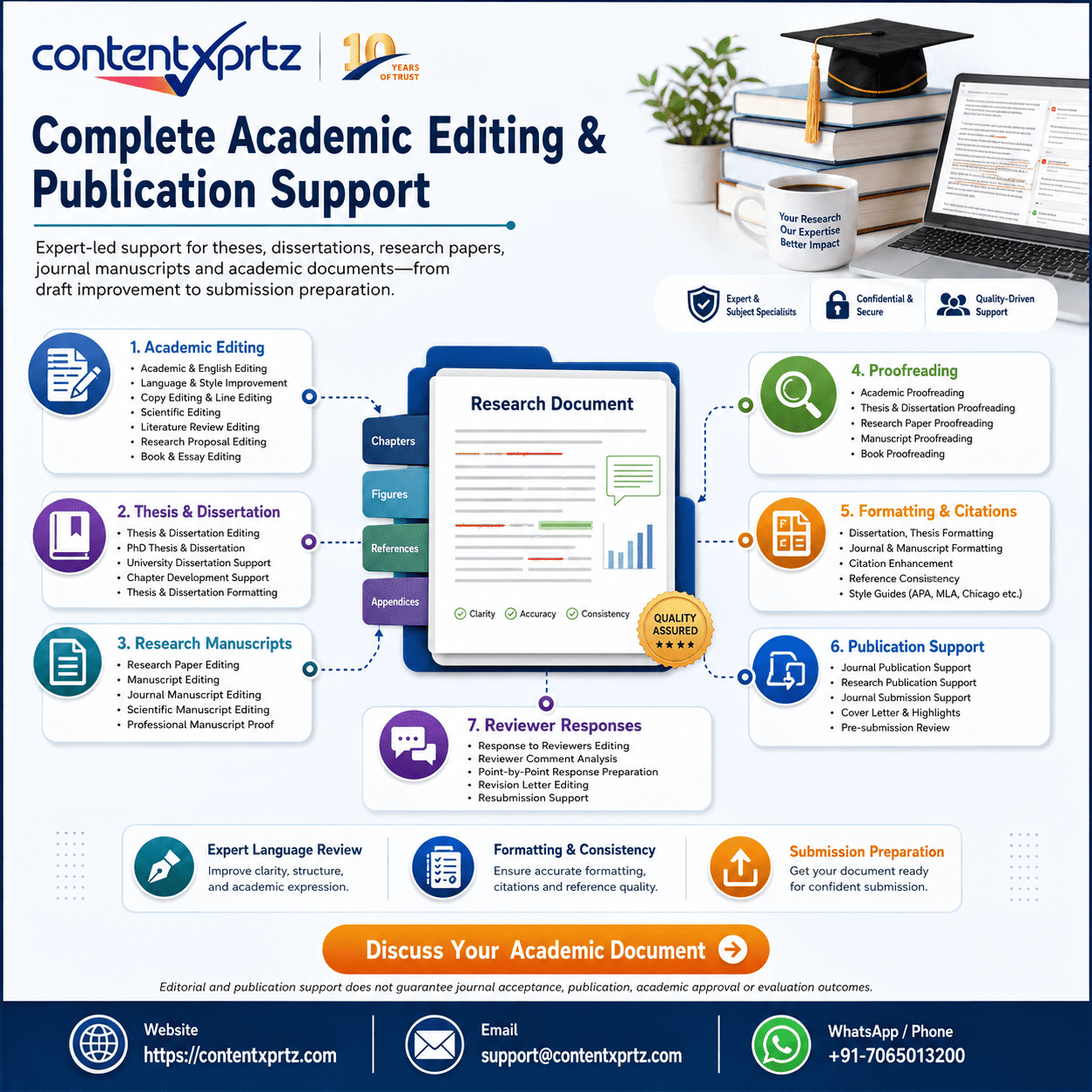
Preparing a contribution for Advanced Series in Management may require more than proofreading because the author has to align a chapter or proposal with a specific book-series context. Contentxprtz can support manuscript editing, business and management research editing, reference consistency, chapter structure, language polishing, formatting and publication-readiness review.
For a proposal or edited-volume contribution, support can also include clarity review for the abstract, title, rationale, chapter outline, cover correspondence and responses to editorial comments. Contentxprtz does not control Emerald’s editorial decisions and cannot guarantee proposal approval, peer-review success, acceptance or publication.
Preparing a manuscript for Advanced Series in Management?
Use professional support to improve the clarity and presentation of your own research, not to manufacture findings or bypass editorial responsibility. Explore publication-readiness support when you need an independent review of structure, language, formatting or submission documents.
Summary: Advanced Series in Management
Advanced Series in Management is an Emerald-published management book series with ISSN 1877-6361 and supplied Scopus Source ID 21100258736. Its scope favours new perspectives on management and welcomes exploratory, analytical, evidence-based, holistic and interdisciplinary approaches. Because it is a book series rather than a standard journal, authors usually engage through book proposals, edited collections or volume-specific chapter opportunities.
Before committing, verify the latest Scopus status and metrics, confirm that your institution accepts the publication type for your purpose, read the current Emerald book-author guidance, and establish the exact route for the relevant volume or proposal. Open access may be available through book or chapter processing charges, but current prices should be checked directly with Emerald.
Frequently asked questions
What is Advanced Series in Management?
Advanced Series in Management is an Emerald Publishing book series focused on management and related disciplines. Emerald describes it as a venue for new perspectives, hybrid or unusual approaches, and scholarly ideas that can influence management theory and practice. It is a serial book series rather than a conventional journal with a standing journal-article submission queue.
Who publishes Advanced Series in Management?
The series is published by Emerald Publishing Limited. Emerald’s current business, management and strategy subject page identifies Professor Miguel R. Olivas-Luján and Professor Tanya Bondarouk as the series editors.
Is Advanced Series in Management indexed in Scopus?
The supplied source record identifies Advanced Series in Management with Scopus Source ID 21100258736 and links to the Scopus source profile. Researchers should still open the current Scopus record before relying on its status for a university, doctoral, promotion or funding requirement because database coverage can change.
What is the Scopus Source ID for Advanced Series in Management?
The supplied Scopus Source Record ID is 21100258736. This identifier is useful for distinguishing the series from similarly named publications and for checking the latest coverage and metrics directly in Scopus.
What is the ISSN of Advanced Series in Management?
The verified series ISSN is 1877-6361. The ISSN Portal records Advanced series in management under ISSN-L 1877-6361 and identifies the print medium with online availability.
What subjects does Advanced Series in Management cover?
Its core field is management, with room for related interdisciplinary work. Emerald highlights themes including human resources, strategic management, information technology and management practice, business diplomacy and international relations, organizational honesty, firm formation and evolution, competence-based strategy, sustainability and emerging technology.
What is the current CiteScore or quartile?
Because citation metrics change by reporting cycle and the accessible official pages did not expose a complete current Scopus metric panel, this guide does not present an undated CiteScore, SJR, SNIP or quartile as current. Authors should verify the latest values in the Scopus source profile before using them in institutional decisions.
Does Advanced Series in Management have an Impact Factor?
A current Journal Citation Reports Impact Factor for this book series was not verified from an official Clarivate source during preparation of this guide. Do not treat CiteScore, SJR or another metric as a substitute for an Impact Factor.
How do I submit work to Advanced Series in Management?
The route differs from a normal journal submission. Emerald’s book-series guidance directs authors toward a book or edited-collection proposal, communication with the relevant commissioning editor, and series-specific expectations. Individual chapters are often contributed to an approved edited volume or call for chapters rather than submitted through a permanent journal portal.
What peer-review process does Emerald use for book proposals?
Emerald states that book proposals go through rigorous single-anonymous peer review: the reviewer knows the proposer’s identity, while the proposer does not know the reviewer’s identity. Emerald says it aims to return proposal feedback within 4–6 weeks, after which revision may be requested before a contractual publication offer.
What manuscript materials are required?
For final book manuscripts, Emerald’s author guidelines list items such as a title page, contents, individual chapter Word files, clearly labelled figures and tables, contributor information where applicable, and required permissions or editorial forms. Chapters in edited collections should include abstracts and keywords. Series- or volume-specific instructions may add requirements.
Is Advanced Series in Management open access?
The series contains both purchasable and open-access volumes or chapters. Emerald supports open-access books and individual chapters, including gold open access subject to applicable book or chapter processing charges, while other content may remain access-controlled. Authors should confirm the option offered for the specific project.
Does Advanced Series in Management charge an APC?
A standard journal APC is not the right concept for this book series. Emerald publishes separate book processing charges and chapter processing charges for gold open access. These charges can change and depend on format and chapter length, so the current Emerald open-access books page should be checked before making a budget decision.
Is Advanced Series in Management suitable for PhD researchers?
It can be relevant when a doctoral researcher has management-focused work that suits a planned series volume, edited collection or book proposal and when the publication type satisfies the researcher’s institutional rules. Scopus coverage alone does not make every contribution appropriate or every doctoral programme eligible to count it in the same way as a journal article.
Can Contentxprtz guarantee acceptance in the series?
No. Contentxprtz can support ethical manuscript assessment, academic editing, language polishing, formatting, reference consistency and publication-readiness checks, but editorial selection, peer review, contracting and publication decisions remain entirely with Emerald and the relevant editors.
Authoritative sources used
- Emerald: Advanced Series in Management — official series scope and volume listing.
- Emerald: Business, management & strategy — current series-editor listing.
- Emerald: Publish a book or series — proposal-to-publication workflow.
- Emerald: Book peer review process — single-anonymous review and stated 4–6 week target for proposal feedback.
- Emerald: Books publishing author guidelines — manuscript checklist and permissions requirements.
- Emerald: Publish an open access book — OA books/chapters and current processing-charge framework.
- ISSN Portal: 1877-6361 — confirmed title and ISSN identity.
- Scopus Source ID 21100258736 — supplied official source-profile link for current coverage and metrics verification.
Journal and series information is time-sensitive. Reconfirm current indexing, metrics, editorial information, fees and author requirements before submission.