Academic Journal Articles: How to Find, Read, Write, and Publish Scholarly Work
Academic journal articles are one of the main ways researchers communicate evidence, methods, interpretation, theory, and scholarly debate. Yet the phrase can mean several different things to a student or first-time author. You may be trying to find credible sources for an assignment, understand whether a paper is peer reviewed, read a dense research article efficiently, convert thesis work into a journal manuscript, or prepare a study for submission without breaching academic or publication ethics.
The practical difficulty is that journal articles do not all serve the same purpose. An original research paper may report new data, a systematic review may synthesize a body of evidence, a narrative review may explain a field, and an editorial may present expert interpretation rather than a new study. Even within original research, reporting conventions differ across medicine, engineering, social science, business, humanities, and qualitative disciplines. A strong reader therefore asks two questions early: what kind of article is this, and what claim is it qualified to support?
For authors, the challenge is equally concrete. A technically sound study can be difficult to evaluate if its question is vague, methods are under-explained, figures do not match the text, references are inconsistent, or the discussion overstates what the data show. PhD scholars also face the extra task of transforming long thesis chapters into a focused article for a specific journal and audience. Researchers writing in a second language may know their subject deeply while still needing help with academic English, sentence flow, terminology, and journal-specific presentation.
This guide brings those needs together. It explains how scholarly journal articles work, how to identify reliable papers, how to read and cite them critically, what common article structures mean, how peer review fits into publication, and how to prepare a manuscript responsibly. It also explains where free self-service tools are usually enough and where ethical journal publication support or academic editing can help improve communication without replacing the author's ideas, evidence, or accountability.
Quick Answer: What Are Academic Journal Articles?
Academic journal articles are scholarly papers published in journals for a research or professional community. They may report original research, review existing studies, present theory, describe methods, offer case analysis, or contribute informed commentary. Many research articles are peer reviewed before publication, but the editorial process varies by journal and article type, so readers should verify rather than assume peer-review status.
If you are using journal articles for research, identify the article type, read beyond the abstract, inspect the methods and limitations, and confirm that the paper supports the claim you want to make. If you are writing one, choose a target journal whose scope matches the study, follow its author instructions, present evidence transparently, cite authentic sources, and keep conclusions proportionate to the findings.
The most important caution is simple: publication in a journal is not a substitute for critical reading. Peer review helps journals evaluate manuscripts, but authors and readers still share responsibility for accuracy, traceable citations, ethical reporting, and appropriate interpretation.
Key Takeaways
- Academic journal articles are not one uniform document type: original studies, reviews, methods papers, case reports, perspectives, and editorials answer different questions.
- Peer reviewed does not mean infallible: methods, evidence, limitations, corrections, and later scholarship still need evaluation.
- Use the full article, not just the abstract: important qualifications usually appear in methods, results, limitations, disclosures, and supplementary material.
- For authors, journal fit comes before formatting: the manuscript's contribution, topic, article type, and audience should align with the target journal's scope.
- Citation accuracy is a research-integrity task: verify every reference and ensure the cited source genuinely supports the associated statement.
- Editing should improve communication, not replace authorship: researchers remain responsible for data, analysis, claims, sources, and final submission.
What This Page Covers
- What academic journal articles are and how major article types differ
- How peer review, editors, reviewers, and authors interact
- How to find and evaluate credible scholarly journal articles
- How to read a research paper efficiently without oversimplifying it
- How to structure and prepare a journal manuscript for submission
- Common citation, ethics, writing, and journal-selection mistakes
- When self-service is enough and when professional editing or publication support may help
Table of Contents
- Methodology and academic sources
- Meaning and types of academic journal articles
- How peer review works
- Finding and evaluating reliable articles
- Reading scholarly papers efficiently
- Writing and preparing a journal manuscript
- Free versus professional support
- Common mistakes and practical examples
- Publication-readiness checklist
- Contentxprtz support, summary, FAQs, and conclusion
Methodology and Academic Sources
This article is based on common scholarly reading, manuscript-preparation, editing, peer-review, and publication-readiness workflows. Journal requirements vary by discipline, publisher, article type, and editorial policy, so the target journal's current author instructions remain the controlling practical source for submission details.
For publication ethics and editorial responsibilities, readers can consult the Committee on Publication Ethics (COPE) and the ICMJE Recommendations. ICMJE's guidance emphasizes that authorship carries accountability and that manuscript submission should accurately address authorship, disclosures, and related publication issues. Publisher guidance such as Springer Nature's manuscript submission guidance also reinforces the need to follow author instructions and complete a careful pre-submission check.
These sources are not interchangeable with a specific journal's rules. A psychology journal, engineering transactions journal, medical journal, or humanities review can have very different reporting expectations. Researchers should also follow university policies, research-ethics approvals, funder conditions, reporting guidelines, and discipline-specific standards that apply to their work.
What Academic Journal Articles Mean in a Research Context
An academic journal article is a contribution to a documented scholarly conversation. It should allow readers to understand what question is being addressed, how evidence was obtained or selected, what the authors found or argued, how the work relates to prior literature, and where uncertainty remains.
That definition matters because the value of an article is not simply that it looks academic. The reader needs to know whether it presents primary data, synthesizes earlier studies, proposes a conceptual argument, describes a method, or offers commentary. Different article types provide different levels and kinds of evidence.
| Article type | Main purpose | Useful for | Key caution |
|---|---|---|---|
| Original research | Reports a defined study and its findings | Direct evidence, methods, data interpretation | One study may not generalize beyond its design or sample |
| Systematic review | Finds and synthesizes studies using an explicit method | Evidence mapping, comparison, research gaps | Quality depends on search, eligibility, appraisal, and synthesis methods |
| Meta-analysis | Statistically combines compatible study results | Estimating pooled effects | Heterogeneity and included-study quality can affect conclusions |
| Narrative review | Explains and interprets a body of literature | Orientation, theory, conceptual context | Selection methods may be less reproducible than systematic reviews |
| Methods or protocol paper | Describes a method, instrument, protocol, or planned study | Reproducibility and research design | May not contain completed outcome data |
| Editorial or commentary | Offers expert interpretation or a position | Debate, context, emerging issues | Usually not equivalent to original empirical evidence |
A careful literature review uses these categories deliberately. For example, a review article can help you understand the field and discover primary studies, while an original article is often better when you need to examine exactly how a specific result was produced.
How Peer Review Fits into Academic Journal Articles
Peer review is an editorial evaluation process in which subject or methodological experts assess a manuscript and provide comments that help an editor decide whether the work should be rejected, revised, or considered for publication. It is designed to test the manuscript's reasoning, methods, reporting, relevance, and contribution; it is not a guarantee of truth.
Springer Nature's editor guidance describes peer review as a critical evaluation of whether methods are appropriate, results are accurate, and conclusions are supported. ICMJE likewise treats submitted manuscripts as part of a confidential editorial process and places responsibilities on authors, reviewers, and editors. Review models differ: some journals use single-anonymized or double-anonymized review, some use open review, and editorial practices vary across fields.
A typical peer-review pathway
- Submission: the author uploads the manuscript, figures, declarations, cover letter, and other required files.
- Editorial screening: an editor checks scope, basic quality, policy compliance, and whether the paper should proceed.
- Reviewer selection: suitable experts are invited, usually with conflict-of-interest and confidentiality expectations.
- Review reports: reviewers comment on strengths, weaknesses, methods, interpretation, presentation, and required changes.
- Editorial decision: the editor may reject, request minor or major revision, or in some cases accept.
- Revision and response: authors revise carefully and explain how each reviewer point was addressed or why a suggestion was not adopted.
- Further review and decision: revised work may return to reviewers or be decided by the editor.
Authors should treat reviewer comments as evidence to consider, not instructions to obey mechanically. A respectful response should identify each comment, describe the change made, and give a reasoned explanation when the authors disagree. Contentxprtz offers publication support where researchers need help organizing revisions or improving the clarity of a reviewer response while retaining responsibility for scientific decisions.
How to Find Reliable Academic Journal Articles
Reliable searching begins with a question that can be translated into concepts. If your topic is “remote work and productivity,” your search may need related terms such as telework, hybrid work, work-from-home, employee performance, knowledge workers, or organizational productivity. Different databases interpret search syntax differently, so adapt the query to the platform.
Use several discovery routes
- University library databases and subject indexes
- Multidisciplinary scholarly databases
- Publisher journal platforms
- Institutional and discipline repositories
- Reference lists of strong seed papers
- Forward citation searching to identify newer work
When the task is a thesis, systematic review, or formal evidence synthesis, document the search process rather than relying on memory. Record databases, search strings, dates, filters, inclusion criteria, and reasons for excluding studies. Reproducibility matters because a literature review should show how evidence was selected.
Check the article before trusting the article
Look at the research question, design, sample, measures, analysis, effect sizes or qualitative interpretation, limitations, funding, conflicts, ethics information where relevant, and whether the conclusions extend beyond the data. Search for corrections or retractions when a paper is important to your argument. Also distinguish the version of record from a preprint or accepted manuscript, because wording, pagination, figures, and conclusions can change between versions.
How to Read Academic Journal Articles Efficiently
Efficient reading does not mean reading only the abstract. It means using the structure of the paper to answer your research question while still checking the evidence needed to interpret the claim responsibly.
- Start with your purpose. Are you looking for a definition, a method, a result, a theoretical framework, or evidence for a literature review?
- Scan the title, abstract, figures, and section headings. Decide whether the paper deserves deeper reading.
- Read the research question and methods. Ask what was studied, who or what was included, and how the evidence was generated.
- Read results before accepting the discussion. Separate what the study found from how the authors interpret it.
- Check limitations and disclosures. These often define how far a claim can reasonably travel.
- Trace important references. If a claim is central, go to the original source instead of relying on a secondary citation.
- Write a structured note. Record purpose, design, sample, key findings, limitations, relevance, and full citation details.
This approach prevents a common mistake: collecting quotations without understanding the study. In a strong literature review, each article contributes to a comparison, pattern, contradiction, method, or research gap rather than becoming an isolated paragraph summary.
How to Write an Academic Journal Article for Publication
Writing for a journal starts with a contribution that fits a specific scholarly audience. Formatting matters, but it comes after the more fundamental question: what does this manuscript add, and why is this journal an appropriate place for that contribution?
1. Define the contribution in one or two sentences
Before drafting, state the problem, evidence, and contribution plainly. If you cannot explain why the paper exists, the introduction is likely to become a long literature summary without a clear research gap or objective.
2. Select the journal before finalizing the manuscript
Read the journal's aims and scope, recent articles, article types, word limits, reporting requirements, data policies, ethics expectations, reference style, figure instructions, and submission checklist. Avoid choosing a journal solely because of a metric or broad prestige label. Fit between manuscript and readership is central.
3. Build the article around evidence
For original research, methods should make the study understandable and results should report findings consistently across text, tables, and figures. Do not hide inconvenient findings or introduce new results for the first time in the discussion. For review articles, explain how literature was identified and selected at the level appropriate to the review type.
4. Make the discussion proportionate
Interpret the findings in relation to the research question and prior evidence. Explain agreements, differences, plausible mechanisms, practical or theoretical implications, and limitations. Avoid converting association into causation when the design does not support that inference.
5. Verify the references and declarations
Check every in-text citation, reference-list entry, DOI, author order, year, and title against the source. Confirm authorship, contributor acknowledgements, funding, conflicts, ethics approval, consent, data availability, and AI-use disclosures where the journal requires them. ICMJE's current recommendations stress accountability in authorship and transparent publication practices.
6. Edit in layers
First edit for scientific or scholarly logic; then for section structure; then for paragraph coherence; then for sentences, terminology, grammar, and style; finally for formatting and submission files. This order prevents time being spent polishing text that later needs substantive restructuring.
Free, Low-Cost, and Professional Options
| Option | Best use | Strength | Limitation |
|---|---|---|---|
| Library and database tools | Finding scholarly literature | Structured discovery and institutional access | Coverage and interfaces differ by database |
| Reference manager | Organizing citations and PDFs | Saves time and supports style consistency | Imported metadata still requires checking |
| Grammar and spell-check tools | Surface-level language cleanup | Fast for obvious errors | Can miss technical meaning, argument flow, and journal conventions |
| Supervisor or coauthor review | Research logic and disciplinary fit | Deep context about the project | Availability and editing depth vary |
| Professional academic editing | Clarity, structure, language, consistency | Focused manuscript-level review | Should not replace author decisions or fabricate content |
| Publication support | Journal readiness, formatting, submission, reviewer response | Helps manage a complex submission workflow | Cannot guarantee acceptance or editorial decisions |
Free tools are often enough for early literature discovery, citation organization, and basic language checks. Expert assistance becomes more useful when the manuscript is technically dense, written in a second language, derived from a long thesis, being revised after peer review, or struggling with inconsistent structure and journal requirements.
When Self-Service Is Enough and When Expert Editing Is Safer
Self-service is usually enough when the article is short, the author knows the target journal, coauthors provide strong feedback, the language is already clear, and the manuscript does not have major structural problems. A reference manager, journal checklist, and careful final read may be sufficient.
Expert editing can be safer when sentence-level problems obscure technical meaning, sections repeat or contradict one another, the argument is difficult to follow, tables and text disagree, references are inconsistent, or reviewer comments require a large coordinated revision. ESL researchers may also benefit from editing that improves idiomatic academic English without flattening disciplinary nuance.
The ethical boundary is authorship. Editing should improve expression, organization, consistency, and compliance while preserving the author's research decisions. The researcher remains responsible for the study, data, analysis, claims, citations, authorship, disclosure, and final submission. University and journal policies on permitted editing or AI assistance should be followed where applicable.
Ethical Academic Editing and Author Responsibility
Publication support is ethical when it strengthens communication without disguising who did the intellectual work. ICMJE notes that authorship carries credit and accountability; its guidance also distinguishes activities such as language editing or proofreading from contributions that, by themselves, qualify someone for authorship. That distinction helps researchers use editorial assistance without confusing editing with authorship.
Authors should never accept fabricated citations, invented data, undisclosed manipulation, or rewritten conclusions that exceed the evidence. References should be authentic and traceable. Any use of AI-assisted tools should be verified carefully, and authors should follow the disclosure requirements of the target journal or institution. If a tool suggests a citation, find and read the actual source before using it.
Publication outcomes depend on many factors beyond language: methodological quality, novelty, journal scope, research ethics, reporting completeness, reviewer judgment, editorial priorities, and the state of the field. For that reason, responsible editorial services should not promise guaranteed publication, indexing, acceptance, or academic approval.
Common Mistakes to Avoid with Academic Journal Articles
- Using the abstract as proof: abstracts are condensed and may omit limitations, subgroup details, and methodological qualifications.
- Assuming every journal item is peer reviewed: confirm the article type and editorial pathway.
- Choosing sources only by citation count: older, controversial, or heavily criticized papers can also be highly cited.
- Citing a review when the original study is required: trace important claims back to primary evidence where appropriate.
- Confusing preprints with versions of record: confirm which version you read and which one should be cited.
- Writing before choosing a journal: article type, scope, word limit, reporting rules, and audience can materially change the manuscript.
- Overstating causality or generalizability: keep conclusions within the design, sample, and evidence.
- Letting reference software go unchecked: metadata errors can propagate into the final bibliography.
- Treating language editing as authorship transfer: editorial help should preserve the researcher's intellectual responsibility.
Practical Examples and Mini Case Studies
Example 1: A master's student finding sources for a literature review
A student begins with a broad search for “employee wellbeing.” The result set is too large and conceptually mixed. Instead of collecting the first 20 papers, the student reframes the question around burnout among remote technology workers, creates synonym groups, searches two subject-relevant databases, and uses a strong recent review to identify primary studies. The final literature review compares definitions, samples, measures, and findings rather than summarizing articles one by one.
Example 2: A PhD scholar converting a thesis chapter into a journal article
The thesis chapter contains extensive background, multiple side analyses, and a long methodology explanation. For a journal article, the scholar identifies one central research question, removes thesis-only context, condenses methods without sacrificing reproducibility, selects the most relevant results, and rewrites the discussion around the target journal's audience. Professional journal manuscript support can help with structure and language, but the scholar decides what evidence and claims remain.
Example 3: An author receives major revision
Three reviewers raise overlapping concerns about sampling, terminology, and figure clarity. The author first groups the comments by issue, performs the necessary analysis, revises the manuscript, and creates a point-by-point response showing where each change appears. Where a reviewer requests an analysis that is not appropriate for the design, the author explains the reasoning respectfully and adds clarification to the limitations. The response is specific rather than defensive.
Example 4: A team discovers a citation problem before submission
During final checking, a coauthor finds that several references were imported from a preprint database and no longer match the published versions. The team verifies titles, author order, years, journal details, page or article numbers, and DOIs, then updates the in-text citations. This prevents avoidable traceability errors and ensures that readers can locate the sources actually used.
Academic Journal Article Publication-Readiness Checklist
- The manuscript has one clear central contribution and fits the target journal's scope.
- The selected article type matches the study and journal instructions.
- Title and abstract accurately reflect the work without overstating outcomes.
- The introduction identifies the research problem, relevant literature, and objective.
- Methods are transparent enough for readers to judge the design and analysis.
- Results are consistent across text, tables, figures, and supplementary files.
- The discussion separates evidence from interpretation and acknowledges limitations.
- Every important factual claim is supported by an authentic, relevant source where citation is needed.
- References have been checked against authoritative records rather than trusted blindly from software.
- Authorship, acknowledgements, funding, conflicts, ethics, consent, and data statements are complete where applicable.
- The manuscript follows the journal's word limit, formatting, figure, file, and reporting requirements.
- All authors have reviewed and approved the final version and submission decision.
How Contentxprtz Can Help with Journal Manuscripts
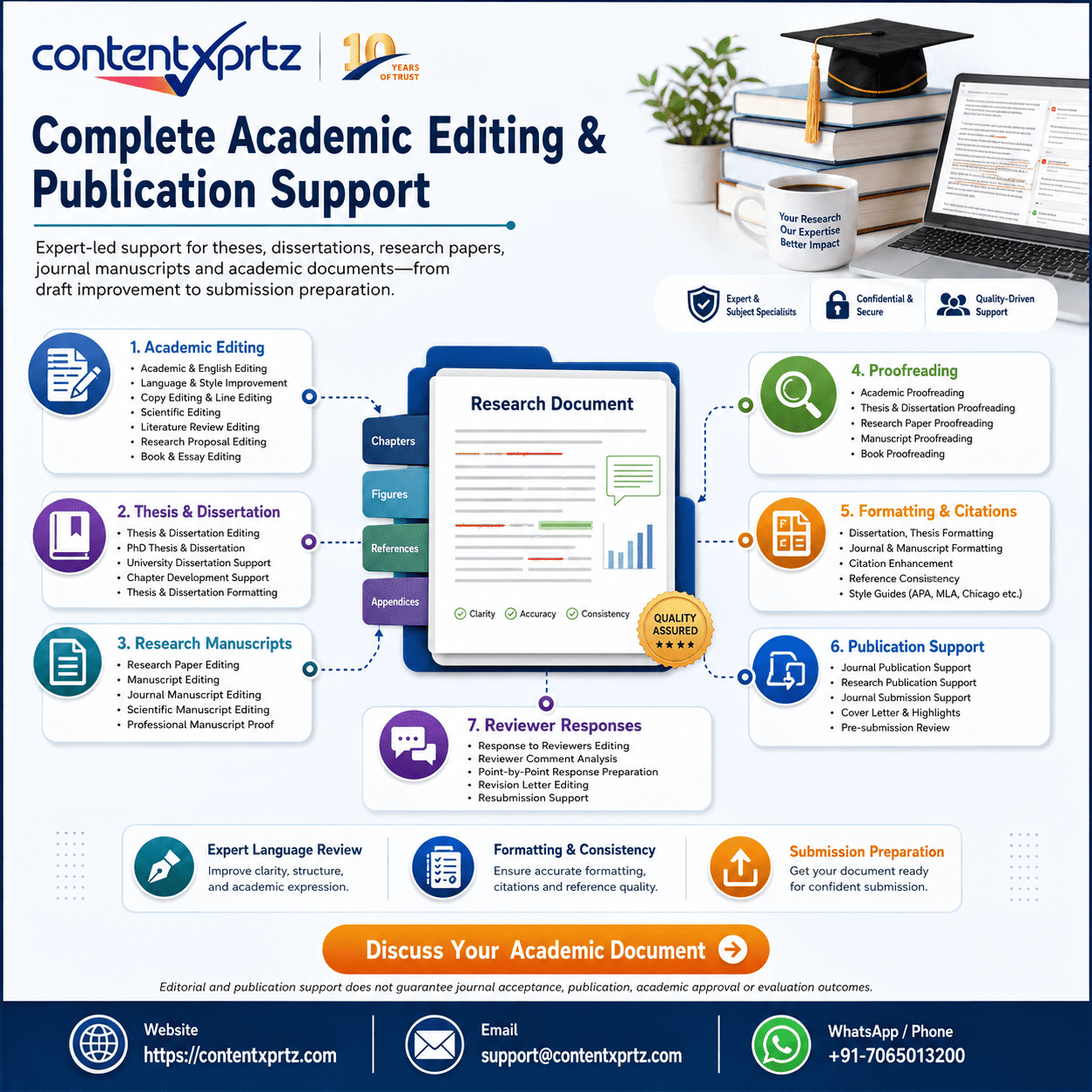
Contentxprtz supports researchers who already own the research decisions but need help making the manuscript clearer, more consistent, and better aligned with publication requirements. Relevant support may include academic editing, proofreading, journal manuscript editing, formatting, submission preparation, and reviewer-response organization.
The aim is not to replace the author or manufacture a publishable result. It is to help a genuine manuscript communicate its research more effectively. For multilingual authors, this may involve improving grammar, syntax, terminology, paragraph flow, and academic tone. For thesis-derived papers, it may involve reducing repetition and sharpening the article-level contribution. For revised manuscripts, it may involve ensuring that changes are consistent across the paper and response letter.
Preparing a Journal Manuscript?
If your research is complete but the manuscript needs clearer academic English, stronger organization, journal-specific preparation, or reviewer-response support, Contentxprtz can provide ethical, author-preserving assistance.
Summary: Academic Journal Articles
Academic journal articles are structured scholarly contributions, but their purpose and evidential value depend on article type, research design, editorial process, and publication context. Students and researchers should identify what kind of paper they are reading, evaluate the methods and limitations, verify citations and versions, and connect each source to a clear research purpose.
Authors should begin with contribution and journal fit, then build a transparent manuscript around evidence. Peer review can improve a paper and help editors evaluate it, but it does not remove the author's responsibility for accuracy or the reader's responsibility for critical appraisal. Ethical editing can improve clarity, language, structure, consistency, and compliance without replacing the researcher's intellectual role.
Frequently Asked Questions About Academic Journal Articles
What are academic journal articles?
Academic journal articles are scholarly papers published in academic or professional journals to communicate research, analysis, reviews, theory, methods, or informed commentary to a specialist audience. Many research articles undergo peer review before publication, but the exact editorial process depends on the journal and article type. A journal article usually includes a title, author information, abstract, main text, references, and publication metadata such as volume, issue, pages, and a DOI when one is assigned. Original research commonly presents a research question, methods, results, and discussion, while review articles synthesize existing evidence rather than reporting a new experiment or dataset. For students and researchers, the important point is to identify the article type and read the methods, evidence, limitations, and publication context rather than assuming every journal-looking document has the same evidential value. When using an article in a thesis or manuscript, verify the authoritative version and cite it according to the required style.
Are all academic journal articles peer reviewed?
No. Many academic journals use peer review for original research and review papers, but not every item appearing in a journal is necessarily peer reviewed. Editorials, letters, news items, book reviews, corrections, perspectives, invited commentaries, and some special content may follow different editorial pathways. Even among research papers, peer-review models vary by journal, discipline, and publisher. Therefore, do not infer peer-review status from the journal layout alone. Check the journal's article-type description, editorial policy, and the specific record for the paper. If an assignment requires peer-reviewed evidence, confirm that the item meets that requirement before citing it. Peer review is also not a guarantee that a study is correct; readers still need to assess the research question, methods, sample, analysis, reporting quality, limitations, conflicts of interest, corrections, and whether the conclusions are supported by the evidence. Critical reading remains part of responsible scholarship.
How do I find reliable academic journal articles for research?
Start with a clear research question and search in appropriate scholarly databases, library platforms, journal websites, and reputable discovery tools. Use the key concepts in your question, then add synonyms, alternative spellings, population terms, methods, or outcomes. For a literature review, keep a record of databases, search terms, dates, and screening decisions so you can explain how sources were identified. Once you find a useful paper, use its references for backward searching and its citing papers for forward searching. Reliability should be evaluated article by article: check the journal and publisher, article type, authors and affiliations, methods, sample, data analysis, reporting transparency, limitations, funding and conflict disclosures, correction or retraction notices, and relevance to your question. A highly cited article may be important, but citation count does not automatically prove methodological quality. For high-stakes reviews, combine multiple databases and seek librarian or subject-specialist guidance where possible.
What is the difference between a research article and a review article?
A research article reports a study in which the authors analyze original data, experiments, observations, simulations, surveys, interviews, archival material, or another defined evidence source. Its structure often includes an introduction, methods, results, and discussion, although disciplines vary. A review article primarily synthesizes existing studies to explain what is known, where findings agree or conflict, and what questions remain. Narrative reviews may organize literature conceptually, while systematic reviews use explicit search, eligibility, screening, and synthesis methods; meta-analyses may statistically combine compatible study results. Both can be valuable, but they answer different questions. Use original research when you need direct evidence about a specific study and use reviews to understand the broader state of a field or identify important primary studies. Before citing either, examine the scope, methods, selection process, recency, limitations, and whether the article type fits the claim you are making.
How can I tell whether an academic journal article is credible?
Credibility comes from a combination of transparent methods, appropriate evidence, responsible reporting, and trustworthy publication practices rather than from one badge or metric. Read the abstract only as a screening tool, then inspect the full article. Ask whether the research question is clear, the study design fits the question, the sample or evidence base is adequate, the analysis is explained, results are reported consistently, limitations are acknowledged, and the conclusions stay within what the data support. Check references, ethics or consent statements where relevant, funding and conflicts of interest, data or code availability when applicable, and the journal's correction and retraction mechanisms. Also search for later corrections, expressions of concern, retractions, or substantial critiques. Journal reputation and indexing can provide context, but they should not replace article-level evaluation. For unfamiliar fields, discussing the paper with a supervisor, librarian, statistician, or subject specialist can reduce misinterpretation.
What sections should an academic journal article contain?
The required sections depend on discipline, journal, and article type, but an original empirical paper commonly includes a title, author information, abstract, keywords, introduction, methods, results, discussion, conclusion or implications, acknowledgements, disclosures, and references. Many journals use an IMRaD-style core: Introduction, Methods, Results, and Discussion. The introduction defines the problem and positions the study in prior literature. Methods explain what was done so readers can judge validity and, where possible, reproduce the work. Results present the findings without hiding inconvenient outcomes. Discussion interprets those findings in relation to the research question and previous evidence, while limitations clarify boundaries. Review articles, theoretical papers, qualitative studies, case reports, humanities scholarship, and short communications may use very different structures. Always follow the target journal's author instructions rather than forcing a generic template. Structure should make the research logic transparent and help readers distinguish evidence from interpretation.
How do I write an academic journal article for publication?
Begin with the research contribution, not with formatting. Define the central question, identify the evidence that answers it, and choose a target journal whose scope and readership fit the work. Read that journal's author instructions and several recent articles of the same type. Build a logical outline, then draft sections around the study design and evidence. Make the abstract accurate, the introduction focused, the methods sufficiently transparent, the results complete, and the discussion proportionate to the findings. Verify every citation against the source, use consistent terminology, check tables and figures against the text, disclose relevant funding or conflicts, and confirm authorship responsibilities before submission. Language editing can improve clarity and consistency, especially for multilingual authors, but it should preserve the author's meaning and not invent evidence or claims. Before submission, complete the journal's checklist, prepare required files, and have all authors approve the final manuscript.
Can I use AI to write or edit academic journal articles?
AI tools may assist with limited tasks such as brainstorming search terms, checking readability, reorganizing notes, or suggesting language revisions, but their use must follow the rules of the university, funder, discipline, journal, and publisher. Authors remain responsible for the accuracy, originality, citations, data, analysis, and final wording of the manuscript. AI systems can generate plausible but false references, distort technical meaning, overstate findings, or introduce text that is difficult to trace, so every output requires human verification against authentic sources and the underlying research. AI should not be listed as an author because authorship requires accountability that a tool cannot accept. Where a journal requires disclosure of AI-assisted writing or analysis, provide the requested information accurately. Ethical human editing remains different from outsourcing authorship: the purpose is to improve communication while preserving the researcher's intellectual contribution and responsibility.
How should I cite academic journal articles correctly?
Use the citation style required by your university, supervisor, target journal, or publisher, and verify the bibliographic details against the article's authoritative record rather than copying a citation blindly from a search engine. Typical elements include author names, publication year, article title, journal title, volume, issue, page range or article number, and DOI. Styles such as APA, MLA, Chicago, Harvard, and Vancouver format these elements differently. Reference managers can save time, but imported metadata may contain capitalization errors, missing pages, duplicate records, incorrect author order, or preprint details instead of the final version. Check every in-text citation against the reference list and every reference against the source. Also ensure that the cited paper actually supports the statement you attach to it. Accurate citation is not merely formatting; it allows readers to trace evidence and helps distinguish your interpretation from prior work.
When should I use professional editing or journal publication support?
Professional support is most useful when the research and core argument are already the author's, but the manuscript needs clearer academic English, stronger organization, consistent terminology, journal-specific formatting, reference checking, submission preparation, or help responding coherently to reviewer comments. Self-editing may be enough for a short paper when the author is confident in the language, structure, and journal requirements. Expert review becomes more valuable for a thesis-derived article, multidisciplinary manuscript, complex revision, or submission where inconsistent language is obscuring otherwise sound research. Ethical support should not fabricate data, create fake citations, guarantee acceptance, or replace decisions that belong to the author. Contentxprtz can assist with journal manuscript editing and publication support while keeping the researcher responsible for the study, claims, data, citations, authorship, and final submission. Authors should also follow any institutional or journal policy on declaring editorial assistance.
Conclusion: Use Journal Articles as Evidence, Not Decoration
The practical goal is not to collect the largest number of academic-looking sources or to make a manuscript sound more complicated. It is to connect a clear question with appropriate evidence, evaluate that evidence critically, communicate methods and findings transparently, and make it possible for readers to trace the scholarly record.
Free tools and self-editing are often enough for early research, routine assignments, and manuscripts that are already structurally strong. Expert-assisted editing or publication support becomes more useful when technical meaning is being obscured by language, a thesis chapter needs article-level focus, a submission requires complex journal-specific preparation, or reviewer comments require coordinated revision.
Contentxprtz helps researchers improve clarity, structure, consistency, ethics, and publication readiness while preserving the author's ideas, evidence, decisions, and accountability. Academic integrity remains central at every stage—from source selection and citation to authorship, revision, and final submission. “At Contentxprtz, we don’t just edit; we help ideas reach their fullest potential.”