Academic Journal: How Scholarly Publishing Works
An academic journal is one of the main channels through which researchers communicate new findings, scholarly arguments, reviews, methods, and debates to a specialist audience. For a student or first-time author, however, the phrase can hide a complicated system: peer review, editors, journal scope, indexing databases, article processing charges, publication ethics, revisions, and the pressure to choose a credible venue.
The practical question is not only “What is an academic journal?” It is also “Which journal is appropriate for my paper, how can I verify that it is legitimate, and what should I do before submission?” A strong publication decision begins with research fit and transparency rather than prestige alone. The journal should serve the audience that needs the work, explain how it reviews submissions, disclose fees and policies clearly, and provide author instructions that your manuscript can realistically meet.
This guide is written for postgraduate students, PhD scholars, early-career researchers, faculty members, ESL authors, and professionals who need a clear route through scholarly publishing. It explains journal types, peer review, indexing, open access, journal selection, manuscript readiness, ethics, common mistakes, and the points at which professional journal publication support or academic editing can be useful without replacing the author’s intellectual responsibility.
Quick Answer: What Is an Academic Journal?
An academic journal is a recurring scholarly publication that publishes research articles and other discipline-specific academic content. Most research journals use editorial screening and peer review to decide whether a manuscript is sufficiently relevant, rigorous, clear, and original for publication, although review practices vary by field and article type.
For authors, the most important action is to treat a journal as an editorial community rather than a ranking label. Read its aims and scope, recent papers, peer-review policy, ethics guidance, fees, indexing claims, licensing terms, and author instructions before submitting. If a journal’s website is vague, its claims are difficult to verify, or it promises guaranteed acceptance, do not proceed until you have independently checked the venue.
A journal can be respected without appearing in every global database, and indexing alone cannot guarantee quality. The best match is a transparent journal whose subject, readership, article type, and publication model fit your research and your institutional requirements.
Key Takeaways
- An academic journal publishes scholarly work for a defined research or professional community.
- Peer review evaluates a manuscript, but review models and standards differ among journals and disciplines.
- Journal selection should begin with scope fit, audience, transparency, and author requirements—not a metric alone.
- Indexing claims should be verified directly with the official database or journal list when they matter to your institution.
- Open access describes reader access, not automatically quality; fees, licences, and policies must still be evaluated.
- Authors remain responsible for research integrity, data, citations, claims, disclosures, and the final manuscript.
- Ethical editing can improve clarity and submission readiness without promising acceptance or replacing authorship.
What This Page Covers
- The practical meaning of an academic or scholarly journal.
- How editors and peer reviewers make publication decisions.
- How to distinguish journal types, publishing models, and article types.
- How to verify indexing, open-access, fee, and ethics information.
- A step-by-step method for choosing a suitable journal.
- Common submission mistakes and deceptive-journal warning signs.
- A publication-readiness checklist and examples for real research situations.
Table of Contents
- Methodology and academic sources
- What an academic journal means in research
- Types of academic journals and publishing models
- How peer review works
- Indexing, metrics, and journal visibility
- How to choose the right journal
- Academic integrity and author responsibility
- From manuscript to publication
- Common mistakes
- Practical examples
- Publication-readiness checklist
- How Contentxprtz can help
- Summary
- Frequently asked questions
Methodology and Academic Sources
This guide is based on common scholarly publishing workflows, journal-selection practice, manuscript preparation, academic editing, and publication-ethics principles. Publisher expectations are not identical: requirements vary by discipline, journal, article type, funder, institution, and study design. Authors should always use the target journal’s current instructions as the controlling submission source.
For journal transparency and publishing ethics, this article points readers to the Committee on Publication Ethics (COPE) Core Practices and the collaborative Principles of Transparency and Best Practice in Scholarly Publishing. Authors in medical and health fields may also need the current ICMJE Recommendations. When verifying Web of Science coverage, use Clarivate’s official Master Journal List rather than a journal’s own marketing claim.
These sources help with policy questions, but they do not select a journal for you. The author still needs to compare manuscript scope, audience, methods, contribution, open-access needs, and institutional requirements.
What an Academic Journal Means in Research
An academic journal is best understood as a structured scholarly conversation. Each issue or continuously published volume adds new work to an existing body of knowledge. Articles cite earlier scholarship, define a problem, present evidence or analysis, explain methods, and make claims that other researchers can examine, reproduce, challenge, or extend.
That function distinguishes journals from general magazines or news sites. Journal articles are usually written for readers who already understand the field’s vocabulary and research conventions. The writing may therefore be dense, but the underlying standard should still be clarity: a reader should be able to identify the question, evidence, method, results or argument, limitations, and contribution.
Academic journal, scholarly journal, and research journal
The terms academic journal, scholarly journal, and research journal are often used interchangeably. In practice, some journals publish primarily original research, while others include reviews, methodological papers, case reports, theoretical articles, short communications, letters, perspectives, editorials, protocols, data papers, or book reviews. The correct article type matters because it determines structure, word limits, reporting requirements, review expectations, and sometimes whether the item is externally peer reviewed.
Who is involved?
Authors produce and defend the research. Editors assess scope and editorial priority. Peer reviewers evaluate the work from relevant disciplinary perspectives. Publishers manage production, distribution, policies, platforms, and archiving. Libraries and databases support discovery and access. Readers complete the cycle by using, testing, citing, teaching, or challenging the published work.
Types of Academic Journals and Publishing Models
Journals differ by purpose, access model, discipline, ownership, review approach, and the kinds of articles they publish. Understanding these differences prevents authors from choosing a venue on name recognition alone.
| Journal model | What it means | What the author should verify |
|---|---|---|
| Subscription journal | Readers or libraries pay for access to some or all content. | Author rights, repository policy, optional open-access route, funder compliance. |
| Fully open-access journal | Published articles are freely accessible to readers. | Licence, fee policy, waiver policy, peer review, archiving, publisher transparency. |
| Hybrid journal | Subscription journal with optional open access for individual articles. | Open-access charge, licence, funding eligibility, institutional agreements. |
| Society journal | Published by or for a scholarly or professional society. | Scope, publisher arrangement, membership policies, editorial independence. |
| University or institutional journal | Hosted or supported by a university or research institution. | Editorial governance, continuity, peer review, archiving, platform stability. |
| Mega-journal | Broad-scope venue often emphasizing technical soundness over perceived novelty. | Subject coverage, article criteria, fees, indexing, readership relevance. |
No single model is automatically superior. A no-fee society journal may be ideal for one project, while a reputable open-access journal may better meet another author’s funder requirements. The decision should be evidence-based and documented.
Open access and article processing charges
Open access concerns the reader’s ability to access the article, not the rigor of the journal. Some open-access journals charge an article processing charge (APC); others are funded by institutions, societies, grants, or consortia and charge authors nothing. Legitimate subscription journals may also offer optional open access.
Before submission, check whether fees are stated clearly and at what stage they apply. Also examine the licence, copyright terms, waiver rules, and whether your funder requires a particular licence. An APC should never appear as a surprise after acceptance if the journal’s policy is transparent.
How Peer Review Works in an Academic Journal
Peer review is a structured evaluation by people with relevant expertise, but it is not a guarantee that a paper is correct. Its purpose is to help editors judge whether a submission meets the journal’s standards and to help authors improve the work before publication.
Common review models
- Single-anonymous review: reviewers know the authors’ identities, while authors do not know the reviewers.
- Double-anonymous review: author and reviewer identities are concealed from one another as far as the process allows.
- Open peer review: identities, reports, responses, or parts of the review record may be made visible.
- Post-publication review: formal or informal evaluation continues after publication.
Reviewers may assess research design, evidence, statistics, novelty, literature coverage, reporting standards, interpretation, ethical approvals, reproducibility, and the relationship between claims and results. In humanities disciplines, they may focus more heavily on argument, sources, originality, interpretation, and scholarly contribution.
What editorial decisions mean
Common decisions include reject, revise and resubmit, major revision, minor revision, and accept. The wording differs by publisher. A request for revision is not an acceptance promise. Editors may send a revised manuscript back to the same reviewers or make a decision internally. Authors should respond to each comment carefully, show where changes were made, and explain any reasoned disagreement without becoming defensive.
Indexing, Metrics, and Journal Visibility
Indexing makes journal content easier to discover, but different databases serve different purposes and use different inclusion criteria. A journal may be indexed in a subject database, a multidisciplinary citation index, an open-access directory, or a regional platform. Authors should verify the specific claim that matters to them.
If a university requires Web of Science or another database, search the official source using the exact journal title and ISSN. Clarivate’s Master Journal List is the appropriate place to check Web of Science coverage. For open-access journals, DOAJ provides a directory and publishes transparency criteria that can help authors understand good publishing practice.
Metrics are context, not a shortcut
Journal-level metrics can help describe citation patterns or visibility, but they cannot tell you whether your individual study is strong, whether a journal matches your topic, or whether reviewers will value the contribution. Citation behavior differs dramatically among disciplines. A journal metric should therefore be one contextual signal rather than the central reason for submission.
Also beware of invented or misleading metrics that mimic established names. If a number is important to your decision, identify who calculates it, what data it uses, and whether your institution recognizes it.
How to Choose the Right Academic Journal
The best journal-selection process begins with manuscript fit. Authors often make the mistake of starting with a ranking list and trying to force the paper into a prestigious title. A better method is to define what the paper actually contributes and then identify journals that publish for the relevant audience.
Step 1: Write a one-sentence manuscript fit statement
State the research question, method or approach, population or material, and main contribution in one sentence. This prevents the journal search from drifting toward venues that sound impressive but publish different kinds of work.
Step 2: Identify journals already present in your literature
Review the journals that repeatedly appear in your strongest references. They are not automatically your targets, but they show where related scholarly conversations are taking place. Look especially at recent articles rather than only classic citations.
Step 3: Read aims, scope, and recent papers
Do not rely on a journal’s title. A journal called “International Journal of…” may still have a narrow methodological or thematic focus. Read the aims and scope, then examine at least several recent articles. Ask whether your manuscript would look recognizably at home among them.
Step 4: Check article type and technical requirements
Confirm word limits, abstract format, figure limits, data requirements, reporting checklists, reference style, supplementary files, anonymization instructions, and ethical statements. Some mismatches can be fixed through formatting; others reveal that the journal is not appropriate.
Step 5: Verify publishing practices
Review the peer-review process, fees, open-access model, archiving, corrections, retractions, conflicts of interest, authorship policies, and contact information. Compare suspicious or unusually strong claims with official external sources.
Step 6: Build a ranked shortlist
Create a primary, secondary, and backup option based on fit rather than wishful thinking. Because simultaneous submission to multiple journals is generally not allowed for the same manuscript, a sensible sequence saves time if the first journal declines the paper.
| Criterion | Questions to ask | Strong evidence |
|---|---|---|
| Scope fit | Does the journal publish this topic, method, and article type? | Several recent, genuinely comparable papers. |
| Audience fit | Who needs to read or use the findings? | Journal readership aligns with the intended scholarly community. |
| Editorial transparency | Are peer review, ethics, fees, and contacts clear? | Detailed, consistent policies and identifiable editors. |
| Indexing needs | Does an institution or funder require specific coverage? | Claim verified directly in the official database or list. |
| Publishing model | Are access, licence, APC, and copyright terms acceptable? | Costs and rights disclosed before submission. |
| Practical requirements | Can the manuscript meet format and reporting rules? | Article type, word count, data and ethics requirements are feasible. |
Ethical Academic Editing and Author Responsibility
Publication support is ethical when it improves communication while leaving research ownership and intellectual responsibility with the authors. Editing can correct grammar, improve paragraph logic, standardize terminology, remove ambiguity, refine a cover letter, check references, and help organize a reviewer response. It should not fabricate experiments, invent citations, manipulate data, create undisclosed authorship, or make unsupported claims.
Authors remain responsible for the accuracy of their data, analysis, interpretation, citations, permissions, conflicts of interest, authorship, and final submission. That responsibility also applies when using AI tools. AI-generated or AI-assisted text can contain false references, inaccurate summaries, invented facts, or subtle changes in meaning. Researchers should verify all output and follow the disclosure requirements of their institution, journal, and discipline.
Medical journal authors should pay special attention to current ICMJE guidance, while researchers in all fields can use COPE resources to understand publication-integrity expectations. For a thesis or dissertation, university policy may impose additional restrictions on external editing or AI assistance.
Step-by-Step: From Manuscript to Academic Journal Publication
A publication-ready manuscript is not simply a grammatically polished document. It is a complete evidence package that allows editors and reviewers to understand what was done, why it matters, and whether the claims are supported.
- Finalize the research story. Align the title, abstract, introduction, methods, results, discussion, and conclusion around the same research question and evidence.
- Select the target journal before final formatting. Journal-specific requirements can affect article structure, length, reporting checklists, data statements, and supplementary files.
- Check reporting and ethics requirements. Include approvals, consent, trial registration, funding, conflicts, data availability, author contributions, and other statements where applicable.
- Verify references. Confirm that each citation exists, supports the statement made, and matches the reference list. Check DOI, title, author, journal, year, volume, and pages where relevant.
- Prepare files exactly as requested. This may include a main manuscript, title page, blinded file, figures, tables, supplementary data, graphical abstract, cover letter, or highlights.
- Submit through the official journal system. Be cautious with unsolicited links or payment requests that do not match the publisher’s domain or stated process.
- Track all correspondence. Save manuscript versions, reviewer reports, decision letters, revision notes, and proof corrections.
- Respond to reviewers systematically. Quote or summarize each point, explain the change, identify where it appears, and respectfully justify any disagreement.
- Review proofs carefully. Acceptance is not the end of quality control. Check equations, symbols, author names, affiliations, tables, figures, references, and layout.
Common Academic Journal Mistakes to Avoid
Many preventable problems occur before peer review begins. Correcting them early can save weeks of unnecessary resubmission work.
Submitting outside the journal’s scope
A technically strong paper can be rejected quickly if its subject, article type, or audience does not match the journal. Scope is not a formality; it defines the conversation the editors are responsible for curating.
Choosing by impact metric alone
A metric does not tell you whether the journal publishes your method, serves your readers, or values your contribution. Using it as the sole selection criterion can lead to serial desk rejections and wasted time.
Trusting indexing claims without verification
Journal websites can contain outdated or misleading logos. Verify coverage at the source when an index is important to your degree, promotion, funding, or institutional policy.
Ignoring article-type instructions
A manuscript may be within scope but still use the wrong structure. A brief report, systematic review, case report, registered report, perspective, and original research article can have different expectations.
Using unverifiable or AI-invented references
Every citation should be authentic, traceable, and read closely enough to support the claim. Reference accuracy is part of research integrity.
Submitting simultaneously to multiple journals
Most scholarly journals expect exclusive consideration while a manuscript is under review. Check policy, and withdraw formally before submitting elsewhere when necessary.
Responding defensively to reviewers
Reviewer comments can be frustrating, but the response letter is an academic document. Separate tone from substance, answer each point, and use evidence when disagreeing.
Practical Examples: Choosing and Preparing for an Academic Journal
Example 1: A PhD scholar with a strong but overly broad manuscript
A doctoral researcher has a 9,000-word paper developed from one thesis chapter. The first target journal accepts 6,000-word original articles and publishes a narrow subfield. Rather than cutting 3,000 words mechanically, the researcher identifies the paper’s single strongest contribution, removes thesis background that the journal’s audience already knows, moves supporting material to a supplement where permitted, and aligns the discussion with recent articles from the journal. The result is not merely shorter; it is better matched to the venue.
Example 2: An ESL author receives “language editing required” feedback
An engineering manuscript contains sound experiments but inconsistent terminology, long sentences, and ambiguous references to figures. The editor invites resubmission after language improvement. Ethical manuscript editing focuses on clarity, grammar, technical consistency, and argument flow while preserving the data and meaning. The author checks every substantive change, confirms discipline-specific terms, and submits a response explaining the language revisions. No claim of guaranteed acceptance is appropriate because editorial judgment remains independent.
Example 3: A journal claims prestigious indexing
A researcher receives a flattering email invitation from a journal claiming Web of Science indexing. The website shows several logos but does not identify the collection or coverage. The researcher searches the exact journal title and ISSN in the official Master Journal List and cannot confirm the claim. Combined with hidden fees and a promise of review within 48 hours, the evidence is sufficient to pause and seek an alternative journal.
Example 4: A funded project requires open access
A research team has a funder requirement for open access under a specific licence. Their preferred journal is reputable but the standard subscription route does not satisfy the requirement. Instead of assuming the journal is unsuitable, they check the publisher’s open-access options, licence choices, repository policy, and institutional agreement. The team chooses a compliant route and records the funding statement and licence requirements before submission.
Example 5: A systematic review targets the wrong article category
A student prepares a systematic review but selects a journal that publishes only invited reviews. The topic fits, but the article type does not. After reviewing author instructions, the student identifies another journal that accepts unsolicited systematic reviews and requires a specific reporting checklist. This small policy check prevents an avoidable desk rejection.
Academic Journal Publication-Readiness Checklist
Use this checklist after selecting a target journal and before uploading files.
- The manuscript clearly fits the journal’s aims, scope, readership, and accepted article type.
- The title and abstract accurately represent the work and do not overstate conclusions.
- Methods, sources, data, or analytical procedures are described at the level expected in the discipline.
- Results and claims are consistent; limitations are acknowledged rather than hidden.
- Ethics approval, consent, registration, funding, conflicts, author contributions, and data statements are complete where applicable.
- Every in-text citation has a matching reference, and each reference has been verified against an authentic source.
- Tables and figures are legible, numbered, cited in the text, and permitted under copyright or licence rules.
- Language is clear and consistent, including terminology, abbreviations, tense, and scientific notation.
- Word count, reference style, file naming, anonymization, supplementary material, and cover-letter requirements match the journal’s instructions.
- All co-authors have reviewed and approved the final manuscript and submission details.
- Any professional editing or AI assistance has been handled in line with relevant disclosure and institutional policies.
- The submission is being considered by only one journal unless the journal explicitly permits another arrangement.
How Contentxprtz Can Help With Journal Readiness
Professional support is most useful when it solves a defined manuscript problem. A researcher may understand the study deeply but need help making the paper clearer to an international audience, aligning sections, correcting language, checking reference consistency, or organizing a detailed response to reviewers.
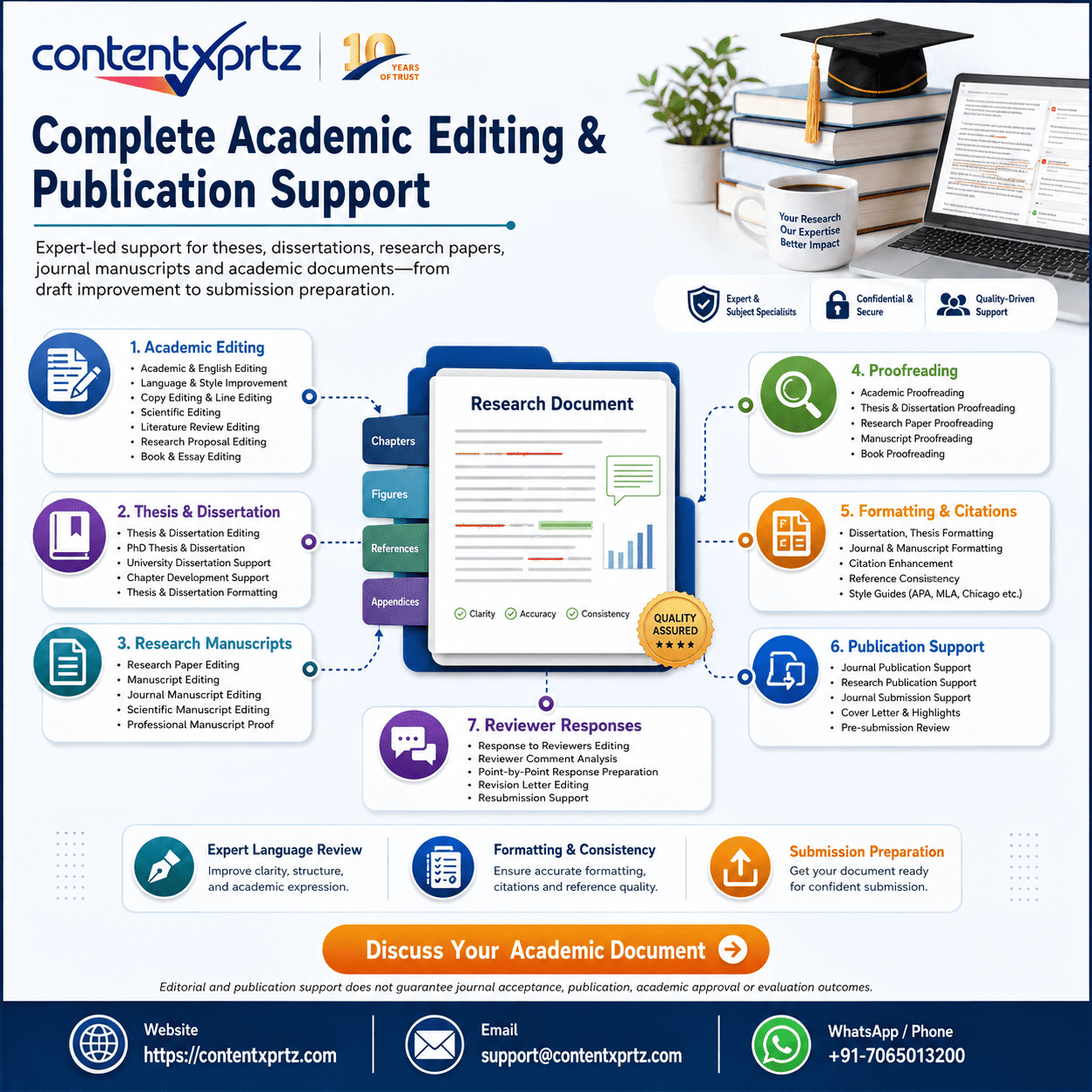
Contentxprtz provides ethical journal publication services, manuscript editing, proofreading, formatting, and submission-readiness support. The goal is to strengthen communication and compliance while preserving the author’s ideas, evidence, interpretations, and responsibility. Researchers who need language-focused improvement can also use manuscript editing support, while authors addressing editorial feedback may benefit from reviewer response support.
What professional support cannot ethically do is guarantee publication, invent evidence, manufacture citations, bypass peer review, or substitute for genuine scholarship. A good editor helps the manuscript communicate the research more accurately; the editor does not become the hidden researcher.
Explore journal publication support from Contentxprtz if your manuscript needs a structured readiness review before submission or revision.
Summary: Academic Journal
An academic journal is a formal venue for scholarly communication, but successful journal publishing requires more than finding a recognizable title. Authors need to match the manuscript to the journal’s scope and audience, understand the review model, verify indexing and fee claims, follow ethics and reporting requirements, and prepare a complete submission package.
Free self-service research is often enough when the journal’s policies are clear and the manuscript is already well structured. Expert assistance becomes more useful when language, organization, journal-specific formatting, reference consistency, or reviewer responses are creating avoidable barriers. In every case, the author remains responsible for the research, data, claims, citations, disclosures, and final submission.
The strongest publication strategy is therefore evidence-led and realistic: choose a transparent journal that serves the right readers, make the paper easy to evaluate, and treat peer review as part of scholarly communication rather than a guarantee of acceptance.
Frequently Asked Questions
What is an academic journal?
An academic journal is a periodical publication that communicates research, scholarly analysis, reviews, and other discipline-specific work to an academic or professional audience. Most research journals use editorial screening and some form of peer review before accepting original articles, although the exact review model differs by field and publication. A journal is not automatically reputable simply because it calls itself scholarly. Researchers should examine its scope, publisher, editorial board, peer-review policy, ethics information, fees, licensing, archiving, and indexing claims. The strongest journal choice is one whose readership and aims closely match the manuscript rather than one selected only because of a high metric or broad reputation. Authors should also distinguish journals from repositories, magazines, conference proceedings, preprint servers, and databases. Those resources can all support scholarship, but they serve different functions. Before submitting, read the journal's author instructions and several recent articles, confirm that your study fits the scope, and verify any claimed indexing directly with the relevant database or official journal list.
What is the difference between an academic journal and a peer-reviewed journal?
Academic journal is a broad term for a periodical that publishes scholarly content, while peer-reviewed journal describes a journal that sends at least some submissions to independent experts for evaluation before editorial acceptance. In everyday research use the terms often overlap, but they are not perfectly interchangeable. Some academic journals publish editorials, letters, book reviews, news, invited commentaries, or other content that may receive editorial review rather than external peer review. Review models also differ: single-anonymous, double-anonymous, open peer review, post-publication review, and discipline-specific variants all exist. Therefore, do not infer the review process from a journal title or database appearance alone. Read the journal's peer-review policy and the article-type instructions. For an assignment or thesis that specifically requires peer-reviewed sources, confirm that the individual article type is peer reviewed. For a manuscript submission, understand what reviewers will assess, such as methodological soundness, novelty, reporting quality, interpretation, ethics, and fit with the journal's readership.
How do I know whether an academic journal is reputable?
Start with transparent evidence rather than a single badge, metric, email invitation, or indexing claim. A reputable journal normally states its aims and scope, publisher identity, editorial leadership, peer-review process, publication ethics, correction and retraction procedures, copyright or licence terms, fees, and contact information clearly. Check whether the editorial board includes identifiable scholars with relevant expertise and whether recent articles look consistent with the stated scope. If the journal claims inclusion in Web of Science, DOAJ, or another index, verify that claim on the index owner's official site. Review the publisher's policies for conflicts of interest, research integrity, complaints, appeals, authorship, and data where relevant. Warning signs include guaranteed acceptance, unrealistically fast review promises, hidden charges, copied websites, misleading metrics, very broad scope, unverifiable editors, and aggressive solicitation unrelated to your research. No checklist can replace judgment, so discuss uncertain venues with a supervisor, librarian, research office, or experienced colleague before submitting.
How do I choose the right academic journal for my research paper?
Choose a journal by matching your manuscript to the journal's real editorial scope and audience. Begin by identifying the central research question, method, field, contribution, and readers who would use the findings. Then shortlist journals that have recently published work with comparable topics, methods, populations, or theoretical framing. Read each journal's aims and scope, article types, word limits, reporting requirements, data policies, reference style, review model, open-access options, charges, and typical editorial expectations. Consider practical factors such as whether the journal is indexed in databases important to your institution or discipline, whether its publishing model is acceptable to your funder, and whether the timeline fits a genuine deadline. Metrics can be one input, but they should not override scope fit and research integrity. A focused manuscript submitted to a well-matched journal usually has a more defensible publication strategy than the same manuscript repeatedly sent to prestigious but unsuitable venues.
Are all academic journals indexed in Scopus or Web of Science?
No. Academic journals can be legitimate without being indexed in Scopus or Web of Science, and coverage varies by discipline, geography, language, journal age, and the selection policies of each database. Some strong specialist or regional journals may be indexed elsewhere or may still be developing their indexing history. Conversely, a website claiming that a journal is indexed is not proof that the claim is current. If indexing matters for a university rule, promotion requirement, funding condition, or publication strategy, verify the exact journal title and ISSN in the official database or journal list. Also check whether the specific coverage is current and which collection or index applies. Indexing is a discoverability and curation signal; it does not guarantee that every article is methodologically strong or that a journal is the best fit for your paper. Use indexing together with scope, editorial quality, peer-review transparency, ethics, readership, publisher practices, and institutional requirements.
What does open access mean for an academic journal?
Open access means readers can access published research online without paying a subscription fee, but the business and licensing model can vary. Some fully open-access journals charge an article processing charge, some are funded by societies or institutions and charge authors nothing, and some subscription journals offer an optional open-access route for individual articles. Authors should check who retains copyright, which Creative Commons licence is used, what reuse rights apply, whether fees are clearly disclosed, and whether a funder or university has specific open-access requirements. An article processing charge does not by itself indicate poor quality, and a no-fee journal is not automatically stronger. The key questions are transparency, editorial independence, peer review, ethics, archiving, and whether the publishing model fits the author's obligations and budget. Never pay an unexpected invoice without first checking the journal's published fee policy and confirming that the communication came from the legitimate publisher.
What happens after I submit a manuscript to an academic journal?
The usual sequence is technical checks, editorial screening, peer review when appropriate, an editorial decision, revision if invited, possible re-review, final acceptance, production, proof correction, and publication. The exact path varies widely. At initial screening, editors may check scope fit, article type, formatting, ethics declarations, reporting completeness, originality concerns, and whether the manuscript offers a contribution suitable for the journal. A desk rejection can occur before external review and does not necessarily mean the research has no value; it may reflect fit, priority, presentation, or editorial capacity. If the paper is reviewed, comments can range from minor language changes to major methodological or interpretive concerns. Authors should answer reviewer points systematically, revise only where justified, and explain respectfully when they do not adopt a suggestion. Acceptance should never be assumed until the journal issues a formal decision. During production, authors still need to check proofs carefully because typesetting can introduce errors.
Can professional editing help with an academic journal submission?
Professional editing can help when a sound manuscript needs clearer academic English, stronger organization, more consistent terminology, cleaner references, better adherence to journal formatting, or a more coherent response to reviewer comments. Ethical editing should improve communication without inventing data, changing results, fabricating citations, hiding authorship, or taking over intellectual decisions that belong to the researchers. The level of assistance should also comply with the author's university, funder, employer, or target-journal policies. Authors remain responsible for the research question, methods, data, analysis, claims, references, disclosures, and final submitted version. For ESL researchers, editing can be especially useful when language obscures an otherwise strong argument. Contentxprtz can support manuscript editing, proofreading, formatting, journal-readiness checks, and reviewer-response clarity, but publication decisions remain with editors and reviewers. A responsible service should never promise guaranteed acceptance or guaranteed publication.
What are common warning signs of a predatory or deceptive journal?
Common warning signs include guaranteed or nearly guaranteed acceptance, promises of peer review within an implausibly short time, hidden or shifting publication fees, fake impact metrics, unverifiable indexing claims, poor or copied website content, editorial board members who cannot be confirmed, and solicitation emails that praise work they clearly have not read. Other concerns include a journal scope that covers almost every discipline, unclear ownership, weak contact information, pressure to pay quickly, and policies that do not explain corrections, retractions, conflicts of interest, licensing, or peer review. One warning sign may have an innocent explanation, so evaluate the overall pattern rather than relying on a single red flag. Verify journal claims using official sources such as DOAJ or a database provider's journal list, search for the publisher's established presence, and ask a librarian or research office when uncertain. Avoid blacklists or social-media accusations as the sole basis for a decision because they may be incomplete or outdated.
How should a first-time author prepare for academic journal publication?
A first-time author should prepare the research story and submission strategy before focusing on cosmetic formatting. Clarify the paper's central question, main finding, contribution, limitations, and intended readership. Select a target journal whose scope is demonstrably aligned, then read its author instructions and several recent papers. Build the manuscript around the journal's required article type and reporting expectations, verify every citation, label tables and figures clearly, and make sure ethical approvals, consent statements, funding, conflicts, authorship contributions, data availability, and trial registration are handled where applicable. Before submission, perform separate checks for scientific logic, structure, language, references, and technical formatting. Ask co-authors to approve the final version and agree on authorship order and responsibilities. Keep a clean record of files and correspondence. If you use editing or AI-assisted tools, follow applicable disclosure policies and verify all output. The goal is not to make the paper sound grander; it is to make the research accurate, transparent, readable, and appropriately matched to the journal.
Conclusion: Choose the Journal, Then Prepare for Its Readers
The practical challenge behind the term academic journal is deciding where research belongs and preparing it so editors and reviewers can judge it fairly. A suitable journal is not simply the one with the biggest name. It is the one whose scope, readership, editorial standards, publishing model, and author requirements align with the work.
Researchers can do much of this themselves by reading journal policies, checking recent papers, verifying database claims, and following a rigorous manuscript checklist. When a paper is scientifically or academically sound but needs clearer English, stronger organization, journal-specific formatting, or a careful reviewer response, professional support can reduce avoidable communication problems without changing authorship or making unrealistic promises.
Contentxprtz supports researchers with ethical editing and publication-readiness assistance designed to improve clarity, structure, consistency, and compliance while keeping research responsibility where it belongs—with the author.
Discuss your journal-readiness requirements with Contentxprtz when you need targeted support before submission or resubmission.
At Contentxprtz, we don’t just edit; we help ideas reach their fullest potential.