Essay Checker Free: What It Can Check, What It Misses, and How to Review Your Essay Properly
Essay checker free searches usually come from a practical problem: you have written an essay, you know it needs another review, and you want to catch mistakes before submitting it without immediately paying for editing. A free checker can be useful for spotting spelling problems, punctuation slips, repeated words, basic grammar issues, and sentences that may be difficult to read. Used well, it gives students and academic writers a convenient first pass over a draft.
The limitation is that an essay is more than a collection of grammatically correct sentences. A university marker may be looking for a clear response to the assignment question, a defensible argument, relevant evidence, critical analysis, logical paragraph development, accurate citation, discipline-appropriate style, and a conclusion that follows from the discussion. A tool can flag a sentence as long or passive without understanding whether the argument is accurate, whether a source supports the claim, or whether the paragraph belongs in the essay at all.
This matters especially for postgraduate students, PhD scholars, researchers, first-time academic writers, and multilingual authors. Under time pressure, it is tempting to treat a green score, a low error count, or an “all clear” message as proof that the essay is ready. It is not. Automated checking should be treated as one stage in a broader academic editing workflow. You still need to compare the draft with the question and rubric, verify sources, inspect paragraph logic, review citations, and make sure every change preserves your intended meaning.
This guide shows how to use a free essay checker responsibly, what it can and cannot evaluate, how to decide between self-editing, proofreading, and deeper academic editing services, and how to complete a practical pre-submission review. The goal is not to replace your judgment. It is to help you use software as a useful screening tool while keeping authorship, academic integrity, and final responsibility with you.
Quick Answer: How Should You Use an Essay Checker Free?
A free essay checker is best used as a first-pass language and readability check, not as the final judge of academic quality. Run it after you have a complete draft. Review spelling, punctuation, grammar, repeated wording, unclear sentences, and consistency suggestions one by one. Accept only changes that preserve your intended meaning and fit the academic style required by your institution.
Then perform checks the software cannot reliably complete: confirm that your essay answers the question, each paragraph has a clear purpose, evidence supports each important claim, quotations and paraphrases are cited correctly, and the conclusion follows from the analysis. Compare the final draft against the rubric or submission instructions.
If the document is high stakes, structurally weak, written in a second language, or repeatedly receiving feedback about clarity, a human proofreader or editor can provide contextual review. The key distinction is simple: software finds patterns; academic review evaluates meaning in context.
Key Takeaways
- A free essay checker can catch many surface-level language issues, but it cannot reliably judge the quality of your argument or evidence.
- Do not accept every automated suggestion; technical terms, quotations, discipline-specific style, and nuanced claims can be misread by software.
- Similarity or AI-detection indicators should not be treated as automatic proof of plagiarism or authorship.
- Check structure, citations, source accuracy, and rubric alignment separately from grammar.
- Proofreading is a final-stage quality check, while editing may involve deeper improvements to clarity, flow, and organization.
- Free self-service checking is often sufficient for routine drafts; higher-stakes academic work may benefit from expert review.
- The author remains responsible for every claim, citation, interpretation, and final submission.
What This Page Covers
- What a free essay checker normally checks and what it misses
- A practical difference between grammar checking, proofreading, and academic editing
- How to review an essay in layers instead of relying on one score
- How to handle grammar, citation, similarity, and AI-writing indicators responsibly
- When free checking is enough and when professional support may be useful
- Common mistakes that make technically “clean” essays academically weak
- A pre-submission checklist and exactly ten detailed FAQs
Table of Contents
- What a free essay checker means in practice
- What it can and cannot check
- Free tools versus proofreading and editing
- Step-by-step essay checking workflow
- Citations, similarity, AI indicators, and academic integrity
- Common mistakes to avoid
- Practical examples
- Pre-submission checklist
- Frequently asked questions
Methodology and Academic Sources
This article is based on common academic writing, editing, proofreading, and submission-readiness workflows. Because expectations differ by institution, subject, assignment type, and journal, writers should always check their own rubric, university policy, and target publication instructions. The APA Style guidance on style and grammar is a useful reference when APA conventions apply, while the Purdue Online Writing Lab grammar resources provide university-based explanations of common writing issues.
For research and publication ethics, the Committee on Publication Ethics guidance and ICMJE recommendations on author responsibilities reinforce the principle that authors remain accountable for their work. Writing assistance, language editing, and proofreading can support communication, but they do not transfer responsibility for the claims, sources, or conclusions.
What Does “Essay Checker Free” Mean in an Academic Context?
In practice, an essay checker free service is a no-cost or limited-access software tool that scans writing for possible language or presentation issues. The exact features vary, but the common promise is convenience: paste or upload a draft, run a scan, and review highlighted suggestions.
The phrase can describe very different functions. One checker may focus on spelling and grammar. Another may score readability or style. A third may include citation prompts, similarity checking, paraphrasing suggestions, or an AI-writing indicator. These functions should not be treated as equivalent. A grammar flag is a language pattern prediction; a similarity match is a text-overlap signal; an AI indicator is an estimate from a classifier. None of those outputs is automatically an academic judgment.
Academic quality has several layers
An essay normally needs to succeed at more than sentence correctness. A useful review therefore separates at least six layers:
- Task alignment: Does the essay answer the actual question and meet the rubric?
- Argument: Is there a clear position or controlling idea?
- Evidence: Are important claims supported by relevant, credible sources?
- Structure: Do sections and paragraphs develop the argument logically?
- Academic integrity: Are quotations, paraphrases, ideas, and data attributed correctly?
- Language and presentation: Are grammar, spelling, punctuation, tone, references, and formatting consistent?
Most free checkers are strongest in the final layer and weakest in the first five. That does not make them useless. It simply defines their correct place in the workflow.
What Can a Free Essay Checker Check—and What Can It Miss?
A free checker is effective when the problem can be identified from patterns in the text. It is less reliable when the problem requires subject knowledge, interpretation of evidence, or understanding of your assignment.
| Review area | Free checker can often help with | Human or author review still needs to judge |
|---|---|---|
| Spelling and punctuation | Typos, duplicated words, missing punctuation, common spelling variants | Discipline-specific terms, names, intentional wording, required regional English |
| Grammar | Agreement, tense patterns, sentence fragments, common usage problems | Whether a technically correct sentence expresses the intended academic meaning |
| Clarity and style | Very long sentences, repeated wording, vague constructions, readability signals | Whether a revision preserves nuance, certainty, limitation, and disciplinary tone |
| Structure | Occasional paragraph-length or heading signals | Thesis logic, paragraph purpose, sequencing, counterargument, synthesis, conclusion |
| Citations | Possible formatting patterns or missing citation signals in some tools | Whether the source is real, accurately represented, appropriate, and cited at the correct claim |
| Similarity | Text overlap when a database or comparison corpus is available | Whether overlap is legitimate quotation, common wording, correctly cited use, or plagiarism |
| AI-writing indicator | A probabilistic pattern score in tools that offer this feature | Actual authorship, permitted use, drafting history, disclosure, and institutional policy |
| Academic quality | Limited indirect signals | Argument strength, evidence quality, critical analysis, originality of reasoning, rubric fit |
The table explains why one overall “essay score” can be misleading. An essay may have excellent grammar and weak analysis. It may have a strong argument and inconsistent punctuation. It may be highly original but contain repeated technical phrases that a similarity tool highlights. Review the underlying issue rather than chasing a score.
Free Essay Checking, Proofreading, and Academic Editing: Which One Do You Need?
The right level of help depends on the stage of your draft and the consequence of errors. Use the lightest intervention that solves the actual problem.
Use a free essay checker when the draft is already conceptually sound
A free checker is usually enough when you understand the assignment, have a clear argument, have verified your sources, and mainly want to catch avoidable language mistakes. It is particularly useful for short coursework, discussion papers, reflective writing, and early proofreading passes.
Use proofreading when the content is finished but errors remain
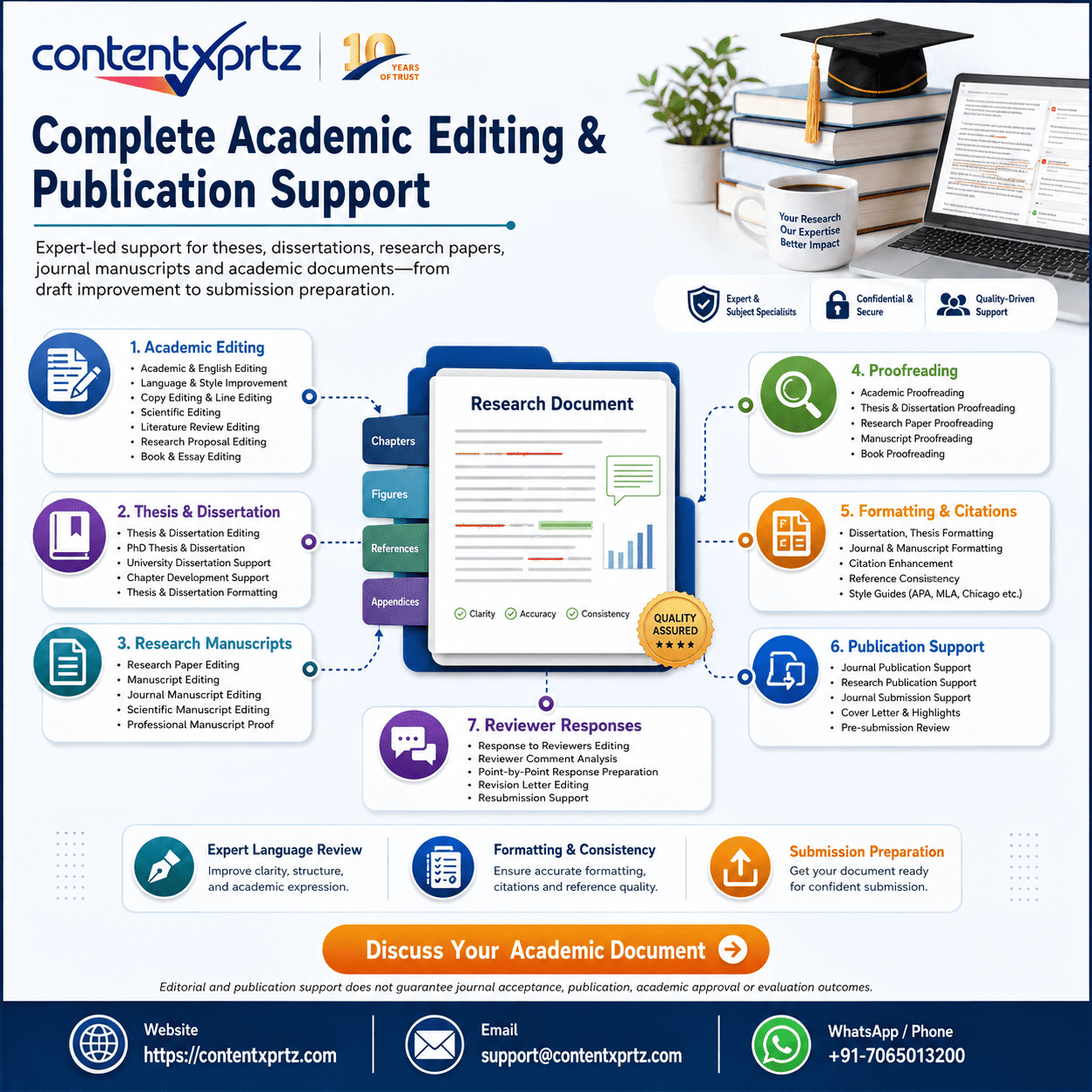
Proofreading focuses on the final surface of the document: grammar, punctuation, spelling, capitalization, consistency, cross-references, formatting, and residual typographical mistakes. It should happen after major rewriting. Contentxprtz offers proofreading support for writers who want a human final check while retaining ownership of the content.
Use academic editing when clarity and flow need deeper attention
Editing is broader. Depending on the agreed service level, an editor may identify unclear paragraphs, repeated ideas, weak transitions, inconsistent terminology, awkward academic tone, or organization that prevents the reader from following the argument. A responsible editor should not invent data, replace the author’s analysis, or silently change the intellectual meaning.
For dissertations, thesis chapters, research papers, and long assessed essays, deeper review can be more valuable because small sentence problems often repeat across many pages. Writers who need structured support can also consider dissertation editing support where it fits institutional rules.
When Is a Free Checker Enough, and When Is Expert Editing Safer?
Free checking is enough when errors are low-risk, the document is short, and you can confidently judge every suggestion. Expert review becomes more useful as the document becomes longer, more specialized, more important, or more difficult for you to assess independently.
- Free checking is often enough: early coursework drafts, routine essays, personal statements in development, short reports, or a final spelling-and-grammar pass.
- Peer or tutor feedback may be better: when you are unsure whether the argument answers the question or the evidence is persuasive.
- Professional proofreading may help: when the content is final but language consistency and presentation matter.
- Academic editing may help: when feedback repeatedly mentions clarity, flow, academic tone, paragraph logic, or English-language expression.
- Supervisor or subject-specialist input is essential: when the uncertainty concerns the research method, interpretation, disciplinary accuracy, or substantive conclusions.
Do not use editing as a substitute for intellectual work that your course expects you to perform. Check institutional rules about permitted assistance, particularly for assessed student work.
How to Check an Essay Properly: A Step-by-Step Workflow
The strongest workflow separates thinking problems from language problems. If you start with commas before checking the argument, you may spend time polishing paragraphs that later need to be removed.
1. Re-read the question, rubric, and submission instructions
Highlight the command words: analyse, compare, evaluate, discuss, justify, reflect, or critically assess. Check word count, source requirements, citation style, formatting, and any policy on external or AI-assisted editing. Ask whether the draft actually performs the task rather than merely describing the topic.
2. Write the essay’s main claim in one or two sentences
If you cannot state the central position clearly, the essay may not yet be ready for proofreading. Compare the introduction, topic sentences, and conclusion with that claim. They should point in the same intellectual direction without repeating identical wording.
3. Give every paragraph a job
Write a short label beside each paragraph: define concept, present evidence, compare studies, challenge assumption, explain limitation, provide example, or connect back to the thesis. If two paragraphs have the same job, consider combining them. If a paragraph has no clear job, revise or remove it.
4. Verify evidence and citations before language polishing
Open the original source for important claims. Confirm author names, year, data, quotation wording, page number where required, and whether the source actually supports your sentence. Avoid citing a source merely because another paper cited it. For style conventions, follow the citation system required by your institution rather than mixing formats.
5. Run the free essay checker
Now use the tool for spelling, grammar, punctuation, repetition, and readability signals. Work through suggestions individually. Do not use “accept all” unless you can independently verify that every change is safe.
6. Review sentence meaning after automated edits
Software can make prose smoother while changing meaning. This is especially risky with hedging words such as “may,” “suggests,” “is associated with,” and “appears.” Academic writing often needs careful degrees of certainty. A tool that replaces a cautious statement with a stronger one may accidentally misrepresent the evidence.
7. Check paragraph transitions and information order
Read the first sentence of every paragraph in sequence. The progression should make sense even before you read the details. Add transitions where the relationship is not obvious: contrast, cause, limitation, example, extension, or synthesis.
8. Complete a citation and reference-list audit
Check that every in-text citation that needs a reference-list entry has one, and vice versa. Verify titles, author order, year, journal or book details, DOI where required, capitalization, italics, and punctuation according to the required style. Automated citation generators can save time, but their metadata still needs review.
9. Proofread the formatted document
Check the version you will actually submit, not only text copied into a web tool. Look at headings, page numbers, tables, figures, captions, block quotations, spacing, bullet lists, footnotes, and the reference list. Formatting errors often become visible only in the final file.
10. Perform a final read without editing every sentence
Read once for meaning and reader experience. Ask what a marker will understand from the essay, where they might lose the argument, and whether the conclusion answers the question. This last pass is for coherence, not endless rewriting.
How to Handle Citations, Similarity Reports, and AI-Writing Indicators
These three issues are often grouped together by essay-checking platforms, but they answer different questions and should be interpreted separately.
Citation checking
A citation checker may notice formatting patterns or possible missing references, but it cannot reliably confirm that a source supports your interpretation. Open the source and verify the claim yourself. If you paraphrase, express the idea genuinely in your own wording and sentence structure while retaining the source citation. If you quote, reproduce the wording accurately and follow the required quotation format.
Similarity checking
Similarity means textual overlap. Overlap can be legitimate or problematic depending on context. Reference-list entries, standard method phrases, assignment titles, properly marked quotations, and technical expressions may create matches. The meaningful question is not “How do I get the score to zero?” but “Is every borrowed phrase or idea represented and attributed correctly?”
AI-writing indicators
AI detectors estimate patterns; they do not observe the writing process. Do not use a detector result as a substitute for evidence of authorship or academic misconduct. If your institution permits certain AI-assisted tasks, follow its disclosure rules. Keep outlines, notes, source records, version history, and drafts where useful. Most importantly, be able to explain and defend your argument, evidence, and wording.
Ethical support should strengthen the author’s communication rather than disguise authorship. Contentxprtz provides plagiarism and AI integrity guidance where writers need help understanding responsible revision and attribution practices.
How to Decide Whether an Automated Suggestion Is Safe to Accept
Use a three-question test for every significant suggestion:
- Is it linguistically correct? Check grammar and syntax in the full sentence, not just the highlighted phrase.
- Does it preserve the exact meaning? Pay special attention to numbers, comparisons, cause-and-effect language, hedging, and limitations.
- Does it fit the academic context? A more conversational phrase may be readable but inappropriate for a formal research essay, while a shorter sentence may remove necessary technical precision.
When a suggestion fails any one of these tests, reject it or rewrite the sentence yourself. A checker should support judgment, not replace it.
Common Mistakes to Avoid When Using a Free Essay Checker
- Using the checker before the argument is settled. Structural revision should come before sentence polishing.
- Accepting every suggestion automatically. Automated edits can alter meaning or mishandle technical language.
- Chasing a perfect score. A high tool score does not prove the essay answers the question well.
- Treating similarity as plagiarism. Investigate the matched text and its attribution.
- Treating a low similarity score as proof of originality. Uncited ideas can still be improperly attributed even without close wording.
- Using AI detection as proof of authorship. These indicators are probabilistic and should be interpreted under institutional policy.
- Ignoring references and formatting. Web checkers may not evaluate the final document layout correctly.
- Letting the tool flatten your voice. Replacing every distinctive phrase with generic wording can make academic prose less precise.
- Failing to verify factual changes. A language tool should not be trusted to correct data, terminology, or source claims.
- Skipping the final human read. The author should always review the submission version after automated edits.
Practical Examples: How Different Writers Should Use Essay Checking
Example 1: A first-year student with a clear argument but frequent grammar errors
Situation: A student has written a 1,500-word sociology essay. Tutor feedback on earlier work says the ideas are relevant but sentence-level errors make the discussion harder to follow.
Common mistake: The student runs a checker and accepts every rewrite, including changes that remove cautious language from research claims.
Better approach: The student first checks the thesis and paragraph order, then runs grammar and punctuation checking. Each suggestion is reviewed against the original meaning. The student keeps phrases such as “the evidence suggests” where stronger wording would overstate the source.
Ethical expert help: If the same language pattern repeats throughout the essay, a proofreader can identify recurring issues and explain them without changing the student’s ideas.
Example 2: A postgraduate student whose essay is grammatically clean but structurally weak
Situation: A master’s student receives a strong grammar score, yet the draft reads like a sequence of article summaries.
Common mistake: The student keeps editing sentence style because the tool offers many small suggestions, while the real problem is lack of synthesis.
Better approach: The student groups sources by themes, methods, and disagreements, rewrites topic sentences around analytical points, and compares evidence inside paragraphs. Grammar checking happens only after the new structure is stable.
Ethical expert help: An academic editor can flag unclear organization and transitions, while the student remains responsible for interpreting the literature and deciding the argument.
Example 3: An ESL researcher preparing a conference essay or research paper
Situation: The writer understands the subject deeply but uses long sentences and article/preposition patterns influenced by another language.
Common mistake: Automated rewriting simplifies specialized terms and makes several claims sound more certain than the data allow.
Better approach: The writer uses the checker to identify repeated patterns, then reviews each change in context. Technical terms are protected, cautious reporting verbs are retained, and the final paper is read for consistency of terminology.
Ethical expert help: Human editing support can improve fluency and clarity while preserving the researcher’s intended meaning.
Example 4: A student worried by a similarity result
Situation: A checker highlights multiple matches in a literature-based essay, including the reference list, a correctly quoted definition, and several technical terms.
Common mistake: The student tries to paraphrase every highlighted phrase simply to reduce the percentage.
Better approach: Each match is reviewed by function. The quoted definition remains in quotation marks with citation. Reference entries remain unchanged. Technical terms remain where no accurate substitute exists. Any genuinely over-close paraphrase is rewritten from understanding and cited properly.
Ethical expert help: Guidance can help the student distinguish responsible paraphrasing from score manipulation and understand the institution’s own integrity policy.
Essay Checking and Pre-Submission Checklist
Assignment and argument
- The essay answers the exact question rather than only discussing the general topic.
- The main claim is clear and consistent from introduction to conclusion.
- Each paragraph has one identifiable purpose in the argument.
- Counterarguments or limitations are addressed where the assignment requires them.
Evidence and citations
- Important factual and research claims are supported by appropriate sources.
- Quotations have been checked against the original source.
- Paraphrases preserve the source meaning and include attribution.
- In-text citations and reference-list entries correspond.
- Citation style is consistent with the required guide.
Language and clarity
- Automated grammar suggestions have been reviewed rather than accepted blindly.
- Technical terminology is used consistently.
- Long sentences have been checked for logic, not shortened mechanically.
- Pronouns and references are clear.
- Transitions show how paragraphs relate to one another.
Academic integrity and authorship
- Borrowed words, ideas, data, and images are attributed as required.
- Any permitted editing or AI assistance follows institutional policy.
- The writer can explain the argument, sources, and decisions in the final essay.
- No citation, quotation, data point, or reference has been invented.
Final document
- The final submitted file has been proofread after formatting.
- Headings, page numbers, tables, figures, spacing, and references are consistent.
- Word count and submission requirements are satisfied.
- The correct version of the file is ready for upload.
How Contentxprtz Can Help When Free Essay Checking Is Not Enough
Self-service tools are efficient when you mainly need to catch visible language errors. They become less useful when the main challenge is contextual: a paragraph does not develop the argument, transitions are weak, academic tone is inconsistent, terminology shifts, or the writer is unsure whether revisions preserve the intended meaning.
Contentxprtz can provide ethical academic editing and proofreading that focuses on clarity, consistency, readability, and manuscript presentation. For student work, the level of assistance should remain consistent with university rules. For research manuscripts, editing can support publication readiness without claiming guaranteed acceptance or replacing author responsibility.
If your draft needs more than a free automated scan, the relevant next step is essay writing and editing support tailored to the document’s actual problems rather than a generic score.
Summary: Essay Checker Free
An essay checker free tool can be a useful part of your editing process, particularly for spelling, punctuation, grammar, repetition, and readability. Its value is speed: it can help you notice patterns that are easy to miss after reading your own draft repeatedly.
Its limitation is context. Academic quality depends on whether the essay answers the question, develops a defensible argument, uses evidence accurately, organizes ideas logically, cites sources responsibly, and communicates with the required level of precision. Those decisions cannot be reduced to a grammar score, similarity percentage, or AI indicator.
The most reliable approach is layered: check the task and argument first, verify evidence and citations second, review structure third, use automated language checking fourth, and finish with a human proofread of the final formatted document. Use professional editing when the project is important enough that context, consistency, and reader understanding need more than self-service software can provide.
Frequently Asked Questions
Is there an essay checker free that can check my whole essay?
Many free essay checkers can scan a full essay for spelling, grammar, punctuation, repeated words, basic readability, and some style issues, although free plans may impose word or feature limits. The important point is that a full-document scan is not the same as a full academic review. A tool may flag a sentence as awkward without understanding the assignment question, evidence quality, paragraph logic, discipline conventions, or whether the conclusion actually follows from the argument. Use the free checker as a first-pass quality control, then review the essay yourself from the level of purpose, structure, evidence, citation accuracy, and academic tone. For high-stakes work, a human proofreader or academic editor can assess issues that automated checking cannot reliably judge.
What does a free essay checker usually check?
A free essay checker usually focuses on surface-level language signals such as spelling, punctuation, grammar, word choice, sentence length, repetition, and readability. Some tools also offer style suggestions, citation prompts, similarity reports, or AI-writing indicators. These additional features should be interpreted carefully because their scope and accuracy differ by tool. An academic essay also needs a clear response to the question, coherent paragraph development, appropriate evidence, accurate citations, logical transitions, and a conclusion that synthesizes rather than merely repeats. Those deeper qualities often require the writer’s own review or expert feedback.
Can a free essay checker improve my essay grade?
A checker may help you remove avoidable language errors and make sentences easier to read, but it cannot guarantee a grade. Grades depend on the assignment rubric, quality of ideas, evidence, analysis, structure, citation practice, subject knowledge, and the institution’s marking criteria. Treat automated suggestions as editing prompts rather than a score predictor. Compare every proposed change with your meaning and the marking rubric. If the tool makes the prose more polished but the essay still does not answer the question or support claims with evidence, the core academic problem remains.
Is an essay checker the same as proofreading?
Not exactly. Automated essay checking is a software-assisted scan that identifies patterns or possible errors. Proofreading is the final quality-control stage in which a person reviews the text for spelling, grammar, punctuation, formatting, consistency, and residual mistakes in context. Human proofreading can also notice problems caused by tables, headings, references, quotations, numbering, or discipline-specific terminology that software may mishandle. For an early draft with weak organization, editing should usually come before proofreading because polishing sentences is less useful when paragraphs still need to be reorganized or rewritten by the author.
Can a free essay checker detect plagiarism accurately?
Some free tools provide similarity or originality features, but a similarity result is not the same as a plagiarism judgement. Similarity can come from properly quoted text, references, common phrases, technical terminology, assignment templates, or legitimately reused wording. Conversely, a low similarity score does not prove that every idea has been attributed correctly. Academic integrity depends on accurate quotation, paraphrasing, citation, source use, and authorship practices. If your institution provides an approved similarity system, follow its guidance and interpret the report in context rather than trying to force a particular percentage.
Can an essay checker tell whether my writing was generated by AI?
Some services display AI-writing indicators, but such outputs should not be treated as definitive proof of authorship. Detection systems can produce uncertain or inconsistent results, especially with heavily edited text, formulaic academic language, short passages, or writing by multilingual authors. If your university has an AI-use policy, the safest approach is to follow that policy, keep notes and drafts showing your writing process, verify every source and citation, disclose permitted assistance when required, and remain able to explain your argument. A responsible editor can improve clarity while preserving your voice and meaning.
Should I accept every grammar suggestion from an essay checker?
No. Automated suggestions are recommendations, not commands. A checker can misunderstand technical vocabulary, discipline-specific phrasing, quoted material, statistical notation, names, intentional emphasis, or a sentence whose meaning depends on surrounding context. Review each change and ask whether it preserves the original meaning, improves clarity, and fits the required academic style. Reject changes that alter a claim, weaken precision, introduce a factual error, or make the language less appropriate for your discipline. After accepting multiple edits, reread the paragraph as a whole because individually sensible changes can create repetition or broken flow.
What is the difference between free essay checking and academic editing?
Free essay checking is mainly a self-service screening step. Academic editing is a contextual review of the manuscript’s language and presentation, often covering clarity, paragraph flow, academic tone, consistency, terminology, transitions, and sometimes structural concerns depending on the service level. Ethical academic editing should preserve the author’s ideas and responsibility, and it should not invent evidence, fabricate citations, or guarantee marks or publication. For a routine class draft, a free checker plus careful self-editing may be enough. For a thesis chapter, dissertation, research paper, or important assessed essay, deeper human review may be more useful.
How should I check an essay before submission?
Use several passes rather than one final scan. First, reread the assignment question and rubric. Second, check the thesis or central claim and make sure every major paragraph contributes to it. Third, verify evidence and citations against the original sources. Fourth, review paragraph structure and transitions. Fifth, run a spelling and grammar check. Sixth, proofread the final formatted document for headings, page numbers, quotations, references, tables, and spacing. Finally, read difficult sections aloud or in a different display format. This layered process catches more problems than relying on a single automated score.
When should I use professional essay editing instead of a free checker?
Professional editing becomes more useful when the essay is high stakes, the deadline is important, English is not your strongest academic language, feedback repeatedly mentions clarity or structure, the document is long, or the work must follow detailed academic or publisher conventions. It is also useful when automated suggestions conflict with your intended meaning or when you need a second reader to identify recurring patterns. Choose ethical support that explains the level of editing, preserves authorship, and does not promise guaranteed grades. Contentxprtz can assist with academic editing and proofreading when self-service checking is no longer enough.
Conclusion: Use a Free Essay Checker as a Tool, Not a Verdict
The real problem most writers are trying to solve is not “How do I make the checker show no errors?” It is “How do I submit an essay that is clear, accurate, well supported, properly cited, and recognizably my own work?” A free checker can help with one part of that goal, especially sentence-level cleanup, but it cannot replace academic judgment.
For routine work, self-editing plus a free checker may be enough. For an important assessed essay, thesis chapter, dissertation, research paper, or document written under significant language pressure, human proofreading or academic editing may provide the contextual second read that software lacks. The writer should still make the intellectual decisions, verify every source, approve every substantive change, and follow institutional rules.
Contentxprtz helps writers improve clarity, structure, consistency, ethics, and academic presentation while keeping responsibility with the author. “At Contentxprtz, we don’t just edit; we help ideas reach their fullest potential.”