Best Writing Essay Services: How to Choose Ethical Academic Support
Best writing essay services should help you improve an essay you can still recognise, explain, and defend as your own. For students, postgraduate researchers, ESL writers, and professionals returning to study, the real need is often not “someone to write my essay,” but skilled support with structure, clarity, grammar, citations, argument flow, and final quality control. The most useful services make those boundaries explicit: they work with your draft, follow your assignment requirements, preserve your ideas, and show you what changed.
That distinction matters because essay support sits on a spectrum. At one end are free resources such as university writing centres, library guides, style manuals, spelling and grammar tools, and academic-writing tutorials. In the middle are tutoring, developmental feedback, copyediting, proofreading, formatting, and citation checks. At the other end are services that create assessed work for a student to submit as their own. The last category raises serious academic-integrity concerns and can conflict with institutional rules. A careful buyer therefore asks not only “Is this service good?” but also “What exactly will the service do, and is that form of help permitted for my assignment?”
Quality also depends on the problem you are trying to solve. A strong argument with small language errors may only need proofreading. A draft with unclear logic, repetitive paragraphs, or weak transitions may need developmental editing before sentence-level correction. A paper with accurate content but inconsistent references may need citation and formatting support. Students working in a second language may benefit from edits that improve readability while preserving discipline-specific meaning. The right service is the one whose scope matches the draft.
This guide explains how to compare ethical essay support, what to look for in a professional provider, when free or low-cost help is enough, how to avoid ghostwriting and contract-cheating risks, and how to prepare a draft for efficient editing. Contentxprtz is included as one expert-assisted option for writers who want structured feedback, editing, proofreading, and citation support without handing over responsibility for the academic work.
Quick Answer: Best Writing Essay Services
The best writing essay services are transparent, ethical, and specific about scope. They should help with an author-created draft through tutoring, developmental feedback, editing, proofreading, citation checks, formatting, or revision guidance without pretending that third-party authorship is the student’s own work.
Choose a provider that asks for your brief, rubric, citation style, deadline, and draft before promising a result. Prefer tracked changes, comments, or a clear revision summary. Avoid services that guarantee grades, offer undisclosed ghostwriting, invent sources, or refuse to explain how the work is produced.
Before using any outside help, check your institution’s academic-integrity and editing rules. The safest service is one that leaves you responsible for the ideas, evidence, interpretation, and final submission.
Key Takeaways
- The strongest essay services improve your own draft rather than replace your authorship.
- Editing, proofreading, tutoring, and citation support are different services and should be priced and scoped separately.
- Institutional rules determine what external assistance is permitted for assessed work.
- Tracked changes and comments make professional editing more transparent and educational.
- Free resources are often enough for early planning and basic corrections; deeper problems may require human review.
- Never accept fabricated citations, unverifiable claims, or promises of guaranteed grades.
- Final responsibility for arguments, evidence, citations, and submission remains with the author.
What This Page Covers
- How to define a legitimate essay-support service
- How to compare free, low-cost, and professional options
- How to distinguish editing from ghostwriting and contract cheating
- What professional editing can reasonably improve
- How to evaluate price, turnaround, expertise, and privacy
- How to prepare a draft for efficient editing
- How Contentxprtz can support ethical revision and proofreading
Table of Contents
Methodology and Academic Sources
This article is based on common academic-writing, tutoring, editing, proofreading, citation, and revision workflows. It also reflects public guidance on academic integrity and responsible writing support. For independent guidance, students can consult the Purdue Online Writing Lab, the MLA Style Center, and TEQSA academic-integrity resources.
Institutional policies differ, so students should always check their own university or course rules before using external editing. Contentxprtz can assist with ethical essay writing and editing support, proofreading, and English editing while preserving author responsibility.
What “Best Writing Essay Services” Means in an Academic Context
In an academic context, the phrase should refer to services that help a writer plan, revise, edit, proofread, and present their own work responsibly. The word best is therefore not a single brand ranking. It is a fit test: does the service solve your writing problem, respect your institution’s rules, and leave you in control of the intellectual work?
A service may be excellent for proofreading but poor for structural feedback. Another may provide strong tutoring but no reference-formatting check. A postgraduate writer may need subject-aware editing, while a first-year student may benefit more from a writing-centre appointment that explains thesis statements and paragraph development. Matching service level to need is more reliable than choosing the provider with the loudest marketing.
| Service | Main purpose | Best used when | Author responsibility |
|---|---|---|---|
| Tutoring | Teach planning, argument, revision, and study skills | You need to learn the process | You write and revise the essay |
| Developmental editing | Improve structure, logic, order, and paragraph flow | The draft feels unclear or repetitive | You decide and approve substantive changes |
| Copyediting | Improve grammar, syntax, tone, and consistency | The argument is stable but language needs work | You verify meaning and accept changes |
| Proofreading | Catch final spelling, punctuation, and formatting errors | The essay is nearly final | You submit only after final review |
| Citation check | Align in-text citations and references with a style | References are inconsistent or incomplete | You verify that all sources are authentic |
The best provider explains these boundaries before work begins. If every request is sold as “essay writing,” ask for a more precise scope.
Why Students, PhD Scholars, and Professionals Search for Essay Support
Most writers search for help because they are trying to close a specific gap between what they know and what they can present clearly on the page. Common pressures include a tight deadline, second-language writing, unfamiliar citation rules, feedback that an argument is “unclear,” or a draft that exceeds the word limit.
For undergraduates, the challenge may be learning how to turn a broad topic into a focused thesis. For postgraduate writers, it may be source synthesis, disciplinary tone, or compression of a complex argument. Professionals returning to university may have strong subject knowledge but be unfamiliar with academic conventions. In each case, the productive response is targeted support rather than handing over authorship.
Typical problems that legitimate support can address
- Weak thesis statements or unclear research questions
- Paragraphs that contain evidence but no visible argument
- Repetition and poor transitions
- Grammar and syntax problems that obscure meaning
- Inconsistent in-text citations and reference lists
- Overuse of quotations or underdeveloped paraphrasing
- Word-count pressure and inefficient sentence structure
- Formatting that does not match the required style guide
Free, Low-Cost, and Professional Essay Support Options
Free support is often the right first step. University writing centres, library consultations, lecturer office hours, peer study groups, style guides, and trusted educational sites can resolve many planning and citation questions. These resources are especially valuable because they often explain the reasoning behind the advice.
Low-cost options include automated grammar tools, reference managers, and short tutoring sessions. Use them as aids, not decision-makers. A grammar checker can flag a sentence, but it may not understand whether a technical term or deliberate stylistic choice is correct. A citation generator can save time, but imported metadata still needs checking.
Professional editing becomes more useful when a draft is long, high-stakes, linguistically complex, or repeatedly difficult to revise alone. A human editor can trace argument flow across sections, notice contradictions, separate language problems from logic problems, and explain patterns that recur throughout the document.
| Need | Free/self-service | Professional support |
|---|---|---|
| Basic grammar or spelling | Often enough | Useful for recurring or complex language issues |
| Understanding an assignment brief | Lecturer or writing centre is usually best | Can help interpret writing requirements after academic clarification |
| Essay structure | Templates and tutoring may be enough | Helpful for advanced or heavily revised drafts |
| Citation formatting | Style guides and reference managers | Useful for large or inconsistent reference sets |
| Final high-stakes polish | Self-proofread plus peer review | Useful when accuracy and presentation matter greatly |
How to Compare the Best Writing Essay Services
Compare providers by asking whether they can explain exactly what happens to your document from upload to return. Transparency is one of the strongest indicators of a responsible service.
1. Check the scope
Ask whether the quoted service includes developmental feedback, line editing, proofreading, citation checking, formatting, or only one of these. A low price can be misleading when the scope is narrow.
2. Check academic-integrity boundaries
Ask how the provider handles assessed work. A legitimate service should be able to support your draft without claiming authorship for you. TEQSA distinguishes academic support from commercial cheating services that outsource assessed work, and students should also follow their own institution’s policy.
3. Check editing method
Tracked changes, comments, or a revision summary help you understand the work and maintain control. A clean rewritten file with no record of changes is less transparent and can make it difficult to see whether the editor altered meaning.
4. Check subject fit
For specialised essays, ask whether the editor is comfortable with your discipline’s terminology and evidence conventions. Subject awareness should improve clarity without pretending to be subject authorship.
5. Check citation competence
If references matter, ask whether the service supports your required style and whether it checks consistency rather than merely reformatting the bibliography.
6. Check privacy and communication
Remove unnecessary personal data before uploading and choose a provider that explains file handling and gives you a clear way to ask questions about revisions.
Ethical Academic Editing and Author Responsibility
Ethical editing improves communication without taking over the writer’s intellectual role. That means the author remains responsible for the thesis, evidence, interpretation, citations, and final decisions.
Academic-integrity rules are not identical across universities. Some institutions allow language editing but restrict structural intervention. Others require disclosure of third-party help. If the policy is unclear, ask the course coordinator before commissioning work. The TEQSA student guidance on commercial cheating services is a useful reminder that students should distinguish legitimate study support from services that sell assessed answers.
Editing should also preserve source integrity. References must be real and traceable. Quotations should match the source. Paraphrases should retain the original meaning and be cited when required. The MLA Style Center guidance illustrates why documentation is part of responsible research writing, while the exact style required for your essay may differ.
A simple authorship test
After receiving help, ask: Can I explain every claim? Have I read the sources? Do I understand the revisions? Could I defend this argument in a discussion with my instructor? If the answer is no, the support may have crossed from editing into replacement of authorship.
Step-by-Step: How to Use an Essay Service Responsibly
- Write the first substantive draft yourself. Capture your thesis, evidence, and reasoning before seeking editorial polish.
- Check the assignment rules. Identify whether editing, tutoring, AI assistance, or third-party feedback must be limited or disclosed.
- Choose the right service level. Structural problems need developmental feedback; stable content with language errors needs copyediting; a near-final file needs proofreading.
- Send the complete brief. Include the rubric, word count, citation style, deadline, and any instructor feedback that affects the revision.
- Request transparent editing. Prefer tracked changes and comments so you can see what was altered and why.
- Review every change. Reject edits that distort your meaning or introduce claims you cannot support.
- Verify citations and quotations. Compare references with the original sources and correct incomplete metadata.
- Run a final author check. Read the essay for coherence, formatting, and compliance, then submit only when it is fully your own approved work.
Common Mistakes to Avoid When Hiring Essay Support
- Buying the wrong service level: proofreading cannot fix a fundamentally weak argument.
- Ignoring university policy: permitted editing boundaries vary across institutions and assignments.
- Sending an incomplete draft: an editor cannot reliably assess flow when major sections are missing.
- Choosing only by price: compare the included scope, turnaround, and revision method.
- Accepting unverified references: every source must be authentic and appropriate to the claim.
- Submitting without reviewing edits: you remain responsible for the final wording and meaning.
- Using automated suggestions blindly: tools can misread context, technical terminology, and citation metadata.
- Expecting guarantees: no ethical provider can guarantee grades, thesis approval, or academic outcomes.
Practical Examples: Matching the Service to the Problem
Example 1: First-year student with a clear idea but weak paragraph structure
A student has completed a 1,500-word sociology essay. The thesis is relevant, but several paragraphs mix background, evidence, and analysis. A tutoring or developmental-feedback service is more useful than proofreading. The reviewer can explain paragraph purpose, topic sentences, evidence placement, and transitions. The student then rewrites the paragraphs.
Example 2: ESL postgraduate writer with strong research but difficult sentences
A postgraduate student understands the literature and has a coherent argument, but long sentences and article usage make the draft hard to read. English-language copyediting with tracked changes can improve grammar and flow while preserving technical terminology. A final author review ensures that no edit changes the scientific or disciplinary meaning.
Example 3: Final essay with inconsistent APA references
The content is complete, but in-text citations and references contain inconsistent years, punctuation, and italics. A citation-formatting and proofreading service can clean the presentation. The student still verifies each source against the original publication and confirms the exact style required by the course.
Example 4: Student tempted by a “guaranteed A” offer
A website offers to produce a complete assessed essay and promises a grade. The safer decision is not to use it. Instead, the student can seek writing-centre support, subject tutoring, or ethical editing of their own draft. A guaranteed academic outcome is not a credible editing promise because grades depend on the work, rubric, instructor, and institutional rules.
Academic Essay Editing and Publication-Readiness Checklist
Before sending the draft
- The assignment question and rubric are attached.
- The draft contains your own thesis, evidence, and analysis.
- The required word count and citation style are identified.
- You have checked whether third-party editing is allowed.
- Unnecessary personal information has been removed from the file.
When the edited file returns
- Review every tracked change and comment.
- Reject any revision that changes your intended meaning.
- Verify quotations, numbers, dates, and citations against sources.
- Check that every in-text citation has a matching reference where required.
- Confirm that the final paper still sounds like you.
- Read the complete essay once without markup before submission.
How Contentxprtz Can Help
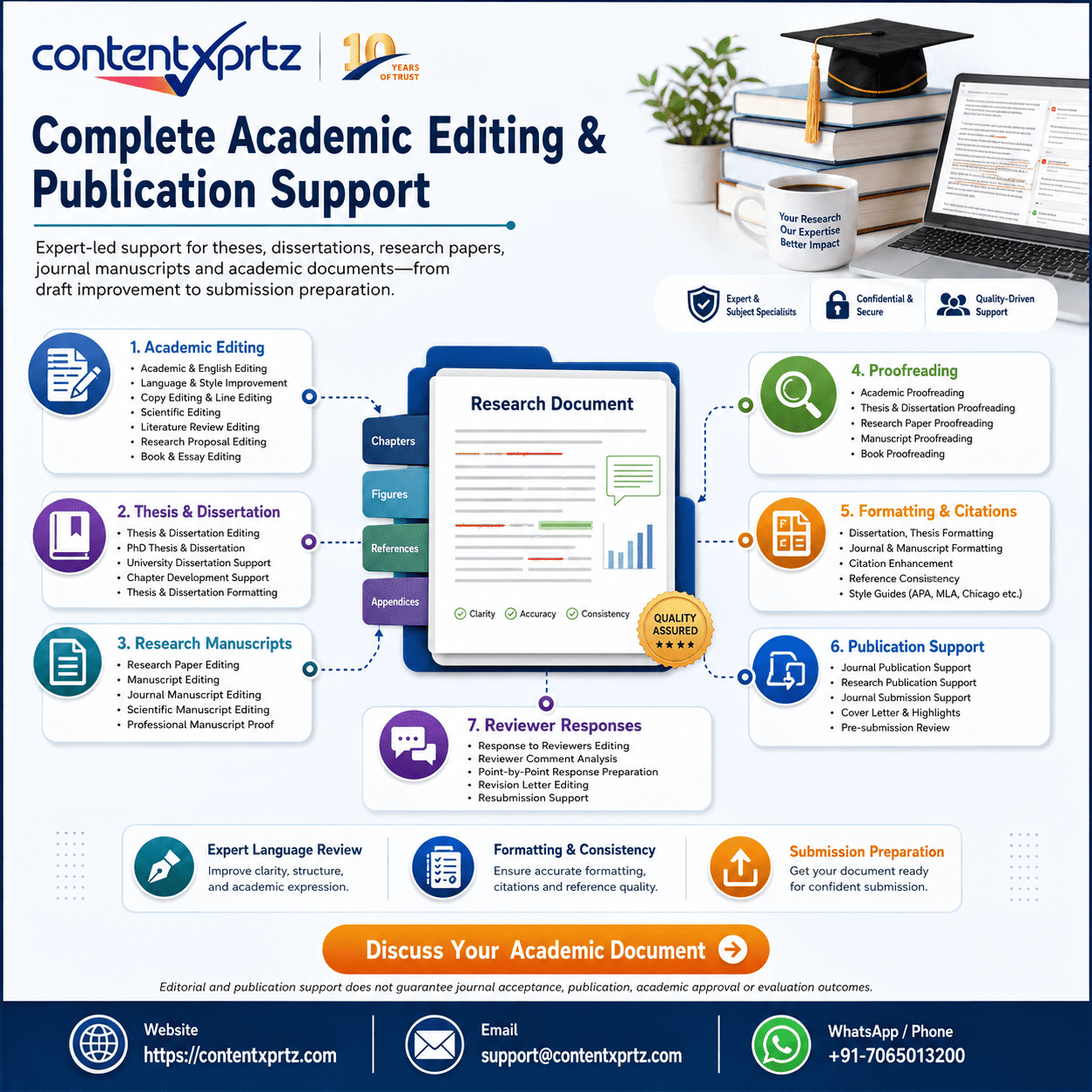
Contentxprtz can support writers who already have material and want a more systematic revision process. Depending on the draft, support may include structural comments, academic-language editing, proofreading, reference consistency checks, and formatting. The goal is to make the writer’s own ideas easier to follow while preserving authorship and responsibility.
For an essay that needs both language and structural review, the essay writing and editing service can be used as an expert-assisted revision layer. Writers who only need final language correction may prefer professional proofreading. If a document has broader academic-English problems, English editing services may be more suitable.
Contentxprtz does not need to be the first step for every student. Free writing resources, instructor feedback, and university support may be enough for many assignments. Professional help becomes more valuable when the draft is complex, high-stakes, or repeatedly difficult to revise independently.
Summary: Best Writing Essay Services
The best writing essay services are those that solve a defined writing problem without taking over the student’s academic role. Ethical options include tutoring, developmental feedback, copyediting, proofreading, citation checks, and formatting of an author-created draft.
Use free resources first when the problem is basic or educational. Choose professional editing when the draft needs deeper structural or language review, and insist on transparent changes. Check institutional rules, verify every citation, and keep control of the argument and final wording. A strong service should improve clarity, not conceal authorship.
Frequently Asked Questions
What are the best writing essay services for students?
The best writing essay services for students are services that strengthen a student’s own work rather than replace it. Look for support that clearly explains whether it provides tutoring, developmental feedback, editing, proofreading, citation checks, or formatting. A legitimate provider should be comfortable working from your draft, assignment brief, marking rubric, and required citation style while keeping you responsible for the argument, evidence, and final submission. It should also explain what it will not do, such as impersonating the student or producing an undisclosed assessed submission from scratch.
Quality matters as much as scope. A useful service should identify structural problems, unclear claims, weak transitions, grammar issues, inconsistent references, and formatting errors in a way you can review and understand. It should preserve your voice and avoid inventing references or evidence. Before ordering, check your university’s rules on third-party editing because permitted assistance differs across institutions and assessment types. For many students, the strongest option is ethical essay editing combined with written feedback and a final author review.
Is using an essay writing service academically ethical?
Using an essay support service can be academically ethical when the assistance is permitted, transparent where required, and does not replace the student’s authorship. Editing, proofreading, tutoring, feedback on structure, citation checking, and language support are commonly distinguishable from ghostwriting, but institutional rules vary. The critical question is who created the ideas, analysis, evidence selection, and final intellectual work.
A student should never assume that a commercial service is allowed simply because it describes itself as tutoring or editing. Read the assessment instructions and academic integrity policy, and ask the instructor when the boundary is unclear. TEQSA’s academic-integrity resources warn students about contract cheating and outsourcing assessed work, while university policies may define acceptable editing more narrowly or broadly. If professional help is used, keep your original drafts, tracked changes, editor comments, and sources. Then personally review every revision. Ethical support should make your writing clearer and more accurate without concealing outside authorship or substituting someone else’s work for your own.
What is the difference between essay editing, proofreading, tutoring, and ghostwriting?
Essay editing improves an existing draft at the sentence, paragraph, and sometimes structural level; proofreading focuses on final errors such as spelling, punctuation, formatting, and small consistency issues; tutoring teaches the writer how to plan, reason, revise, and apply feedback; ghostwriting creates work that is presented as if the student wrote it. Those differences matter because the first three forms of support may be permitted under some institutional rules, while undisclosed ghostwriting of assessed work is generally treated as a serious academic-integrity problem.
When comparing services, ask what the editor will actually change. Developmental editing may comment on thesis clarity, paragraph logic, evidence placement, and organisation. Copyediting may improve grammar, syntax, word choice, and consistency. Proofreading should happen after major revisions are complete. Tutoring should explain methods and leave the decisions to you. A trustworthy provider should describe these levels clearly and should not blur editing into authorship. If your institution limits third-party editing, choose a lighter service or request comments rather than direct rewriting.
Can a professional service improve my essay without changing my ideas?
Yes. A careful editor can improve clarity, organisation, grammar, transitions, citation presentation, and consistency while keeping your ideas intact. The safest workflow begins with your own draft and a clear instruction to preserve argument, evidence, terminology, and author voice. The editor can flag gaps, suggest clearer wording, mark unsupported leaps, and recommend where paragraphs need stronger topic sentences or transitions. You then decide which changes to accept.
This approach is especially useful for ESL writers, busy professionals returning to study, and students who understand their subject but struggle to present it in polished academic English. It is also useful when a draft contains strong ideas but inconsistent referencing or sentence-level errors. Editing should not invent data, create sources, add claims you cannot defend, or rewrite the essay so extensively that authorship becomes unclear. Ask for tracked changes or an annotated copy whenever possible. That gives you a visible record of the editing process and makes the final author review easier.
How do I choose a reliable essay editing service?
Choose a reliable essay editing service by evaluating scope, ethics, expertise, process, communication, and evidence of quality rather than choosing on price alone. Start by checking whether the provider clearly defines editing and proofreading levels, asks for your assignment requirements, supports the required citation style, and explains how revisions are handled. It should provide realistic turnaround information and avoid promises of guaranteed grades or guaranteed academic outcomes.
Next, check whether you can request subject-aware support when the essay uses specialised terminology. Ask whether the editor works with tracked changes, comments, or a revision summary. Confirm privacy practices before uploading personal or unpublished material. Most importantly, ask how the service protects student authorship. A good answer should focus on improving your draft rather than producing an assessed answer for you. You can also compare the service with free resources such as Purdue OWL or your university writing centre. If you mainly need grammar correction, a lighter service may be enough; if you need structural feedback plus language editing, a more comprehensive review is usually more appropriate.
How much do professional essay services cost?
Professional essay-support costs vary because the work can range from a light proofread to intensive structural editing. Price is usually affected by word count, turnaround time, subject complexity, English-language level, citation requirements, and how much intervention the draft needs. A short, well-structured essay needing final proofreading should cost less than a long postgraduate paper requiring developmental comments, copyediting, reference checks, and multiple rounds of revision.
Do not compare providers only by the lowest quoted price. First make sure you are comparing the same service level. One provider may quote for proofreading while another includes structural review and comments. Ask for a written scope so you know whether formatting, references, tables, tracked changes, or a second check are included. Extremely vague fixed-price offers can make it difficult to know what you are buying. If budget is tight, use free writing-centre or library support for planning and citations, revise the draft yourself, and purchase professional editing only for the sections where specialist review will add the most value.
Are free essay writing tools enough for university work?
Free tools can be enough for early-stage support, basic grammar checks, citation reminders, outlining practice, and self-editing, but they do not replace academic judgment. Purdue OWL, university writing centres, library guides, citation resources, and word-processing tools can solve many common problems at no cost. They are especially useful when your argument is already clear and you mainly need to verify style, grammar, or reference conventions.
Their limits appear when a draft has deeper problems with reasoning, structure, discipline-specific tone, source synthesis, or unclear argumentation. Automated suggestions can also be wrong or unsuitable in context, and citation generators may produce incomplete metadata. If you use AI-enabled tools, verify every change and every reference. For a high-stakes essay, dissertation chapter, scholarship statement, or publication-oriented manuscript, a human editor can identify relationships across paragraphs that a simple checker may miss. The right choice depends on the complexity of the problem, your deadline, your institution’s rules, and whether you can confidently evaluate the suggested revisions yourself.
Can an essay service check citations and references?
Yes, an essay editing service can check citation and reference consistency, but the exact scope should be agreed before work begins. A useful citation check may compare in-text citations with the reference list, flag missing entries, identify inconsistent author names or years, standardise punctuation and ordering, and apply the required APA, MLA, Chicago, Harvard, Vancouver, or institution-specific format. It can also flag references that appear incomplete so the author can verify them.
However, an editor should not fabricate missing publication details or claim to have verified a source that was not actually checked. The student remains responsible for ensuring that sources are genuine, accurately represented, and appropriate for the claim. When possible, provide DOI details, publisher pages, PDFs, or a reference-manager export. Use authoritative style resources such as the MLA Style Center or the official guidance specified by your university or journal. Citation editing is most effective after the main argument and source set are stable, because major content revisions can create new citation mismatches.
What should I send to an essay editor for the best result?
Send the editor your latest complete draft, assignment brief, marking rubric if available, word limit, required citation style, deadline, and any specific concerns from your instructor. If there are sections the editor must not change, identify them. If your institution has an editing policy, include that too. These materials let the editor judge the essay against the actual task rather than applying generic writing preferences.
Also explain the level of help you want: comments only, structural feedback, line editing, proofreading, citation review, or a combination. If your essay uses specialised terms, provide a glossary or key sources so the editor does not accidentally simplify necessary terminology. Remove unnecessary personal information before uploading documents. After the edited file is returned, review every suggested change, check quotations and citations against the sources, and read the essay aloud or on a different screen. The final submission should remain something you understand, can explain, and are prepared to defend as your own work.
When should I choose Contentxprtz for essay editing support?
Contentxprtz may be useful when you already have a draft and need structured, ethical help with clarity, academic tone, grammar, organisation, citation consistency, or final proofreading. It can also be useful for postgraduate and professional writers who need a second set of expert eyes before submitting a high-stakes academic document. The most suitable service depends on whether the draft needs developmental feedback, sentence-level editing, a final proofread, or a combination.
The service should be treated as a support layer, not a replacement for your own academic work. You should provide the assignment requirements, keep control of your ideas and evidence, and review every edit before submission. If you only need a few grammar checks, free self-editing resources may be sufficient. If the essay has recurring language problems, unclear paragraph logic, or inconsistent citations, professional editing can save time and make the revision process more systematic. Contentxprtz’s essay writing and editing service is best used to improve an author-created draft while preserving academic integrity and author responsibility.
Conclusion: Choose Support That Strengthens Your Own Writing
Students usually search for essay services because something in the writing process feels difficult: planning, structure, academic English, citations, time pressure, or final accuracy. The practical solution is to identify that problem precisely and choose the lightest level of support that solves it.
Free or self-service support may be enough for early planning, basic grammar, and routine citation questions. Professional editing becomes more useful when a high-stakes draft needs systematic structural feedback, advanced language editing, detailed proofreading, or reference consistency checks. In both cases, academic integrity depends on keeping the ideas, evidence, decisions, and final submission under the author’s control.
Contentxprtz can help improve clarity, structure, language, citation consistency, and submission readiness through ethical editorial support. “At Contentxprtz, we don’t just edit; we help ideas reach their fullest potential.”