Dissertation Project: A Practical Planning, Research and Writing Guide
A dissertation project becomes manageable when you stop treating it as one enormous document and start treating it as a sequence of connected research decisions. The student who tries to “write a dissertation” from a blank page often gets stuck. The student who defines a feasible question, maps the literature, chooses a defensible method, secures any required ethics approval, schedules the research, records decisions, analyses evidence, and revises chapter by chapter has a much clearer path. That distinction matters whether you are completing an undergraduate dissertation, a master’s research project, a professional capstone, or a doctoral-level study with a larger scope.
The practical difficulty is that every decision constrains the next one. A broad topic creates an unmanageable literature search. A vague question makes methodology difficult to justify. A method that depends on inaccessible participants or data can derail the timeline. Late ethics planning can prevent data collection from starting. Weak source management creates citation problems near submission. And if writing begins only after research is “finished,” there may be too little time to refine the argument, improve academic style, check references, and respond to supervisor feedback.
A strong dissertation therefore needs both research planning and writing discipline. You need a question that can actually be answered, a literature review that synthesizes rather than lists sources, a methodology aligned with the question, a realistic schedule with contingency, and a clear record of what you did and why. You also need to understand the boundaries of permitted support. Universities differ in their rules for proofreading, academic editing, generative AI, data handling, and research ethics. The safest approach is to check your programme handbook and supervisor guidance early, then document any approvals or assistance that may need to be disclosed.
This guide takes a people-first approach to dissertation planning. It explains how to move from topic to research question, proposal, literature review, methodology, ethics, data or source analysis, chapter drafting, editing, and final submission checks. It also shows when self-service tools and supervisor feedback may be enough, and when ethical dissertation support or academic editing may be useful for clarity and presentation without taking over the author’s academic responsibility.
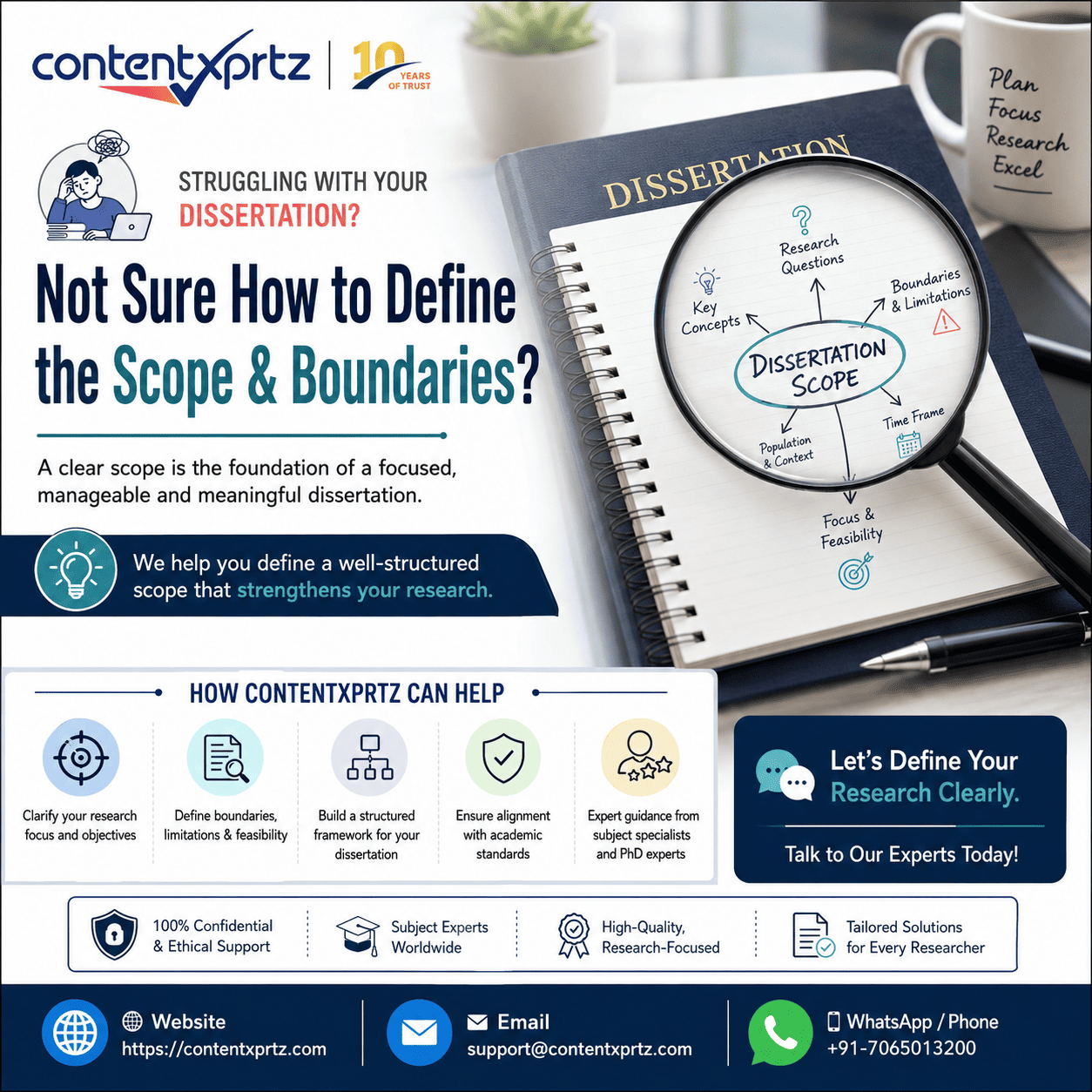
Quick Answer: How Do You Plan a Dissertation Project?
A dissertation project is an independent academic research task built around a focused problem or question. The practical sequence is to check your programme requirements, narrow the topic, define the research question and objectives, review relevant literature, choose a method that can answer the question, secure any required ethics approval, plan the work backward from the deadline, collect or analyse evidence, draft chapters, revise the argument, and complete final language, reference, formatting, and submission checks.
The strongest projects show alignment. Your literature review should establish the context for the question; your methodology should generate or organise evidence that can answer it; your analysis should address the objectives; and your conclusion should respond to the same central problem rather than introducing a new one. If any stage no longer fits, revise the plan explicitly instead of forcing the original proposal onto the work.
Use your university handbook, assessment rubric, supervisor feedback, and current research-ethics guidance as the controlling sources. External writing or editing support can help with clarity, structure, language, and consistency only within the boundaries permitted by your institution. The author remains responsible for the research, evidence, analysis, citations, and final submission.
Key Takeaways
- Start with feasibility, not ambition: a focused, answerable question usually produces a stronger dissertation than a broad topic with no clear boundaries.
- Make every section serve the question: literature, methods, analysis, and conclusions should form one connected line of reasoning.
- Plan research and writing together: draft notes, synthesis, method rationales, and chapter skeletons while the project develops.
- Check ethics and data rules early: approval, consent, privacy, storage, and participant protections can affect the whole schedule.
- Build a citation trail: keep source details, search records, notes, and reference-manager entries accurate from the beginning.
- Protect revision time: a complete draft is a milestone, not the finish line; argument, language, tables, references, and formatting still need review.
- Use support ethically: supervisors, librarians, writing centres, approved tools, and professional editors should strengthen your work without replacing author responsibility.
What This Page Covers
- What a dissertation project means and how it differs from an ordinary long essay.
- How to narrow a topic into a feasible research question, aims, objectives, and proposal.
- How to plan a literature review, methodology, ethics process, data or source analysis, and timeline.
- How to prevent common scope, citation, structure, drafting, and project-management mistakes.
- How to use free, university-based, and professional academic support responsibly.
- Practical mini cases for undergraduate, master’s, ESL, and data-based dissertation situations.
- A final project checklist and ten detailed questions students commonly ask before submission.
Table of Contents
- What a dissertation project means
- Why planning and alignment matter
- Step-by-step dissertation workflow
- Research question, aims, and literature review
- Methodology, ethics, and evidence management
- Timeline, drafting, and revision
- Common dissertation mistakes
- Practical examples
- Dissertation project checklist
- Frequently asked questions
Methodology and Academic Sources
This guide is based on common dissertation planning, academic writing, research-integrity, and editing workflows. Because dissertation formats differ by discipline and institution, the first authority for any student is the current course handbook, assessment brief, ethics rules, data requirements, and supervisor or programme guidance.
The University of Edinburgh guidance on dissertations and research projects emphasises that research projects vary by disciplinary context and that students should consult programme information and supervisors. Its literature review guidance explains the importance of critical evaluation rather than simple reporting. For ethics, students should follow their own institution’s process; the University of Cambridge research ethics guidance is one example of how participant welfare, informed participation, privacy, and supervisor consultation are treated. The UK Research Integrity Office researcher checklist offers a broader good-practice framework.
These external resources support general principles, not a substitute set of rules for every student. Requirements for thesis editing, generative AI, participant recruitment, data retention, word count, chapter order, referencing, and allowed assistance can differ substantially. Contentxprtz support should therefore be used alongside—not instead of—the policies that govern the student’s actual assessment.
What a Dissertation Project Means in Academic Context
A dissertation project is a structured investigation that demonstrates your ability to define a problem, work with evidence, make justified methodological choices, and communicate a sustained academic argument. The final document matters, but the assessed learning usually includes the reasoning that produced it.
Most projects contain the same underlying logic even when chapter names differ. There is a problem or question; a body of previous scholarship that establishes context; a method or analytical framework; evidence, data, texts, cases, or sources; an analysis or interpretation; and a conclusion that states what the project can reasonably claim. A good dissertation makes these connections visible.
Topic, problem, question, aim, and objectives are not the same
Your topic is the broad subject area. The research problem is the specific uncertainty, debate, gap, practical issue, contradiction, or interpretive challenge within that topic. The research question turns that problem into something answerable. The aim states the overall purpose, while objectives break the work into achievable tasks.
For example, “remote work and employee wellbeing” is a topic. A question such as “How do early-career employees in hybrid technology firms describe the effect of manager communication on perceived work isolation?” is narrower and begins to imply a population, context, concept, and possible qualitative design. The final wording still needs supervisor review, feasibility testing, and literature support, but it gives the project direction.
The dissertation is an argument, not a storage place for everything you found
Students often collect more literature, data, notes, quotations, and tables than the final dissertation can use. Selection is part of scholarship. Include material because it helps define the problem, justify a decision, support an interpretation, challenge a claim, or explain a limitation—not simply because you spent time finding it.
Why Planning and Alignment Matter in a Dissertation Project
Planning matters because dissertation problems are often cascading problems. One weak early decision creates several later difficulties. If the question is too broad, the literature review expands uncontrollably. If objectives do not match the question, the methodology becomes hard to justify. If data collection produces information unrelated to the question, analysis becomes descriptive. If the conclusion answers a different question from the introduction, the dissertation feels fragmented.
A useful alignment test is to place five statements next to one another: research question, objectives, evidence needed, method, and planned analysis. Each should explain the next. If you cannot see the connection, revise before investing more time.
Build a decision log
Keep a simple research log recording major decisions, supervisor feedback, changes to the question, search terms, inclusion choices, data-cleaning decisions, coding changes, software versions where relevant, ethics correspondence, and reasons for excluding material. This is not administrative clutter. It protects you from forgetting why a decision was made and helps you write the methodology and limitations sections accurately.
Use the marking criteria as a design constraint
Before drafting, translate the rubric into questions: What counts as critical analysis? How is methodology assessed? Is originality expected in the question, data, synthesis, application, or interpretation? How important are presentation and referencing? What evidence demonstrates independent research? A dissertation should not be written for the rubric mechanically, but ignoring assessment criteria can leave strong research poorly communicated.
Free, Low-Cost, and Professional Dissertation Support Options
Most dissertation projects use a combination of support sources. The goal is not to find one service that does everything; it is to use the right support for the right problem while keeping academic responsibility with the student.
| Support option | Best use | Strength | Important boundary |
|---|---|---|---|
| Supervisor | Question, feasibility, method, interpretation, programme expectations | Knows the academic context and assessment environment | Feedback availability and turnaround may be limited |
| University library | Database searching, source access, reference tools | Discipline-relevant resources and librarian expertise | You still evaluate and interpret the sources |
| Writing centre or study-skills team | Planning, academic style, argument, study workflow | Usually aligned with institutional policy | May focus on coaching rather than document-level editing |
| Peer feedback | Reader clarity, presentation, practice explanations | Free and useful for detecting unclear assumptions | Peers may not know the method or policy requirements |
| Reference manager | Source organisation and citation workflow | Saves time and improves consistency | Imported metadata must be checked manually |
| Professional academic editor | Clarity, consistency, academic language, final readability | Detailed document-level review | Must remain within university rules and preserve authorship |
Use university resources first for policy, assessment, ethics, and subject expectations. If language or presentation remains a problem, academic proofreading or editing may be considered after checking the permitted level of assistance.
When Self-Service Support Is Enough and When Expert Editing Is Safer
Self-service support is usually enough when your research design is settled, the argument is coherent, the language is clear, references are under control, and you mainly need routine checks. Spellcheckers, reference managers, formatting templates, university writing resources, and careful peer reading can handle many final-stage tasks.
Expert support becomes more useful when the same problems recur across chapters: sentences obscure the argument, terminology changes, paragraphs do not develop logically, a literature review reads like a list, tables and narrative conflict, references are inconsistent, or supervisor feedback repeatedly mentions clarity and flow. An ESL researcher may also want sentence-level language editing that preserves technical meaning.
Choose support by the problem. If the research question is still unstable, editing the prose will not fix the design. If the analysis is complete but the text is hard to follow, editing may help. If the document is already polished and only surface errors remain, proofreading is more proportionate. Where deeper guidance is needed, research support can be useful for workflow and clarity, but the student should remain the decision-maker.
Dissertation Project Step by Step: From Topic to Submission
1. Read the assignment rules before narrowing the topic
Record the deadline, word limit, required sections, approved research types, formatting rules, assessment criteria, ethics process, supervision arrangements, data requirements, and permitted use of editing or AI tools. These rules define what “good” means in your context.
2. Turn an area of interest into a research problem
Read enough recent and foundational work to learn the vocabulary of the field. Look for disagreements, under-examined contexts, practical problems, theoretical tensions, methodological limitations, new datasets, changed policy environments, or cases that allow meaningful comparison.
3. Draft and test the research question
Write several versions. Test each for clarity, scope, evidence access, analytical depth, ethical feasibility, and fit with the available time. Avoid questions that are so broad they could support a book, or so narrow that no meaningful analysis is possible.
4. Define the aim and objectives
The aim should state the overall purpose. Objectives should be specific actions such as reviewing a defined evidence base, comparing cases, collecting a particular type of data, analysing a dataset, interpreting texts through a framework, or evaluating a relationship. Each objective should contribute to the central question.
5. Build the proposal as an alignment document
Use the proposal to explain the problem, literature context, question, objectives, method, ethics, analysis, schedule, and limitations. Identify dependencies: access permissions, participant recruitment, equipment, software, translation, archives, licences, or datasets. Include a contingency plan for the most fragile dependency.
6. Create a literature search and note system
Search with concept groups rather than one long sentence. Save bibliographic details immediately. Record what each source contributes, the quality or limitations of its evidence, how it relates to other studies, and where it may appear in your argument. Separate copied quotations from your own notes to reduce accidental citation problems.
7. Finalise methodology and obtain required approval
Explain why the design can answer the question. Specify participants, texts, cases, data, instruments, procedures, variables, coding, analytical framework, or interpretive method as relevant. Address ethics and data management before the activity requiring approval begins.
8. Plan analysis before collecting data where possible
You should know what form of evidence will count as an answer. A pre-specified analysis plan reduces the risk of collecting information that later proves unusable. Qualitative projects can define coding or interpretive principles; quantitative projects can define variables, tests, assumptions, and missing-data decisions; humanities projects can define corpus or archive selection and interpretive criteria.
9. Draft while you research
Write the methodology while decisions are fresh. Build literature sections as thematic syntheses. Draft figure captions and table notes when creating them. Maintain a running limitations list. These small drafts reduce the pressure of assembling everything at the end.
10. Complete a full draft before the final deadline
A full draft lets you evaluate the dissertation as a whole. Check whether the introduction promises what the chapters deliver, whether evidence supports claims, whether discussion goes beyond description, and whether the conclusion actually answers the research question.
11. Revise in passes
Do not edit everything at once. First revise argument and structure, then paragraph logic, then sentence clarity, then references, then tables and figures, then formatting and proofreading. This prevents time being wasted polishing text that later gets deleted.
12. Perform technical submission checks
Verify the required file format, title page, declaration, word count, page numbering, headings, tables, figure resolution, appendices, reference list, anonymisation, naming convention, and submission portal requirements. Open the final uploaded file and check that it renders correctly.
Research Question, Aims, Literature Review, and Source Strategy
The research question is the steering mechanism of a dissertation. It should tell you what evidence to seek and what kind of answer would count as a contribution. Good questions often specify a relationship, experience, process, comparison, interpretation, mechanism, case, population, context, or time frame.
Use a scope test before finalising the question
- Can the key concepts be defined?
- Is the unit of analysis clear?
- Can the evidence be accessed ethically and legally?
- Can the method produce evidence relevant to the wording of the question?
- Can the project be completed and revised before the deadline?
- Would a reasonable reader understand what is outside the scope?
Write the literature review as synthesis
A literature review should establish what scholars know, how they know it, where findings or interpretations differ, and why your project is justified. Group sources by meaningful analytical categories instead of producing one paragraph per author. Compare assumptions, samples, methods, theoretical lenses, contexts, or conclusions. Use review sentences that make relationships explicit: one group of studies finds a pattern; another reports a different result in a different population; methodological limitations may explain the disagreement; your project addresses a defined part of that unresolved issue.
Build an evidence matrix
Create a table in your notes with columns for citation, research question, context, data or corpus, method, key finding, limitation, relevance to your project, and possible chapter use. The matrix helps prevent repeated reading and makes thematic synthesis easier. Do not copy a source’s abstract as your note; write what the source contributes to your own research problem.
If the review or argument needs deeper language refinement after the research is complete, academic writing support can help you see structural and communication issues, provided the final reasoning and claims remain yours.
Methodology, Research Ethics, Data, and Evidence Management
Your methodology section should make the research process understandable and defensible. A reader should see why the chosen approach fits the question, how evidence was selected or generated, what analysis was conducted, what limitations matter, and what ethical controls were used.
Separate methodology from methods
Methodology explains the logic and assumptions behind the approach. Methods are the concrete procedures. A qualitative methodology might justify an interpretive approach, while methods specify semi-structured interviews and thematic analysis. A quantitative methodology may justify measurement and comparison, while methods specify sampling, variables, instruments, and statistical tests. In humanities research, methodology may explain archival selection, textual interpretation, comparative method, critical theory, or historiographic approach.
Plan ethics as part of design, not paperwork at the end
Identify risks before recruitment or data collection. Consider informed participation, voluntariness, privacy, anonymity or confidentiality, sensitive topics, vulnerable groups, incentives, power relationships, data security, retention, and reporting. Even projects using secondary data can raise licensing, privacy, or re-identification issues. Your institution’s rules control whether formal approval is required.
Protect the research record
Use clear file names, version control, secure backups, a data dictionary for quantitative variables where relevant, coding notes for qualitative projects, and a record of exclusions or transformations. Keep raw evidence separate from cleaned or derived files. Never alter source material merely to make it fit the expected result.
Plan for limitations before they become surprises
Every design has boundaries. A small sample affects generalisability; a convenience sample affects selection; self-report data may include recall or social-desirability bias; archival evidence may be incomplete; translation choices may affect interpretation; observational data may not establish causality. Limitations do not automatically invalidate a dissertation. The important skill is to state them accurately and avoid claims that exceed the evidence.
Timeline, Drafting, Editing, and Publication-Readiness Thinking
A dissertation timeline should be built backward from submission and include time for rework. The most common planning error is allocating time to research activities but almost none to integration, revision, reference checking, formatting, and upload problems.
| Stage | Main output | Risk to watch | Planning response |
|---|---|---|---|
| Scope and proposal | Question, aims, plan, provisional sources | Question too broad | Use feasibility tests and supervisor feedback |
| Literature review | Search record, evidence matrix, thematic synthesis | Endless reading | Define relevance criteria and a review cut-off |
| Method and ethics | Final design and required approval | Approval or access delay | Start early and create a fallback design if permitted |
| Data or source work | Organised evidence and research log | Missing, noisy, or inaccessible evidence | Check quality continuously, not only at the end |
| Analysis | Findings, themes, models, interpretations | Description without argument | Link every result back to the question and literature |
| Full draft | Complete document | Chapters do not connect | Run an alignment review before sentence-level editing |
| Revision | Improved argument, clarity, citations, presentation | Polishing too late | Reserve protected time for multiple passes |
| Submission | Final compliant file | Formatting or upload failure | Submit before the last possible minute and verify the file |
Draft by function, not only by chapter order
You do not always need to write Chapter 1 first. Method sections can be drafted while the design is current. Literature synthesis can be drafted after thematic reading. Results tables can be prepared before the discussion. The introduction often improves after the analysis because you then know precisely what the dissertation delivers.
Edit from large decisions to small decisions
First ask whether the argument is logically ordered. Then check whether each chapter has a clear purpose. Then test paragraph logic, evidence, and transitions. Only after those levels are stable should you focus on grammar, punctuation, repetition, and formatting. If sentence-level language is a barrier, ethical professional editing for researchers can improve clarity without changing the underlying research decisions.
Ethical Academic Editing, AI Use, and Author Responsibility
External support is ethical when it is transparent where required, permitted by the institution, and limited to support that does not replace the student’s assessed intellectual work. The author should control the research question, design, evidence, analysis, interpretation, claims, and final decisions.
Editing can improve clarity, grammar, transitions, consistency, terminology, and readability. Proofreading can remove surface errors. Coaching can help a student understand how to revise a weak structure. What support should not do is invent results, fabricate references, write analysis that the student cannot defend, conceal prohibited assistance, or change the meaning of evidence.
Generative AI requires the same policy-first approach. University rules can differ by module and may change. Before using an AI system, check whether the use is allowed, what disclosure is required, and whether the tool can receive the type of information you plan to enter. Never upload confidential participant data, restricted research material, or unpublished information into a service when your policy or data agreement prohibits it. Verify every claim and reference independently. For broader integrity-focused support, Contentxprtz also provides AI and academic integrity guidance centred on responsible authorship.
Common Dissertation Project Mistakes to Avoid
- Choosing a topic instead of a question. “Artificial intelligence in education” is a field, not yet a research design.
- Expanding the project after every interesting paper. New ideas should be tested against scope and objectives before being added.
- Writing a literature catalogue. A dissertation needs synthesis, evaluation, and a clear relationship between previous work and your question.
- Selecting methods before defining the evidence need. The method must answer the question, not simply demonstrate that you can use a tool.
- Leaving ethics until recruitment begins. Approval or departmental review may be required before collecting data.
- Failing to record search and analysis decisions. Memory is unreliable over a long project; maintain a decision log.
- Collecting more data than you can analyse well. A smaller, coherent dataset may produce better analysis than an ambitious but poorly processed one.
- Using citations as decoration. Every citation should support a specific claim, context, method, definition, or scholarly relationship.
- Editing only at sentence level. A grammatically clean dissertation can still have a weak argument if chapter structure and alignment are not revised first.
- Finishing the first complete draft too close to the deadline. Full-draft review often reveals inconsistencies that are invisible chapter by chapter.
Practical Examples: Four Dissertation Project Situations
Example 1: A master’s student with a topic that is too broad
Situation: The student wants to research “social media and mental health among young people.” The literature is enormous and the proposal contains six unrelated objectives. Common mistake: adding more variables to make the project feel substantial. Better approach: define one population, platform or behaviour, outcome, context, and time frame, then choose a method capable of addressing the refined question. Ethical expert guidance: a supervisor or research mentor can help test feasibility; an editor can later improve how the rationale and scope are communicated but should not invent the research question on the student’s behalf.
Example 2: A PhD scholar whose literature review is descriptive
Situation: The chapter contains accurate summaries of many papers but no clear scholarly conversation. Common mistake: organising one paragraph per author. Better approach: create themes around competing explanations, methods, contexts, or findings; compare sources within each theme; and end sections by showing what the synthesis means for the thesis problem. Ethical expert guidance: academic editing can flag repetitive summary, weak transitions, and unclear topic sentences, while the scholar remains responsible for interpretation and source selection.
Example 3: An undergraduate project involving interviews
Situation: The student has prepared interview questions and wants to begin recruiting immediately. Common mistake: treating ethics as a form that can be completed after interviews. Better approach: check the department’s ethics process, consent requirements, data-storage rules, recruitment language, participant risks, and whether supervisor or committee approval is required before data collection. Ethical expert guidance: institutional ethics staff and the supervisor are the correct authority; external services should not claim to replace formal approval.
Example 4: An ESL researcher with a complete but difficult-to-read draft
Situation: The research design and analysis are strong, but long sentences, inconsistent terminology, and paragraph flow make the argument hard to follow. Common mistake: using automated rewriting that changes technical meaning. Better approach: revise structure first, then use language editing focused on clarity, grammar, terminology, and transitions while checking every change against the intended meaning. Ethical expert guidance: a professional editor can support readability if the university permits it and the author approves the final wording.
Dissertation Project and Submission-Readiness Checklist
Question and scope
- The research question is specific, feasible, and consistent with the programme brief.
- The aim and objectives clearly contribute to answering the question.
- The boundaries of population, case, dataset, text, context, or time period are explicit.
- The project can be completed with available access, resources, skills, and time.
Literature and sources
- Search terms, databases, and important search dates are recorded.
- The literature review synthesizes themes, debates, methods, and gaps rather than listing studies.
- Claims are traceable to authentic sources.
- Reference-manager metadata and final citations have been checked.
Methodology and ethics
- The methodology is justified in relation to the research question.
- Sampling, source selection, instruments, procedures, or analytical framework are explained.
- Required ethics or departmental approval was obtained before relevant research activity began.
- Data storage, confidentiality, consent, licensing, and retention requirements are addressed where relevant.
Analysis and argument
- The analysis does more than describe the evidence.
- Results or interpretations are connected to the research question and literature.
- Limitations are stated accurately without making the project sound stronger or weaker than the evidence supports.
- The conclusion answers the question and does not introduce unsupported new claims.
Writing and submission
- Chapter purposes are clear and transitions show how the argument develops.
- Terminology, abbreviations, tables, figures, headings, and formatting are consistent.
- The allowed level of editing or AI assistance has been checked and documented if required.
- The final file has been proofread, opened after export, and checked against submission instructions.
How Contentxprtz Can Help With a Dissertation Project
Contentxprtz supports students and researchers who need ethical help improving the communication and readiness of dissertation work. The most appropriate service depends on the stage of the project. Early-stage researchers may need guidance on structure, literature-review organisation, or how to turn supervisor feedback into a revision plan. Later-stage authors may need academic editing for clarity, consistency, and flow. Near submission, proofreading and formatting checks can help remove surface errors.
Support should remain proportional. Contentxprtz does not replace the student’s responsibility for the question, research design, evidence, analysis, citations, or institutional compliance. Before using any external service, check the editing and assistance rules that apply to your course. If support is permitted and your draft needs structured language or presentation help, explore dissertation writing and editing services focused on helping you revise your own academic work more clearly.
Summary: Dissertation Project Planning and Writing
A strong dissertation project is a chain of aligned decisions. Start with the programme rules and a feasible research problem. Turn that problem into a focused question, define the aim and objectives, and use the literature review to establish scholarly context. Choose a methodology because it can answer the question, not because the method is fashionable or familiar. Address ethics and data requirements before relevant research activity begins. Maintain a research log, source system, and realistic timeline with room for delays.
Draft throughout the project and revise from large issues to small ones: argument, chapter structure, paragraph logic, evidence, citations, sentence clarity, formatting, and final proofreading. Free university resources and supervisor guidance should be central. Professional support can be useful when language, flow, organisation, or document-level consistency remains weak, but it should preserve academic integrity and author ownership. The final dissertation should be work you understand, can defend, and can explain decision by decision.
Frequently Asked Questions
What is a dissertation project?
A dissertation project is an extended, independently managed academic investigation in which you define a focused question, engage critically with relevant literature, choose an appropriate method or analytical approach, produce an evidence-based argument, and present the work in the format required by your programme. The exact form varies by discipline. A laboratory dissertation may centre on experiments and data analysis, a social-science project may use interviews or surveys, a humanities dissertation may develop a sustained textual or archival argument, and a professional programme may use a work-based project. The important point is that a dissertation is not simply a long essay. It is a planned research process with connected decisions about scope, evidence, ethics, analysis, writing, and revision. Start by checking your handbook and assessment criteria, then discuss feasibility with your supervisor before committing to a narrow design. Keep a written record of your research question, aims, milestones, source-search strategy, methods, and approvals. That project record makes later writing more coherent because your chapters can show how each stage contributes to the same central question.
How do I choose a good topic for my dissertation project?
Choose a topic that is academically worthwhile, sufficiently focused, feasible with the time and resources available, and supported by accessible evidence or data. Interest matters because you will live with the subject for months, but interest alone is not enough. Begin with a broad area, map the main debates, and identify a problem, tension, gap, comparison, population, context, or case that can be investigated within your programme limits. Then test the topic by asking four questions: Can I state the problem in one or two sentences? Can I access the literature or data I need? Can the project be completed before the deadline, including ethics and revision time? Does the question match the methods and skills available to me? A common mistake is selecting an ambitious topic that sounds impressive but requires more participants, data, languages, archives, software, or field access than the student can realistically obtain. A supervisor can help you narrow the scope. Your final topic should be broad enough to matter but precise enough to guide decisions about reading, methods, analysis, and chapter structure.
What should a dissertation project proposal include?
A dissertation project proposal should explain what you plan to investigate, why the problem matters, what the existing literature indicates, how you will answer the question, what ethical or practical issues may arise, and how the work can be completed within the available time. Although university templates differ, a useful proposal usually includes a provisional title, background or rationale, research problem, research question, aims or objectives, a focused literature overview, proposed methodology and methods, sampling or source-selection logic where relevant, an analysis plan, ethics and data-management considerations, expected limitations, a timeline, and a working reference list. The proposal should show alignment rather than simply list components. For example, if your question asks how participants experience a process, your method must be capable of producing evidence about experience. If your project depends on restricted records, the proposal should explain access and contingency plans. Treat the proposal as a decision document, not a promise that nothing will change. Refinement is normal as your reading deepens, but major changes should be discussed with your supervisor and recorded so the final dissertation accurately reflects the research actually conducted.
How long should I spend planning before I start writing the dissertation?
Plan early, but do not wait for a perfect plan before you begin writing. Dissertation work is iterative: reading improves the question, writing exposes gaps in reasoning, methods reveal feasibility limits, and analysis may change the emphasis of later chapters. A useful approach is to create a backward schedule from the submission deadline and protect time for ethics, recruitment or data access, analysis, full-draft completion, supervisor feedback, editing, formatting, reference checking, and technical submission. Your first planning stage should be long enough to establish a workable question, provisional chapter map, source-search process, method, major risks, and milestones. After that, write continuously. Draft research notes, literature synthesis paragraphs, definitions, method rationales, and chapter skeletons while the project develops. Do not treat writing as the final stage after all research is complete. If your programme provides milestone dates, make those fixed anchors in the schedule. Add contingency for delayed responses, failed recruitment, software problems, inaccessible sources, or a slow ethics process. A realistic plan is one that includes revision time, not one that fills every week with new research activity.
How do I write the literature review for a dissertation project?
A dissertation literature review should synthesize and critically evaluate the scholarship that directly informs your research problem, rather than summarise one source after another. Start with concepts from the research question and build a reproducible search approach using relevant databases, library catalogues, citation tracing, and subject terminology. Record key search terms, dates, databases, inclusion choices, and important sources. As you read, organise evidence by themes, theories, methods, findings, debates, contradictions, or chronological developments rather than by author name alone. For each cluster, ask what is known, how it is known, where evidence agrees or conflicts, what limitations affect interpretation, and what remains unresolved. The literature review should eventually justify your own project: it should show why your question is appropriate and how your research design relates to previous work. Avoid presenting a vague claim that “no research exists” unless you can support it. A smaller, defensible gap may be a different population, setting, comparison, method, time period, dataset, or interpretation. Keep citations traceable to the original sources and follow the referencing style required by your institution.
How do I choose the right methodology for my dissertation?
Choose methodology by starting with the research question, not with a favourite tool. The methodology explains the reasoning behind how knowledge will be generated or interpreted; methods are the specific procedures used to collect or analyse material. If your question asks about measurable relationships, a quantitative design may be appropriate. If it asks about meanings, experiences, discourse, or context, qualitative approaches may be stronger. Mixed methods can be useful when the question genuinely requires complementary forms of evidence, but they also increase workload. In humanities disciplines, methodology may concern textual interpretation, archival method, historiography, comparative analysis, or theoretical framework rather than participant-based data collection. Your method must also be feasible, ethical, and analytically coherent. Explain sampling or source-selection decisions, instruments, procedures, variables or coding approaches, limitations, and how the analysis will answer the research question. Do not choose interviews, surveys, experiments, or software merely because they are common. Check programme requirements, discuss the design with your supervisor, and secure any required approval before collecting data. A clear justification is more valuable than unnecessary methodological complexity.
Do I need ethics approval for my dissertation project?
You may need formal ethics approval, and you should determine this before collecting data. Requirements vary by university, department, discipline, research design, participant group, type of personal data, and location. Projects involving interviews, surveys, observations, experiments, identifiable records, sensitive topics, vulnerable participants, clinical information, or personal data commonly require review or an explicit determination from the relevant institutional process. Some departments also require students to submit ethics documentation even for projects that appear low risk. Do not assume that a supervisor’s informal agreement automatically replaces a required committee or departmental approval. Read your institution’s current ethics guidance, complete the required forms, and allow time for revisions. Your plan should address informed consent where applicable, privacy, confidentiality, data storage, risk, withdrawal, recruitment, and how results will be reported. If the project changes materially after approval, check whether an amendment is required. The safest sequence is: define the method, identify ethical issues, obtain the required approval, and only then begin the activity covered by that approval.
Can I use AI tools for a dissertation project?
AI tools may be permitted for limited tasks in some programmes and restricted or prohibited in others, so the controlling rule is your university, department, module, and assessment guidance. Before using any generative AI system, check what uses are allowed, whether disclosure or citation is required, and whether confidential, personal, unpublished, or participant data may be entered into the tool. Even when a tool is permitted, treat its output as unverified. AI can produce inaccurate claims, invented references, oversimplified interpretations, biased summaries, or text that does not reflect your intended argument. You remain responsible for the research design, evidence, analysis, citations, and submitted work. A safer use pattern is to use approved tools for clearly bounded assistance such as brainstorming search terms, testing a chapter outline, or identifying sentences that need clearer wording, while independently verifying every substantive claim and source. Do not use AI to fabricate data, invent sources, conceal authorship, or bypass required learning outcomes. Keep a record of tool use if your institution requires transparency.
What is the difference between dissertation editing, proofreading, and writing support?
Dissertation editing, proofreading, and writing support address different problems. Proofreading is usually the final language-quality check for spelling, punctuation, grammar, typographical errors, formatting consistency, and small surface issues. Academic editing may go further by improving sentence clarity, coherence, transitions, repetition, terminology, consistency, and readability while preserving the author’s meaning and intellectual ownership. Writing support can include coaching on planning, argument structure, literature synthesis, research questions, chapter organisation, or how to revise your own draft. The acceptable boundary of external help depends on your university’s policy. Ethical support should not invent research, fabricate references, write assessed analysis on the student’s behalf, or make decisions the student is required to demonstrate independently. Before engaging professional help, check what your institution permits and what must be disclosed. If the project already has a full draft but the language and flow are weak, editing may be appropriate. If the reasoning or design is unresolved, developmental guidance may be more useful. If the text is essentially final, proofreading is usually the last step.
When should I get professional help with a dissertation project?
Professional help is most useful when it supports a problem you have already identified and stays within your institution’s rules. You may benefit from expert assistance when the project scope is unclear, the research question and method do not align, a literature review has become descriptive rather than analytical, an ESL draft is difficult to read, citations and references are inconsistent, chapter transitions are weak, or the final document needs careful editing before submission. Support can also be useful when supervisor feedback identifies recurring language or structural issues that you are struggling to resolve independently. However, external support should strengthen your own work rather than replace it. You should remain responsible for the question, research decisions, data, analysis, interpretation, arguments, citations, and final approval of every edit. Share your programme’s editing policy with any service provider and ask what level of intervention is proposed. Contentxprtz can provide ethical dissertation writing guidance, academic editing, and proofreading focused on clarity and presentation, but the scholar should make the substantive academic decisions and confirm that all assistance is permitted under the relevant university rules.
Conclusion: Turn the Dissertation Into a Manageable Research Process
The main challenge in a dissertation is rarely the word count by itself. It is the need to keep the question, literature, method, evidence, ethics, analysis, writing, and deadline aligned over a long period of independent work. When those parts are planned as a connected system, the project becomes easier to diagnose. You can see whether you need to narrow scope, strengthen literature synthesis, clarify methodology, improve analysis, or simply refine the writing.
Self-service support is often enough when the design is stable and the remaining work is routine. University libraries, writing centres, supervisors, reference tools, and careful proofreading can solve many problems. Expert-assisted editing becomes more useful when the research is yours but the draft needs substantial help with clarity, structure, consistency, or academic language. Any external help should stay within your institution’s rules and preserve your responsibility for the research and final submission.
If your dissertation draft is ready for structured academic review, Contentxprtz can support ethical revision through dissertation writing and editing services aligned to the stage and problem you actually need to solve. Your ideas, evidence, interpretation, and academic decisions remain yours.
“At Contentxprtz, we don’t just edit; we help ideas reach their fullest potential.”