Dissertation Meaning in Kannada: ಪ್ರೌಢ ಪ್ರಬಂಧ Explained
Dissertation meaning in Kannada is most usefully understood as ಪ್ರೌಢ ಪ್ರಬಂಧ (prauḍha prabandha), ವಿದ್ವತ್ಪ್ರಬಂಧ (vidvat-prabandha), or, in a clear research context, ಸಂಶೋಧನಾ ಪ್ರಬಂಧ (samshodhana prabandha). The simpler word ಪ್ರಬಂಧ (prabandha) can also mean an essay or structured composition, so it may be too broad when a university specifically means a long research document submitted for a degree. In everyday academic conversation, students may also use the transliterated word ಡಿಸರ್ಟೇಶನ್. The safest interpretation is therefore not to search for one perfect Kannada equivalent in isolation, but to connect the term with its academic function: a substantial, structured research document in which a student investigates a defined question, explains methods, analyses evidence, and presents conclusions.
This distinction matters because a dissertation is not simply a long college essay. A postgraduate or doctoral dissertation normally involves a research problem, a literature review, a defensible method, evidence or data, analysis, citations, and a conclusion linked to the original research question. Exact requirements differ across universities, disciplines, programmes, and countries. Some institutions use thesis for doctoral work and dissertation for master’s work; others use the terms in the opposite way or treat them as near-synonyms. A Kannada-speaking student should therefore read the official programme handbook before deciding that “dissertation,” “thesis,” ಪ್ರಬಂಧ, or ಸಂಶೋಧನಾ ಪ್ರಬಂಧ always refers to a fixed degree level.
Language adds another layer. A student may understand the research topic in Kannada but be required to submit in English, or may be permitted to write in Kannada while keeping technical terminology, titles, abstracts, or references in another language. Translating academic concepts word for word can create problems when a Kannada term is broader than the institution’s technical definition. The better approach is to preserve the research meaning first and choose terminology second. That means checking the university’s prescribed format, supervisor guidance, citation style, language policy, ethics rules, and any dissertation template before drafting.
This guide gives a practical explanation of the term, a Kannada-English terminology table, a dissertation structure, examples for postgraduate and PhD students, common mistakes, an academic-integrity checklist, and guidance on when self-editing is enough and when professional dissertation support may help. Contentxprtz can assist with ethical dissertation editing and academic support when a scholar needs help with clarity, structure, language, formatting, or proofreading while retaining responsibility for the research, arguments, data, citations, and final submission.
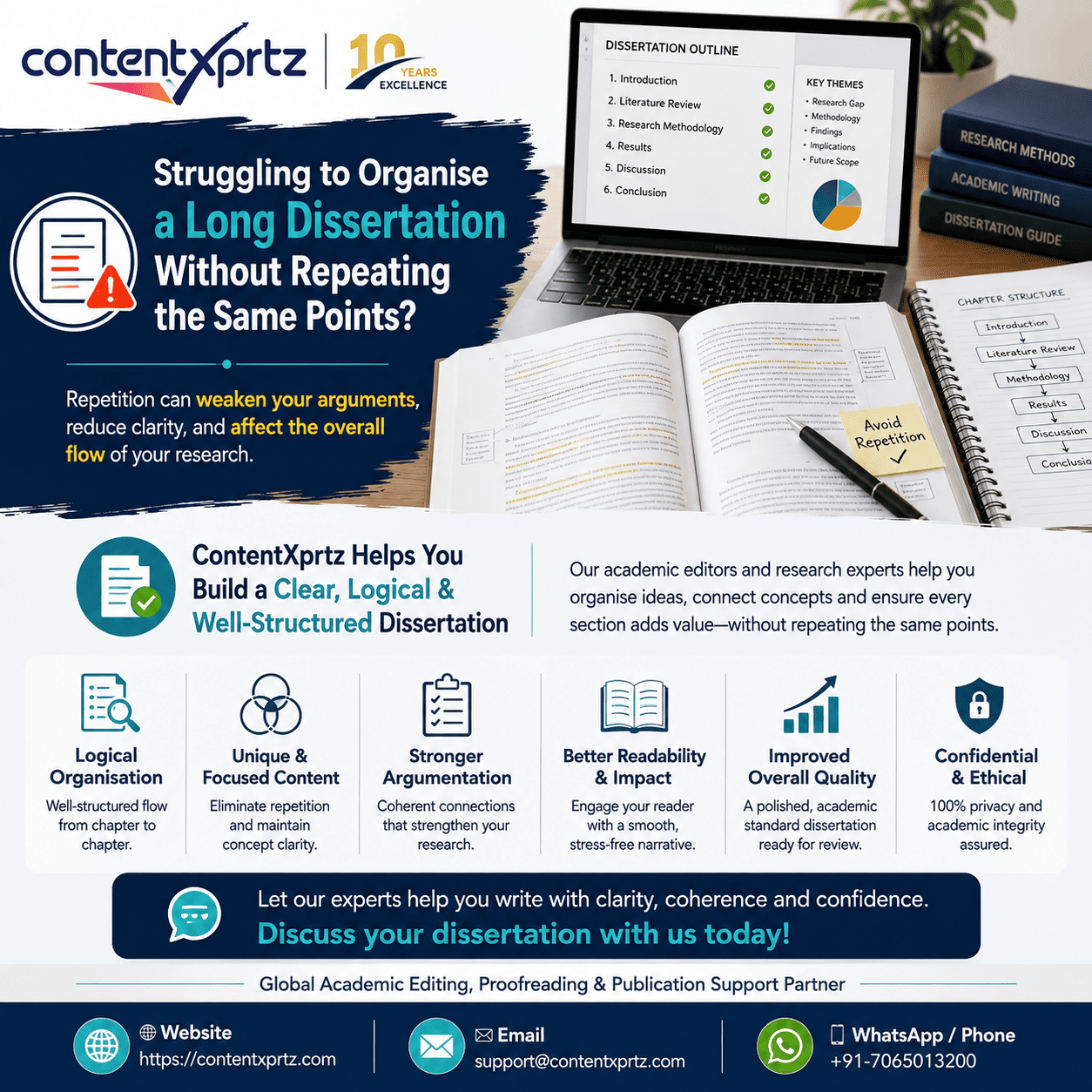
Quick Answer: What Is Dissertation Meaning in Kannada?
Dissertation can be translated in Kannada as ಪ್ರೌಢ ಪ್ರಬಂಧ or ವಿದ್ವತ್ಪ್ರಬಂಧ, while ಸಂಶೋಧನಾ ಪ್ರಬಂಧ is a clear descriptive expression meaning a research dissertation or research-based academic work. The broad word ಪ್ರಬಂಧ is also common, but it can refer to an essay or composition as well as a longer scholarly work.
In university use, a dissertation is usually a substantial document submitted as part of an advanced degree. It presents a defined research problem, relevant literature, a method, evidence or analysis, and conclusions. The exact degree level and required structure depend on the university and programme, so students should treat the institution’s handbook and supervisor instructions as authoritative.
If you need to explain the term to a Kannada-speaking student, a practical phrasing is: “Dissertation ಎಂದರೆ ನಿರ್ದಿಷ್ಟ ಸಂಶೋಧನಾ ವಿಷಯದ ಕುರಿತು ಸಾಕ್ಷ್ಯ, ವಿಧಾನ, ವಿಶ್ಲೇಷಣೆ ಮತ್ತು ತೀರ್ಮಾನಗಳನ್ನು ಒಳಗೊಂಡ ವಿಸ್ತೃತ ಶೈಕ್ಷಣಿಕ ಸಂಶೋಧನಾ ಪ್ರಬಂಧ.” In English, this means a detailed academic research document on a defined topic that includes evidence, method, analysis, and conclusions.
Key Takeaways
- ಪ್ರೌಢ ಪ್ರಬಂಧ, ವಿದ್ವತ್ಪ್ರಬಂಧ, and ಸಂಶೋಧನಾ ಪ್ರಬಂಧ can all communicate the idea of a dissertation in Kannada, but context determines the best choice.
- ಪ್ರಬಂಧ by itself is broader and can mean essay, composition, thesis, or dissertation, so university context should be made explicit.
- A dissertation is normally a structured research document, not simply a long essay or a collection of copied information.
- The distinction between thesis and dissertation is not universal; always follow the terminology used by the student’s own university.
- Core sections often include an introduction, literature review, methodology, findings or analysis, discussion, conclusion, and references, but discipline-specific formats differ.
- Academic integrity requires original research thinking, accurate citations, traceable sources, and honest representation of data and authorship.
- Professional editing can improve clarity, structure, language, and formatting, but the student remains responsible for the research and final academic claims.
What This Page Covers
- The most useful Kannada meanings of “dissertation” and how they differ in nuance
- The academic definition of a dissertation for postgraduate and doctoral students
- Dissertation versus thesis terminology in Indian and international university contexts
- A typical dissertation structure with Kannada academic terms
- A step-by-step process for interpreting a university dissertation requirement correctly
- Common translation, research, citation, and editing mistakes to avoid
- Practical examples, a submission checklist, FAQs, and ethical editing options
Table of Contents
Methodology and Academic Sources
This guide combines common Kannada academic terminology with established higher-education practice. For Indian students, the University Grants Commission academic-integrity regulations are important because they explicitly discuss thesis, dissertation, research work, originality, and plagiarism in higher education. Students should also read their own university regulations, since programme-specific requirements can be more detailed.
For practical dissertation planning and graduate writing, the Purdue Online Writing Lab thesis and dissertation resources provide a useful academic writing reference. Citation presentation should follow the exact style required by the institution or discipline; students using APA can consult the official APA Style reference guidance. Researchers preparing work for later publication should also understand authorship and reporting responsibilities, such as those described in the ICMJE recommendations for scholarly work where relevant to the discipline.
These sources do not create a single universal definition of “dissertation” for every programme. Instead, they support the broader principles used in this article: research work should be original, traceable, accurately cited, responsibly authored, and prepared according to institutional requirements. Contentxprtz can support ethical academic editing services, but the university handbook and supervisor remain the first sources for programme-specific rules.
Dissertation Meaning in Kannada in an Academic Context
The most accurate Kannada explanation depends on how technical the context is. A general dictionary-style equivalent may be ಪ್ರೌಢ ಪ್ರಬಂಧ or ವಿದ್ವತ್ಪ್ರಬಂಧ. In a research setting, ಸಂಶೋಧನಾ ಪ್ರಬಂಧ is especially clear because ಸಂಶೋಧನೆ signals research and ಪ್ರಬಂಧ signals an extended written work.
| Kannada term | Transliteration | Practical meaning | Best use |
|---|---|---|---|
| ಪ್ರಬಂಧ | Prabandha | Essay, composition, thesis, or extended written work depending on context | General use when the academic context is already obvious |
| ಸಂಶೋಧನಾ ಪ್ರಬಂಧ | Samshodhana prabandha | Research dissertation / research-based academic work | Clear explanation for postgraduate or research students |
| ಪ್ರೌಢ ಪ್ರಬಂಧ | Prauḍha prabandha | Advanced or scholarly dissertation | Formal dictionary-style or academic explanation |
| ವಿದ್ವತ್ಪ್ರಬಂಧ | Vidvat-prabandha | Scholarly dissertation or learned treatise | Formal scholarly context |
| ಡಿಸರ್ಟೇಶನ್ | Dissertation | Kannada-script transliteration of the English term | Campus conversation when the official programme uses the English word |
No single row should be treated as universally mandatory. If a university document calls the requirement a “dissertation,” retain that official label when communicating formally and, where helpful, add a Kannada explanation in parentheses. This prevents a translation from accidentally changing the programme requirement.
A simple Kannada definition
ಡಿಸರ್ಟೇಶನ್ ಎಂದರೆ ವಿದ್ಯಾರ್ಥಿಯು ಆಯ್ದ ಸಂಶೋಧನಾ ವಿಷಯದ ಕುರಿತು ಕ್ರಮಬದ್ಧವಾಗಿ ಅಧ್ಯಯನ ನಡೆಸಿ, ಸಾಹಿತ್ಯ ಸಮೀಕ್ಷೆ, ಸಂಶೋಧನಾ ವಿಧಾನ, ದತ್ತಾಂಶ ಅಥವಾ ಸಾಕ್ಷ್ಯ, ವಿಶ್ಲೇಷಣೆ, ತೀರ್ಮಾನ ಮತ್ತು ಉಲ್ಲೇಖಗಳನ್ನು ಒಳಗೊಂಡಂತೆ ಸಿದ್ಧಪಡಿಸುವ ವಿಸ್ತೃತ ಶೈಕ್ಷಣಿಕ ಪ್ರಬಂಧ.
In English: a dissertation is an extended academic research document prepared through systematic study of a selected topic, normally including a literature review, research method, data or evidence, analysis, conclusions, and references.
Why Students, PhD Scholars, and Researchers Search for This Meaning
Students usually search for “dissertation meaning in Kannada” because the English term appears in a university notice, syllabus, admission brochure, supervisor instruction, or project guideline but the academic expectation is not yet clear. Understanding the translation is only the first step; the real goal is to understand what work must be completed.
A master’s student may be told to submit a dissertation carrying a certain number of credits. A doctoral scholar may see both “thesis” and “dissertation” in different documents. A Kannada-medium student may understand the subject well but struggle with English research terminology. A first-generation university student may know the word ಪ್ರಬಂಧ from school essay writing and incorrectly assume that a dissertation follows the same pattern.
The distinction matters because a dissertation is evaluated as research. Examiners may look for a coherent problem statement, appropriate literature, defensible methods, analysis linked to evidence, transparent limitations, accurate citations, and a conclusion that answers the research question. Language quality matters, but grammar alone cannot compensate for weak research design or unsupported claims.
For that reason, the most useful answer to the Kannada meaning should lead directly to the next question: What does my university expect this dissertation to contain? Students should locate the programme regulations, approved template, word-limit guidance, language policy, ethics requirements, citation style, and submission procedure before they begin drafting.
Free, Low-Cost, and Professional Dissertation Support Options
Many students can solve terminology and early drafting questions without paying for professional support. The best option depends on whether the problem is translation, research design, academic language, formatting, or final quality control.
| Option | Best for | Strength | Limitation |
|---|---|---|---|
| University handbook and syllabus | Official meaning, structure, word limit, assessment rules | Programme-specific and authoritative | May use technical language that still needs explanation |
| Supervisor or research guide | Topic, method, chapter expectations, discipline conventions | Direct academic context | Availability and feedback time vary |
| Kannada-English dictionary or glossary | Understanding individual terms | Fast and low-cost | A word-level translation may miss academic nuance |
| Peer or writing group | Readability, discussion, motivation, basic feedback | Collaborative and often free | Peers may not know formal university rules |
| Grammar and reference tools | Surface errors and citation organisation | Useful for routine checks | Cannot validate research logic or source accuracy automatically |
| Professional dissertation editor | Language, structure, consistency, formatting, final proofreading | Focused quality control for high-stakes submission | Should not replace authorship, analysis, or original research |
The safest sequence is usually to resolve academic requirements with the university first, then use tools or editing support for the parts they are genuinely suited to address.
When Self-Service Help Is Enough and When Expert Editing Can Help
Self-service is often enough when the student only needs the Kannada meaning of a term, has a clear university template, receives regular supervisor feedback, writes confidently in the required language, and can check formatting and references independently. A strong student can also use peer feedback and university writing resources to solve many routine issues.
Expert editing becomes more useful when the dissertation is technically strong but difficult to read, when chapters use inconsistent terminology, when English is not the writer’s strongest academic language, when the argument is obscured by sentence-level problems, or when references and formatting need systematic checking. A professional editor may also help identify repetition, unclear transitions, missing signposting, inconsistent tables, or language that overstates what the evidence actually shows.
There is an important boundary. Ethical editing improves communication without taking over the intellectual work. The researcher should make the research decisions, understand the method, interpret the results, verify every citation, and approve every substantive change. Students should also check whether their institution requires editing assistance to be declared. Contentxprtz dissertation proofreading support can focus on language and consistency while preserving the author’s academic responsibility.
How to Interpret and Prepare a Dissertation: Step-by-Step
1. Read the exact university requirement
Start with the official syllabus, programme regulations, dissertation handbook, or departmental instructions. Record the exact English term used by the institution, the required credits, word range, submission date, language, formatting specifications, and assessment process. Do not replace an official term with a translated term in formal documents unless the university permits it.
2. Confirm what “dissertation” means in your programme
Ask whether the dissertation is an independent research project, an extended literature review, a practice-based project, a design project with commentary, a clinical or professional project, or another recognised format. The word can describe different kinds of advanced work across disciplines.
3. Translate for understanding, not for substitution
If Kannada helps you understand the task, write a personal glossary: dissertation = ಸಂಶೋಧನಾ ಪ್ರಬಂಧ / ಪ್ರೌಢ ಪ್ರಬಂಧ; literature review = ಸಾಹಿತ್ಯ ಸಮೀಕ್ಷೆ; methodology = ಸಂಶೋಧನಾ ವಿಧಾನಶಾಸ್ತ್ರ; findings = ಸಂಶೋಧನಾ ಫಲಿತಾಂಶಗಳು; discussion = ಚರ್ಚೆ / ವಿಶ್ಲೇಷಣಾತ್ಮಕ ಚರ್ಚೆ; references = ಉಲ್ಲೇಖಗಳು. Use the university’s official terminology in the submitted document where required.
4. Define a researchable question
A dissertation topic should be narrow enough to investigate with the available time, data, literature, and methods. Convert the broad topic into a question that identifies the issue, population or material, context, and analytical focus. A good question guides the literature review and determines what evidence is relevant.
5. Build the literature base before drafting major claims
Search scholarly databases, library catalogues, institutional repositories, and authoritative sources appropriate to the discipline. Keep a reference manager or evidence table. Record why each source matters, what method it uses, what it finds, and how it relates to the research question.
6. Choose and justify the method
Explain how data, texts, cases, participants, experiments, documents, or other evidence will be selected and analysed. The method should be appropriate to the question and consistent with ethical requirements. If ethics approval is required, obtain it before collecting regulated data.
7. Draft chapters around functions, not word count alone
Each chapter should perform a clear job: introduce the problem, position it in literature, explain the method, present evidence, analyse the evidence, and answer the question. A dissertation that reaches the word limit without a coherent argumentative structure is still weak.
8. Check citations, originality, and evidence
Verify every quotation, paraphrase, table, figure, and borrowed idea. Use the citation style required by the university. Similarity software can be a useful screening tool, but academic integrity depends on genuine authorship, accurate attribution, and original analysis rather than chasing a particular percentage.
9. Revise from argument level to sentence level
First revise the research logic and chapter structure. Next review paragraph flow and transitions. Only then focus on grammar, spelling, punctuation, formatting, and typographical errors. This order prevents a student from polishing sentences that later need to be removed or rewritten.
10. Complete a final compliance check
Before submission, compare the document against the official checklist: title page, declaration, abstract, contents, chapter order, table and figure lists, references, appendices, formatting, file naming, signatures, ethics documents, and submission portal requirements.
Dissertation vs Thesis Meaning in Kannada: Are They the Same?
Thesis and dissertation are related terms, but their degree-level meanings are not globally fixed. Both can refer to substantial academic research documents. The safest Kannada explanation for either term may involve ಪ್ರಬಂಧ or ಸಂಶೋಧನಾ ಪ್ರಬಂಧ, but the official English label should be retained when programme rules distinguish them.
A common mistake is to learn one international convention and apply it everywhere. In some university systems, “thesis” is associated with doctoral research and “dissertation” with a master’s project. In others, the usage is reversed. Some institutions use “thesis” for both. Professional programmes may use “dissertation,” “capstone,” “project report,” or “research project” for work with different assessment criteria.
How a Kannada-speaking student should handle the difference
- Use the English term printed in the official programme document when completing forms or title pages.
- Use a Kannada explanation such as ಸಂಶೋಧನಾ ಪ್ರಬಂಧ when you need conceptual clarity.
- Do not infer the degree level only from the English word “thesis” or “dissertation.”
- Ask the department whether a proposal, viva, defence, ethics approval, publication requirement, or prescribed chapter structure applies.
- Follow the institution’s own template even if an online example uses a different convention.
Typical Dissertation Structure with Kannada Academic Terms
There is no universal chapter order, but many research dissertations contain comparable functional parts. The table below helps a Kannada-speaking student connect common English headings with understandable Kannada equivalents. Always use the headings required by the university rather than translating them mechanically.
| English section | Kannada equivalent | Purpose |
|---|---|---|
| Title Page | ಶೀರ್ಷಿಕೆ ಪುಟ | Identifies the dissertation, author, degree, department, university, and submission details |
| Abstract | ಸಾರಾಂಶ | Summarises the problem, method, main findings, and conclusion |
| Introduction | ಪರಿಚಯ | Defines the problem, context, objectives, questions, and significance |
| Literature Review | ಸಾಹಿತ್ಯ ಸಮೀಕ್ಷೆ | Synthesises relevant scholarship and establishes the research gap |
| Methodology | ಸಂಶೋಧನಾ ವಿಧಾನಶಾಸ್ತ್ರ | Explains research design, data, sampling, tools, procedures, and analysis |
| Results / Findings | ಫಲಿತಾಂಶಗಳು / ಸಂಶೋಧನಾ ಫಲಿತಾಂಶಗಳು | Presents what the study found |
| Discussion | ಚರ್ಚೆ | Interprets findings in relation to the question and prior research |
| Conclusion | ತೀರ್ಮಾನ / ಸಮಾರೋಪ | Answers the research question and states implications and limitations |
| References | ಉಲ್ಲೇಖಗಳು | Provides traceable bibliographic details for cited sources |
| Appendices | ಪರಿಶಿಷ್ಟಗಳು | Includes supplementary materials where permitted |
Some disciplines combine results and discussion, use several empirical chapters, or organise the dissertation as publishable papers. Humanities dissertations may rely more heavily on textual interpretation, while laboratory, social science, engineering, or clinical research may require detailed method and data sections. Structure should follow disciplinary logic as well as institutional rules.
How to Choose the Right Kannada Word for Dissertation
Choose the term according to the reader and purpose. If you are explaining the concept to a student or parent, ಸಂಶೋಧನಾ ಪ್ರಬಂಧ is often the clearest because it directly communicates “research document.” If you need a formal dictionary-style equivalent, ಪ್ರೌಢ ಪ್ರಬಂಧ or ವಿದ್ವತ್ಪ್ರಬಂಧ may be appropriate. If you are filling out a university form, keep the official word “Dissertation” unless the institution provides an approved Kannada version.
Avoid treating translation as a purely linguistic exercise. Academic terms carry procedural meaning. “Dissertation” may imply a supervisor, proposal approval, research ethics, primary or secondary research, a viva, a specified word count, or a particular submission format. None of these obligations can be inferred from the Kannada word alone.
When preparing bilingual materials, a useful format is Dissertation (ಸಂಶೋಧನಾ ಪ್ರಬಂಧ) on first use. After that, use the term consistently. If the dissertation is written in Kannada, create a small terminology list for technical concepts that might otherwise be translated inconsistently across chapters.
Ethical Academic Editing and Author Responsibility
Editing a dissertation is ethical when it improves communication while preserving the student’s intellectual ownership. An editor can correct grammar, improve clarity, flag ambiguous sentences, reduce repetition, standardise headings, check consistency, identify formatting problems, and point out places where a claim appears unsupported. The student should decide how substantive comments are addressed and should remain able to explain every part of the dissertation.
The boundary becomes problematic when another person invents data, writes research findings the student did not produce, fabricates citations, changes conclusions without the author’s understanding, or supplies a complete assessed dissertation in place of the student’s own work. University policies on permitted assistance differ, so students should check whether editing or translation support must be acknowledged.
Academic integrity also means more than a similarity score. The UGC framework emphasises originality and responsible attribution in thesis and dissertation work. Students should cite borrowed ideas, verify sources, distinguish quotation from paraphrase, maintain accurate data records, and avoid presenting translated or AI-generated material as verified scholarship without checking it. Contentxprtz academic integrity support can help identify citation and originality risks, but the author remains responsible for the final work.
Common Dissertation Meaning and Writing Mistakes to Avoid
- Assuming ಪ್ರಬಂಧ always means dissertation. The word can also mean essay or composition. Add research context where needed.
- Assuming thesis and dissertation have a universal degree-level difference. Terminology varies by institution and country.
- Starting to write before reading the university handbook. This can create avoidable problems with structure, word limits, ethics, and formatting.
- Translating technical terms differently in every chapter. Build a bilingual glossary and apply one approved form consistently.
- Writing a long descriptive essay instead of a research argument. A dissertation needs a question, evidence, method, analysis, and defensible conclusions.
- Treating the literature review as a list of summaries. Compare, synthesise, and evaluate research in relation to the dissertation problem.
- Using sources without verifying them. References should be authentic, traceable, and actually support the claims for which they are cited.
- Focusing on grammar before research logic. Revise the argument and chapter structure before final proofreading.
- Believing a low similarity percentage automatically proves originality. Academic integrity depends on authorship, attribution, evidence, and honest research practice.
- Allowing an editor or tool to alter meaning silently. The author should review every substantive change and retain control of interpretations and conclusions.
Practical Examples: Dissertation Meaning in Real Academic Situations
Example 1: A Kannada-medium master’s student sees “dissertation” in the syllabus
Situation: A student understands ಪ್ರಬಂಧ as a long essay from earlier education and assumes the master’s dissertation is mainly a descriptive write-up.
Common confusion: The student begins collecting general information without defining a research question or method.
Correct approach: The student checks the department handbook and learns that the dissertation must include a proposal, literature review, methodology, data analysis, and a supervised final report. The student uses ಸಂಶೋಧನಾ ಪ್ರಬಂಧ as a personal Kannada explanation but follows the official English template.
Ethical expert help: A supervisor should guide research design. Later, an editor can improve clarity and consistency without designing the study or writing findings for the student.
Example 2: A PhD scholar is confused by thesis and dissertation terminology
Situation: The scholar reads international websites where “dissertation” means doctoral work, but the local university regulations consistently use “thesis.”
Common confusion: The scholar starts changing labels in forms and draft title pages because an online definition appears more authoritative.
Correct approach: The scholar keeps the university’s official term “thesis” and understands both thesis and dissertation as forms of advanced ಸಂಶೋಧನಾ ಪ್ರಬಂಧ. The institutional terminology controls the formal submission.
Ethical expert help: Editing support can standardise terms within the manuscript, but official labels should be verified against university documents rather than inferred from general web usage.
Example 3: An ESL researcher translates Kannada notes into an English dissertation
Situation: The researcher conducted interviews in Kannada, coded themes in Kannada, and is writing the final dissertation in English.
Common confusion: Key concepts are translated differently across chapters, and some quotations lose contextual meaning.
Correct approach: The researcher creates a bilingual terminology sheet, documents the translation procedure, preserves important original-language terms where analytically relevant, and explains how quotations were translated. The method section makes the language process transparent.
Ethical expert help: A language editor can check readability and consistency, while the researcher retains responsibility for the accuracy of translations and interpretations. Academic translation and localization support may be useful when the university permits such assistance.
Example 4: A student uses grammar software and assumes the dissertation is ready
Situation: The software reports few grammar errors, so the student believes the document is submission-ready.
Common confusion: The literature review is still descriptive, the methodology does not explain sampling, two tables are not discussed, and references use mixed styles.
Correct approach: The student revises at several levels: research question, evidence, method, chapter logic, paragraph flow, citation accuracy, then language. Surface correctness is treated as one part of quality rather than the whole evaluation.
Ethical expert help: A structured manuscript assessment can flag clarity and organisation issues, while the student makes the research decisions and substantive revisions.
Dissertation Research, Writing, and Submission Checklist
Meaning and programme requirements
- The official university term—dissertation, thesis, project, or another label—is confirmed.
- The student understands the requirement as a research task, not merely a long essay.
- The approved language of submission and any bilingual requirements are confirmed.
- Word limit, chapter format, citation style, ethics process, and deadline are recorded.
Research design and evidence
- The research question is specific and feasible.
- The literature review synthesises relevant scholarship rather than listing sources.
- The method is appropriate, transparent, and ethically compliant.
- Data, texts, cases, or other evidence are documented and analysed consistently.
Writing and language
- Kannada and English technical terms are used consistently.
- Every chapter has a clear purpose linked to the research question.
- Claims are proportional to the evidence and limitations are stated honestly.
- Paragraphs use clear topic sentences, transitions, and academic tone.
Citations and academic integrity
- Every source is authentic, traceable, and actually consulted where cited.
- Quotations, paraphrases, tables, and figures are attributed correctly.
- The required citation style is consistent throughout the dissertation.
- Any permitted editing, translation, or AI assistance is handled according to institutional policy.
Final submission
- Title page, declaration, abstract, contents, lists, references, and appendices match the template.
- Tables, figures, numbering, headings, page layout, and cross-references are checked.
- The student has read the final version and understands every substantive statement.
- File format, naming convention, signatures, and portal submission requirements are verified.
How Contentxprtz Can Help with Dissertation Writing and Editing
Students often reach a point where they understand the dissertation requirement but need help presenting the research clearly. Contentxprtz can support dissertation language editing, proofreading, structure review, consistency checks, academic tone, reference presentation, and formatting. The service is most appropriate when the scholar already owns the research question, evidence, analysis, and conclusions.
For a Kannada-speaking researcher, support may also include identifying inconsistent translations of academic terminology, improving English expression while preserving technical meaning, checking whether chapter transitions are clear, and flagging sentences that appear stronger than the evidence allows. Where translation is involved, the author should verify specialised terminology and retain responsibility for the accuracy of quoted or translated data.
If the document is close to submission, dissertation writing and editing support can be used for ethical, author-led improvement. It does not replace supervisor approval, institutional requirements, research integrity, or the scholar’s responsibility for the final submission.
Summary: Dissertation Meaning in Kannada
Dissertation meaning in Kannada can be expressed as ಪ್ರೌಢ ಪ್ರಬಂಧ, ವಿದ್ವತ್ಪ್ರಬಂಧ, or more descriptively ಸಂಶೋಧನಾ ಪ್ರಬಂಧ. The broad word ಪ್ರಬಂಧ is also used, but because it can mean an essay or composition, students should make the research context clear.
Academically, a dissertation is a substantial research document prepared for a degree or advanced programme. It normally brings together a research question, literature, method, evidence, analysis, conclusions, and references. Exact terminology and structure vary by university and discipline, so the programme handbook and supervisor instructions should guide the formal submission.
The practical next step is simple: first understand the institution’s exact requirement; then plan the research; then write and revise in stages; finally check integrity, citations, language, structure, and formatting. Translation helps understanding, but it should not override official academic terminology.
Frequently Asked Questions
What is dissertation meaning in Kannada?
Dissertation meaning in Kannada can be expressed as ಪ್ರೌಢ ಪ್ರಬಂಧ, ವಿದ್ವತ್ಪ್ರಬಂಧ, or ಸಂಶೋಧನಾ ಪ್ರಬಂಧ. The simple word ಪ್ರಬಂಧ is also used, but it has a broader meaning and can refer to an essay or composition. In a university setting, a dissertation is an extended research document submitted as part of an advanced academic programme. It usually addresses a defined research question and includes a review of relevant literature, a research method, evidence or data, analysis, conclusions, and references. The most useful Kannada explanation is therefore not just a one-word translation; it is “a structured research dissertation.” If a university officially uses the English word “Dissertation,” students should retain that term in forms and title pages and use the Kannada equivalent only to clarify meaning. Always check the programme handbook because the exact structure, word limit, language, and degree-level usage vary across institutions.
Is ಪ್ರಬಂಧ the exact Kannada word for dissertation?
ಪ್ರಬಂಧ is a valid and common Kannada word for an extended piece of writing, but it is not always specific enough to mean “dissertation” by itself. Depending on context, it can refer to an essay, composition, thesis, or scholarly work. For a research-degree context, ಸಂಶೋಧನಾ ಪ್ರಬಂಧ makes the research function explicit, while ಪ್ರೌಢ ಪ್ರಬಂಧ or ವಿದ್ವತ್ಪ್ರಬಂಧ can express a more advanced or scholarly dissertation. The best choice depends on the audience. For a student who simply wants to understand a syllabus, “Dissertation (ಸಂಶೋಧನಾ ಪ್ರಬಂಧ)” is clear. For an official university form, use the institution’s prescribed English or Kannada wording rather than inventing a translation. This matters because academic labels can carry formal requirements such as credits, supervision, ethics approval, viva, or specific chapter structures that a general dictionary word cannot communicate on its own.
What is the difference between thesis and dissertation in Kannada?
In Kannada, both thesis and dissertation may be explained with terms such as ಪ್ರಬಂಧ or ಸಂಶೋಧನಾ ಪ್ರಬಂಧ, so the translation alone does not establish a universal difference. The English distinction also varies internationally. Some institutions use “dissertation” for a master’s research project and “thesis” for doctoral work; others use the terms differently, and some use “thesis” for both levels. A Kannada-speaking student should therefore avoid memorising a fixed rule such as “thesis always means X and dissertation always means Y.” The correct rule is to follow the terminology used by the university. If the syllabus says “Master’s Dissertation,” use that phrase. If the PhD regulations say “Thesis,” use “Thesis.” Kannada can then be used as an explanatory layer—such as ಸಂಶೋಧನಾ ಪ್ರಬಂಧ—without changing the official academic label. The programme handbook should also be checked for proposal, defence, word-count, and formatting requirements.
How do you explain dissertation in simple Kannada?
A simple Kannada explanation is: “ಡಿಸರ್ಟೇಶನ್ ಎಂದರೆ ಒಂದು ನಿರ್ದಿಷ್ಟ ಸಂಶೋಧನಾ ವಿಷಯದ ಕುರಿತು ವಿದ್ಯಾರ್ಥಿಯು ಕ್ರಮಬದ್ಧವಾಗಿ ಅಧ್ಯಯನ ಮಾಡಿ, ಸಾಕ್ಷ್ಯ ಅಥವಾ ದತ್ತಾಂಶವನ್ನು ವಿಶ್ಲೇಷಿಸಿ, ತೀರ್ಮಾನಗಳನ್ನು ಮಂಡಿಸುವ ವಿಸ್ತೃತ ಶೈಕ್ಷಣಿಕ ಸಂಶೋಧನಾ ಪ್ರಬಂಧ.” In English, this means a dissertation is an extended academic research document in which a student systematically studies a defined topic, analyses evidence or data, and presents conclusions. For many students, this explanation is more useful than a one-word translation because it distinguishes a dissertation from an ordinary essay. A dissertation usually requires planning, a research question, literature review, methodology, analysis, citations, and formal academic presentation. However, not every programme uses the same chapter order. Students should use the simple Kannada explanation to understand the concept, then read the official university instructions to learn exactly what their own dissertation must contain.
What are the main parts of a dissertation?
Many dissertations include a title page, abstract, introduction, literature review, methodology, results or findings, discussion, conclusion, references, and appendices. Kannada equivalents may include ಶೀರ್ಷಿಕೆ ಪುಟ for title page, ಸಾರಾಂಶ for abstract, ಪರಿಚಯ for introduction, ಸಾಹಿತ್ಯ ಸಮೀಕ್ಷೆ for literature review, ಸಂಶೋಧನಾ ವಿಧಾನಶಾಸ್ತ್ರ for methodology, and ಉಲ್ಲೇಖಗಳು for references. This structure is common but not universal. Humanities research may organise chapters around themes or texts. Engineering or science dissertations may give more space to methods, experiments, models, and results. Practice-based programmes may include a project or portfolio. Some universities combine results and discussion or require a separate declaration, list of abbreviations, ethics statement, or publications section. The correct structure is always the one specified by the programme, so students should use online examples only as orientation and not as a substitute for their university template.
Can I write a dissertation in Kannada?
You can write a dissertation in Kannada only if your university and programme permit Kannada as a language of submission. Language rules vary by institution, discipline, and degree. Some programmes permit the full dissertation in Kannada; others require English; some may allow regional-language work with an English abstract, translated title, bilingual keywords, or other specified elements. Students should confirm the rule in writing before preparing a full draft. If research data or interviews are in Kannada but the dissertation is written in English, the methodology should explain how translation was handled, especially where meaning could affect analysis. A bilingual terminology list can help keep technical words consistent. Translation assistance can improve clarity, but the researcher should verify specialised terms, quotations, and interpretations. If external editing or translation is used, check whether the university requires disclosure or acknowledgement. The institution’s language policy and supervisor guidance are more authoritative than general online advice.
How is a dissertation different from a normal college essay?
A dissertation is usually more research-intensive, structured, and methodologically explicit than a normal college essay. An essay may answer a question by developing an argument from assigned or independently selected sources. A dissertation typically begins with a defined research problem, reviews a larger body of scholarship, explains how evidence was selected or generated, analyses that evidence systematically, and presents conclusions connected to the research question. It may also require ethics approval, a supervisor, a proposal, primary data, a viva or defence, and a formal submission template. In Kannada, the broad word ಪ್ರಬಂಧ can describe both an essay and a dissertation, which is why ಸಂಶೋಧನಾ ಪ್ರಬಂಧ is often a clearer explanation for advanced research work. The difference is therefore not only length. It is the level of independent research, evidence, method, academic accountability, and formal assessment expected by the programme.
Do I need professional editing for my dissertation?
Professional editing is not automatically necessary for every dissertation. A student who writes clearly, has a strong supervisor, follows the university template carefully, and can check language and references independently may be able to complete the final revision without paid support. Editing becomes more useful when the research is strong but the writing is difficult to follow, terminology is inconsistent, English is not the author’s strongest academic language, chapter transitions are weak, or formatting and references need systematic quality control. Ethical editing should improve clarity rather than replace the student’s research or authorship. The author should understand and approve every substantive change, verify all citations, and remain responsible for conclusions. University policies on editing assistance also vary. If support is permitted, Contentxprtz dissertation proofreading or editing can focus on language, structure, consistency, and presentation while leaving research decisions and final academic responsibility with the scholar.
Can AI tools write or translate my dissertation for me?
AI tools can assist with limited tasks such as brainstorming terminology, identifying possible wording alternatives, or checking surface-level language, but using them to generate or translate assessed dissertation content requires careful verification and must comply with university policy. AI output can contain factual errors, invented references, inaccurate translations, overconfident claims, or wording that does not preserve the researcher’s intended meaning. This is especially important when translating Kannada interviews, technical concepts, participant quotations, or discipline-specific terms. The researcher should verify every source, citation, data point, translation, and analytical statement. If the institution requires disclosure of AI assistance, follow that rule. AI should not be treated as an author, research participant, or substitute for scholarly judgment. A safe principle is that any text included in the dissertation must be content the student understands, can defend, and has verified against authentic evidence and programme requirements.
What should I check before submitting a dissertation?
Before submission, check the dissertation at four levels: research, integrity, writing, and compliance. Confirm that the research question is answered, the method is accurately described, findings are supported by evidence, limitations are stated, and conclusions do not go beyond the data. Verify every citation, quotation, table, figure, and reference against the original source. Check that Kannada and English terminology is consistent and that any translated material preserves meaning. Then review chapter order, headings, numbering, grammar, punctuation, tables, figures, cross-references, page layout, and the required citation style. Finally, compare the document against the official university checklist for title page, declaration, abstract, word count, ethics documents, appendices, signatures, file format, naming convention, and submission portal. The student should read the final version personally and be able to explain all substantive content before submitting it.
Conclusion: Understand the Term, Then Follow the Research Requirement
The immediate answer is that dissertation in Kannada can be explained as ಪ್ರೌಢ ಪ್ರಬಂಧ, ವಿದ್ವತ್ಪ್ರಬಂಧ, or, very clearly in a research context, ಸಂಶೋಧನಾ ಪ್ರಬಂಧ. But the more important academic lesson is that a dissertation is defined by what the programme requires the student to research, analyse, document, and defend—not by one translated word.
Free self-service support is often enough to understand terminology, read university instructions, build a bilingual glossary, and make routine language corrections. Expert-assisted editing can be useful when a high-stakes dissertation needs clearer structure, stronger readability, consistent terminology, careful proofreading, or formatting checks. Such support should remain author-led and should never substitute for original research, evidence, citation accuracy, or academic responsibility.
Contentxprtz helps scholars improve clarity, structure, consistency, ethics, and dissertation readiness while preserving the author’s ideas and decisions. If your draft is ready for author-led review, explore dissertation writing and editing services aligned with your university requirements. “At Contentxprtz, we don’t just edit; we help ideas reach their fullest potential.”