Custom Dissertation Writing: Ethical Support for Better Research and Clearer Academic Writing
Custom dissertation writing is a phrase students often search when a major research project starts to feel too complex to manage alone. The pressure may come from a difficult literature review, an uncertain methodology, fragmented supervisor feedback, weak academic English, inconsistent citations, or a submission date that is getting close. The useful question is not simply “Who can write my dissertation?” but “What kind of personalised academic support will help me produce a stronger dissertation while keeping the research, argument, decisions, and final responsibility genuinely mine?”
That distinction matters. A dissertation is normally an assessed demonstration of independent research and academic judgement. Ethical custom support therefore focuses on guidance, structure, editing, proofreading, feedback, research organisation, citation accuracy, and publication-ready presentation. It should not involve an undisclosed third party creating assessed work for a student to pass off as their own. University rules vary, so scholars should always check their handbook, supervisor guidance, and any policy on external editing or AI assistance before using a service.
For a real researcher, custom support can still be highly valuable. A doctoral candidate may need help turning five disconnected literature themes into a coherent chapter. A master’s student may have sound results but struggle to explain the method clearly. An ESL researcher may need professional academic editing so accurate ideas are not weakened by grammar or sentence structure. Another student may simply need dissertation proofreading to catch inconsistent headings, missing references, table-number errors, and style-guide problems before submission.
This guide explains what ethical custom dissertation support can include, how to choose the right level of help, where free and professional options differ, what mistakes to avoid, and how to protect academic integrity. Contentxprtz is discussed as an expert-assisted option for students and researchers who want tailored dissertation editing and writing support without surrendering authorship or scholarly responsibility.
Quick Answer: What Is Custom Dissertation Writing?
Custom dissertation writing should mean personalised support matched to your dissertation topic, discipline, stage, university requirements, and writing needs. In an ethical model, the student remains the author and decision-maker. The support may include research planning, chapter outlines, literature-review organisation, feedback on argument flow, language editing, dissertation proofreading, citation checks, formatting, and preparation for supervisor review.
The safest way to use such support is to define exactly what you need and what your institution permits. If you need a cleaner draft, ask for editing. If you are confused about chapter logic, ask for structural feedback. If you are stuck at the research-design stage, seek coaching from a supervisor, librarian, methods adviser, or subject specialist. If you need final quality control, request proofreading and formatting rather than outsourced authorship.
A provider should be able to explain these boundaries clearly. Be cautious of services that advertise guaranteed grades, guaranteed approval, fabricated references, or complete assessed dissertations written for submission under your name.
Key Takeaways
- Ethical custom dissertation writing support is personalised assistance, not hidden replacement of student authorship.
- Useful support can include planning, literature-review organisation, academic editing, dissertation proofreading, citation checks, and formatting.
- The right service depends on whether your main problem is research design, argument structure, language, references, or final presentation.
- University rules on external editing, AI, and permitted assistance differ, so always check them before commissioning work.
- Custom support should never invent data, fabricate citations, misrepresent authorship, or guarantee academic outcomes.
- Tracked changes, clear scope, subject matching, and transparent academic-integrity policies are strong trust signals.
- The student remains responsible for sources, analysis, interpretation, conclusions, and final submission.
What This Page Covers
- What custom dissertation writing means in an ethical academic context
- How dissertation writing, editing, proofreading, coaching, and formatting differ
- Free, low-cost, and professional support options
- How to decide when expert support is useful
- Academic-integrity boundaries and author responsibility
- A step-by-step workflow for getting tailored dissertation help
- Practical examples, common mistakes, and a pre-submission checklist
Table of Contents
Methodology and Academic Sources
This guide is based on common dissertation-development workflows, academic editing practice, university guidance on plagiarism and dissertation writing, and research-integrity principles. The University of Oxford’s plagiarism guidance stresses that students must distinguish their own work from material or assistance derived from others, while its study-skills guidance points students toward independent reading, research, referencing, and dissertation-writing skills.
Legal and institutional rules also vary by jurisdiction. In England, explanatory notes to the Skills and Post-16 Education Act 2022 distinguish commercial contract-cheating services from generally accepted support such as tutoring and proofreading. For research authorship more broadly, the UK Research Integrity Office provides resources on appropriate credit and author responsibility. These sources support a practical rule: use external help to improve your work, not to disguise who actually created the academic contribution.
Because dissertation requirements differ across institutions and disciplines, your university handbook and supervisor remain the primary authority for what is permitted in your case.
What Custom Dissertation Writing Means in an Academic Context
In a responsible academic context, custom dissertation writing is best understood as customised dissertation support. “Custom” means the assistance is adapted to your topic, level, discipline, university instructions, writing strengths, research stage, and deadline. It does not need to mean that another person secretly authors your assessed work.
A dissertation combines several tasks that students often experience as separate problems: defining a research question, building a literature base, selecting methods, managing data, interpreting findings, developing an argument, writing chapters, citing sources, responding to feedback, and meeting formal submission rules. A generic grammar checker may help one part of this process, but it cannot diagnose whether your literature review answers the research question or whether your conclusion actually follows from your findings.
Five common forms of personalised support
- Research coaching: helping you clarify the research problem, create milestones, and prepare questions for your supervisor.
- Structural feedback: reviewing chapter sequence, argument flow, signposting, and links between research questions, methods, results, and conclusions.
- Academic editing: improving clarity, sentence structure, academic tone, coherence, terminology, and consistency while preserving your meaning.
- Dissertation proofreading: correcting grammar, punctuation, spelling, formatting inconsistencies, references, captions, numbering, and typographical errors.
- Formatting and citation support: checking the required style, reference-list consistency, headings, tables, figures, appendices, and institutional presentation rules.
These services solve different problems. A student with a weak research design does not primarily need proofreading. A student with a complete and logically sound thesis may not need substantive editing. The most ethical and economical approach is to identify the actual bottleneck before buying support.
Why Students, PhD Scholars, and Researchers Search for Custom Dissertation Writing
Most students search for custom support because a dissertation creates several high-stakes demands at the same time. The work is long, cumulative, and often unfamiliar. Problems that seem small in a 2,000-word essay can become serious across 40,000 or 80,000 words.
They are overwhelmed by scope
A broad topic can generate hundreds of sources and multiple possible directions. Students may keep reading without deciding what belongs in the dissertation. Personalised guidance can help turn a broad interest into a manageable research question and a chapter plan that makes each section earn its place.
They have supervisor feedback but do not know how to act on it
Comments such as “needs more synthesis,” “the argument is not clear,” or “methods need justification” are academically meaningful but can be difficult to translate into line-by-line revisions. Structured feedback can help the researcher interpret the comment, identify affected sections, and make the revisions personally.
They are writing in a second or additional language
Strong research can be obscured by long sentences, inconsistent terminology, article errors, unclear transitions, or discipline-specific phrasing. ESL academic editing can improve readability without changing the researcher’s ideas.
They are close to submission
Late-stage problems often include inconsistent references, missing figure sources, table numbering, heading levels, duplicated phrases, tense shifts, and university-format requirements. A final quality-control pass can catch these issues when the student is too familiar with the text to see them easily.
The important point is that these are legitimate academic-support needs. The solution should be proportional to the problem and should keep the author actively involved.
Free, Low-Cost, and Professional Dissertation Support Options
Different support channels are useful at different stages. The table below separates what each option does well from what it cannot safely replace.
| Option | Best for | Main strength | Main limitation |
|---|---|---|---|
| Supervisor meetings | Research direction, argument, method, disciplinary expectations | Directly aligned with programme expectations | Time may be limited and line editing may not be included |
| University writing centre | Writing process, structure, study skills, academic conventions | Usually free and institutionally appropriate | Availability and specialist subject depth vary |
| Academic librarian | Database searching, literature strategy, source management | Strong research-search expertise | Does not normally edit full chapters |
| Grammar and reference tools | Basic language checks, citations, bibliography organisation | Fast and low cost | Cannot judge argument quality or research logic reliably |
| Peer writing group | Accountability, reader feedback, motivation | Useful for clarity and progress | Feedback quality is inconsistent |
| Professional dissertation editing | Clarity, structure, language, consistency, references, final polish | Detailed customised review | Must stay within university rules and preserve authorship |
| Subject-specialist consultation | Technical terminology, method explanation, discipline conventions | High contextual relevance | Should advise rather than make undisclosed research decisions |
Start with the resources already available through your institution. Professional support becomes most valuable when you have a defined problem that internal support cannot cover at the needed depth or speed.
When Free Support Is Enough and When Expert Editing Is Safer
Free support is often enough when you are early in the project, can access your supervisor regularly, and mainly need direction or accountability. Expert editing becomes useful when the dissertation already contains substantial original work but needs a deeper, systematic review for clarity, consistency, and presentation.
Free support may be enough when
- You are still narrowing the topic and research question.
- You need help finding databases or improving search terms.
- Your supervisor can review the next major decision before you draft further.
- You need general academic-writing workshops or referencing tutorials.
- You have enough time to revise repeatedly using feedback.
Professional support may add value when
- Multiple chapters have inconsistent structure, terminology, or argument flow.
- Your supervisor has identified language problems that distract from the research.
- You are an ESL scholar and need high-level academic English editing.
- You need a full-document check for citations, headings, tables, figures, and formatting.
- You have revised several times and need an independent reader to identify blind spots.
- You need tracked, actionable feedback rather than general advice.
A reputable service should tell you when a lighter option is enough. Paying for the largest package is not automatically the best academic decision.
Ethical Academic Editing and Author Responsibility
Ethical dissertation support follows one central rule: the dissertation must remain an honest representation of the student’s own research and intellectual work. External support may improve communication, but it should not create a false impression about who formed the argument, conducted the analysis, or wrote assessable original content.
Oxford’s plagiarism guidance explicitly warns against submitting material written by professional agencies or other people as one’s own, while also distinguishing ordinary proofreading from substantive outside authorship. In England, legislation addressing commercial contract cheating similarly distinguishes cheating services from generally accepted study support such as tutoring and proofreading. These boundaries are useful even outside those institutions because they illustrate the difference between support and substitution.
Support that is normally lower risk
- Explaining grammar or academic-style problems
- Marking unclear sentences for the author to revise
- Correcting typographical and formatting inconsistencies
- Checking references against a required style
- Suggesting a clearer chapter order without supplying the argument
- Asking questions that reveal gaps in reasoning
- Helping build a revision plan from supervisor comments
Support that creates serious integrity risk
- Writing assessed chapters for undisclosed submission under the student’s name
- Inventing data, results, interviews, references, quotations, or citations
- Rewriting copied material merely to evade similarity detection
- Creating an argument or interpretation the student does not understand or own
- Changing findings to make them appear more publishable or significant
- Guaranteeing grades, approval, originality scores, or academic outcomes
If a university permits external editing only within stated limits, those rules override general advice. Ask the provider to work within that scope and keep a record of what assistance was received if disclosure is required.
Step-by-Step: How to Use Custom Dissertation Writing Support Responsibly
The best custom support starts with diagnosis rather than with a vague request to “improve everything.” A clear workflow protects authorship, reduces cost, and gives the editor a precise target.
Step 1: Check your university rules
Read the dissertation handbook and any guidance on proofreading, external editing, collaboration, or AI. If the rules are unclear, ask your supervisor or programme office before sending the dissertation to a third party.
Step 2: Define the exact problem
Write down what is not working. For example: “My literature review summarises papers but does not compare them,” “My methods chapter is hard to follow,” or “I need final proofreading in APA style.” This helps you choose the correct service.
Step 3: Prepare the right materials
Provide the dissertation draft, university formatting guide, citation style, supervisor comments, research questions, and any terminology list. Do not ask an editor to guess requirements that are already documented by your institution.
Step 4: Agree the scope before editing begins
Specify whether you want proofreading, language editing, structural comments, reference checking, or a combination. Ask whether changes will be made with Track Changes or comments so you can review them.
Step 5: Keep control of substantive decisions
When an editor flags a weak claim or unclear link, decide how to fix it using your own research. If a suggested sentence changes the meaning, revise it yourself. If a source is needed, locate and read the source rather than accepting a fabricated or unverified citation.
Step 6: Review every change
Do not accept an edited file blindly. Compare revisions, check technical meaning, verify references, and make sure the voice still feels like your academic work. This review is especially important in methods and results sections where a small wording change can alter interpretation.
Step 7: Run a final submission check
Confirm title-page details, pagination, table of contents, headings, figures, appendices, citation style, reference completeness, declarations, word count, and submission file format. Save the final version and source files in a clearly labelled archive.
Common Mistakes to Avoid When Seeking Dissertation Writing Help
The biggest mistakes happen when students choose support based on urgency rather than on academic fit.
Buying a complete dissertation instead of solving the real problem
A student may feel stuck because the literature review is disorganised, yet the real need is a review framework and feedback. Outsourcing the whole dissertation introduces serious academic-integrity risk and prevents the student from developing the knowledge needed for a viva, defence, or later research.
Using proofreading when the argument needs substantive revision
Perfect grammar cannot rescue a chapter that has no clear analytical purpose. If the examiner cannot see the link between evidence and claim, structural feedback is more important than punctuation.
Accepting references you have not checked
Never cite a source simply because an editor, tool, or AI system suggests it. Open the source, verify its bibliographic details, read the relevant section, and confirm that it supports the claim you are making.
Ignoring supervisor comments
External support should help you respond to supervisor feedback, not replace it with a competing academic direction. When advice conflicts, your programme requirements and supervisor guidance usually take priority.
Choosing a provider that hides its process
Trustworthy support should have a clear scope, turnaround, confidentiality approach, editing method, and academic-integrity boundary. Vague promises such as “100% approval” or “zero plagiarism guaranteed” are not useful quality indicators.
Practical Examples: What Ethical Custom Dissertation Support Looks Like
Example 1: The literature review that became a catalogue
Situation: A master’s student had written 9,000 words summarising one paper after another. The supervisor said the chapter needed “more synthesis.” Common mistake: The student considered paying for a replacement literature review because they did not know how to restructure what they already had. Better approach: A writing adviser helped the student build a thematic evidence matrix and identify four debates that directly related to the research question. The student then rewrote the chapter around comparisons, agreements, contradictions, and gaps. Appropriate custom support: structural feedback and editing on the student’s revised chapter, not ghostwriting.
Example 2: Strong research, weak academic English
Situation: A PhD scholar had completed data collection and analysis but received repeated feedback that long sentences made the argument difficult to follow. Common mistake: The scholar tried automated rewriting on entire paragraphs, which changed technical meaning and terminology. Better approach: A subject-aware editor used tracked changes to shorten sentences, improve transitions, and standardise terminology while flagging any sentence where the intended meaning was uncertain. The scholar reviewed every change. Appropriate custom support: ESL academic editing and proofreading while preserving the author’s analysis.
Example 3: The final week formatting crisis
Situation: A doctoral candidate had a complete dissertation but discovered inconsistent heading levels, missing table references, duplicate bibliography entries, and appendix numbering problems. Common mistake: The candidate spent hours re-reading already polished chapters instead of doing a systematic submission audit. Better approach: The candidate used the university checklist and commissioned a final-format and reference-consistency review. No content was created; the focus was presentation, cross-references, and error detection. Appropriate custom support: dissertation proofreading and formatting.
Custom Dissertation Writing and Submission Checklist
Before seeking support
- Read the university rules on external editing, collaboration, and AI.
- Identify the exact problem: research design, structure, language, citations, or formatting.
- Collect supervisor feedback and the current approved dissertation plan.
- Choose the lightest level of support that solves the problem.
Before sending your draft
- Remove or protect sensitive participant data where necessary.
- Provide the relevant style guide and university formatting instructions.
- State whether UK, US, or another English convention is required.
- Explain technical terms, abbreviations, and discipline-specific preferences.
- Agree whether edits will be tracked and whether comments will explain substantive issues.
During revision
- Review every substantive change for accuracy and meaning.
- Verify every citation against a source you have read.
- Make research and interpretation decisions yourself.
- Resolve conflicts between external suggestions and supervisor guidance.
- Keep earlier versions so you can trace changes.
Before submission
- Check title page, declaration, abstract, contents, lists of tables and figures.
- Check pagination, headings, captions, numbering, appendices, and cross-references.
- Check in-text citations against the reference list in both directions.
- Confirm word count and required file format.
- Complete any required disclosure of editing or other assistance.
How Contentxprtz Can Help With Dissertation Writing and Editing
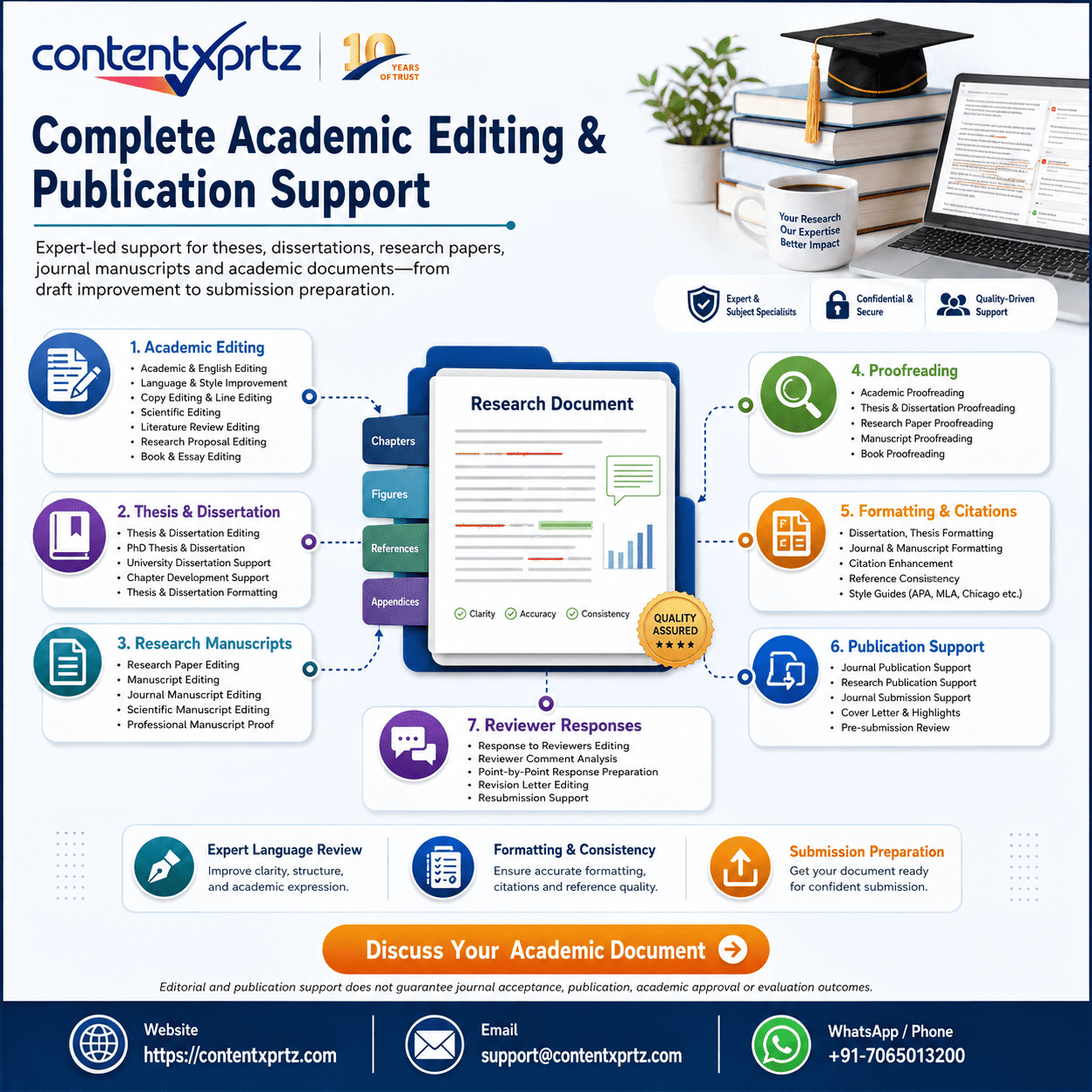
Contentxprtz supports students, PhD scholars, and researchers who need detailed academic assistance while retaining responsibility for their work. The most relevant service for this topic is dissertation writing and editing support, which can be scoped around planning, chapter clarity, academic language, structure, proofreading, references, and submission readiness.
The useful starting point is not a promise of a grade or approval. It is a clear description of your dissertation stage and the problem you need solved. A student with a complete draft may need final proofreading; a researcher with several chapters may need consistency editing; another scholar may need structured feedback on a literature review before rewriting it themselves.
Contentxprtz can also support related needs such as academic English editing and professional proofreading. The researcher remains responsible for the research question, evidence, analysis, citations, conclusions, and final submission.
Summary: Custom Dissertation Writing
Custom dissertation writing is most useful when it is treated as customised academic support rather than outsourced authorship. The right assistance can help a student plan revisions, organise literature, improve chapter flow, explain methods more clearly, strengthen academic English, check citations, and prepare a polished submission. The value comes from expert feedback tailored to a specific dissertation, not from replacing the researcher’s intellectual work.
Use your supervisor, writing centre, and librarian first where appropriate. When you need deeper document-level support, choose a provider with transparent academic-integrity boundaries, tracked edits, a defined scope, and no guaranteed-outcome claims. Check every change, verify every source, and make the final academic decisions yourself.
Frequently Asked Questions About Custom Dissertation Writing
What does custom dissertation writing mean?
Custom dissertation writing should mean personalised academic support built around your research question, discipline, stage of study, and university rules. Ethical support can include planning, research coaching, structural feedback, language editing, proofreading, citation checking, formatting, and feedback on drafts you have written. It should not mean paying someone to produce assessed dissertation text that you submit as your own.
Is custom dissertation writing ethical?
It can be ethical when the service supports the student's own research and writing rather than replacing authorship. Editing, proofreading, coaching, feedback, formatting, and reference checks are commonly permissible forms of support, but rules differ by institution. Before using any service, check your dissertation handbook, supervisor guidance, and any disclosure requirements.
Can someone write my dissertation for me?
For an assessed dissertation, outsourcing authorship is normally incompatible with academic integrity because the submitted work is expected to represent the student's own learning and intellectual contribution. Some jurisdictions and universities also have specific rules on contract-cheating services. A safer alternative is to ask for coaching, editing, research-method feedback, or chapter-by-chapter comments on text you have produced.
What can a dissertation editor change?
A dissertation editor can usually improve grammar, punctuation, academic style, clarity, consistency, headings, transitions, citation presentation, table and figure labelling, and formatting. Depending on university rules, an editor may also flag logic gaps, unclear claims, weak structure, or missing links between research questions and conclusions. The student should make substantive research decisions and approve every change.
How is dissertation editing different from dissertation writing?
Dissertation writing creates original text and argument. Dissertation editing improves text that already exists. In ethical academic support, the student remains the author while the editor strengthens clarity, consistency, organisation, and presentation without inventing findings, fabricating sources, or taking over the student's intellectual work.
When should I seek custom dissertation support?
Useful points include the proposal stage, after supervisor feedback, when a literature review feels disorganised, when methods need clearer explanation, after completing a rough chapter draft, before submission, and during final proofreading. Getting support early can reduce last-minute formatting and consistency problems, but it should complement rather than replace regular supervisor engagement.
Can custom dissertation support help with a literature review?
Yes, ethical support can help you refine search terms, organise an evidence matrix, group studies by theme, improve synthesis, identify unsupported claims, and check citation consistency. The researcher should still choose sources, read them, assess their quality, decide what evidence means, and write or approve the final interpretation.
Can an editor help with methodology and results chapters?
An editor can help make the methodology transparent and the results readable by checking terminology, sequence, tense, table labels, explanation, and alignment with the research questions. A subject specialist may also flag areas that appear incomplete or confusing. However, an editor should not invent methods, manipulate data, create findings, or make undisclosed research decisions on the student's behalf.
How much custom dissertation support do I need?
Choose the lightest level that solves your actual problem. If your argument is sound but language is uneven, proofreading may be enough. If chapter logic and flow are weak, substantive editing or structured feedback may be more appropriate. If you are stuck before drafting, coaching and planning support may be better than editing. Ask for a clear scope before work begins.
How do I choose a trustworthy dissertation support service?
Look for transparent scope, subject matching, confidentiality, clear turnaround expectations, sample or tracked-edit workflows, explicit academic-integrity boundaries, and a process that keeps you in control of decisions. Avoid providers that promise guaranteed grades, guaranteed approval, fabricated references, plagiarism removal guarantees, or completed assessed work for submission as your own.
Conclusion: Get Tailored Dissertation Support Without Giving Up Authorship
A dissertation is difficult because it asks you to combine research, judgement, evidence, writing, and project management over a long period. Needing help does not mean you need someone else to become the author. The most productive form of custom dissertation writing support is the kind that makes your research clearer, more coherent, more accurate, and easier to assess.
Start by identifying the real bottleneck. Use university resources where they solve it. When you need specialist document-level support, choose editing, proofreading, structural feedback, or research guidance that respects your institution’s rules and keeps you in control.
If you have a dissertation draft and want tailored support with structure, academic language, proofreading, references, or final presentation, explore Contentxprtz dissertation writing and editing services. Share your stage, requirements, and permitted scope so the support can be matched to your actual academic need.
At Contentxprtz, we don’t just edit; we help ideas reach their fullest potential.